
You're halfway through a warm commute, your skirt feels fine, and then you notice it. Your underwear has shifted, the leg edge is riding up, and every step adds a little more rub where your thighs meet. By the time you reach your desk, you're not thinking about your outfit anymore. You're thinking about that sting.
That moment is exactly where good choices help. Anti chafing underwear isn't magic, and it isn't just softer underwear with a new label. It's a practical system of coverage, stable fit, smoother edges, and moisture control working together over a full day. Once you understand that balance, you can shop with confidence and spot vague claims in seconds.
Table of Contents
- What Anti Chafing Underwear Really Does
- Understand Friction Moisture and Skin Irritation
- Choose Coverage Fabric and Construction
- Match Styles to Movement and Climate
- Use Scenario Guides for Full-Day Comfort
- Care for Performance Through Repeated Wear
- Choose Cautiously for Sensitive Skin
- Build Your Everyday Anti-Chafing Strategy
What Anti Chafing Underwear Really Does
Think about a long walk in a dress on a humid afternoon. At first, everything feels easy. Twenty minutes later, warmth builds, your stride repeats thousands of times in miniature, and a brief that looked perfect in the mirror starts to twist. The fabric bunches. Bare skin meets bare skin. That small, repeated movement is the problem anti chafing underwear is designed to reduce.
A buffer between moving surfaces
Your body creates two kinds of contact. Skin can rub against skin, especially between the thighs. Skin can also rub against fabric that shifts, folds, or presses at an edge. A thoughtful design adds a buffer in the first case and reduces relative motion in the second. Longer coverage can separate thighs. A stable waistband and leg opening can keep the garment where you put it. Smoother transitions can prevent one narrow line from taking all the pressure.
This idea isn't new. A U.S. patent granted on December 19, 2007, for an undergarment with breathable mesh side panels and moisture-wicking structures in the inner-thigh fold shows designers were already building friction management into garments instead of relying only on powders or creams. That patent concerned a male undergarment and doesn't prove clinical effectiveness for women's products, but the geometry lesson still applies. Separate contacting surfaces. Ventilate the warm zone. Keep construction smooth where movement repeats.
What it can't promise
No pair can guarantee prevention for everyone. Your result depends on fit, sweat, movement, body shape, outer clothing, and skin sensitivity. A pair that's brilliant for a seated workday may fail on a walking tour. A snug style may stay put for one person and dig for another.
Treat anti chafing underwear as equipment you match to your day, not as a promise printed on a tag.
That mindset changes how you shop. You'll check cut before color. You'll inspect edges, gusset, and fabric behavior. You'll ask how a pair handles heat at hour six, not just how soft it feels at minute one. You'll also plan care and changes, because performance changes as fabric gets damp and as elastic ages. Excitingly, those checks are simple once you know what to look for.
Understand Friction Moisture and Skin Irritation
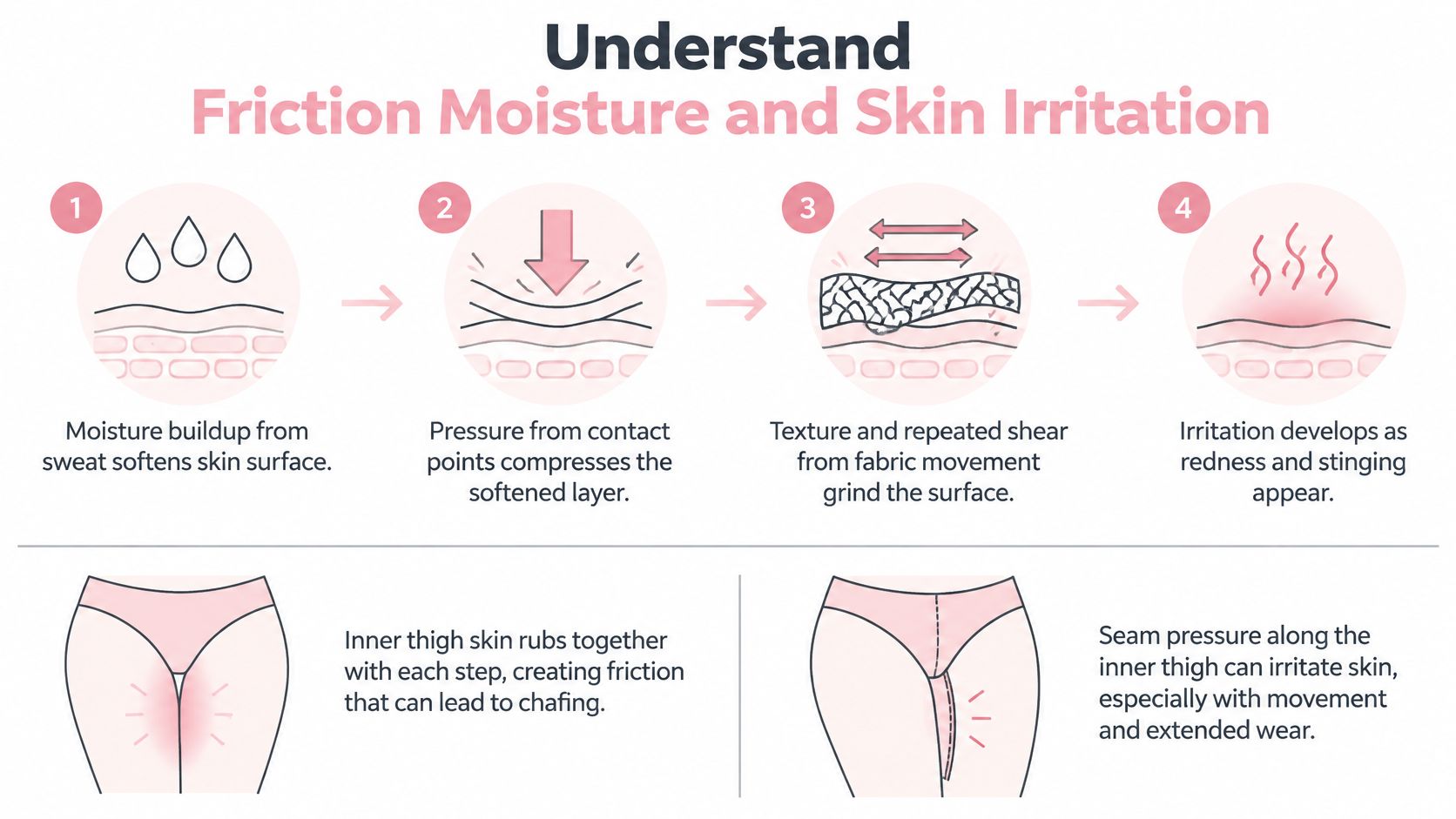
Chafing rarely starts with one dramatic rub. It builds through a sequence you can learn to interrupt. Warmth rises. You perspire. Skin becomes damp and more vulnerable. A garment shifts by a small amount, again and again. Pressure concentrates at a seam, band, or point where thighs touch. Redness and stinging follow.
The visual below maps that sequence from moisture to irritation.
Why moisture changes everything
A foundational 2008 skin and textile friction study of 22 adults found a positive linear relationship between skin hydration and the coefficient of friction. When skin shifted from very dry to normally moist, friction increased by approximately 43% for women and 26% for men. Completely wet fabric produced friction coefficients more than twice those measured with natural, dry skin against textile. That study didn't test a specific garment, so it doesn't prove one fabric prevents chafing. It does explain why a pair can feel fine dry and troublesome later.
That is also why readers exploring breathable moisture-wicking underwear choices for warm days should think beyond a soft hand feel. Softness is a sensation. Friction under damp conditions is a performance question. Texture, stickiness, and repeated shear matter once sweat enters the picture.
Name the irritation correctly
Not every sore spot has the same cause, and naming it helps you choose better.
- External thigh chafing: Inner thighs rub together during walking, often under skirts or dresses.
- Fabric or edge irritation: A leg opening, seam, or bonded edge presses and moves against skin.
- Vulvar or skin-fold discomfort: Heat and moisture collect in folds, and sensitive skin reacts to texture, pressure, or prolonged dampness.
These can overlap, but they don't call for identical fixes. More thigh coverage may help the first. It won't fix a digging gusset edge. Tighter bands may hold a garment still, yet they can also create a new pressure point.
Practical rule: Anti chafing underwear works best as one part of a broader plan that includes accurate fit, suitable coverage, ventilation, sweat management, and a timely change into a dry pair.
Choose Coverage Fabric and Construction
Start your inspection like a textile detective. Hold the garment up. Trace where it will sit during walking, sitting, climbing stairs, and bending. Ask where skin meets skin, where fabric ends, and where pressure will concentrate. Those three questions reveal more than a label that says soft or breathable.
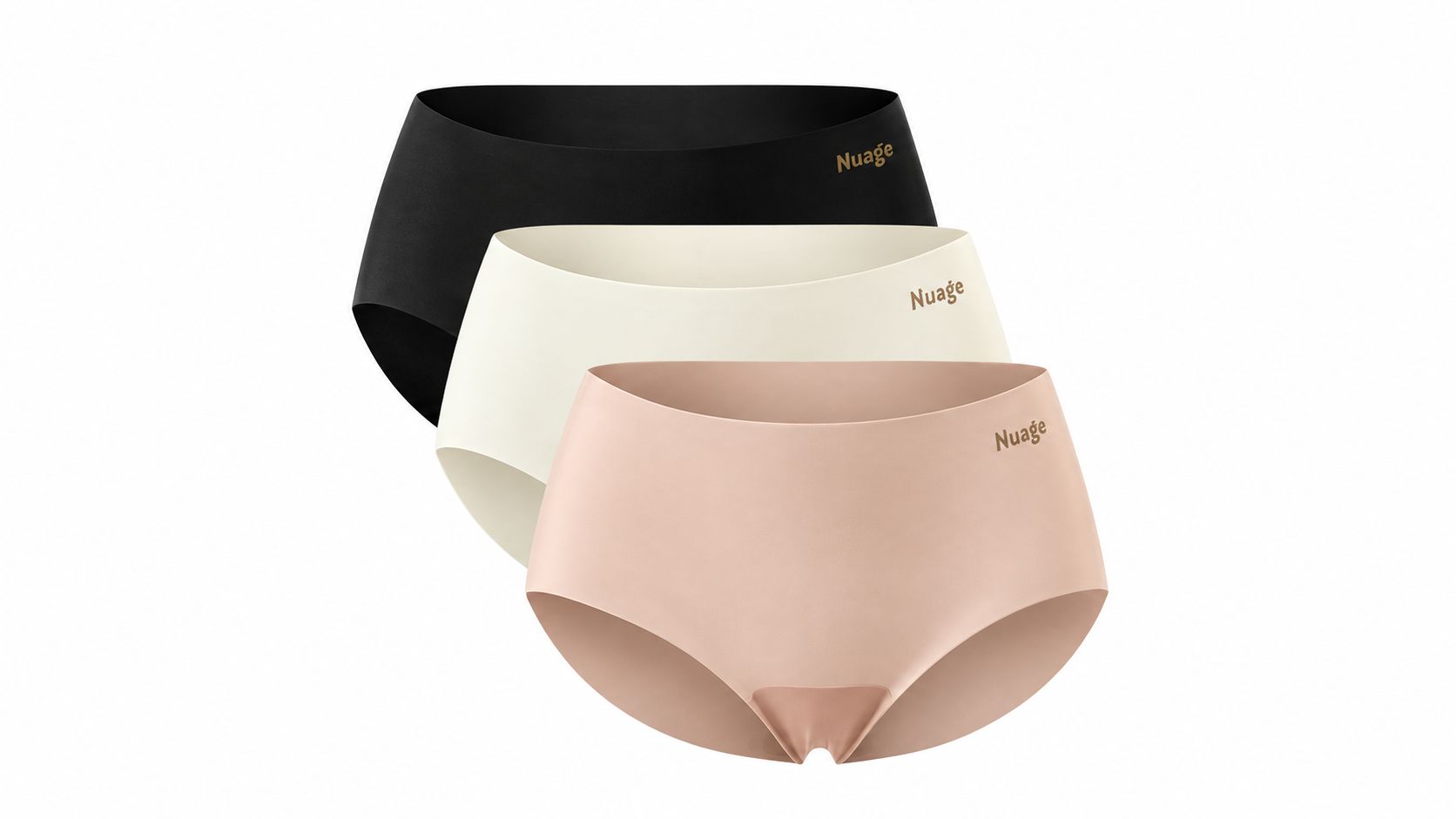
The brief pictured here gives you a useful shape to examine while you work through the checklist.
Inspect coverage and stability first
Longer-leg cuts can reduce direct thigh-to-thigh contact because fabric stays between the surfaces. Briefs offer less separation but may feel cooler and work neatly under trousers. Either can fail if it travels. Look for a waistband that lies flat without squeezing, leg openings that stay in place without biting, and enough rear coverage to avoid constant adjustment.
As one concrete example, the NuCloud Original Mid-Rise Brief(3-Pack) is described as a PFAS-free stretch brief with raw-cut edges, a 3D contoured cut, and a 100% cotton-lined gusset, with a size tip to size up if you're between sizes. Use those kinds of stated details, fabric, edge finish, gusset, and sizing guidance, as inspection points for any pair you consider.
Judge fabric by behavior, not adjectives
Breathability should connect to measurable behavior. Research summarized in a study of knitted underwear fabrics and thermal and wet comfort identifies thickness, porosity, air permeability, moisture regain, drying time, thermal conductivity, and water-vapor transmission as relevant predictors, with fiber type and knit structure influencing those properties. Separate textile testing in the verified material reports modal distributed and wicked moisture faster than comparison samples, with an average time approximately 50% lower in the tested set.
You don't need a lab at home. You do need better questions. Does the listing state fabric composition and gusset material? Where are seams or bonded edges placed? Does mesh appear where heat builds, or only as decoration? Does the fabric recover after you stretch it gently, or does it stay wavy? Remember, a breathable gusset can't compensate for a dense waistband that traps heat around your middle.
Anti-Chafing Garment Feature Checklist
| Feature | Potential Benefit | What to Check |
|---|---|---|
| Leg coverage | Separates thighs | Length stays below your main rub zone |
| Waistband | Stable placement | Lies flat, doesn't roll or squeeze |
| Leg opening | Limits garment travel | Holds gently without a deep pressure line |
| Seams and bonds | Smoother transitions | No ridge at inner thigh or gusset edge |
| Gusset | Manages the most sensitive zone | Material stated, edges smooth and well placed |
| Fabric and mesh | Moves heat and moisture | Composition, ventilation zones, stretch recovery |
| Care label | Preserves fit over time | Wash and dry method you will actually follow |
Match Styles to Movement and Climate
There's no universal winning cut. There's a best match for your movement, clothing, and weather on a particular day. That is liberating. Instead of hunting for one perfect pair, you build a small rotation where each style has a job.
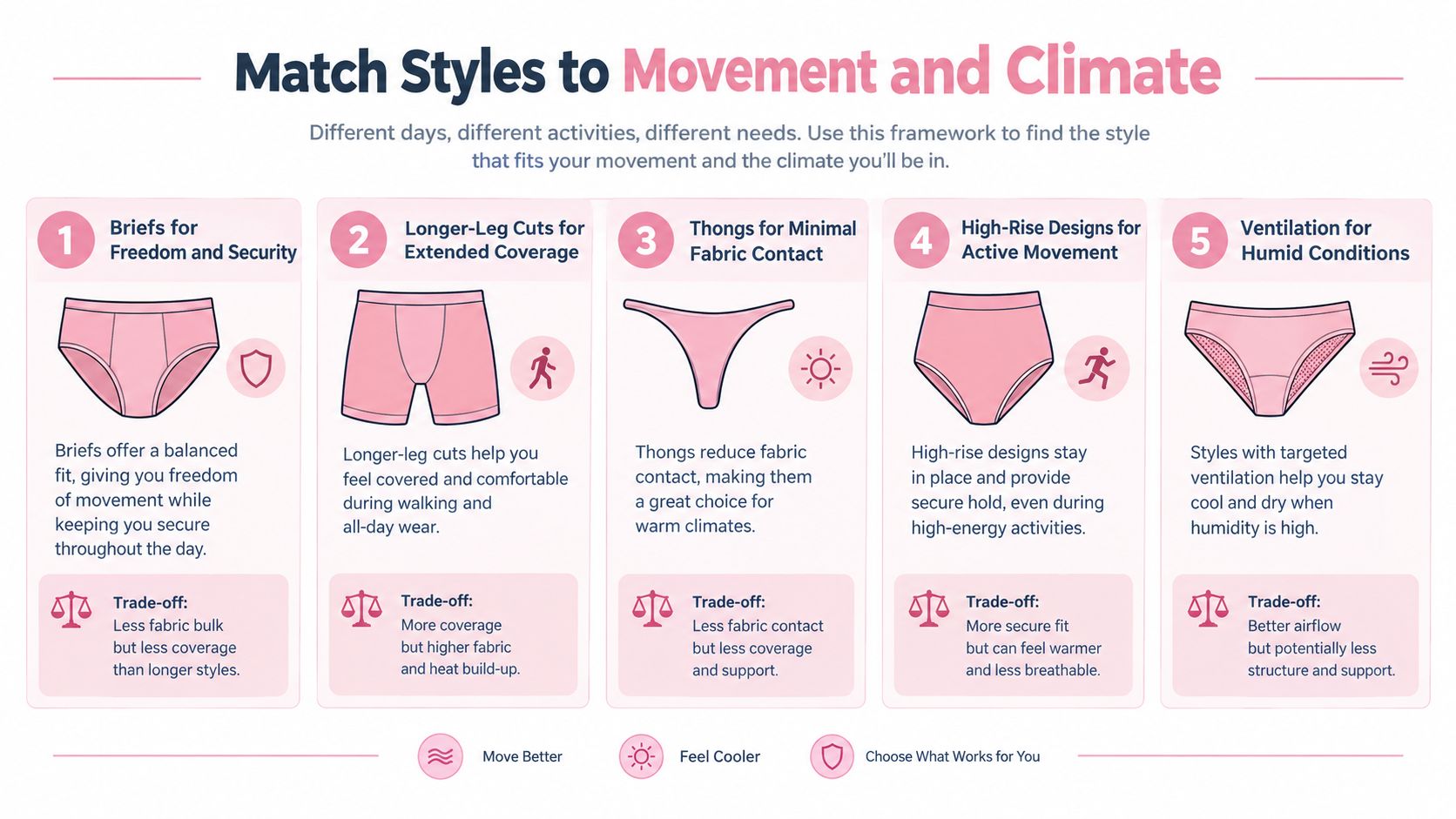
The comparison below frames five common options by use and trade-off.
Compare the main cuts
Briefs balance freedom and security. They suit desk days, trousers, and moderate walking when the leg edge stays smooth. Their limit is thigh separation. If your thighs touch well below the leg opening, a brief leaves that contact zone uncovered.
Longer-leg cuts shine for walking, travel days, and skirts because they place fabric between thighs for longer. Check that the leg doesn't roll upward into a tight rope. A rolled edge can be worse than a shorter, stable edge.
Thongs reduce rear fabric and can feel light in warm settings. They provide minimal thigh coverage, so they aren't a direct answer to thigh-to-thigh rubbing. Fit at the front and gusset matters greatly because there's less fabric to distribute movement.
High-rise designs can feel secure and smooth under high-waisted clothing. The trade-off is more fabric and possible waist pressure during long sitting or heat-related swelling. A high rise should support placement, not act like compression shapewear unless that's what you want.
Targeted ventilation styles place mesh or more open knit where airflow demand is greatest. They're appealing for humid commutes and active days. Still inspect the non-mesh panels and bands. One airy zone doesn't make the whole garment airy.
Match movement before fashion
Desk work rewards low bulk, a calm waistband, and edges that don't press while seated. Cycling adds repeated hip flexion, so front seams and leg openings need close scrutiny. Workouts add sweat volume and faster movement, making stability and post-workout changes important. Humid weather raises the value of airflow and drying behavior for every cut.
Choose the least fabric that still solves your contact problem, then confirm it stays put without squeezing.
That sentence prevents two common mistakes. You won't buy maximum coverage for a problem caused by a waistband. You also won't expect a minimal cut to separate thighs it never covers.
Use Scenario Guides for Full-Day Comfort
A garment doesn't experience your calendar one event at a time. It experiences load. Heat, steps, sitting pressure, sweat, and clothing friction accumulate. Thinking in day-load scenarios helps you predict when a favorite pair will thrive and when it needs backup.
Recent textile findings summarized in a 2025 comfort study on wet conditions, friction, and discomfort reinforce that dampness can change how a garment feels during activity. Drying also depends on thickness, texture, air permeability, airflow, sweat volume, and moisture capacity. In plain language, your morning test in a cool bedroom can't fully predict a humid afternoon.
Four day-load examples
Desk to dinner: Pick a stable rise, low-bulk edges, and coverage that suits both outfits. If you'll change from trousers into a skirt, think ahead about thigh contact during the evening walk. A pair that's invisible at work but leaves thighs bare later may not finish the job.
Walking-heavy city day: Favor longer coverage, secure leg placement, and moisture management. Test stairs and a brisk pace before a big sightseeing day. Small upward creep at home becomes constant adjustment after repeated blocks.
Long-haul travel: Prolonged sitting, cabin movement, and body swelling can change fit. Avoid a waistband or leg opening that's already at your pressure limit when you board. Carry a spare pair in your personal bag so you can change if you arrive damp or uncomfortable. That's not fussiness. That's smart logistics.
Workout or humid weather: Prioritize ventilation, stable placement, and how the fabric feels when damp. Change after heavy sweating when practical. Lingering in a wet pair for errands extends exactly the warm, damp period you're trying to shorten.
Test before the big day
Wear a new style first for a familiar activity with an easy exit. Walk your usual route. Sit through a normal work block. Note heat, pressure marks, movement, and skin response afterward. If it passes, graduate it to travel or an event. If it fails in a small test, believe the evidence. Your skin has given you useful data, and another cut or size may solve the issue beautifully.
Care for Performance Through Repeated Wear
A great fit on day one can drift if washing and storage slowly change stretch, surface texture, or edge condition. Care is not housekeeping trivia. It's how you protect the placement and smoothness you paid for.
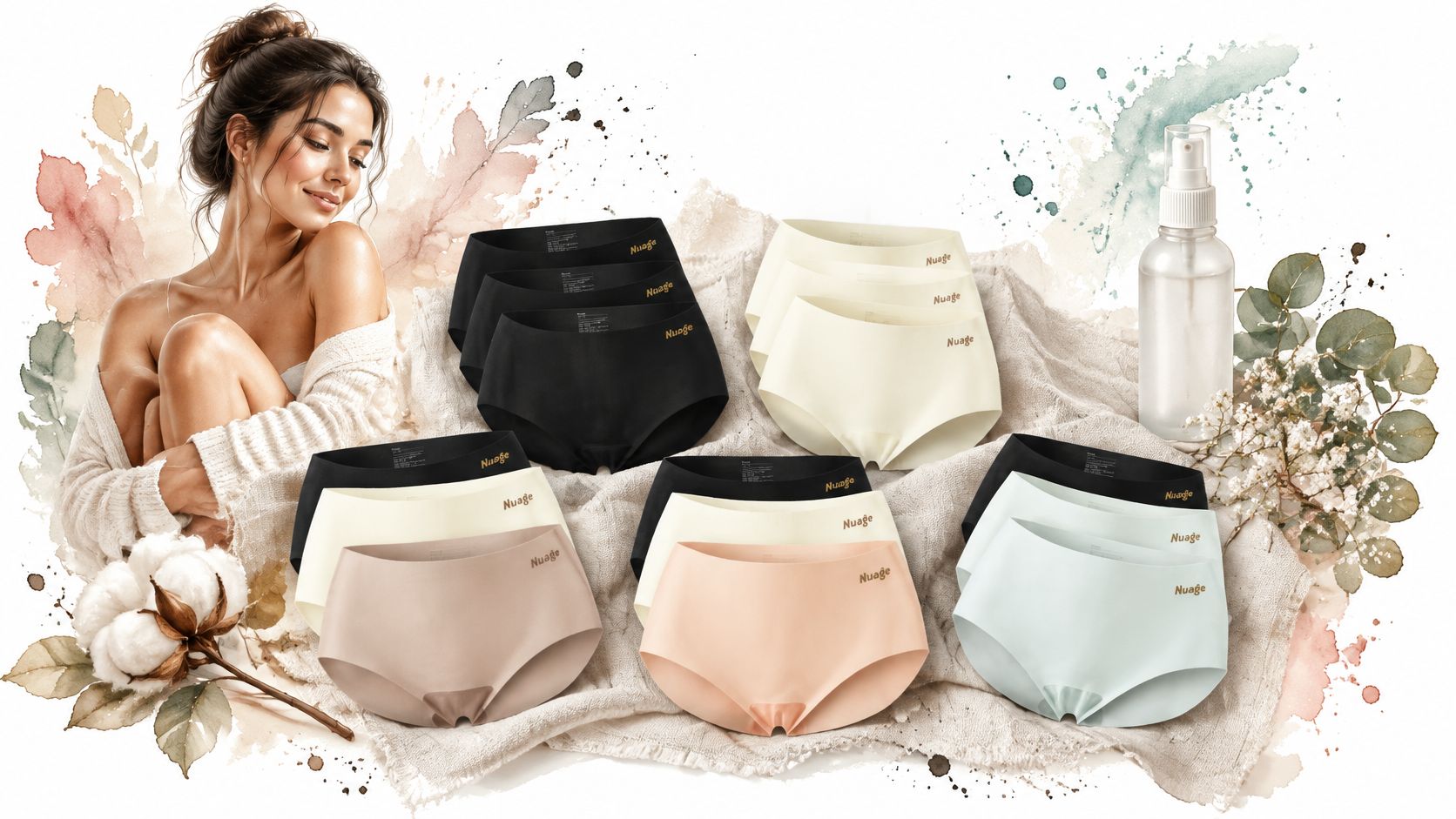
This image is a good reminder to treat your rotation as a small comfort wardrobe, not a single overworked pair.
Follow the label and rotate pairs
Always start with the garment's own instructions. General guidance on how to wash underwear without damaging delicate fabrics can support your routine, but the product label wins if there's any conflict. Use the stated wash method, let pairs dry fully before storage, and avoid stuffing damp underwear into a closed drawer or travel pouch.
Rotation gives elastic and knit fibers time to recover between wears. It also stops you from depending on one pair through back-to-back high-sweat days. You don't need an unsupported replacement schedule. You need inspection habits.
The short video below offers a visual reset on everyday handling before you check older pairs.
A concise care checklist
- Washing: Follow the label for water, cycle, and detergent guidance.
- Drying: Dry fully in the method the label allows before folding.
- Storage: Fold smoothly so bonded edges aren't crushed into sharp creases.
- Rotation: Alternate pairs instead of rewearing one damp or stretched pair.
- Replacement checks: Retire pairs with distorted leg openings, persistent stretching, rough spots, loose seams, or damaged bonded areas.
Run your fingertips along the inner leg and gusset edges. If a once-smooth transition now feels gritty, curled, or uneven, your skin will notice during movement. Replace the pair before a demanding day turns a small defect into a sore lesson.
Choose Cautiously for Sensitive Skin
Here's the assumption to challenge with enthusiasm and care. Tighter, smoother, or faster wicking doesn't always mean more comfortable. That's especially true when external thigh protection and vulvar sensitivity get treated as the same problem. They aren't.
A 2025 sportswear study on synthetic fabrics, drying, and air permeability sits within a wider evidence picture where moisture, texture, stickiness, and friction shape discomfort during activity. Fiber label alone doesn't decide your experience. A fabric can dry quickly and still irritate if its wet-skin friction, surface texture, or edge pressure is wrong for you. Maximum wicking is not automatically maximum comfort.
Separate three different goals
Cosmetic smoothing is about outline under clothing. External coverage is about separating thighs. Vulvar comfort is about how the gusset, seams, bonds, moisture, and pressure affect sensitive skin. A design made to smooth the front outline may look sleek under a dress, but that doesn't mean it resolves irritation. Judge each claim by the zone it addresses.
People prone to eczema, recurrent rash, vulvar sensitivity, or yeast-like symptoms should be particularly cautious with new garments. This guide can't diagnose symptoms or replace medical advice. Persistent burning, unusual discharge, sores, or recurring problems deserve professional care rather than another underwear experiment.
Use a gentle wear-test protocol
- Start with the intended size: Don't size down for a locked-in feeling.
- Inspect before wearing: Check gusset material, seam placement, bonded edges, and any ridge near folds.
- Limit compression: Leg openings should hold, not carve a line or trap heat through excess pressure.
- Begin with a shorter, familiar wear: Increase duration only if skin stays calm.
- Change after heavy sweating: Don't let a successful workout become hours in damp fabric.
- Stop if warning signs appear: Remove the garment if burning or persistent redness develops.
Pay attention to where discomfort begins. Burning at a gusset edge points to construction or sensitivity. Redness lower on the thighs points toward contact coverage. A ring where elastic sat points to pressure. Those clues make your next choice smarter and kinder.
Build Your Everyday Anti-Chafing Strategy
You now have a clear framework, and it's wonderfully usable. Start with the day, not the drawer. Activity and climate tell you how much coverage, ventilation, and stability you need. Your clothing tells you which rise and edges will stay discreet. Your skin tells you how much pressure and texture you can accept.
Your purchase and wear sequence
Before buying, check fabric composition, gusset material, seam or bond locations, rise, leg coverage, sizing guidance, and care requirements. Stretch the fabric gently and watch recovery. Look for the exact place each edge will land on your body. If a listing hides those details behind vague softness language, treat that as missing information.
After the first wear, assess six things. Did it twist or ride up? Did heat build? Did any band leave uncomfortable pressure? Did fabric stay damp against skin? Did thighs remain separated where you needed coverage? Did your skin look and feel calm afterward? Write the answer on your phone if you're comparing styles. Memory gets fuzzy. Notes make your next purchase accurate.
No single feature guarantees prevention, and comfort can change across a full day. That's not a weakness in your strategy. It's the reason your strategy works. You're managing a balance among coverage, moisture control, garment movement, edge pressure, and fit over time.
Make three practical commitments. Keep a spare pair ready for high-sweat or travel-heavy days. Change out of damp garments when practical. Prioritize fit and construction over sweeping claims. With those habits, anti chafing underwear becomes less of a hopeful purchase and more of a reliable daily tool, one comfortable step at a time.
Explore briefs, high-rise styles, thongs, and mesh designs organized around real comfort challenges like digging, rolling, visible lines, and overheating at Nuage Wears. Compare fabric, gusset, edge, and sizing details against your day-load needs, then choose the coverage and ventilation that fit your life.