
You got dressed feeling fine, and by midmorning you're already negotiating with your bra. That's not a vanity problem, it's a fit problem, and it's exactly why searching for the best everyday bras so often leaves you with a drawer full of almosts. Stop shopping for a name. Start judging what a bra does on your body, through a real day.
Table of Contents
- The Workday Bra Problem Almost Everyone Has
- What 'Best' Actually Means for an Everyday Bra
- Fit Cues That Tell You a Bra Is Working
- Matching Everyday Problems to the Right Design Fix
- Choosing Between Bralette, Lightly Lined, and Molded Full-Support
- Support by Scenario Across the Week
- Fabric Behavior and Care That Decide Long-Term Comfort
- Your Quick Check for Knowing You Chose Well
The Workday Bra Problem Almost Everyone Has
At 8 a.m. the bra felt perfectly reasonable. By 3 p.m. the band has crept up your back under your sweater, you're doing the discreet shoulder shuffle to rescue a slipping strap in a meeting, and there's a pink groove where the other strap decided to dig instead. Then you catch your reflection and see the seam drawing a clear outline across your fitted top.
Sound familiar? Of course it does. Most of us own that bra. Some of us own four of it in different colors because it was fine in the fitting room for ninety seconds under bright lights while standing perfectly still.
Why the Fitting Room Lies to You
A fitting room tests none of the things that ruin your day. You don't sit at a desk for three hours, reach for a shelf, carry a bag on one shoulder, hurry for a train, or slouch over lunch in there. A bra can look smooth standing still and still migrate, gap, or bite the minute you live in it.
That's why I don't trust first impressions. I trust behavior over time. Does the band stay where you put it? Do the cups still contain you after you've bent, twisted, and breathed normally? Are you thinking about your bra at 4 p.m., because if you are, it failed.
If you're adjusting it more than once, it isn't an everyday bra. It's a part time job.
Here's my blunt reframe, and it's the one I'd give a friend. The best everyday bras aren't a ranked list someone else made for a body that isn't yours. Best is a personal outcome, a bra that stays level, contains you without drama, and disappears under your clothes until you take it off at night. Once you learn to spot that outcome, you can judge any bra in any store, at any price, in about ninety seconds. That's a skill worth more than any single recommendation, because your body, your wardrobe, and your week will keep changing. The failures above, the riding band, the digging strap, the visible seam, aren't random bad luck. They're diagnosable. And diagnosable means fixable.
What 'Best' Actually Means for an Everyday Bra
Let's define our terms before you spend another dollar. For me, best means behavior, not brand, not lace, not how cute it looks on a hanger. A great everyday bra does three unglamorous things really well, all day, without you supervising it.
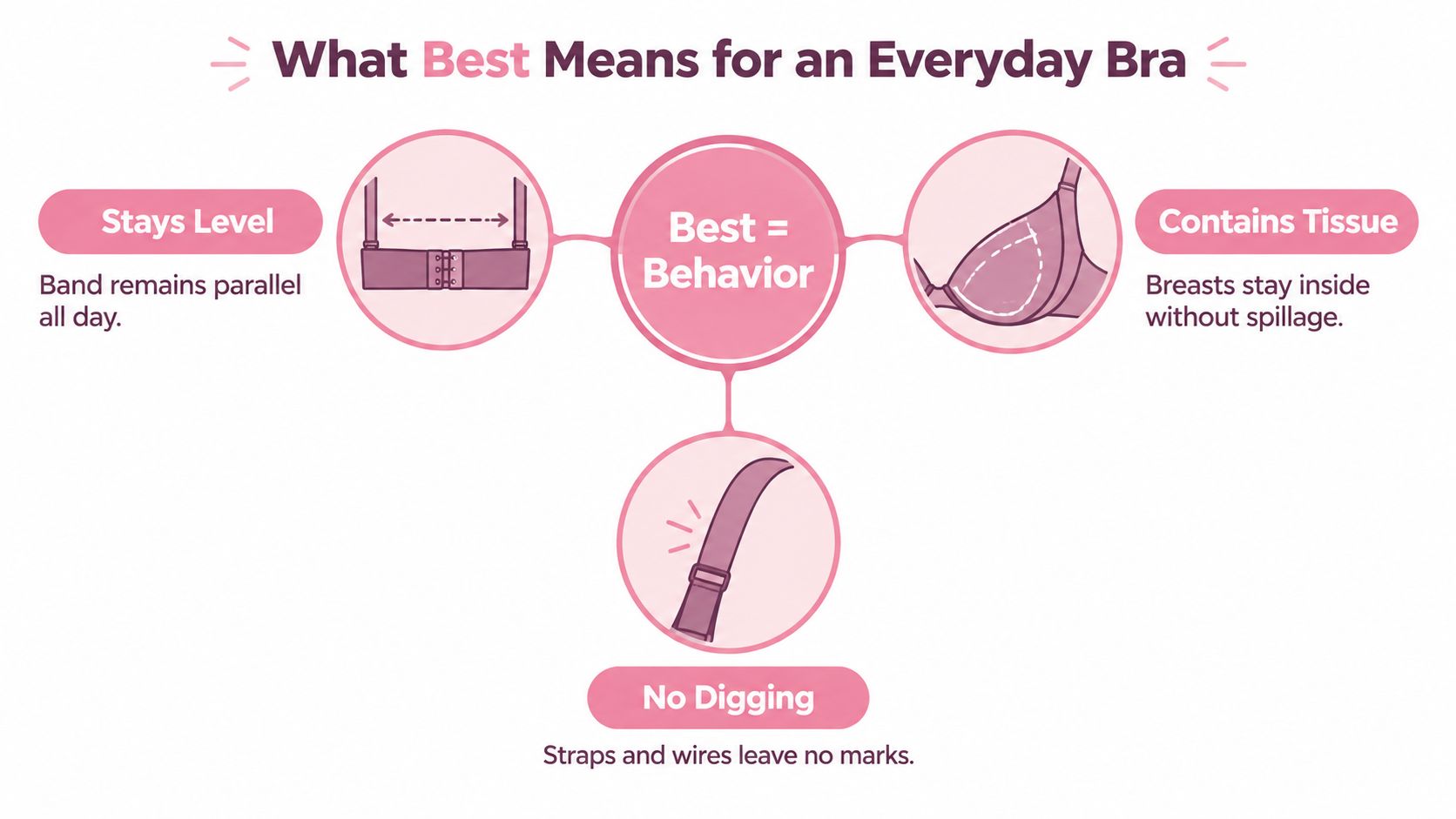
First, it stays level. The band sits parallel to the floor and stays there, because the band is the foundation that carries the load. Second, it contains tissue, meaning your breasts sit inside the cups without gaping at the top or spilling over the edges. Third, it doesn't dig. Straps hold position without trenching your shoulders, and edges lie flat instead of carving lines you can still see in the shower.
Preference Alone Is a Terrible Guide
I say this with love, because I've done it too. We pick the size we've always worn, decide it feels okay, and move on. The evidence says that approach is shaky. A 2025 peer reviewed analysis noted that research across multiple studies has found approximately 75% to 100% of women wear the wrong bra size, regardless of breast size, as reported in the 2025 peer reviewed fit analysis. In that same work, subjective reports agreed with objective fit assessments in only 51% of cases.
Read that again. Your gut feeling about fit is roughly a coin toss. That's not a personal failure, it's what happens when nobody teaches you what to check. Cups that were too large, a front band floating away from the sternum, and straps that were too loose topped the list of problems found, and most wearers hadn't flagged them.
So treat choosing a bra as a fit and load distribution problem. The band should do the heavy lifting, the cups should shape and contain, and the straps should stabilize, not hoist. When that division of labor breaks down, softness won't save you. A cloud soft bra with a loose band will still ride up and dump its work onto your shoulders by lunch.
If budget is part of your decision, and it should be, it's worth comparing construction features across price tiers before you buy, and guides to the best bras for every budget can help you see what you gain as prices rise. Just don't let price substitute for fit. An expensive wrong size is still the wrong size, only now it hurts your wallet too.
Fit Cues That Tell You a Bra Is Working
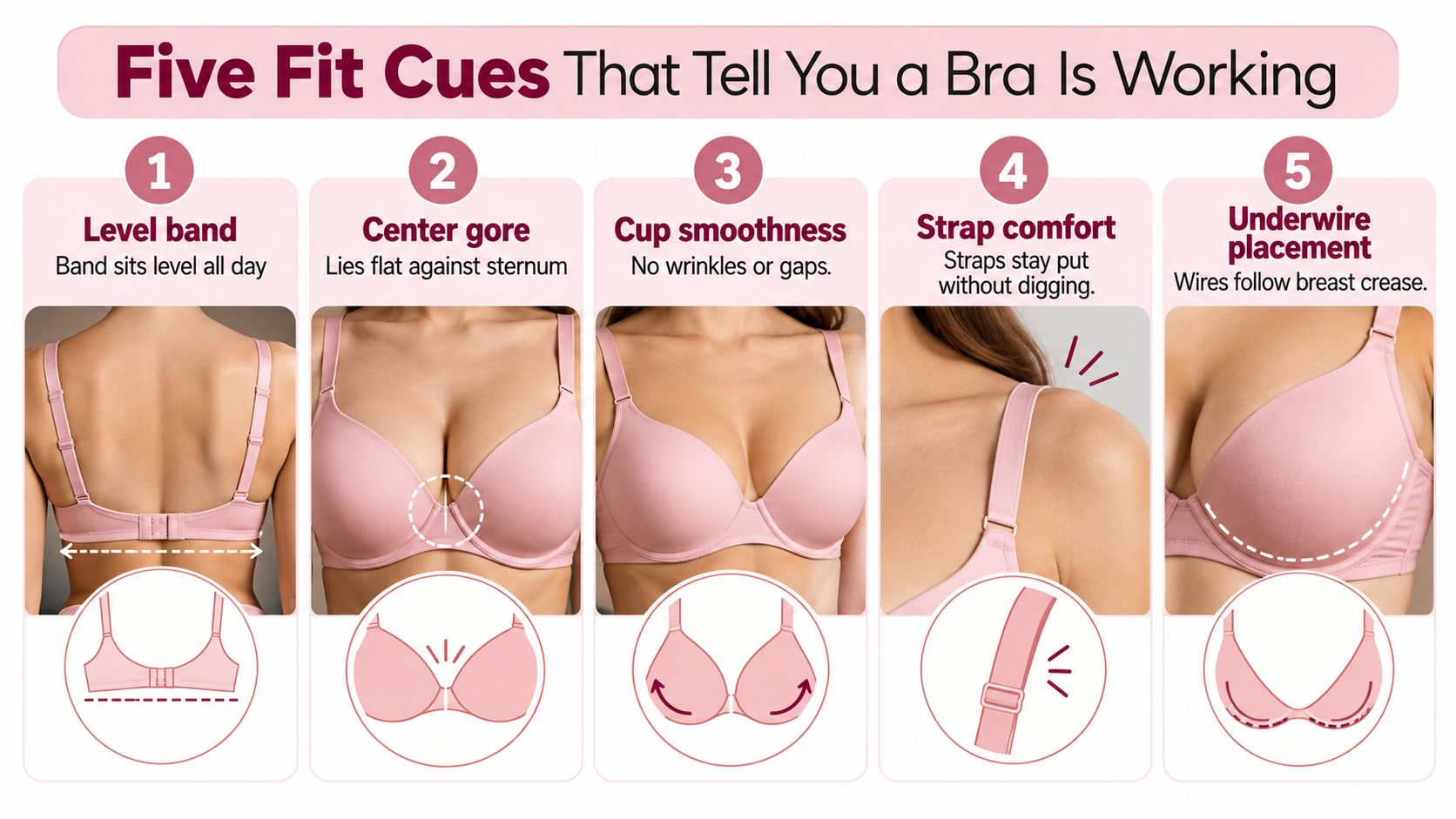
Enough theory. Here's the hands on check I want you to run on every candidate, in this order, before you look at the price tag or the color. It takes about ninety seconds and it'll save you a drawer of regrets.
The Five Checks in Order
- Band level first: Fasten it on the loosest hook and look sideways in the mirror. The band should sit level or slightly lower in back, snug enough that it doesn't slide when you raise your arms. If it rides up, the band is too loose or the size is wrong, and no strap adjustment will fix that.
- Cups contain, not cover: Bend forward, settle into the cups, then stand up. You want no gaping when you move and no spillover at the top or sides. Gaping usually means the cup is too large or the wrong shape for you, while spillover means you need more volume, not more tightening.
- Straps stabilize: Tighten until they stay put with about two fingers of slack underneath. If you have to crank them down to feel supported, the band isn't doing its job. If they slip no matter what, check placement and width before you blame your shoulders.
- Center front contact: On styles with a defined center, it should lie flat against your sternum rather than floating away or sitting on breast tissue. Floating usually signals cups that are too small or too shallow for your shape.
- Movement test last: Sit down, stand up, reach overhead, twist, and take a brisk walk around the store or your bedroom. A working bra stays put through all of it. Anything you have to tug back into place now will annoy you tenfold by hour six.
Practical rule: Fix problems in band, cup, strap order. Most people do it backwards, yanking straps tighter to compensate for a band that's floating around their ribs.
One more thing friends always ask me about. When band and cup letters start to feel like algebra, especially at less common combinations, a clear breakdown of how a 44B size breaks down by band and cup volume makes sister sizing and refitting far less mysterious. Sizes are a starting point, not an identity. Bodies change, weight shifts, hormones do their thing, and a bra that fit last year may honestly not fit now. Refit periodically and don't take it personally. The number on the tag works for you, not the other way around.
Matching Everyday Problems to the Right Design Fix
Now let's talk construction, because once the fit is right, specific irritations have specific engineering answers. The mistake I see constantly is chasing a symptom with the wrong fix, usually by sizing down or tightening something, which trades one problem for a worse one.
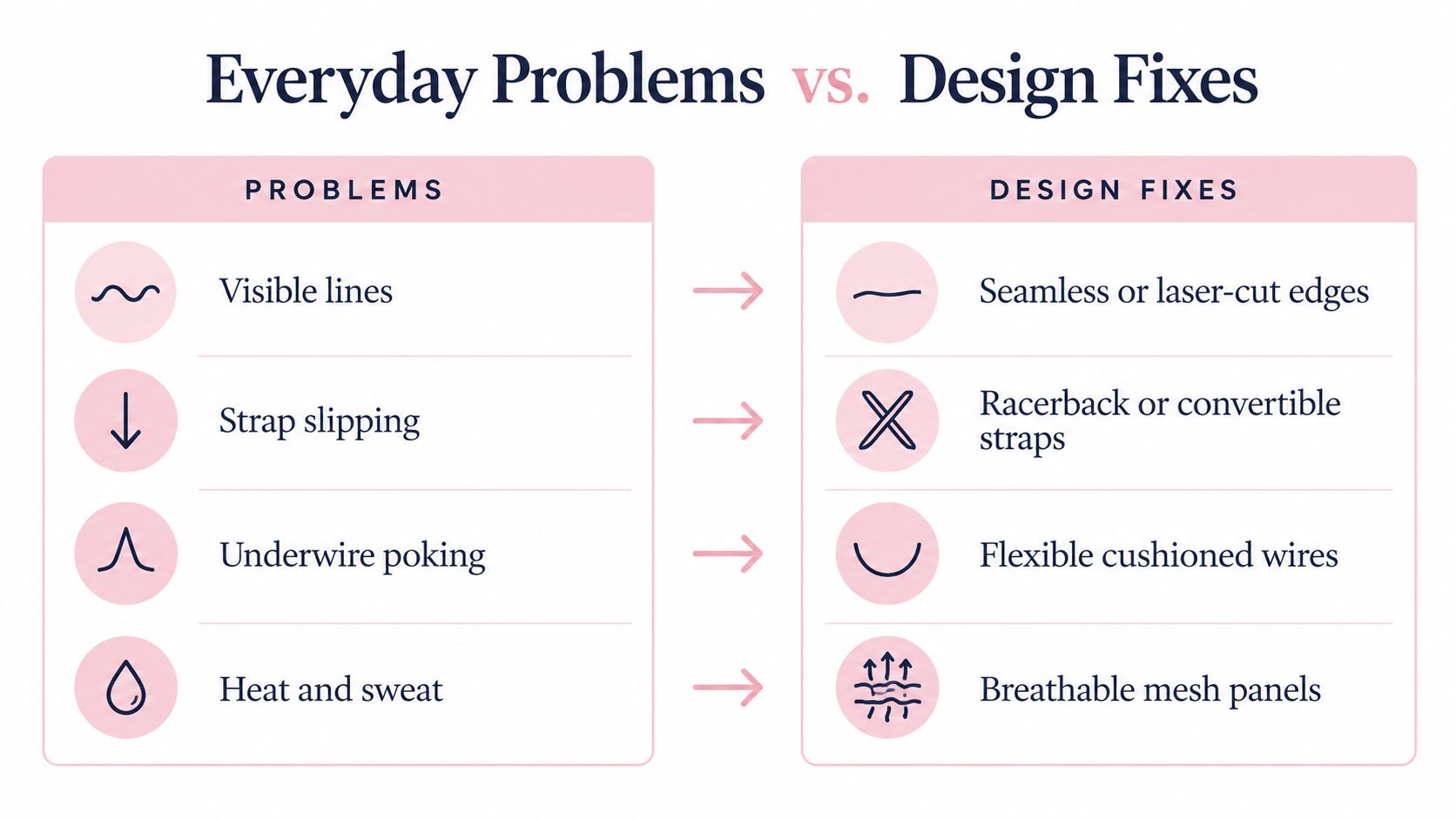
Visible lines under fitted tops call for smooth or laser cut edges that taper into the skin instead of ending in a thick stitched ridge. The wrong fix is a tighter bra, which just makes the ridge dig deeper and show more. If a seam announces itself through a tee in the store, it'll do it at work too. Walk away.
Rolling, riding up, and constant readjusting point to weak anchoring. Look for bonded bands and stay put cuts that grip through contact and shape rather than squeezing harder. Sizing down to stop movement is the classic trap here. You get less migration for about an hour, then more digging, more bulging, and a band that rolls because it's fighting your body.
Pressure Is a Design Issue, Not a Toughness Test
Digging at the waist, band, or shoulders means pressure is concentrated in too small an area. The fix is wider, softer contact zones that spread load. Pressure research found the highest measured loads in some designs at the shoulder, 4.66 kPa before exercise, and at the side seam, 4.25 to 4.48 kPa, when strap and band lengths were reduced, as detailed in published research on bra pressure and comfort. Tightening didn't create uniform support. It just moved discomfort into hotspots.
- Heat and moisture on long days: Choose breathable mesh zoning and moisture responsive panels in the spots that trap warmth. A fully padded, fully sealed bra in August is a tiny sauna, no matter how supportive it felt in an air conditioned store.
- Front outline showing through thin fabric: Look for smoothing shields and clean, uninterrupted front panels. Texture, seams, and hardware in exactly the wrong place will telegraph through silk and fine knits.
- Straps that slip off narrow or sloping shoulders: Try racerback or convertible strap geometry that changes the angle of pull, rather than overtightening straight straps until they saw into you.
Notice the pattern. Every right fix changes the geometry or the surface, not the tightness. If a salesperson's only answer is to go smaller or pull harder, that's not fitting, that's wishful thinking with hardware.
Choosing Between Bralette, Lightly Lined, and Molded Full-Support
These three aren't rivals, they're points on a spectrum, and most of us need more than one point covered. Your job isn't to declare a winner. It's to place yourself based on your cup size, your wardrobe, and what your day demands.
Here's a quick look at how differently these three archetypes present, even before you try them on.
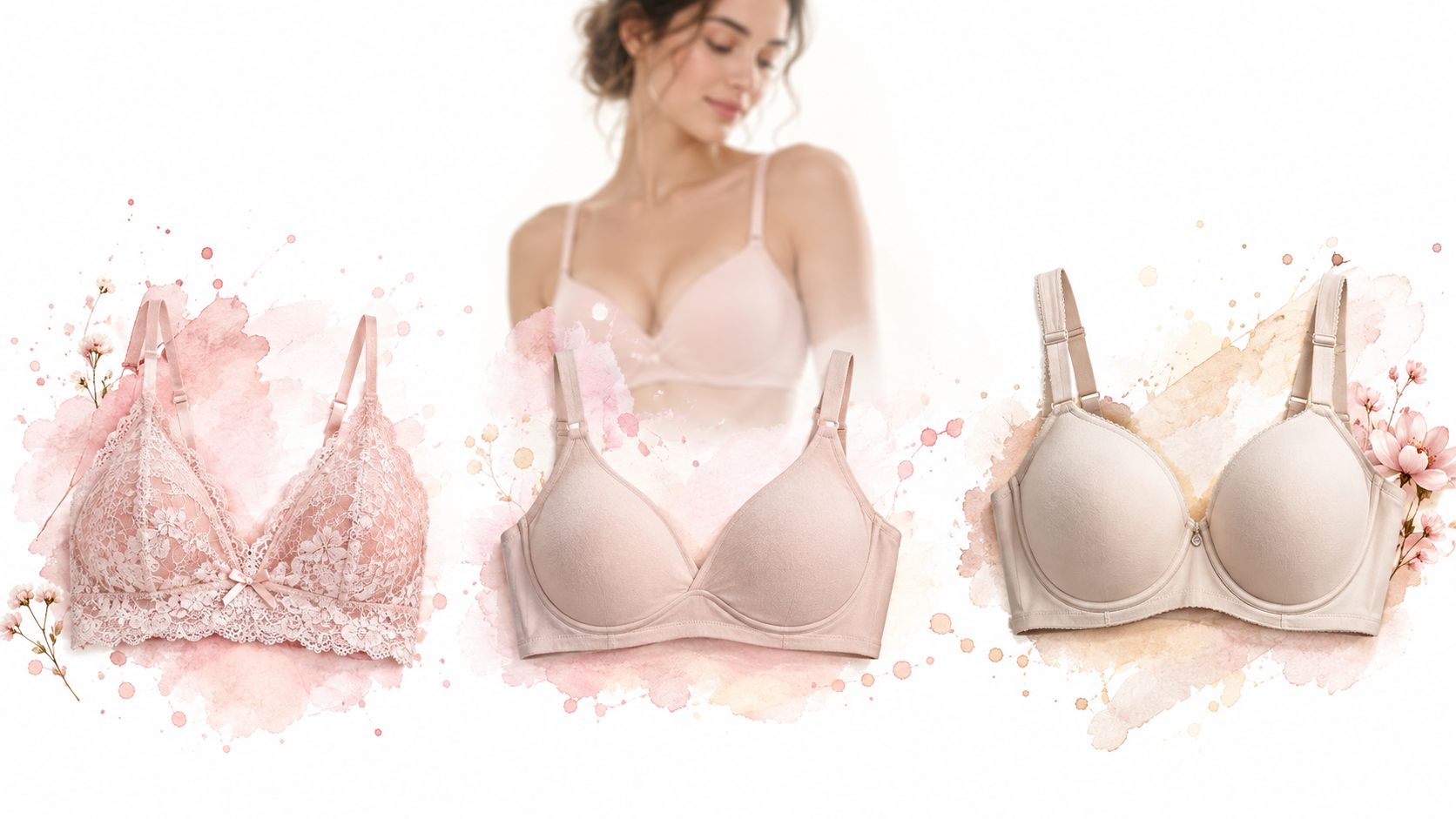
Soft bralettes are the off duty heroes. They're breathable, forgiving, easy to wash, and lovely for smaller cup sizes, lounging, and low movement days. Where they fall apart is load. On fuller busts or longer, more active days, many bralettes let the band drift and the straps inherit work they can't do, so you end up unsupported and oddly tired. If you love the category, look for a real underband and adjustable straps rather than a decorative elastic strip.
Lightly lined styles, wireless or underwire, are my desk to dinner default for most wearers. They give you shape and a smooth surface under clothing without the rigid architecture of a fully molded cup. They're also the most forgiving if your two sides aren't perfectly matched, which, welcome to being human, is most of us. If you're weighing wire free options in this middle category, this overview of what to look for in a wireless bra for daily wear is a useful companion while you compare.
This short video walkthrough is worth watching before you shop, since seeing strap placement and cup behavior in motion makes the trade offs much easier to judge.
Molded full support cups earn their place when containment is the priority. Fuller bust days, structured outfits, and situations where you want a defined, separated shape all suit them. Their weakness shows at the edges. A molded cup keeps its own shape whether or not you fill it, so a slight mismatch becomes visible gaping or a hard rim under thin tops. Fit has to be precise here. Close enough isn't.
My honest advice? Build a small rotation across the spectrum instead of hunting for one mythical bra that does everything. Two reliable middle options, one soft off duty piece, and one structured option will carry most weeks beautifully.
Support by Scenario Across the Week
Everyday is a misleading word, because your Tuesday desk marathon and your Saturday errand run ask completely different things of a bra. Treating everyday as automatically low support is how people end up sore on the days that weren't supposed to count as active.
This matters more than the industry admits. Research from the University of Portsmouth reports that 51.5% of 1,659 surveyed women experience breast pain, according to the University of Portsmouth Research Group in Breast Health. A 2024 study involving 24 women with D-cup or larger breasts found improved fit and support reduced pain, yet even professionally fitted bras showed reduced support after four weeks, and only 70% fit correctly after professional fitting. Support isn't a one time purchase decision. It's a scenario match plus ongoing checks.
Match the Bra to the Day You Actually Have
| Scenario | Support Need | Fabric Priority | Key Features |
|---|---|---|---|
| Desk day | Moderate, stable through long sitting | Smooth, low friction, breathable at the band | Level band, smooth cups, straps that don't migrate when you reach or type |
| Long haul travel | Gentle and forgiving for swelling and hours of sitting | Soft stretch with recovery, easy care | Wireless comfort, wide contact areas, nothing that pinches at hour six |
| Brisk walking and errands | Firmer control of movement in all directions | Breathable, moisture responsive, shape retaining | Secure band, adjustable or convertible straps, contained cups |
| Off duty time | Light, minimal structure | Plush, airy, low compression | Bralette ease, thin panels, zero hardware digging in |
Read the table against your actual calendar, not your aspirational one. If four of your five weekdays are desk days with a brisk commute, that's your dominant scenario, and it's the one your primary everyday bra must master. The off duty bralette you adore on Sundays doesn't owe you commuter performance, and judging it that way is unfair to both of you.
One bra rarely wins every scenario. The smarter question is which scenario rules your week, and whether this bra wins that one.
Also, know when to bow out. A flexible everyday bra is not exercise equipment. If you're running, jumping, or doing anything high impact, switch to proper sports support rather than asking a desk bra to improvise. And recheck support after repeated laundering, since a bra that was perfect in week one can retire by week six. If the band now rides up on the tightest hook, it has told you everything. Believe it.
Fabric Behavior and Care That Decide Long-Term Comfort
Day one comfort is easy to sell. Month three comfort is where bras tell the truth, and it comes down to one plain idea. Stretch without recovery is just slow surrender. A fabric that stretches to fit you but doesn't snap back will feel dreamy in the store and baggy, drifty, and unsupportive within weeks.
This is why softness alone misleads people. The underband contributes more than 80% of total breast-weight support, as shown in biomechanical research on bra support and load distribution, so band stability matters far more than how plush the cup fabric feels between your fingers. Judge the band's recovery first. Stretch it, release it, and watch whether it returns crisply or sighs back slowly.
Soft modal knits like NuCloud modal illustrate the good version of plush. They drape smoothly and feel gentle during long wear, but they still need that stable, recoverable band doing the structural work underneath. NuAir mesh shows the opposite trade off, airy and moisture friendly for warm days, as long as the surrounding construction doesn't dig. Bonded finishes without seams erase lines beautifully, yet they can trap heat, so pairing them with thin breathable panels is what makes them livable. Nuage Wears builds its everyday bras and bralettes around these problem solving fabrics and finishes, which is one concrete example of designing for the failure points rather than around them.
Care is the other half of durability, and it's boring in the best way.
- Wash cold in a mesh laundry bag: Heat and agitation are elastic's enemies, and hooks snag everything they meet.
- Air dry flat: Dryers cook recovery out of bands faster than almost anything else you can do.
- Rotate between wears: Resting a bra between days lets elastic recover, the same logic you'd apply when you elevate your gym wardrobe and rotate active pieces instead of wearing one set into the ground.
Treat care as part of the purchase. A well made bra you launder gently will outlast a pricier one you blast weekly.
Your Quick Check for Knowing You Chose Well
Forget hype, forget the marketing copy, forget what worked for your friend with a completely different body. You chose well when four quiet things are true at the same time, and you can verify every one of them yourself in under a minute at the end of a normal day.
- The band stayed level: It ends the day where it started, no creeping, no rolling, no rescue tugs.
- The cups contained you: No gaping when you bend, no spillover when you move, no constant readjusting.
- It disappeared under clothes: At least one fitted top shows your outfit, not your bra's seams, edges, or hardware.
- It still feels right at hour eight: No grooves, no hotspots, no counting the minutes until you can take it off.
That's the whole verdict. The best everyday bras are almost boring in the best sense, because a bra doing its job properly gives you nothing to think about. You get dressed, you live your day, and your attention stays on your actual life. Hold every future purchase to these four signals and you'll stop collecting almosts. You'll start building a small rotation you reach for without thinking, which is the entire point.
Ready to put this checklist to work on bras designed around real failure points like digging bands, visible lines, slipping straps, and overheating? Explore the problem solving everyday bras, bralettes, and seamless essentials at Nuage Wears, run the five fit cues on your favorites, and keep only the ones that disappear into your day.