
You're in a fitting room, wearing a T-shirt and turning from side to side to see whether the cups look smooth. From the front, everything seems fine. Then you notice the cup is creating the shape, holding the fabric away from your body, and changing where your breast tissue sits. The bra isn't just supporting you, it's directing the whole silhouette.
That's why shopping for a bra with padding can feel confusing. Padding isn't one fixed feature or one predictable level of lift. It can mean a barely-there lining, a firm molded cup, a removable insert, or a structured push-up panel. The right choice depends less on the promise on the label and more on what you'll be doing, wearing, and feeling during the day.
Table of Contents
- Understanding the Bra With Padding Basics
- A Short History of the Padded Bra
- Padding Types and How They Feel
- How Padding Changes Fit, Pressure, and Breathability
- Pros and Cons of Wearing a Bra With Padding
- How to Fit and Wear a Padded Bra Well
- Choosing the Right Padding for Your Day
- Final Takeaways on Finding Your Best Fit
Understanding the Bra With Padding Basics
A padded bra has additional material inside or attached to the cup beyond the fabric and seam structure. That extra material can alter shape, projection, coverage, or tissue positioning. It may smooth the outline beneath clothing, create more forward projection, help conceal nipples, or add fullness in a particular area of the cup.
Padding exists on a spectrum. A thin foam liner can feel almost invisible against the skin, while a thick insert can noticeably change the cup's depth and silhouette. Some pads are permanently built into the cup. Others sit in a pocket so you can remove, reposition, or replace them.
Padding is a category, not a style
A push-up bra can be padded, but so can a balconette, T-shirt bra, wireless bra, bralette, or lightly lined everyday bra. The style describes the bra's shape and support system. Padding describes one part of the cup construction.
That distinction matters when you're trying to solve a specific problem. If a thin blouse shows too much outline, a lightly lined cup may be enough. If you want a more centered shape under a fitted dress, you may prefer a contoured or angled pad. If one breast is slightly fuller than the other, removable inserts can offer more control than permanently molded cups.
Practical rule: Choose the amount and placement of padding for the clothes and activities ahead, not simply for the most dramatic effect in a product photo.
Fit still comes first. A padded cup can disguise a sizing issue in the mirror, but it can't make an unsuitable shape comfortable for a full day. The band should stay level, the cup should contain your breast tissue, and the straps should support without digging. Once those basics work, padding becomes a useful shaping tool rather than a source of bulk, heat, or awkward gaps.
A Short History of the Padded Bra
The modern padded bra arrived during a period when lingerie makers were responding to changing ideas about the ideal silhouette. Frederick Mellinger of Frederick's of Hollywood introduced the first padded bra to mainstream lingerie history in 1947, and the company marketed a push-up style called the Rising Star by the following year. That development came a little over three decades after Mary Phelps Jacob received a U.S. patent for her backless brassiere in 1914. This account of the bra's history places padding in a clear postwar innovation wave.
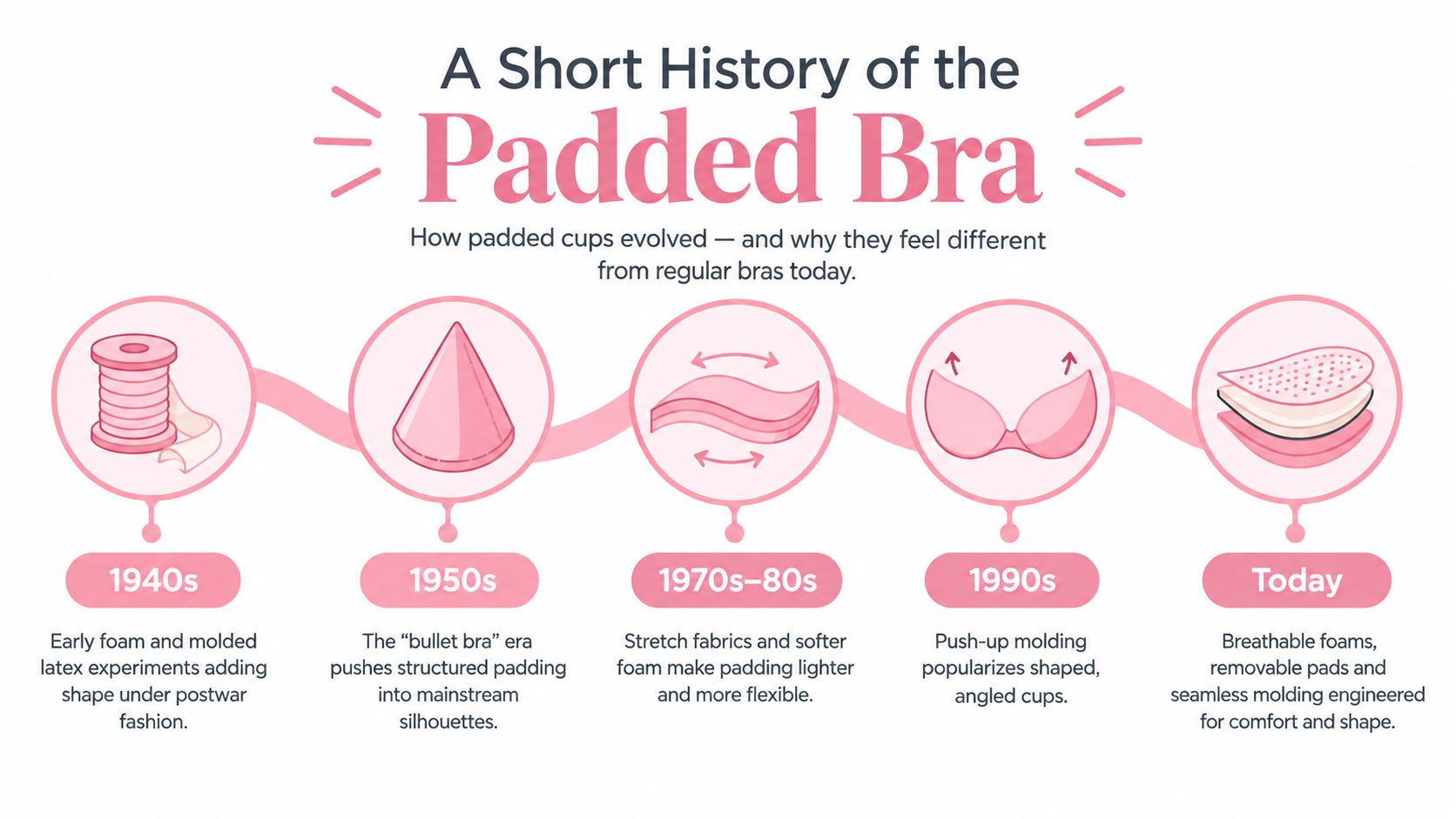
The important shift wasn't just the addition of more material. Padding introduced a new way to control the cup's shape. Instead of relying only on stitched fabric panels, designers could build a more predictable curve into the garment and respond to fashion that emphasized the bust.
Why one label can describe very different cups
Over time, padded cups have answered different wardrobe problems. Structured shaping suited outfits that demanded a pronounced silhouette. Smoother, thinner lining became useful beneath close-fitting clothing, where seams and texture could show through. More recent constructions have focused on reducing the sense that a padded bra is heavy, rigid, or overly warm.
That layered history explains why two bras both described as padded can feel completely different. One may hold its dome firmly and resist compression. Another may flex with the body and soften the outline. A third may let you remove the inserts entirely.
Treat the label as a starting point, not a complete description. Cup depth, pad placement, fabric density, edge finish, and the way the bra attaches to your body all matter more than the single word “padded.”
Padding Types and How They Feel
The most useful way to compare padding is to ignore the marketing language and consider what you can feel in your hand. Is the cup firm or flexible? Does it bend easily? Can air move through it? Does the material add volume everywhere, or only in one area?
Four common constructions
Molded foam is usually a single-density sheet shaped into a dome with heat and pressure. It feels smooth and relatively firm, keeps its contour under clothing, and offers reliable nipple coverage. Because the thickness is built into the cup, you get a consistent shape, but you have less control over how much volume the bra adds.
Spacer fabric uses a three-dimensional knit structure with air pockets between layers. It tends to feel lighter and more springy than dense foam. Spacer cups can offer a smooth outline with more flexibility and airflow, although they may provide less dramatic projection than a strongly molded push-up cup.
Removable pads are separate inserts made from materials such as cotton, foam, or silicone. They let you change the bra's effect for different outfits, correct a small asymmetry, or remove the inserts for washing and sleeping. Their trade-off is movement. A loose insert can fold, shift, or create an uneven edge if the pocket doesn't hold it securely.
Air-light or microfoam padding uses a thin layer to smooth the silhouette without adding much volume. It's a good middle ground if you want modesty under a lightweight top but don't want a strongly shaped bust.
| Padding Type | Material | Feel & Weight | Best For |
|---|---|---|---|
| Molded foam | Shaped foam sheet | Firm, smooth, more structured | Consistent shape and coverage under fitted clothing |
| Spacer fabric | Three-dimensional knit | Springy, light, and more breathable | Everyday wear when airflow and flexibility matter |
| Removable pads | Cotton, foam, or silicone inserts | Adjustable, with variable weight | Asymmetry, changing outfits, and customizable coverage |
| Air-light or microfoam | Thin foam layer | Soft, light, and low volume | Smoothing without a visibly enhanced shape |
A bra cup can also use more than one approach. For example, a flexible outer cup may contain a thin fixed liner plus a removable insert for optional lift. If you enjoy comparing construction details beyond lingerie, the explanation of a structured blazer with shoulder padding offers a useful parallel: padding changes the garment's architecture, not just its appearance.
How Padding Changes Fit, Pressure, and Breathability
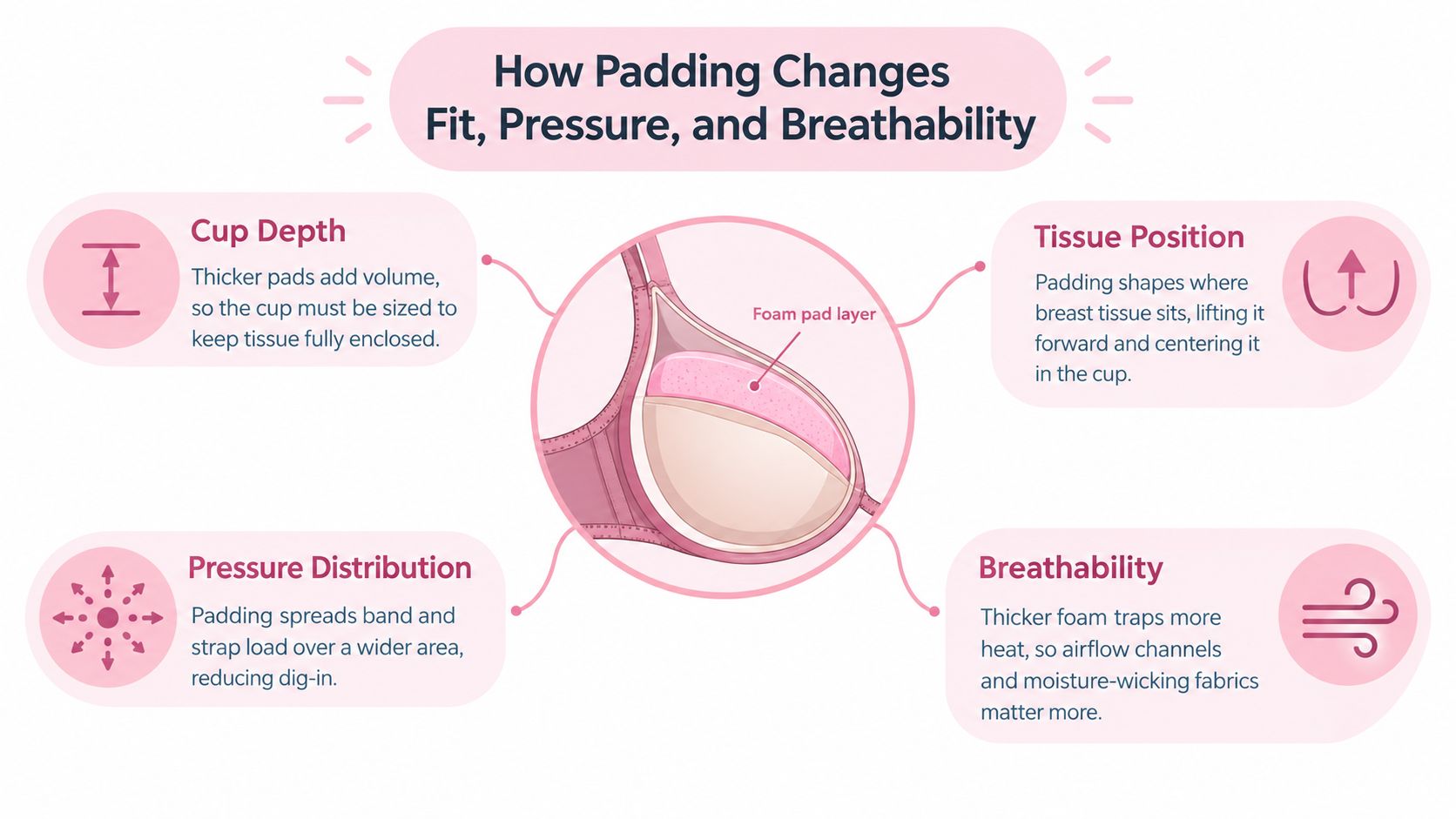
You put on a padded bra, adjust the band, and still notice a small gap near the top of the cup. The band may fit correctly. The issue can be internal space: a thicker pad occupies part of the cup before your breast tissue does. The cup therefore needs enough depth for both the padding and your body. If its firm contour does not match your breast shape, the edge may gape at the top or center.
Molded foam holds its form instead of collapsing, helping the cup keep a smooth outline as you move. That structure can spread contact more evenly than a soft, unstructured layer. Dense material can also hold warmth close to the skin, so fabric choice matters as much as pad thickness during extended wear.
Pressure is a construction issue
A controlled pressure-profile study found that auxetic pads produced a more even load than traditional molded foam pads during static cycling. Mean pressure measured 2.92 kPa for auxetic pads compared with 4.81 kPa for molded foam, while maximum pressure was reduced by 25% and pressure variability was approximately halved, with standard deviations of 0.85 kPa and 1.70 kPa respectively. The pressure-profile study connects cup geometry and material response with localized compression, stability, and comfort during movement.
Those findings describe construction, not a universal winner. The pad forms part of the bra's support system. A heavy or rigid cup can alter the way the band and straps feel after hours of walking or sitting. Straps may feel tighter because they carry more of the garment's weight, while a firm cup can press against one area when its curve does not match your breast root. Hormonal sensitivity can change that experience too. Readers looking for perimenopause breast pain relief can find additional context on comfort during hormonal changes.
Heat and moisture follow the fabric system
Closed, dense foam usually permits less air movement than an open knit or cotton-lined insert. Spacer structures hold small air spaces within the fabric, while moisture-wicking linings can move perspiration away from the skin more effectively than smooth, non-absorbent layers.
Fabric research illustrates why the full cup matters. In a moisture-responsive bra-panel study, the plain panel measured 202.55 cc/cm2/s when dry and 121.41 cc/cm2/s when wet, while the outer bra layer showed the highest breathability in both conditions. A separate sports-bra materials study identified weft-knit single jersey as a strong drying and support option, with a short drying time of 16 minutes and recovery/support values of 89% DER. The textile research PDF supports assessing the foam, knit structure, lining, and panel zoning together.
For humid weather or all-day wear, inspect the complete cup and surrounding band rather than judging the pad alone. The most flattering shape may not be the most comfortable choice for every day.
Pros and Cons of Wearing a Bra With Padding
A padded bra can make dressing easier when your clothing needs a smooth, consistent surface. It can also become uncomfortable when the cup construction solves a visual problem but ignores heat, movement, or your natural breast shape.
What padding can do well
Under a thin shirt, a light lining can provide nipple modesty without requiring a bulky extra layer. Molded cups can also create a clean outline beneath fine knits because the outer surface stays smooth instead of following every small change in tissue position.
Padding can help create visual balance when one side is slightly different from the other. Removable inserts are especially practical here because you can use one insert, adjust its position, or remove both when you want the least structure.
Some molded wireless bras offer light shaping without an underwire. They won't all provide the same level of support, but the cup itself can keep its form and reduce the need for rigid seams. That can feel pleasant for casual outfits or relaxed days.
Where it can become a problem
Dense foam may retain heat, particularly in warm weather or during long periods of sitting and walking. A removable insert can shift inside its pocket, producing a lump on one side or a gap at the top of the cup. Extra material also adds weight, and that weight may increase the tension you feel at the straps over the course of a day.
A highly structured cup has less stretch, so it can expose a fit mismatch more dramatically. If your tissue doesn't align with the cup's fixed curve, you may see wrinkling, empty space, or pressure rather than a smooth fit. Removable pads can also make a cup appear fuller than the true fit, which can complicate size checks.
| Factor | Padded Bra | Non-Padded Bra |
|---|---|---|
| Nipple coverage | Usually more consistent | Depends on fabric and lining |
| Silhouette | Smooth and shaped by the cup | Follows natural tissue and seams more closely |
| Customization | Higher when inserts are removable | Usually limited |
| Warm-weather comfort | Can feel warmer with dense foam | Often allows a lighter, less insulated feel |
| Fit feedback | A molded shape can hide or create gaps | Fabric may reveal shape changes more directly |
| Weight | Varies with pad density and construction | Often lighter, depending on support features |
The better option depends on the actual situation. A non-padded bra may feel fresher under loose clothing, while a lightly padded bra may behave better under a fitted top. Neither category wins automatically.
How to Fit and Wear a Padded Bra Well
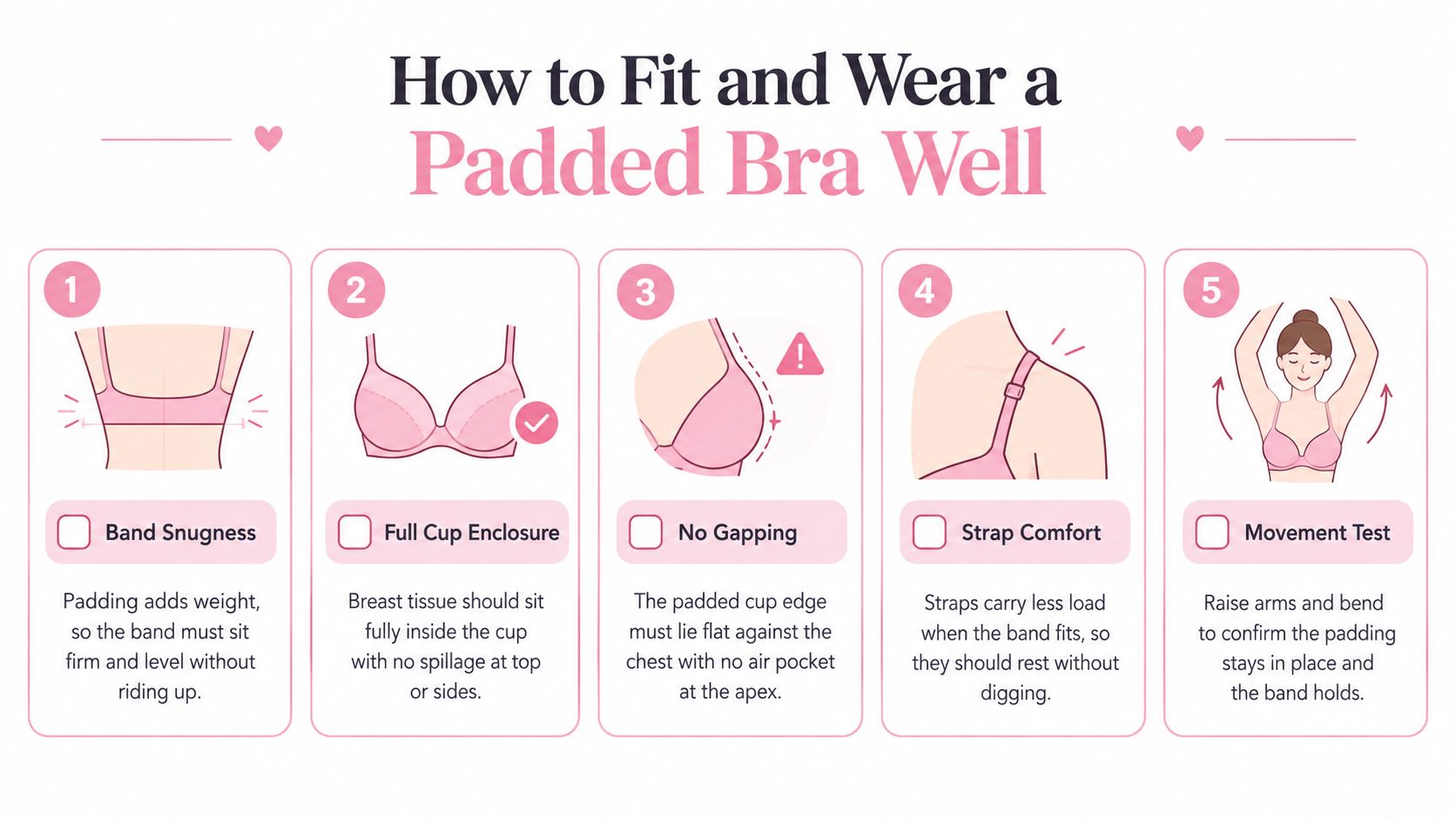
Start with the band. Padding adds structure and sometimes weight, so the band needs to sit snugly around your torso and remain level instead of riding up. It shouldn't pinch, but you also shouldn't need the straps to pull the bra into place.
Use this fitting sequence
- Fasten the band and check its line. Put the bra on the loosest comfortable fastening and look at the back. A band that climbs upward usually isn't providing stable support.
- Settle your tissue into the cup. Lean forward slightly while fastening, then use your hand to guide breast tissue from the side and underneath into the cup. This helps you assess the fit rather than the position you happened to have before dressing.
- Inspect the cup edge. There shouldn't be spillage at the top, sides, or center. The padded edge should lie flat against your chest. Wrinkles can mean the cup is too deep or the pad curve doesn't match you, while a firm ridge or bulge can signal insufficient space.
- Follow the breast root. If the bra has an underwire or defined seam, it should trace the natural base of the breast instead of sitting on breast tissue. Padding shouldn't force the wire into a different position.
- Adjust the straps last. Once the band and cups are right, shorten the straps only enough to keep them in place. Raise your arms, bend forward, and twist. The band should stay level, and the cups and inserts shouldn't shift.
Try removable inserts separately. Take one out, refit the cup, then repeat on the other side. If the bra only looks or feels acceptable when the inserts are filling empty space, the padding may be masking a cup-shape or size issue.
For more guidance on evaluating size and fit, use this bra size 44 fitting resource alongside the checklist above.
A short movement test can reveal more than standing still. This fitting demonstration provides another visual reference:
Red flags include a riding-up band, straps that dig even after the band is adjusted, a cup edge that cuts into tissue, an air pocket at the apex, or an insert that migrates during normal movement. Those signs don't mean padding is wrong for you. They mean that particular combination of pad, cup, and body shape needs reconsideration.
Choosing the Right Padding for Your Day
A comfortable padded bra should match the fabric weight, activity level, climate, and neckline of your outfit. Start with the day, then choose the silhouette. Marketing often encourages shoppers to select the most dramatic lift, but a high-projection cup can feel excessive during an ordinary commute or warm afternoon.
Match the construction to the situation
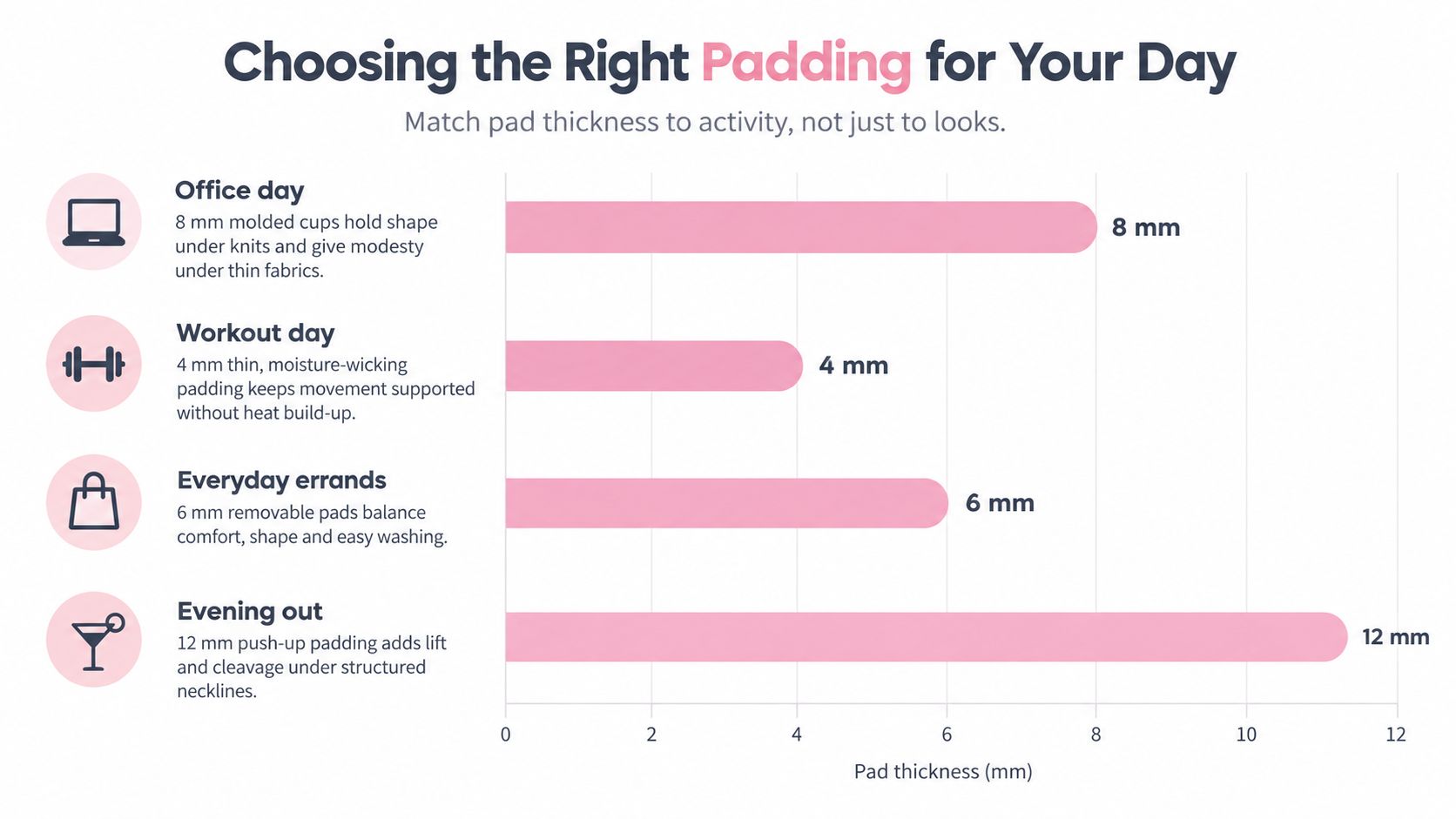
For an office day, a moderately molded cup can hold a clean shape beneath fine knits and provide coverage under lightweight fabrics. Look for a smooth edge and enough cup depth so the contour doesn't create a shelf at the top.
Workout-heavy days call for a lighter, flexible approach. Thin foam or removable pads can provide coverage while working with a moisture-managing band and stable support structure. If you're sweating, prioritize airflow and drying behavior over a dramatic contour.
Travel rewards simplicity. A molded cup can preserve its form beneath several outfits and avoid visible seams under fitted clothing. Removable pads offer flexibility, but they can be less convenient if they fold or need repositioning after washing.
An evening outfit may justify more projection, especially beneath a structured neckline. For work-from-home days, lounging, or warm weather, thin padding or removable inserts may feel less restrictive and allow more airflow.
Ask four questions before you buy
- What will you wear? Thin fabric and close-fitting knits often benefit from a smooth, lightly lined surface.
- How much will you move? Choose flexible construction and stable support for walking, exercise, or active work.
- What's the climate like? In heat or humidity, breathable spacer structures and moisture-managing linings may feel better than dense foam.
- What neckline needs to work? A plunging, balconette, or full-coverage cup will place padding differently, so match the neckline rather than relying on the word “push-up.”
A wireless option can be useful when flexibility matters more than a sharply defined shape. This wireless bra guide can help you consider support and comfort together instead of treating padding as the only decision.
The best pad for an evening out may be the wrong pad for a long flight. Your wardrobe doesn't need one universal answer.
Final Takeaways on Finding Your Best Fit
A bra with padding works best when you treat it as a fit-and-comfort decision first and a shaping decision second. Padding can smooth, cover, lift, center, or balance, but it can't compensate for a band that rides up or a cup that doesn't follow your breast shape.
Molded foam gives the most consistent contour and resists collapsing. Spacer fabric offers a lighter, more flexible construction with room for airflow. Removable pads give you control over coverage and asymmetry, while thin microfoam can smooth the outline without adding much volume.
The cup shape still has to match your tissue. The band should feel firm without pinching, the cup edge should lie flat, and the straps should stay comfortable after ordinary movement. If the bra looks perfect only while you're standing still, it hasn't passed the true test.
Use this three-step framework on your next shopping trip:
- Assess the day. Decide whether you need coverage, smoothness, flexibility, airflow, or extra shaping.
- Try different constructions. Compare at least one molded, removable, spacer, or lightly lined option that suits the outfit.
- Prioritize fit over effect. Keep the bra that stays level, encloses your tissue, and feels comfortable when you move, even if another style creates a more dramatic mirror image.
Your most useful padded bra may not be the thickest one or the one with the strongest lift. It's the one that supports the way you live.
Nuage Wears offers comfort-focused bras, bralettes, and everyday apparel designed around practical concerns such as visible lines, digging, movement, and overheating. Visit Nuage Wears to explore options that can complement your daily fit needs, from workwear to travel and relaxed days.