
You put on a bra that promises serious lift. By lunchtime, the band has crept up your back, the straps have left red grooves, and your breasts still shift whenever you walk or reach. Tightening everything usually makes the problem worse, not better.
The best bras for sagging breasts aren't defined by dramatic lift alone. They need to contain tissue, keep the band stable, distribute pressure, and suit the way you move. A supportive bra should feel secure without feeling punitive. Here's how to find one that works with your anatomy instead of fighting it.
Table of Contents
- Why Your Current Bra Might Be Making Things Worse
- Understanding Breast Sagging and What Bras Can Actually Do
- How to Find Your Perfect Fit Step by Step
- Choosing Between Underwire, Wireless, and Encapsulation Styles
- Lifestyle Habits That Complement Your Bra Support
- Common Myths About Supportive Bras Debunked
Why Your Current Bra Might Be Making Things Worse
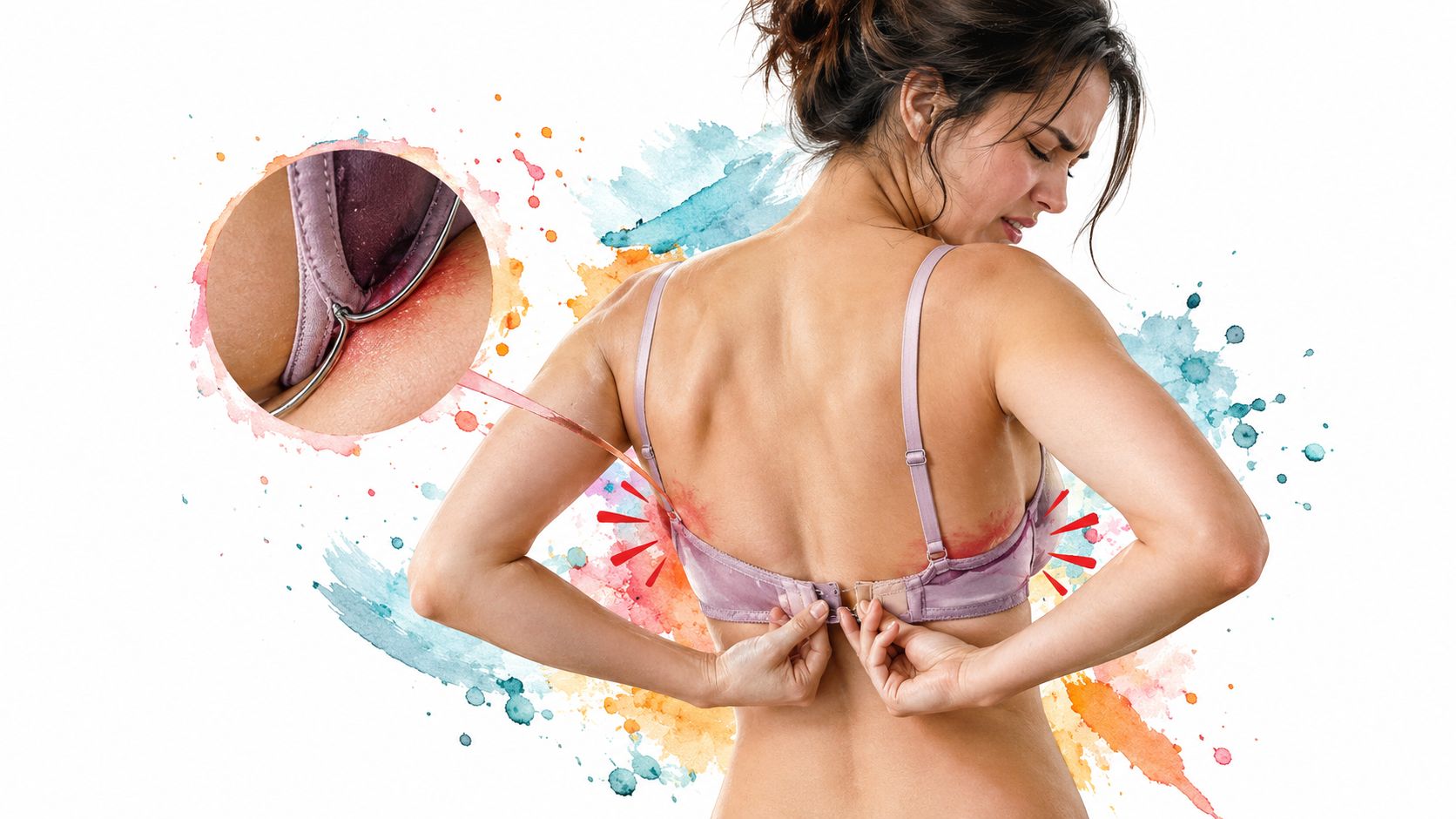
A woman can leave home feeling properly supported and still spend the rest of the day adjusting her bra. The cups may look smooth at first, but tissue gradually spills toward the center or underarm. The band rides upward, the straps take on too much weight, and an underwire presses into breast tissue instead of sitting around it.
This isn't a minor annoyance. A cross-sectional study found that 85% of women were wearing ill-fitting bras when assessed against professional fitting criteria, and self-selected sizes differed significantly from professionally determined sizes (the study's findings on bra fit and size selection). A size label can't tell you whether the cup shape matches your breast, whether the band suits your torso, or whether the garment stays stable during movement.
The warning signs are easy to miss
Check your bra at the end of a normal day, not only when you first put it on. These signs point to a fit problem:
- The band rises: A stable band should remain level around your torso. If it travels upward, the straps may be compensating for insufficient band support.
- The cups overflow: Tissue spilling at the top, center, or underarm means the cup isn't containing your breast fully.
- The cups gape: Empty space can indicate the wrong cup shape, not necessarily a cup that's too large.
- The straps dig in: Shoulder marks often mean the band isn't carrying enough of the load.
- The wire presses inward: An underwire should surround the breast root, never sit directly on breast tissue.
- You keep repositioning yourself: Constant scooping, tugging, or tightening is practical evidence that the design isn't working.
Practical rule: A bra should hold your breasts in place without forcing them into a narrow shape.
Maximum lift can also create pressure points. A very tight cup may compress tissue against the chest, while a rigid band can restrict comfortable movement. The better target is stable containment, where the breast is supported from below and the sides without painful squeezing.
Your first task isn't to buy a more aggressive bra. It's to identify what currently fails, then choose construction that fixes that specific failure.
Understanding Breast Sagging and What Bras Can Actually Do
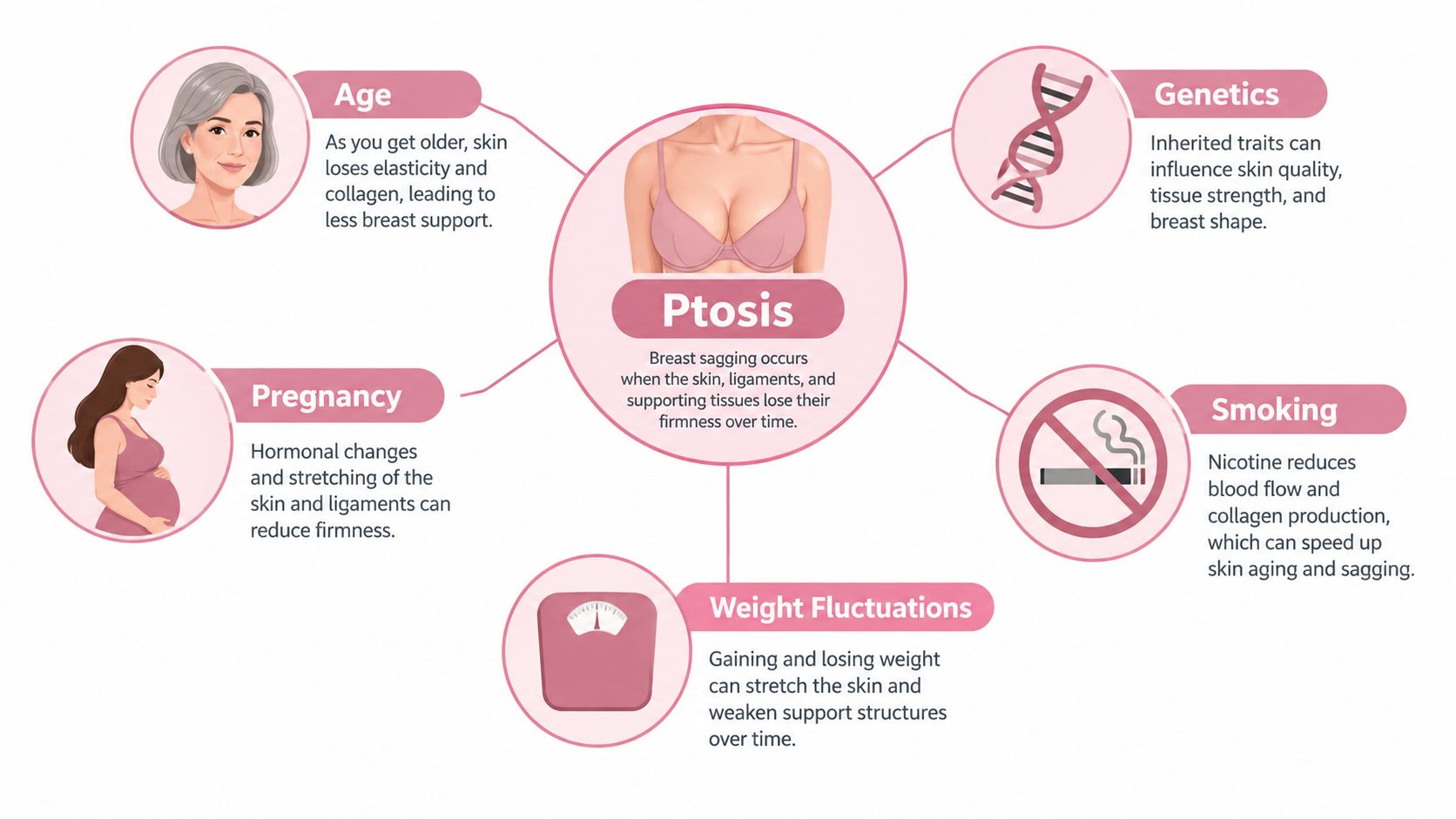
Breast sagging is clinically described as breast ptosis. Research identifies age, breast size, body mass index, pregnancy history, weight change, and smoking as recurring associated factors. In a study of 132 patients seeking breast augmentation or mastopexy, 85% of participants who had experienced at least one pregnancy reported an adverse change in breast shape afterward (research on breast ptosis risk factors).
That same study found that age, substantial weight loss of more than 50 pounds, or 22.7 kilograms, higher BMI, larger bra-cup size, number of pregnancies, and smoking were significant risk factors for ptosis. Breastfeeding itself, pregnancy-related weight gain, and the absence of regular upper-body exercise weren't significant risk factors in that study. For a broader plain-language overview, this resource on sagging breast causes explained offers useful context about the factors people commonly associate with breast changes.
Support while worn isn't permanent correction
A bra can raise the breast position, reduce movement, improve the silhouette, and make clothing sit better while you're wearing it. It can't reverse changes in skin elasticity or permanently remodel the structures associated with ptosis. Any product promising a lasting anatomical cure is overselling what lingerie can do.
That distinction helps you shop intelligently. Look for cup containment, a stable lower band, comfortable strap distribution, and movement control. Don't judge a garment by how high it pushes the breasts for five minutes in front of a mirror.
The history of bra design points in the same direction. Archaeological evidence from Lengberg Castle in Austria includes breast-support garments with separate cups dating back approximately 600 years, while Mary Phelps Jacob's 1914 patent described a lightweight, backless, boneless brassiere. Later developments increasingly focused on adjustable fit and movement control, including research by Christine Haycock in the 1970s that examined breast movement during exercise (the history of breast support and bra design).
If you're comparing support needs with age and changing comfort priorities, this guide to the best bra for older women can help you think beyond lift alone.
How to Find Your Perfect Fit Step by Step
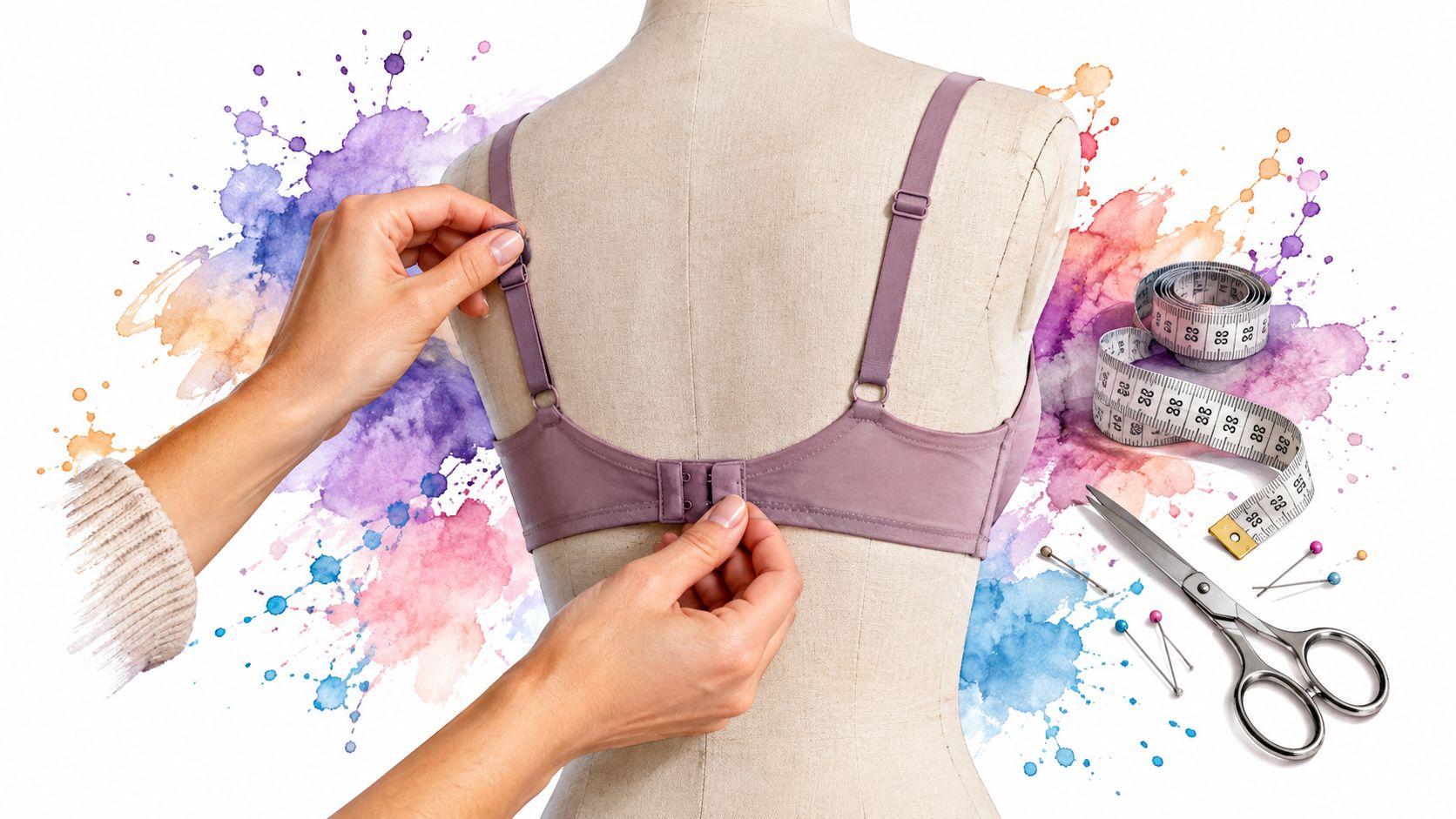
Start with the bra on its loosest hook, unless it's a pull-on style. New bras need room to tighten as the fabric relaxes, and the band should feel firm without restricting breathing. Stand naturally, then raise your arms and rotate your shoulders.
Use the wear-test, not the label
A professional fitting can give you a useful starting point, but it isn't a final verdict. In a study of 24 larger-breasted women, 67%, or 16 of 24 participants, still failed the fit assessment after professional fitting (the study on fitted bras, breast position, and posture). Your body shape, breast distribution, torso length, and preferred movement all matter.
Use this sequence when trying on a bra:
- Set the band: Fasten it securely and check that it stays level when you move. You should be able to slide fingers beneath it, but it shouldn't shift freely.
- Scoop and settle: Lean slightly forward, guide tissue from the underarm into the cup, then stand upright. This reveals whether the cup has enough room and coverage.
- Inspect the center: The center section should sit comfortably between the breasts when the style is designed to separate them. It shouldn't force tissue painfully inward.
- Check the wire or lower frame: If present, it should follow the breast root. If it rests on tissue, feels sharp, or pinches when you sit, reject the bra.
- Adjust straps last: Straps should fine-tune the position, not create the lift by themselves. Keep pressure spread across the shoulder rather than concentrated in a narrow strip.
- Test real movement: Walk, bend, reach overhead, sit at a desk, and twist. A bra that works only while standing still isn't a successful fit.
Watch this fitting demonstration, then repeat the movement checks in your own clothing and routine:
The right bra should leave you aware of support, not pain. Redness that fades quickly can happen with close-fitting clothing, but persistent marks, numbness, chafing, or pain mean the pressure distribution needs attention.
Choosing Between Underwire, Wireless, and Encapsulation Styles
Underwire, wireless, and encapsulation bras solve different problems. None deserves an automatic “best” label. Choose according to where you need control, how much movement you create, and how your skin responds to pressure and heat.
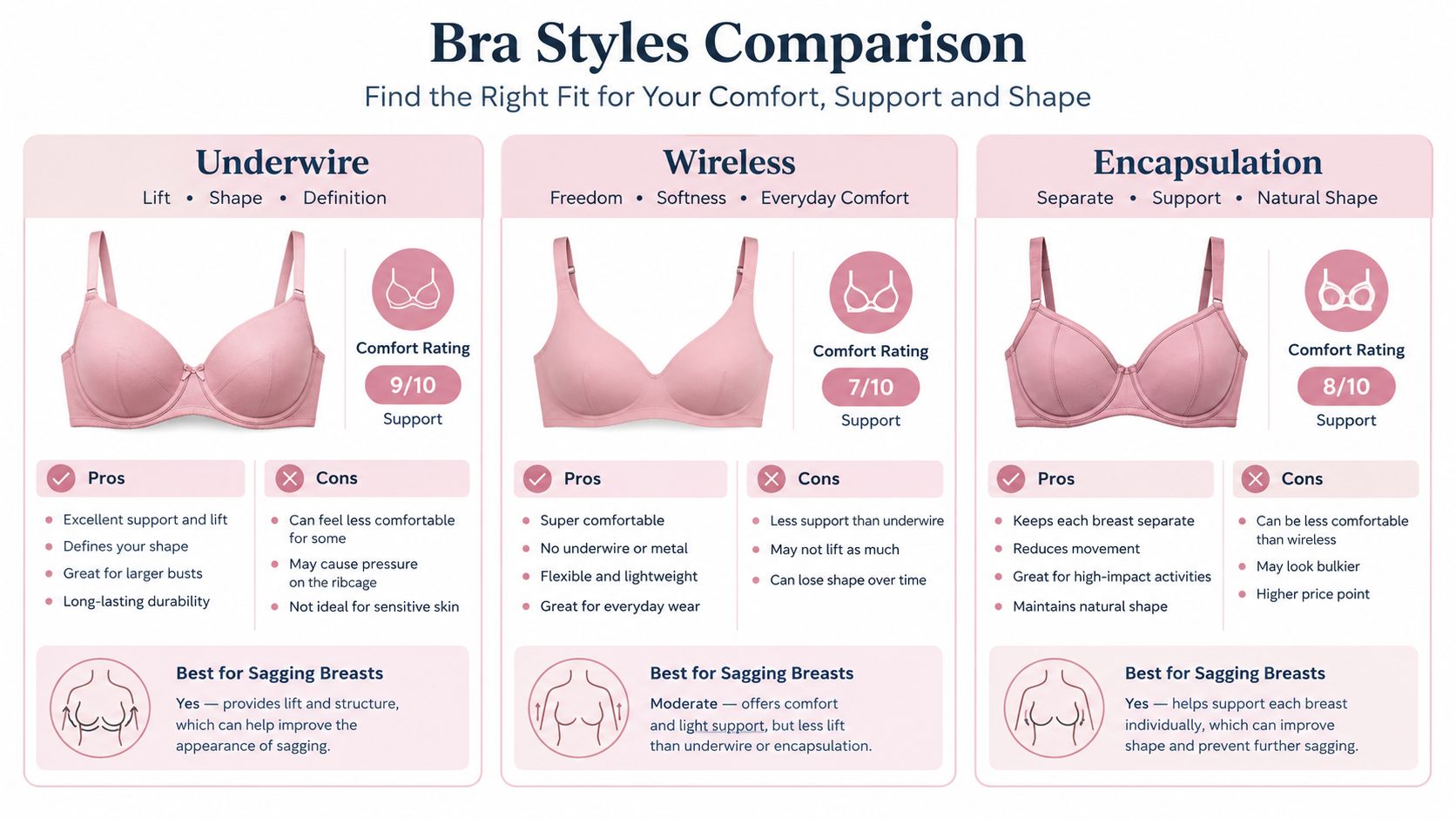
Underwire
An underwire can provide clear separation and a defined lifted shape. It works best when the wire fully surrounds the breast root and the cup has enough depth for the tissue. It fails when the wire sits on breast tissue, the cup is too shallow, or the band shifts and drags the frame out of position.
Choose it for structured outfits or situations where separation matters. Skip it if you consistently experience rib pressure, poking, or soreness, especially after several hours of wear.
Wireless
Wireless construction can feel easier for long sitting, travel, lounging, and low-impact days. It still needs engineering. Look for an anchored lower band, shaped cups, side panels, reinforced seams, and straps that don't stretch excessively.
A wireless bra isn't automatically supportive, and a soft bralette isn't automatically suitable for a larger or lower-set bust. The useful question is whether the garment contains each breast and remains stable while you move. Nuage Wears offers a wireless bra designed for everyday comfort, but the same wear-test standards still apply.
Encapsulation and compression
Encapsulation supports each breast separately, while compression presses breast tissue closer to the chest. Encapsulation usually offers better separation and shape, while compression can be effective when limiting movement matters more than a rounded silhouette.
Research on active support describes high-support sports bras as commonly limiting vertical displacement by about 60% compared with no bra (biomechanics of breast support for active women). That level of control makes sense for exercise, but it doesn't mean you need the same construction for desk work or a flight.
| Scenario | More suitable starting point | What to prioritize |
|---|---|---|
| Desk work | Light wireless containment | Soft band, low friction, no chest compression |
| Walking | Stable wireless or encapsulation | Side containment and controlled bounce |
| Exercise | Encapsulation or purpose-built compression | Motion reduction and secure straps |
| Travel | Breathable wireless support | Moisture management and no digging |
| Formal clothing | Well-fitted underwire or molded wireless style | Smooth outline and reliable positioning |
The best bras for sagging breasts often change with the day. Don't force one garment to handle every setting.
Lifestyle Habits That Complement Your Bra Support
A bra can manage breast movement, but it can't compensate for every source of discomfort. Your posture, activity level, fabric choice, and tolerance for heat all affect how support feels by evening.
Start with your sitting position. Let your shoulders rest rather than rounding forward, keep your feet supported, and avoid collapsing your ribcage toward your desk. Better posture won't reverse ptosis, but it can reduce the extra strain created when the head and shoulders remain projected forward.
Upper-body exercise can also improve general strength and stability. Choose movements that feel controlled, such as rowing patterns, chest presses, shoulder work, and upper-back strengthening. Exercise shouldn't hurt your breasts or back, so use a garment that controls movement without painful compression.
Reduce avoidable fluctuations and friction
Weight changes can affect breast shape and bra fit, so reassess your garment after significant body changes rather than forcing an old size to work. If weight, menopause, or other health changes are affecting comfort, a resource on personalized care at Pause Medical may help you find appropriate support beyond lingerie.
Fabric matters more than many shoppers expect. For long days, favor smooth materials that don't scrape sensitive skin, breathable panels that allow airflow, and edges that lie flat instead of creating concentrated pressure. A bra can fit correctly and still feel miserable if it traps heat or rubs at the underarm.
Use a simple routine:
- For sitting: Choose gentle containment and avoid unnecessary compression.
- For walking: Look for a firm, level band and side support that limits shifting.
- For exercise: Prioritize movement control over a delicate silhouette.
- For heat: Select breathable zones and low-friction construction.
- For recovery: Change out of damp clothing rather than leaving moisture against the skin.
Persistent breast, neck, or back pain deserves medical assessment. A different bra may improve comfort, but it shouldn't be your only response to ongoing symptoms.
Common Myths About Supportive Bras Debunked
Myth one, wearing a bra constantly prevents sagging. A bra supports tissue while it's worn. It doesn't permanently correct ptosis or stop the structural changes linked with age, tissue weight, skin elasticity, pregnancy history, weight change, and smoking. Wear one when it improves comfort, movement control, or clothing fit, not because you owe your body continuous restraint.
Myth two, a larger cup automatically gives more support. A larger cup can provide room, but support depends on the relationship between the cup, band, frame, straps, and breast shape. The fitting evidence is blunt: many women choose poorly fitting sizes, and even professional fitting doesn't guarantee a successful result. Try the garment on your body and test it in motion.
Myth three, maximum lift equals maximum support. A dramatic upward push may create a striking silhouette, but it can also concentrate pressure and force tissue into an unstable position. Support means reducing unwanted movement while distributing load comfortably. A stable band and contained cup are more useful than an aggressive lift that hurts after an hour.
Myth four, compression and containment are interchangeable. They aren't. Compression presses the breasts toward the chest, while containment uses cups, panels, or separate zones to hold each breast in place. Compression has a role during higher-movement activities, but everyday wear often calls for separation, breathability, and less restrictive pressure.
Myth five, a calculator can choose your bra for you. Measurements are a starting point, not a guarantee. Breast shape, tissue distribution, torso proportions, posture, and movement change how a bra behaves. Try several constructions, perform the wear-test, and judge the garment by what happens after you bend, sit, reach, and walk.
The honest standard: Keep a bra only if it supports you through real life without creating a new problem.
The practical answer is simple. Choose bras for containment, stability, and comfort first, then decide how much lift and shaping you actually want. That approach gives you a better silhouette without pretending lingerie can permanently change anatomy.
Nuage Wears offers comfort-first bras and everyday intimates, including wireless and structured designs intended to support movement, reduce digging, and improve all-day wearability. Visit Nuage Wears to explore options, then use the fit and movement checks above before keeping your next bra.