
You know the moment. You step onto a crowded train or settle into a slow bus ride, and ten minutes later you can feel heat building where clothing presses closest to skin. The waistband starts to feel sticky. The seams get noticeable. By the time you reach the office, you're not soaked, but you're distracted.
That's usually when people start searching for breathable moisture wicking underwear. They want fabric that feels cooler, dries faster, and doesn't stay damp through the rest of the day. The confusing part is that most product pages talk about fiber names, while your body feels the result of something bigger: airflow, sweat movement, seam placement, and knit structure.
Breathable underwear isn't a brand-new idea dressed up in modern language. The word wicking dates to 1846, but performance moisture-wicking fabrics for apparel emerged in the late 1980s, with a major milestone in 1986 when DuPont developed Coolmax. By the 1990s, the idea had accelerated in underwear, and by 1998 sweat-wicking fabric engineering had advanced enough to appear in patent filings, as outlined in this history of briefs and fabric technology.
Table of Contents
- The Hot Commute Moment That Started the Search
- What Breathable and Moisture Wicking Actually Mean
- How Underwear Fabrics Compare on Airflow and Drying
- Why Mesh Zones and Seams Change Real Performance
- Matching Underwear Construction to Your Day
- Caring for Performance Fabrics So They Keep Working
- Common Myths About Breathable Underwear
- A Simple Checklist for Choosing Your Next Pair
The Hot Commute Moment That Started the Search
It often starts with a normal day, not a workout. You're wedged between people on a packed commute, your jacket's still on because there's no room to move, and the first place discomfort shows up is underneath everything else. Not your shirt. Not your jeans. Your underwear.
That close-to-skin layer has to manage heat in a cramped environment. It sits in skin folds, under waistbands, under fitted pants, and under pressure from sitting. If the fabric can't let vapor escape or move liquid away, you feel it fast. That's why two pairs made from similar-sounding fibers can wear completely differently by noon.
A lot of shoppers look for a single magic word on the label. Cotton. Modal. Mesh. Performance. Answer is less tidy. A fabric can sound soft and premium and still hold onto dampness. Another can sound overly sporty and do a better job on a long workday.
Practical rule: If underwear feels fine for the first half hour but clammy after a commute, coffee run, or long seated stretch, the issue usually isn't softness. It's moisture handling under pressure.
The same pattern shows up all day. A freezing office makes you forget about it for a while. Then you walk outside in afternoon heat and the trapped humidity returns. Weekend errands turn into a much longer walk than expected, and suddenly a seam that seemed harmless at breakfast starts rubbing.
Three things usually decide whether a pair disappears or becomes annoying:
- Airflow through the fabric so heat can leave before the area feels swampy
- Liquid transport across the surface so sweat doesn't sit in one spot
- Construction choices like seams, gusset shape, and mesh placement
Those are the ideas worth shopping for. Not just a fiber label.
What Breathable and Moisture Wicking Actually Mean
Shoppers often use breathable and moisture wicking as if they mean the same thing. They don't. They work together, but they solve different parts of the discomfort problem.
What breathable means on the body
Breathability is about how easily air and water vapor move through a fabric. In lab testing, brands and textile teams look at measures like MVTR and RET. Higher vapor transmission and lower resistance indicate better breathability. In plain language, a breathable fabric gives body heat and humid air somewhere to go instead of letting them collect in a warm pocket against skin.
That matters before you even see visible sweat. If heat dissipates sooner, the fabric environment feels less muggy. In underwear, that's especially important because the garment covers a small area that gets very little natural ventilation from movement compared with a loose shirt or wide-leg pant.
What wicking means
Wicking is about liquid sweat, not just warm vapor. Think of a sponge touching a shallow tray of water. Once the sponge makes contact, it starts pulling water upward and spreading it outward. In fabric, capillary action does something similar. The structure draws moisture away from the skin and spreads it across a wider area so it can evaporate faster.
That's different from absorbency.
- Absorbency means the fabric can take in liquid and hold it.
- Wicking means the fabric moves liquid through and across itself.
A highly absorbent fabric can still feel wet because the moisture stays concentrated. A wicking fabric with moderate absorbency often feels drier because it spreads the moisture thin.
A pair can absorb sweat and still feel bad. Comfort usually comes from moving moisture, not just soaking it up.
Why people confuse the two
Soft fabrics often feel dry at first touch, so people assume they're performing well. But first-touch comfort and hour-three comfort aren't the same test. Underwear has a small contact zone, close fit, and frequent friction. If liquid stays put, the wearer notices dampness and rubbing quickly.
That's why breathable moisture wicking underwear works best when both systems are doing their jobs at once. Breathability helps heat and vapor escape. Wicking handles the liquid that's already formed.
How Underwear Fabrics Compare on Airflow and Drying
Fiber choice matters. It's just not the whole story. Textile testing defines moisture management as a fabric's ability to wick or diffuse perspiration quickly and efficiently, and performance is often summarized with Overall Moisture Management Capacity, or OMMC, on a 0 to 1 scale. Scores above 0.6 are considered excellent and above 0.8 outstanding. The same testing world also uses breathability measures like MVTR and RET. In one online summary of lab-tested comparisons, modal was reported as the most breathable single-layer fabric at 638 mm/s, with drying speed about 50% faster than cotton, according to the discussion of moisture-management metrics in this textile reference.
The five fabric families most shoppers see
Here's the practical read on the common categories.
| Fabric | Airflow | Drying Speed | Skin Feel | Best For |
|---|---|---|---|---|
| Cotton | Usually decent at first, depends on knit | Slow once damp | Familiar, soft, easy | Easy days, low sweat situations |
| Modal | Strong for a soft fabric | Faster than cotton | Smooth, drapey, soft | Daily wear, desk days, sensitive feel preference |
| Nylon-spandex blends | Varies a lot by knit structure | Usually quick | Stretchy, supportive, sleek | Fitted outfits, movement, all-day hold |
| Microfiber polyester | Strong moisture transport | Usually very quick | Light, slick, sometimes less plush | Workouts, travel, high-sweat days |
| Engineered mesh | Often strongest airflow | Usually quickest | Airy, light, less cushiony | Heat, humidity, active wear, long walks |
What each one gets right, and where it falls short
Cotton wins a lot of people over in the dressing room because it feels straightforward and familiar. But once it gets damp, it tends to stay damp longer. That's the difference between “comfortable now” and “comfortable through the afternoon.”
Modal is the category many shoppers end up loving for everyday use. It's soft, smooth, and less grabby against skin. When the knit is light enough, it can feel polished rather than sporty. It's a strong desk-to-dinner fabric because it balances comfort with better drying than basic cotton.
Nylon-spandex blends usually bring stretch, recovery, and shape retention. That makes them useful under fitted clothes. But nylon-spandex by itself doesn't guarantee airflow. A dense, slick knit can still feel stuffy if the structure is closed.
Microfiber polyester is often the quiet workhorse. It tends to move sweat fast and dry quickly, which makes it practical for activity and travel. Some very sensitive wearers don't love the slick handfeel, especially in hot weather if the knit is dense.
Engineered mesh isn't really a separate fiber family. It's a construction approach, often built from polyester or nylon. That distinction matters. If your priority is moving heat and moisture out fast, mesh usually beats a tighter solid knit made from the same raw fiber.
If a product sounds technical but doesn't tell you anything about the knit, ventilation zones, or seam design, you're probably missing the part that determines day-to-day comfort.
What actually performs on hot skin
For hot commutes, humid afternoons, long walks, and active days, fabrics that combine quick transport with open structure usually feel best. That means shoppers often get better real-world results from modal in lighter everyday builds, or from microfiber synthetics and mesh in higher-sweat situations.
The loser isn't any one fiber. It's dense construction that traps heat and holds moisture close.
Why Mesh Zones and Seams Change Real Performance
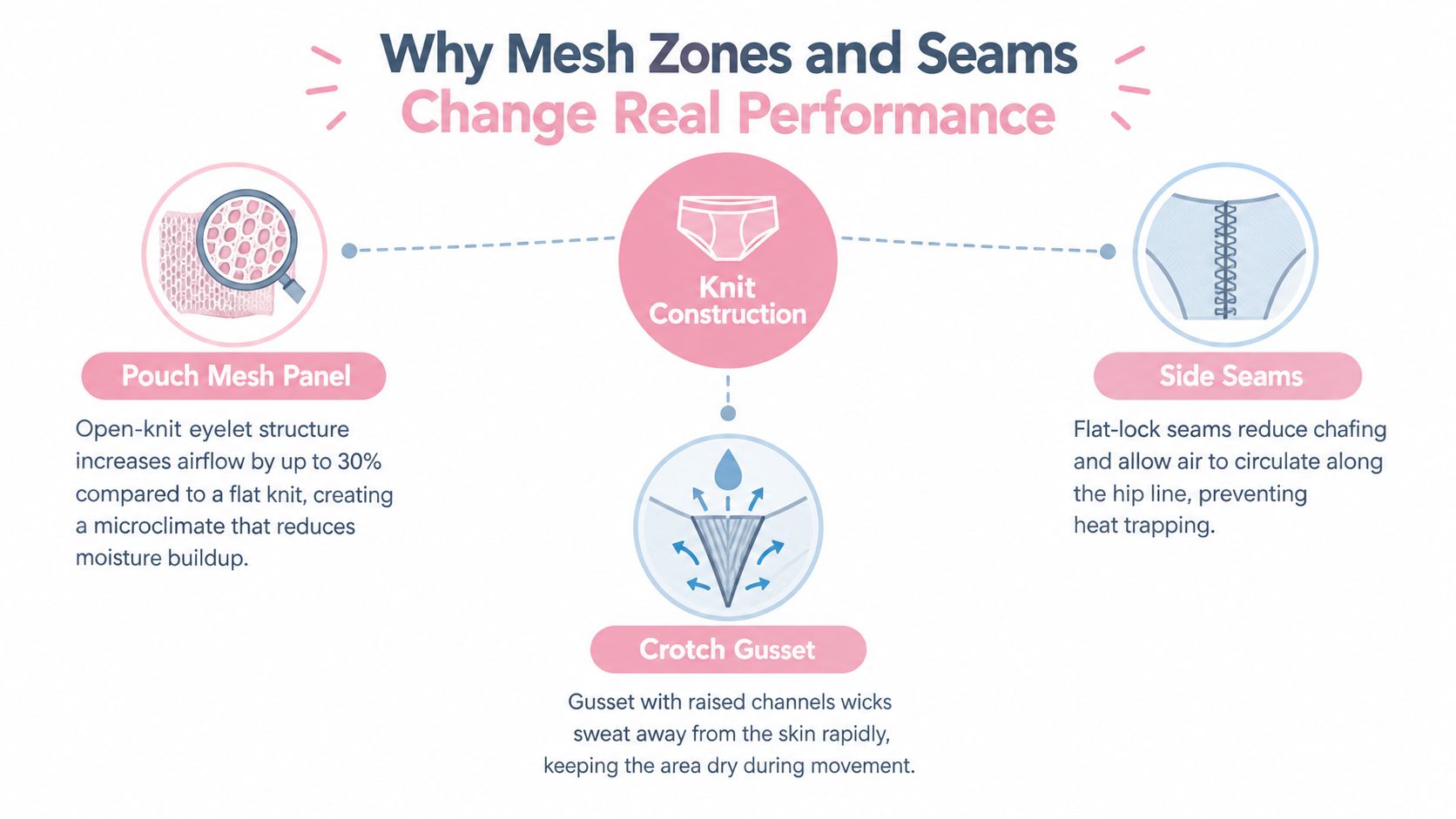
Fiber labels get the headline, but fabric architecture usually decides whether underwear feels airy or sticky. A porous, well-planned knit can outperform a more “natural” fiber in a dense build because it gives moisture somewhere to go.
The structure is doing more work than the label
Independent research on underwear textiles found that finer filament yarns, open and porous structures, shorter stitch length, and lower thickness increased air permeability, water-vapor permeability, and overall moisture-management capacity. The same study also reported that warp-knitted constructions had better moisture transport than weft-knitted constructions, which is why architecture is such a practical lever in breathable underwear design, as detailed in this underwear textile study.
That sounds technical, but the body-level effect is simple. More open pathways mean less trapped heat. Better-connected channels mean sweat doesn't stall in one patch.
Where the design details matter most
Certain zones do more than others:
- Pouch or front panel areas often benefit from open-knit mesh because heat builds there quickly during sitting and walking.
- Crotch gussets matter because they handle moisture concentration, friction, and repeated contact.
- Side seams and hip lines influence how much rubbing you feel once fabric gets even slightly damp.
Raised overlap seams can press moisture into the skin contact area. Flatlock seams reduce bulk, which usually means less chafing and less noticeable wetness. Gusset orientation also matters. When the structure encourages moisture to spread outward instead of pooling inward, the pair tends to recover faster between movement and sitting.
One example of this construction-first approach is NuAir Mesh Flex, which centers its pitch on targeted mesh zoning rather than relying on a fiber label alone.
Matching Underwear Construction to Your Day
The right pair for a desk day isn't always the right pair for a run, and that's where people get stuck. They buy one “performance” style and expect it to work for every situation. Underwear behaves more like footwear than that. Same category, different job.
Start with the moment that usually goes wrong
If your problem shows up during seated work, your needs are different from someone who gets uncomfortable halfway through a workout or after washing a pair in a hotel sink. Instead of asking which fabric is best in general, ask when you first notice discomfort.
| Scenario | Best Fabric | Mesh Zone | Seam Type | Fit Profile |
|---|---|---|---|---|
| Daily desk wear | Lightweight modal or nylon blend | Light gusset or subtle ventilation | Flat or low-profile | Smooth, moderate stretch |
| Workouts and runs | Microfiber synthetic | Targeted high-heat zones | Flatlock | Snug, secure, non-restrictive |
| Long travel days | Quick-drying synthetic blend | Helpful in gusset and side zones | Low-bulk | Flexible, easy to move in |
| Hot weather and humidity | Open-knit mesh build | Strong ventilation emphasis | Minimal bulk | Light contact, airy feel |
| Post-sweat recovery or lounging | Soft modal blend | Optional, not essential | Soft, low-rub | Relaxed support, gentle handfeel |
How to read the table in real life
For office wear, comfort usually means low drama. You want fabric that stays calm under trousers, skirts, or fitted dresses. A lighter modal or nylon blend often works well because it feels polished and doesn't scream gym gear. Moderate stretch helps the garment stay in place without squeezing.
For exercise, the priorities shift. Fast sweat transport and reduced friction matter more than plush softness. A synthetic knit with real ventilation zones and flatter seams usually handles repeated movement better than a soft, absorbent pair.
For travel, drying speed becomes practical, not theoretical. If you wash a pair at night, you want it wearable by morning. That points toward faster-drying synthetics and away from fabrics that stay damp in thicker gusset areas.
Choose for the hardest hour of your day, not the easiest one.
For humid weather, an open structure often beats a luxurious handfeel. The pair that feels slightly less buttery in the drawer may feel much better at 4 p.m.
For lounging or post-sweat recovery, a softer modal blend can be the more pleasant choice because the performance demand is lower and skin feel takes the lead.
Caring for Performance Fabrics So They Keep Working
Even strong fabric architecture can lose its edge if care habits clog pores, stress elastic, or distort mesh. Good underwear doesn't need delicate drama, but it does need smarter laundry habits.
Wash for the fabric you want to keep
A simple routine works well:
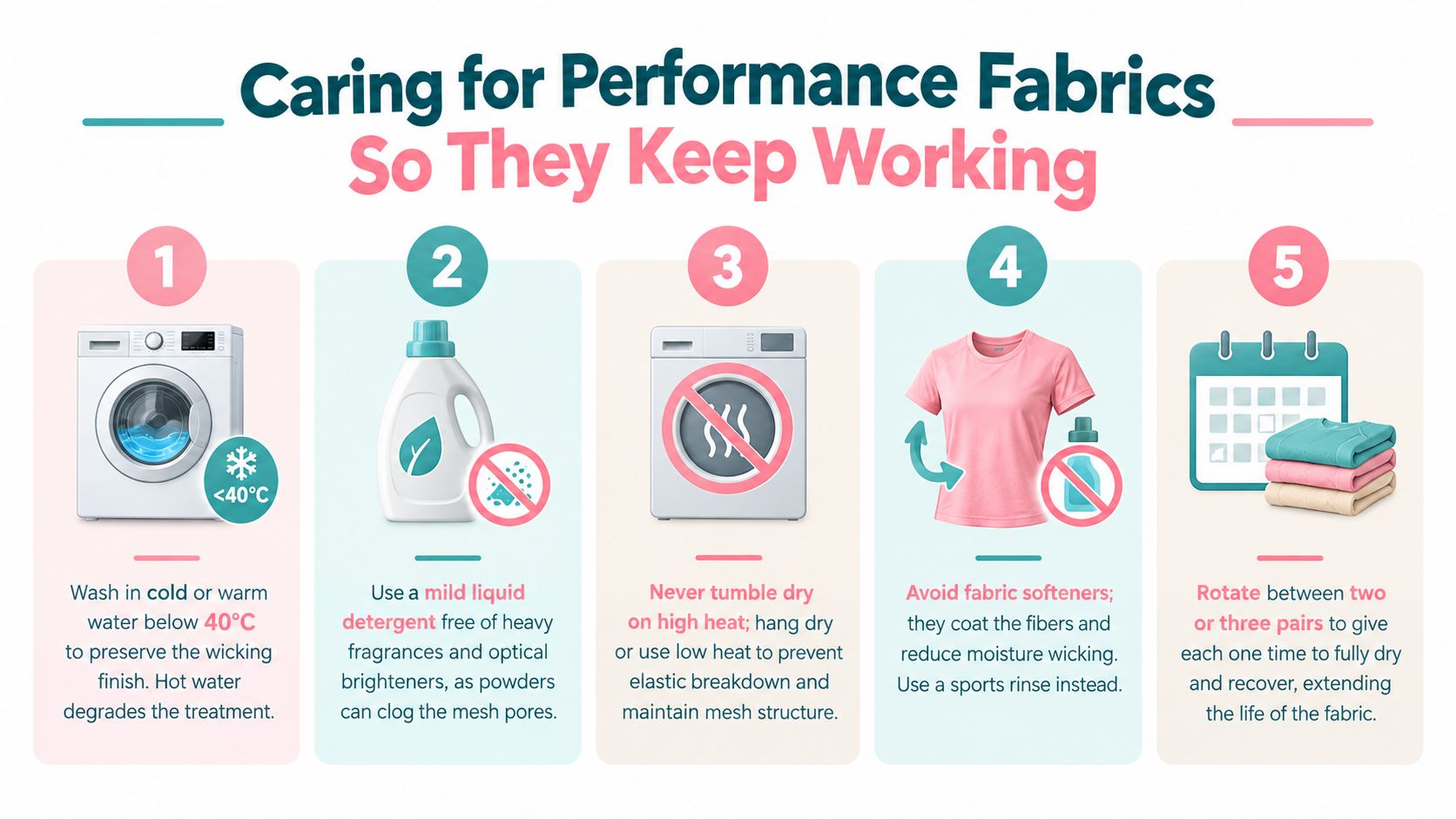
- Use cold or warm water under 40°C. High heat is harder on stretch fibers and any finish sitting on the fabric surface.
- Choose a mild liquid detergent. Heavy softeners and residue-prone products can coat the knit.
- Skip fabric softener. It can flatten the capillary action that helps moisture spread and evaporate.
- Dry gently. Lay flat or use low tumble heat if the care label allows it.
- Rotate your pairs. Elastic and knit recovery are better when a garment gets time off between wears.
What wear looks like before failure
Performance underwear rarely fails all at once. It fades in small ways. The mesh pills. The seams curl. The waistband still looks okay, but the gusset starts feeling damp longer than it used to.
Watch for these signs:
- Longer dry-back time after a normal day
- Flattened mesh texture that no longer feels springy
- Persistent cling where the fabric used to release moisture better
- Loss of recovery in areas that should sit close without sagging
Heat and softener are a bad combo for moisture management. One stresses the stretch. The other coats the pathways that move sweat.
If you've ever wondered why a once-great pair suddenly feels swampier even though it isn't visibly worn out, laundry is often the hidden reason.
Common Myths About Breathable Underwear
Underwear marketing has trained people to trust fiber names more than fabric behavior. That creates some persistent myths.
Myth that sounds right, but misses the point
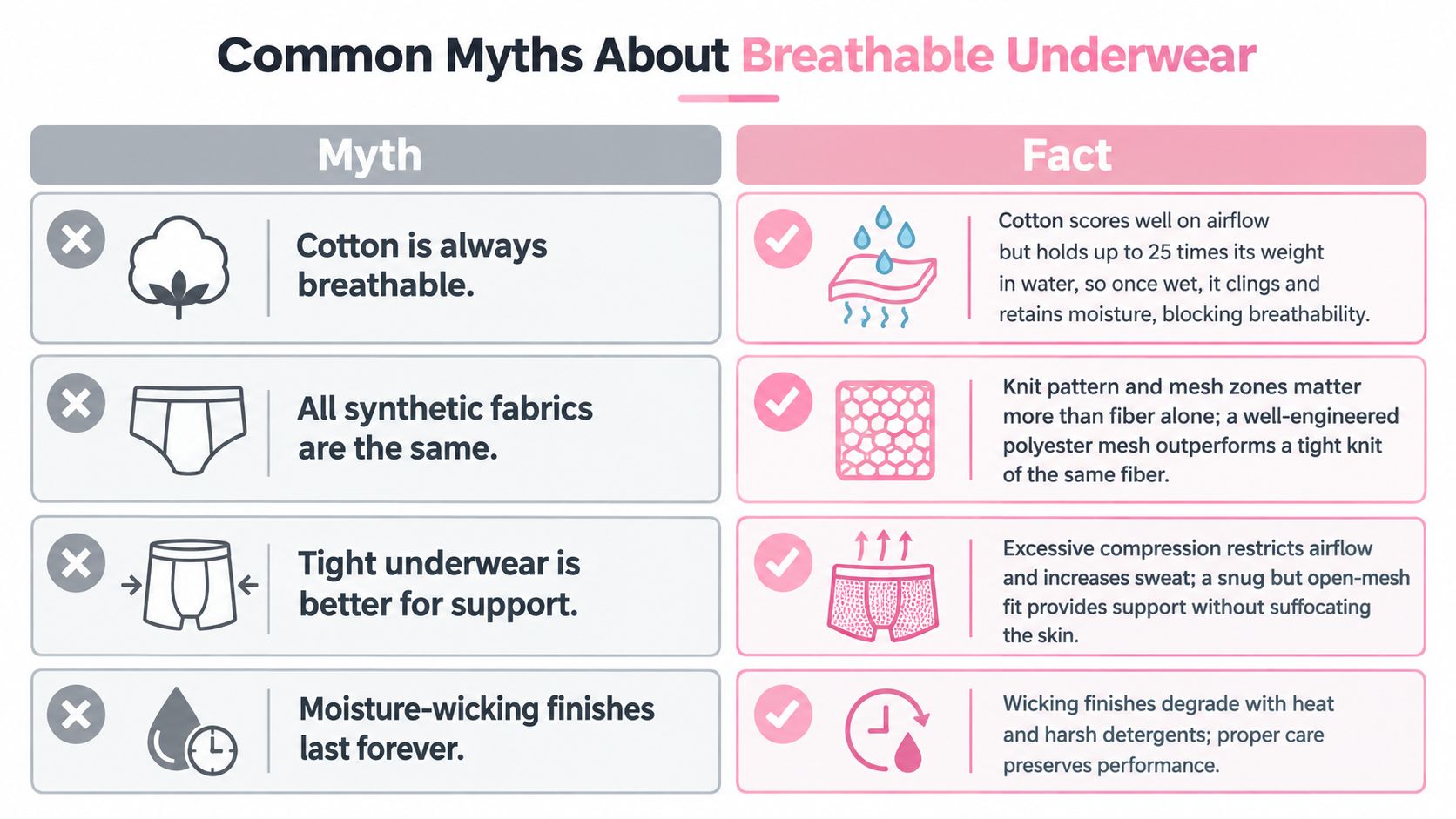
Myth one: cotton is always breathable.
Cotton can feel airy at first, but real comfort changes once moisture enters the picture. Recent research and clinical discussion have pushed attention toward what happens when underwear stays wet, especially in the crotch area, where moisture retention is linked to discomfort, friction, and microbial colonization. A 2026 study on antimicrobial underwear also frames the vulvovaginal microenvironment as a meaningful performance metric, discussed in this clinical and fabric overview.
Myth two: all synthetics behave the same.
They don't. A slick dense knit and an open engineered mesh can feel like completely different products, even if both are built from similar base fibers.
Where fit and finish get misunderstood
Myth three: tighter automatically means sweatier.
A close fit can help moisture move if the structure is built for transport. The problem isn't contact by itself. The problem is contact plus a closed, heat-trapping knit.
Myth four: any moisture-wicking tag means performance.
Not necessarily. If the garment gives you no clue about structure, ventilation zones, or how the gusset is built, the claim is incomplete. Good performance is usually visible in the construction.
Myth five: bamboo wording automatically means cooling.
Many shoppers use “bamboo” as shorthand for a cool, technical fabric. In practice, feel, drying, and breathability still depend on how the yarn was made and how the fabric was knitted.
The useful question isn't “What buzzword is on the label?” It's “What happens after this pair gets warm and slightly damp?”
A Simple Checklist for Choosing Your Next Pair
A good shopping checklist should work in a fitting room, on a product page, or while packing for a trip. You don't need a lab. You need a better filter.
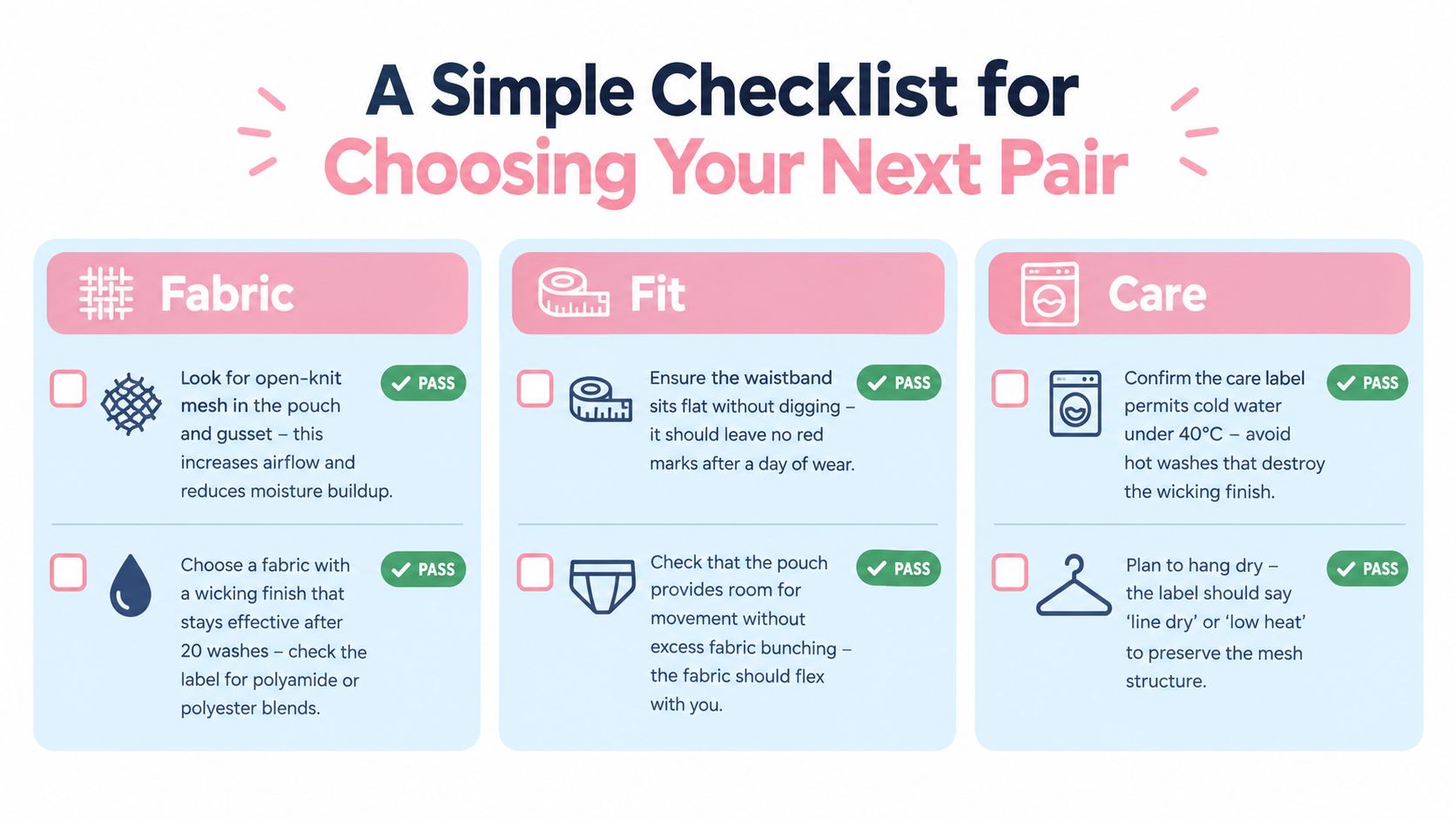
Fabric, fit, and care
Use this quick pass:
- Fabric check: Look for a moisture-transport fabric category you already know suits your day, then check whether the knit is open enough to vent heat in high-contact zones.
- Construction check: Prioritize mesh where heat builds, a gusset that looks intentional rather than like an afterthought, and seams that won't create ridges under pressure.
- Fit check: The waistband should stay put without digging, and the body should sit close enough to move moisture without compressing the skin.
- Care check: If the pair needs fussy treatment you know you won't follow, it probably won't stay high-performing for long.
A shopper who wants extra examples can skim Nuage Wears' guide to breathable underwear features and compare those details against her own routine.
The fastest decision test
Ask three questions before you buy:
- Where will I feel this pair most? Commute, office, walk, workout, travel.
- Is the structure helping? Mesh, porosity, seam bulk, gusset layout.
- Will I care for it properly? Low heat, no softener, sensible rotation.
The best pair is usually the one you stop noticing in the exact part of the day when underwear usually becomes a problem.
Nuage Wears builds comfort-first underwear around the problems people complain about, including overheating, digging, visible lines, and stay-put fit. If you want to see how modal softness, mesh zoning, and scenario-based design come together in real products, visit Nuage Wears.