
You've put on the fitted trousers, checked the front, and turned sideways in the mirror. From the front, everything looks polished. Then the back view catches you off guard: a waistband ridge, a leg opening pressed into the fabric, or a line that appears only when you move. The frustrating part is that the underwear may feel perfectly comfortable.
Learning how to avoid panty lines starts with changing the question. You don't need to default to a thong or squeeze into a smaller size. You need to match the underwear's edge, fabric, rise, and cut to the garment you're wearing, then check that the pair stays flat while you walk, sit, and bend.
Table of Contents
- Why Panty Lines Show and What Actually Causes Them
- How Laser-Cut and Bonded Edges Make Lines Disappear
- Choosing the Right Cut and Fabric for Every Outfit
- Getting the Perfect Fit Without Digging or Riding Up
- Quick Fixes and Everyday Habits That Keep Lines Invisible
- Your Confident No-Show Wardrobe Starts Now
Why Panty Lines Show and What Actually Causes Them
You're getting dressed for work in slim trousers. The underwear feels soft, but the folded leg elastic leaves a narrow ridge that becomes obvious under the fabric. Later, you change into a jersey dress and see a different outline, this time caused by the thicker side seam and waistband. In both cases, the problem is less about how much the underwear covers and more about what the garment's edges are doing against the outer layer.
Visible panty lines, or VPL, describe the outline of underwear showing through outer clothing. The phenomenon was already recognized as a distinct clothing issue by the early 2000s, and reference material identifies clingy, thin, or transparent fabrics as the conditions where it appears most often, as explained in this overview of panty lines and their definition.
The construction problem
Traditional folded edges create thickness exactly where fitted fabric presses against the body. A stitched seam can form a ridge, elastic can create a contrasting band, and a curled opening can cast a visible shadow. Lightweight jersey, leggings, silk, satin, and close-fitting trousers reveal those changes because they follow the body instead of holding a structured shape.
That's why coverage alone doesn't solve VPL. A full brief with a bulky edge can show more clearly than a smaller garment with a flat finish. The useful mental model is simple:
- Seams create ridges.
- Elastic creates pressure points.
- Thick or curled edges create shadows.
- Clingy outer fabrics expose all three.
Thongs became a broader practical answer in the United States during the early 1990s because they removed fabric from the area where lines commonly appeared. Over roughly three decades, the wardrobe conversation has expanded from hiding the back edge to engineering underwear that disappears through knitting, raw-cut finishes, and bonded construction. The shift matters because you can now solve the same outfit problem with different levels of coverage and comfort.
The practical rule: Start with the edge that touches the outer garment, not the amount of fabric in the underwear.
How Laser-Cut and Bonded Edges Make Lines Disappear
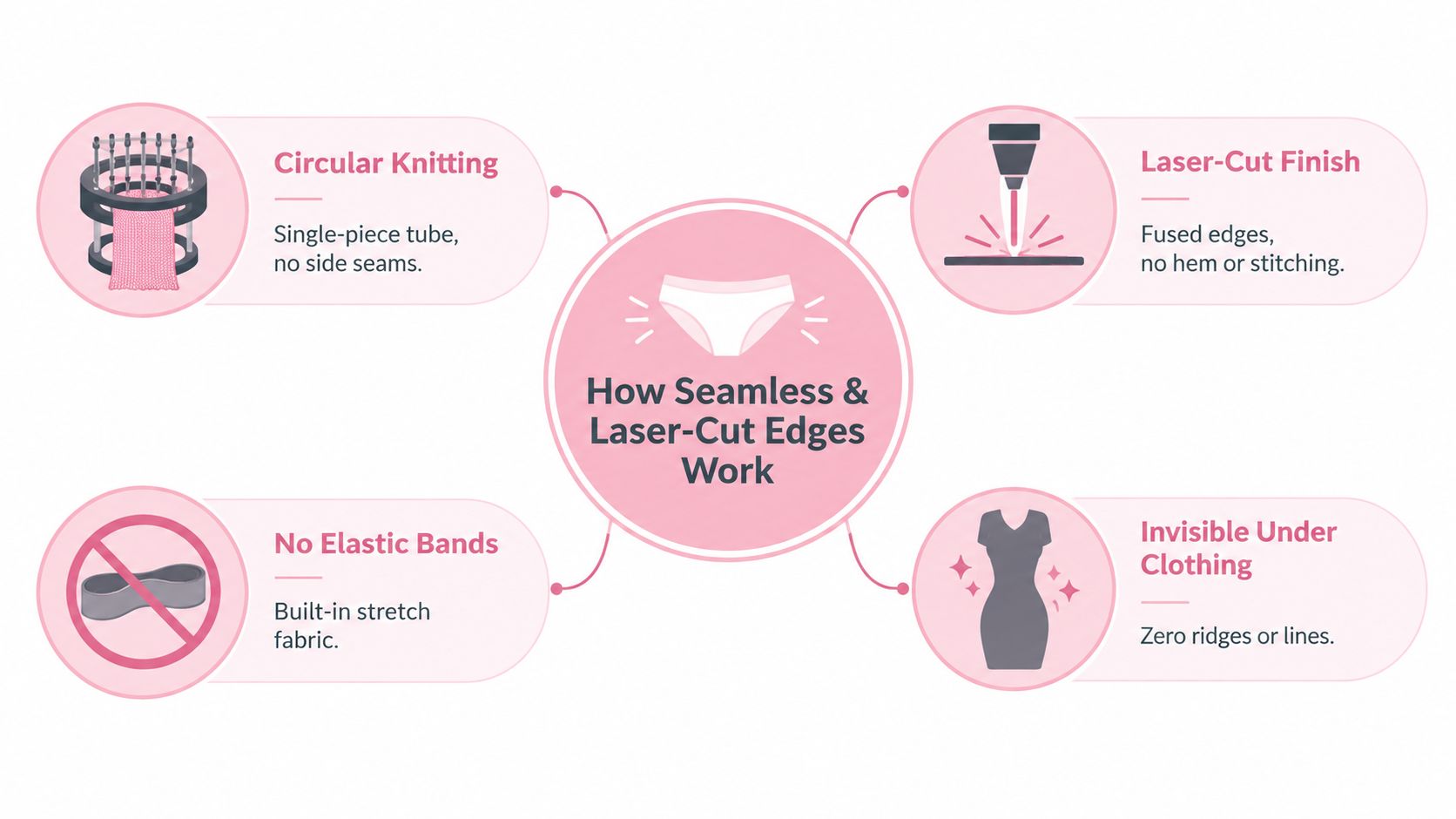
A no-show finish works by reducing raised texture where underwear meets the outer garment. Underwear may be knitted as one continuous piece through circular knitting, avoiding stitched side seams. That construction removes one common source of texture beneath fitted clothing, as described in this technical reference on bonded garment construction.
Know what you're looking for
A smooth main body does not guarantee smooth openings. Inspect the waistband and leg edges separately.
- Look for circular-knit construction. A continuous body removes a side seam that could print through close-fitting clothing.
- Inspect the leg openings. Raw-cut, laser-cut, and heat-bonded finishes generally sit flatter than folded hems with visible topstitching.
- Run your fingers over the bands. The edge should feel smooth and low profile, without a thick ridge, hard adhesive line, or curled section.
- Check waistband tension. Even a flat edge can leave a mark if it stretches tightly across the body.
- Assess the edge against the garment. A finish that stays hidden beneath structured trousers may still show through a delicate, tightly stretched fabric.
Laser-cut and bonded construction limits the material folded back onto itself. Instead of adding a raised hem layer, the edge is cut or fused closer to the skin. The result depends on more than the production method. The opening must lie flat, and the garment must suit the underwear's rise and stretch.
Protect the finish
Bonded edges require more careful laundering than sturdy stitched seams. High wash or dryer heat can weaken the bonded areas, causing curling or making the edge less stable over time. Follow the care label, choose cooler settings where permitted, and avoid treating a no-show finish as indestructible.
Use a simple shopping check: hold the underwear against a light source and turn the edge sideways. If the band looks thick before wear, it is more likely to show beneath delicate or tightly stretched fabric. Flatness is the feature you're buying.
Choosing the Right Cut and Fabric for Every Outfit
A thong may disappear under fitted trousers, yet feel restrictive during a long commute. Choose underwear by the garment's surface, rise, stretch, and the way you will move in it. Workwear, leggings, dresses, workouts, and travel each create different demands, so invisibility should be balanced with coverage, breathability, and freedom from digging or wedgies.
The fabric inside matters as much as the edge. A peer-reviewed textile study on knitted underwear found that texture and stretch affect absorption, spreading speed, and one-way transport capacity, and that these properties can worsen as stretch increases within the same texture group, according to this textile study on seamless knitted underwear performance. For VPL, choose a smooth, moderately stretchy knit that stays close to the body rather than becoming overstretched and ridged.
Match the solution to the outfit
| Outfit Scenario | Most Invisible Cut | Fabric Edge to Look For | When to Skip the Thong |
|---|---|---|---|
| Office trousers | No-show brief or hipster | Laser-cut or bonded leg openings | Skip it when you'll sit for long periods or prefer fuller coverage |
| Leggings | Raw-cut brief, thong, or smooth short | Thin, flat edge with controlled stretch | Skip it when a brief sits flat and doesn't bunch under the waistband |
| Bodycon dress | Thong, no-show brief, or shaping panty | Smooth finish with no folded elastic | Skip it when the dress is textured, printed, or paired with a slip |
| Silk or satin dress | Low-profile thong or no-show brief | Soft, smooth edge with minimal contrast | Skip it when the fabric is unforgiving and a slip provides better overall smoothing |
| Workout clothing | Stay-put no-show brief or thong | Breathable, moderate-stretch knit | Skip it when movement causes wedgies or heat |
| Travel outfit | Mid-rise or high-rise no-show brief | Flat waistband matched to the outer rise | Skip it when a narrow back leaves you adjusting throughout the day |
Structured trousers, printed fabrics, textured skirts, slips, tights, and shaping layers can soften or conceal outlines without requiring a thong. For fitted trousers and skirts, fuller briefs or shaping panties often provide better coverage and comfort, a point also reflected in this wardrobe guidance on non-thong ways to hide panty lines.
For a closer office-versus-casual comparison, use this guide to choosing no-show underwear by wardrobe setting.
Don't overstretch the fabric
A pair that is too small can show through even when its edges have no visible seams. Excess tension pulls the knit tightly across the hips, turning a smooth surface into a ridge. Moderate stretch works better, provided the underwear reaches the body without strain at the leg openings or waistband.
If you avoid thongs, start with a raw-cut brief, hipster, or smoothing short beneath fabrics with some structure. For leggings, look for a flat leg opening and a stable gusset that stays in place during movement. For silk, assess the whole silhouette, including a slip or smooth lining, because changing the underwear alone may not remove every outline.
Getting the Perfect Fit Without Digging or Riding Up
A brief can look invisible in the mirror and still become uncomfortable halfway through a meeting. Comfort and invisibility need to work together. LYCRA's 2026 consumer research reports that 64% of respondents rated comfortable fit as important, while a 2025 underwear poll found that people wanted support without binding, plus underwear that would not ride up or create VPL, as reported in this consumer research on comfort and underwear fit.
Fit controls how the edges behave. Test the underwear with the outfit and through ordinary movement before deciding whether the style works. A pair that digs into your waist, creates a wedgie, or restricts breathing has failed, even if it disappears under fabric.
Use the outer garment as your measuring guide
Match the underwear rise to the garment rise. High-rise trousers usually need a higher waistband so both layers move together. Low-rise trousers can expose a high waistband or make it fold. That mismatch leads to rolling, bunching, and horizontal lines.
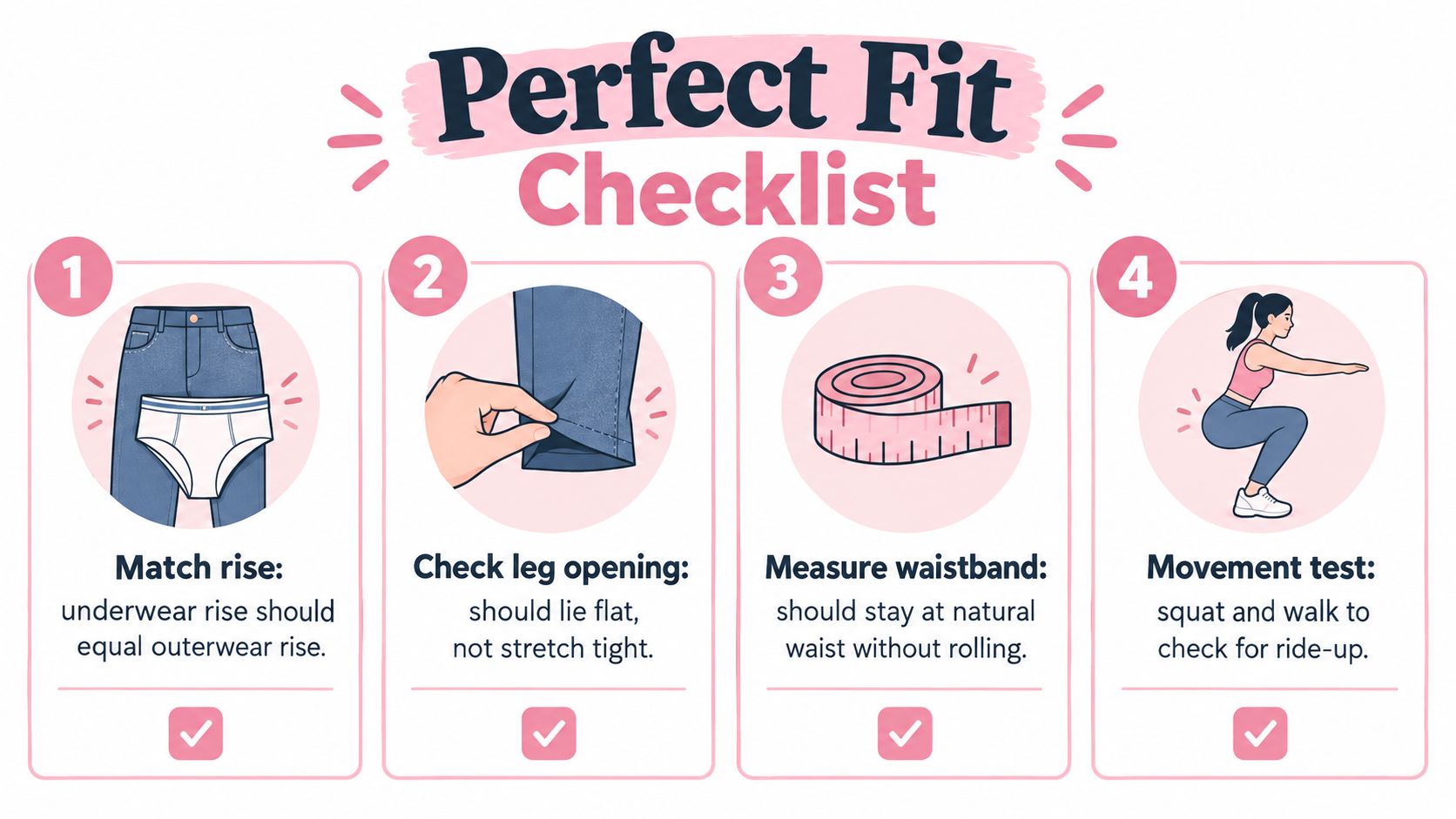
Use this fit check:
- Stand naturally. The waistband should rest where it was designed to sit, without cutting into the skin or collapsing inward.
- Check each leg opening. It should touch the body evenly. Curling, pinching, or diagonal pulling points to the wrong cut or size.
- Sit and bend. Look for a waistband that rolls or a gusset that shifts forward.
- Walk and squat. Movement exposes ride-up that a still mirror misses.
- Put on the target outfit. Check the back and side in natural light, then move again.
Sizing up can reduce digging and excess tension, but too much room lets the underwear shift and bunch. Sizing down can hold an edge more firmly, yet may leave pressure marks and make the knit show through. Choose the size that maintains contact without compression.
For online measurements, follow this no-show underwear sizing guide. Bonded bands, such as those used on the NuFit Perfect Fit Mid Rise Brief, depend on correct tension to stay flat. Raw-cut edges, such as those used on the NuShield Anti Camel Thong, remove a traditional hem but still require the right rise and size to prevent shifting.
A pair passes the fit test only when it stays flat during movement and feels neutral while you're wearing it.
Quick Fixes and Everyday Habits That Keep Lines Invisible
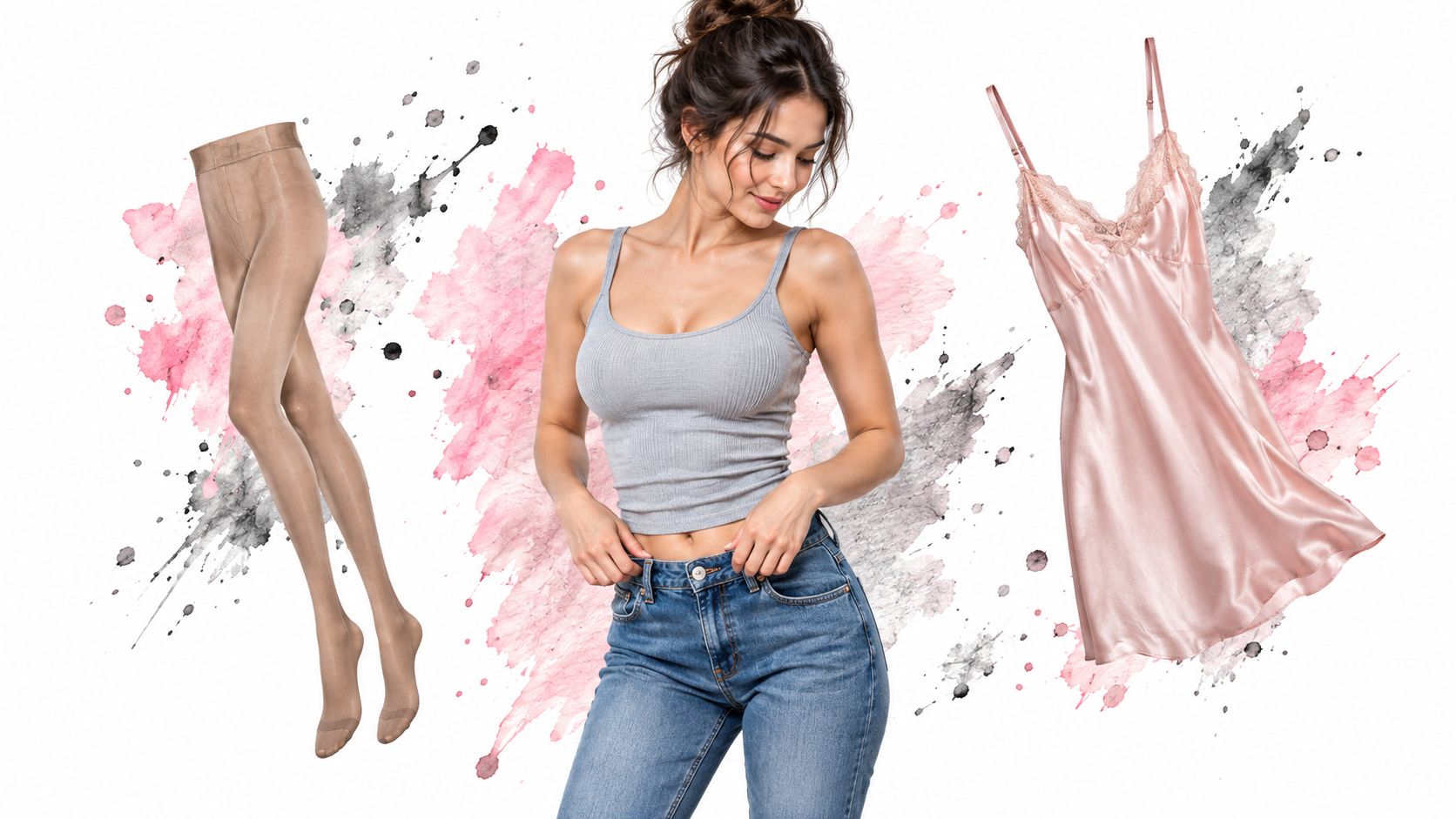
Sometimes you're already dressed and don't have time to rethink the underwear. Start by changing the outer layer. A slip can smooth the contact between underwear and dress, tights can create a continuous surface under a skirt, and a textured or printed fabric can break up a small outline that would stand out on a plain satin panel.
Fix the outfit in the moment
- For a thin skirt: Add a smooth slip or tights rather than repeatedly adjusting a thong.
- For light trousers: Choose underwear close to your skin tone, then check the side seam and waistband in daylight.
- For a printed dress: A brief may provide more comfort while the print disguises minor edge contrast.
- For desk-to-dinner wear: Sit, stand, and walk before leaving. A pair that shifts during commuting won't improve later.
- For gym-to-errands outfits: Check the leg opening after squats and steps, not only while standing still.
A quick mirror check takes only a moment, but lighting changes the result. Use natural light when possible, turn sideways, bend slightly, and look for both the lower edge and the waistband. The back of a skirt can look smooth in a dim bedroom and reveal every ridge in outdoor light.
Care preserves the construction you chose. Wash cool when the care instructions allow it, avoid high dryer heat around bonded finishes, and replace pairs when the edges curl or lose their flat shape. A worn edge can show even when the original design was low profile.
Your Confident No-Show Wardrobe Starts Now
A reliable no-show wardrobe follows a sequence, not a single rule. Check the edge first, then the fabric and stretch, then the rise and fit, and finally the way the pair interacts with the specific outfit. That order prevents the common mistake of blaming your body or buying a thong for a problem caused by a folded waistband.
Build your options around situations:
- Workwear: Keep a brief or hipster with a flat waistband for trousers and structured skirts.
- Leggings and fitted casualwear: Use a raw-cut brief, smooth short, or thong according to comfort and movement.
- Dresses: Pair the underwear with the fabric. Silk may need a slip, while a printed or textured dress may work with fuller coverage.
- Travel: Choose a stable mid-rise or high-rise cut that won't roll while sitting.
- Active days: Prioritize breathability and stay-put support before chasing the thinnest possible edge.
Your final test should happen under the outfit that gives you the most trouble. Walk, sit, bend, and check the silhouette in natural light. If the pair disappears but digs, it isn't the answer. If it feels excellent but creates a ridge, change the edge or outer layer rather than forcing the fit.
The goal is a small rotation of pairs that solve distinct problems: no VPL, no wedgies, no digging, and enough airflow for the day ahead. Once you match those needs to the right cut and fabric, getting dressed becomes much less about mirror surveillance and much more about wearing the clothes you chose.
Nuage Wears offers comfort-first underwear organized around needs such as no VPL, no wedgies, no digging, breathability, and no rolling, including laser-cut styles, bonded bands, breathable mesh options, and multiple rises. Visit Nuage Wears to explore no-show options for workwear, travel, movement, and everyday outfits.