
You pull on a white T-shirt, check the mirror, and there it is: the outline of your bra, clearer than the neckline you wanted to show. A thicker cup might hide texture but feel warmer. A lighter bra might disappear at the edges but leave you wanting more lift.
Choose your compromise before you choose your bra. For desk days, prioritize a smooth finish. For sweaty commutes, put airflow first. For a fuller bust or an active afternoon, keep the support you need, then find the least visible construction that delivers it. That's how you buy a no show bra you'll wear, rather than another almost-right basic.
Table of Contents
- What Makes a Bra Truly No-Show
- Construction Features That Make a Bra Disappear
- Fabrics That Stay Smooth and Breathable
- How to Choose Your Fit, Band and Straps
- Outfit Pairings and Trade-Offs for Your Week
- Choose Your First No-Show Bra This Week
What Makes a Bra Truly No-Show
A visible line under a fitted knit isn't always a seam problem. You might be seeing a cup rim, a raised back clasp, a strap shadow, or a color that contrasts with your skin. Buying something labeled smooth won't automatically solve all of those.
A no-show bra preserves coverage, shaping, and support while minimizing the seams, ridges, and transitions that show beneath thin or close-fitting clothes. Think of no-show as a result under your outfit, not a single cup style. Both wireless and underwired designs can qualify when their construction and fit suit you.
Everyday usefulness matters. In a 2023 YouGov survey of 2,000 U.S. adults, 61% of American women said they wore a bra every day, while 44% regularly wore wireless bras. The practical brief is clear: smoothness needs to work alongside comfort, not replace it.
Choose by the problem you're solving
For office shirts, look for discreet cup edges and a back that doesn't interrupt the fabric. For fitted dresses, check the entire outline, including the sides. Active days need movement control, while fuller busts need containment that doesn't rely on flattening.
If you're buying several basics for value, test a single style before committing to a multipack. A good price won't rescue a cup shape that shows through every work top.
No-show bras compared with standard and strapless bras
| Feature | No-Show Bra | Standard Lined Bra | Strapless Bra |
|---|---|---|---|
| Cup shape | Thin, smooth, low-profile molded or lightly lined | Padded or structured, with contours that can show | Molded or boned, with no straps to hold it |
| Edge finish | Laser-cut or bonded, lies flat under fabric | Lace or elastic trim that can show through | Silicone or elastic grip band along the top edge |
| Straps | Thin, adjustable, often convertible or hidden | Standard straps, often visible at necklines | None, or removable straps used for extra lift |
| Support source | Smooth construction with a firm, even band | Underwire or structured cups | Band grip and molded cups without straps |
These are useful shopping profiles, not rigid categories. A strapless bra can also be no-show, and a standard lined bra may work beautifully beneath a heavier shirt. Keep the table's distinctions in mind when inspecting the actual construction.
Construction Features That Make a Bra Disappear
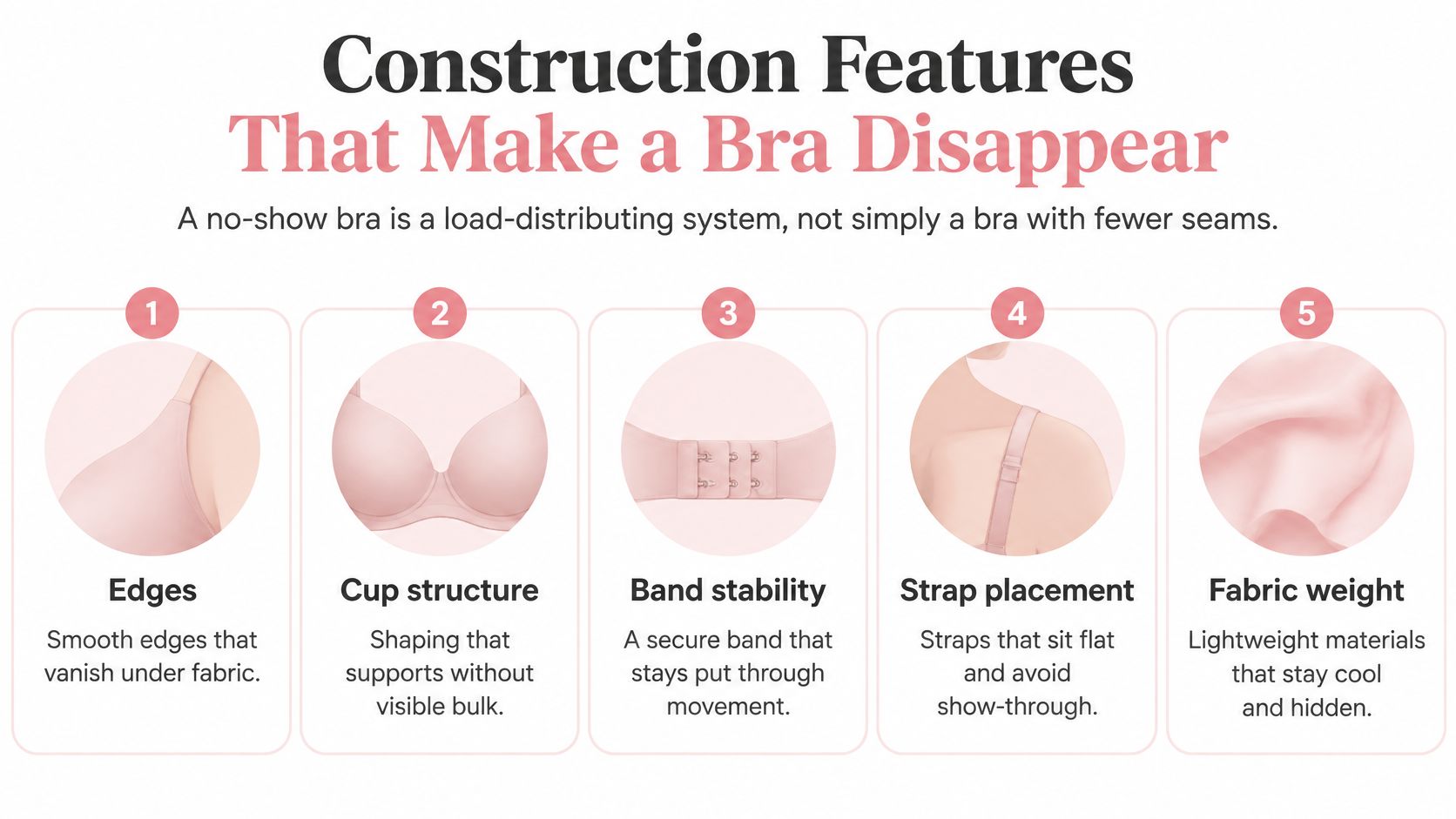
A no-show bra is a load-distributing system, not a bra with fewer seams. Its cups, band, and straps need to work together without leaving pronounced transitions beneath your clothes.
That balance has a mechanical explanation. Finite-element modeling of the body–bra interface found that increasing cup or strap stiffness raised contact pressure, while greater tensile strength improved shaping. In practical terms, firmer isn't automatically better: you want stability where it's useful and flexibility where an edge meets your skin.
Use this construction checklist when comparing styles.
Inspect the places that create an outline
- Edges: Choose laser-cut or bonded finishes that sit flush rather than curling outward. Run a fingertip across the cup edge and side panel. A noticeable ridge deserves an outfit test, especially under a fine knit.
- Cups: Favor a thin, flexible cup with a smooth face. A molded shape can give a clean silhouette, but its rim must follow your breast rather than stand away from it. More padding isn't the answer to a mismatched cup.
- Closure: Feel the back fastening through your top. A flat hook-and-eye closure offers adjustment without a pronounced bump; a hookless back removes the clasp but needs enough stretch to go on comfortably without becoming loose.
- Band: Look for an even band with enough width to remain flat when you sit and reach. Reject a band that folds into a cord or needs constant repositioning.
- Straps: Choose adjustable or convertible straps that follow the outfit's shoulder line. Thin straps help with concealment, but they shouldn't carry so much tension that they cut into your shoulders.
Lightweight fabric supports this low-profile approach, but don't judge it by touch alone. A beautifully soft cup can still have a thick perimeter or an inflexible bonding strip.
Practical rule: Buy the bra that stays discreet while you move, not the one that looks smooth only while you stand perfectly still.
Run a fitting-room movement check
Start by gently pulling the band away from your body and releasing it. It should return evenly rather than twist. Next, lift your arms and reach forward, watching for cup movement and rolled edges.
Finally, inspect your front and side in window light with your actual top on. Check the back with a second mirror rather than guessing from the front.
For bridal dressing, separate decorative lingerie from what a particular gown needs underneath. Get Spliced's guide to elegant lingerie for your bridal look offers occasion-specific context, but let the gown's neckline and fabric decide whether a decorative construction belongs beneath it.
Fabrics That Stay Smooth and Breathable
By mid-afternoon on a warm day, your fabric choice announces itself. A silky surface feels lovely in the fitting room, but the knit structure, lining, and density decide whether the bra still feels cool after your commute, your meetings, and a crowded train home.
A 2024 study of 24 multilayer knitted structures found that fiber type, stitch density, thickness, and porosity significantly influenced moisture transport. Higher stitch density could impede moisture movement, while greater top-layer porosity generally improved it. The fiber name on the label is no guarantee of breathability.
Match the material to your day
No single knit delivers maximum smoothness, support, and cooling at once, so choose the property your day demands. Modal is the strongest pick for a soft, body-following feel under knits and tees. A nylon and elastane blend suits you when you want stretch with a band that returns to shape. For warm conditions, look at spacer mesh and open-knit zones, but hold the cup up to the light before assuming airy means appropriate under a pale shirt.
Fabric trade-offs for a no-show bra
| Fabric | Strength | Trade-off |
|---|---|---|
| Modal | Smooth drape that lies close to the body | Needs gentle washing |
| Nylon and elastane blend | Stretch and recovery that keep the band in place | Check recovery after several washes |
| Polyester spacer mesh | Airflow and a cool-to-the-touch feel | Less opaque under light fabric |
| Bamboo or microfiber blend | Light moisture handling | Check opacity and shape after washing |
Favor thin, low-bulk cup and back panels, and place mesh where you perspire most. Skip unnecessary density beneath the bust. A cool first touch is a fitting-room impression only; lasting cooling shows up hours into the wear.
Check more than softness
- Read the composition: Identify the main fiber and the stretch component, then inspect the lining too. A cool outer knit over a dense lining still traps heat.
- Check opacity: Hold the material toward a window, then confirm it beneath the top you plan to wear, since mesh zones can turn visible under light cloth.
- Test recovery after washing: After several cycles, stretch the band gently and release it. Look for a prompt, even return without rippling, and check that the cup edge still lies flat.
If you buy one fabric first, make it a nylon-elastane blend with spacer or mesh zones. You get support, shape recovery, and enough airflow to cover most of your week.
How to Choose Your Fit, Band and Straps
Match the straps to your neckline before adjusting the fit. Otherwise, you can spend ages perfecting a bra that your outfit will never conceal.
Strap options by neckline and situation
| Neckline or Situation | Strap Option | Why It Works |
|---|---|---|
| Deep V or scoop neck | Thin convertible or adjustable straps | Keeps straps inward, away from the neckline edge |
| Racerback or halter top | Racerback-compatible or strapless style | Avoids a strap crossing the visible back |
| Fuller bust needing lift | Wide adjustable straps | Spreads weight across the shoulders |
| Off-shoulder or strapless dress | Strapless grip style or none | Holds without straps; test for slip before wearing |
| Sheer or silk top | Fine, low-profile straps | Reduces strap shadow under light fabric |
For a halter, make sure the bra's conversion follows the top's cut. For an off-shoulder dress, going without a bra is an option only if you're comfortable with the dress's own coverage and support.
Diagnose fit before changing style
A tight band can create side bulges; a loose one can ride upward and expose the back or straps. But don't automatically increase the band size when you see a ridge. A cup that's too small can also make the whole bra feel restrictive.
Self-assessment isn't always straightforward. A bra-fit study involving 24 participants identified at least one objective fit issue in every participant, while participants' descriptions matched professional assessments only 51% of the time. Use observable checks rather than relying on your usual size.
Our guide to how to know if your bra fits correctly can help you distinguish a cup issue from a band issue.
Run the home fit check in order
- Set the fastening. Start on the middle hook for this comparison, so you can assess adjustment in either direction. If a new bra needs its tightest setting immediately, compare another band size rather than assuming it'll stay stable.
- Check the band's position. Face sideways in a mirror and confirm it sits level around your torso. Raise your arms. The back shouldn't climb, and the front shouldn't lift away.
- Assess the cups separately. Settle your breast tissue inside each cup. Look for a flat upper edge without overflow, gaping, or side creases. If only the cups fail, try a different cup size or shape instead of changing everything.
- Move normally. Bend forward, reach overhead, and turn as though you're grabbing something from a shelf. Straps should remain in place without being tightened aggressively.
- Inspect through clothing. Put on your intended outfit and check front, side, and back in bright window light. Distinguish a fabric shadow from actual cutting-in before deciding what to change.
For fuller busts, use wide adjustable straps when the neckline permits. Keep enough cup depth for separation and coverage rather than accepting a flattened profile as the price of smoothness.
A smooth fit follows your shape. It shouldn't require you to squeeze into a smaller one.
If you're between sizes, try both under the same outfit. Keep the one that passes the movement and cup checks, not the one with the more familiar label.
Outfit Pairings and Trade-Offs for Your Week
A bra that vanishes under a white tee can feel stifling on a packed train, and the airiest option usually gives the least shape. Smooth, supportive, and cool pull against each other, so pick the compromise first, then the style. More structure adds stability and makes a bra less forgiving. Less material feels lighter and gives you less control in return.
Match the construction to your actual week.
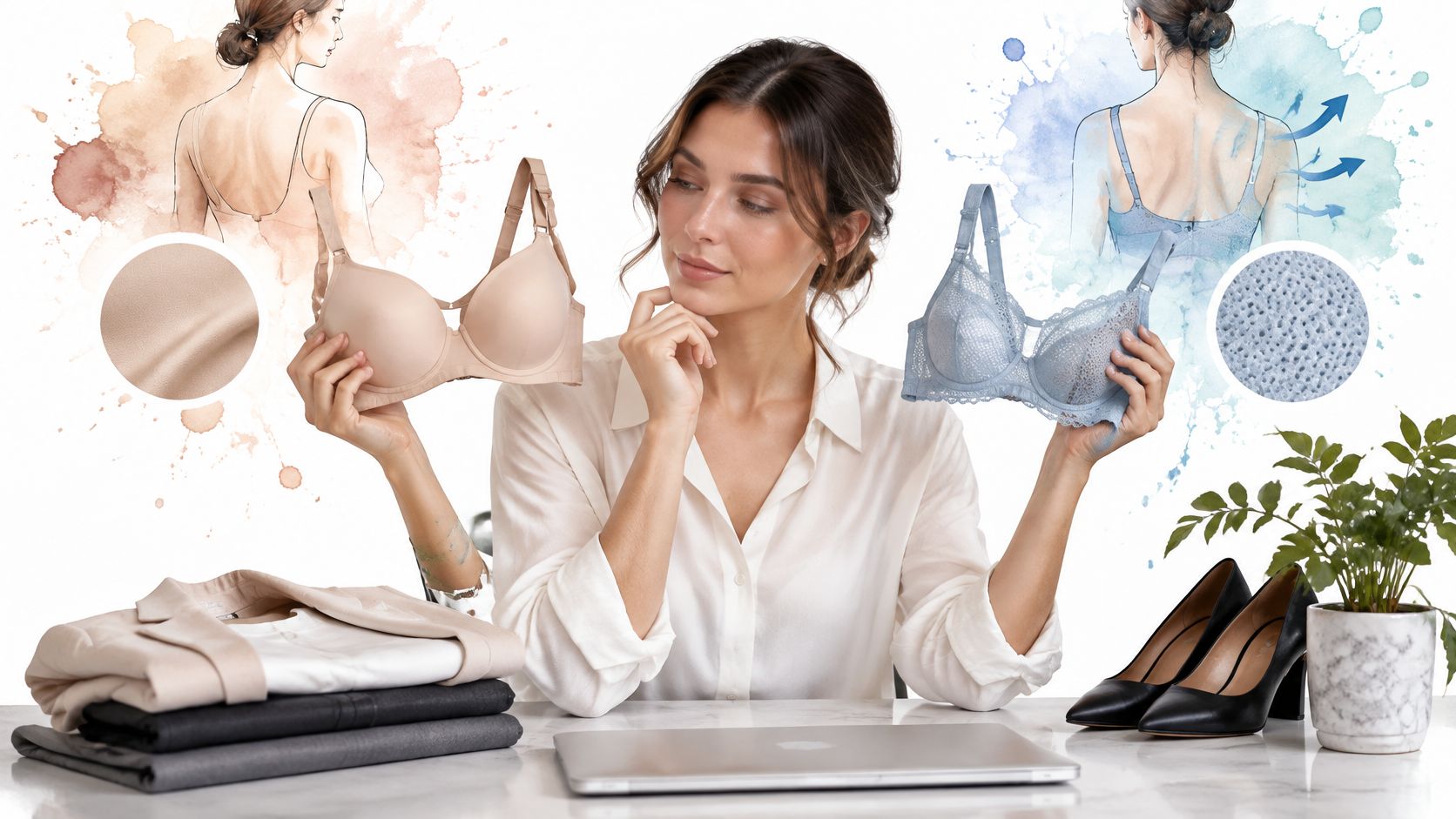
Let the day decide your priority
For desk work, choose smooth, lightly lined cups. Sit at a desk during the try-on and check whether the underband stays comfortable against your seated torso.
For a hot commute, reach for an unlined or mesh-zoned style if its coverage works with your clothes. A 2025 study of perceived stickiness found skin wettedness was the strongest predictor of discomfort during rest, walking, and running, with the effect climbing sharply as skin got wetter. If you expect to sweat, give breathability more weight than maximum smoothing.
For exercise, pick activity-appropriate support with a firm bonded band and breathable panels. Walk, jog, or run through your usual movement in the fitting room. An everyday bra covers only part of a sports bra's job.
For long-haul travel, favor a wireless style that stays put while you sit, lean, and reach. Our guide to choosing a wireless bra compares those options in detail.
No-show bra pairings by outfit
| Outfit | Bra Style to Pair | Feature to Look For |
|---|---|---|
| White T-shirt | Flat-edged molded or lightly lined cup | Smooth cup surface and flat edges |
| Satin or silk blouse | Low-profile, thin-lined bra | No cup texture to show through light fabric |
| Fitted dress or skirt | Bra with smoothing front-panel bottom | Front panel that flattens the outline |
| Leggings or workout top | Breathable mesh-zoned bra with firm band | Airflow and a band that stays in place |
| Plunge or low-cut top | Spacer or plunge-cut bra | Flat neckline edge and no padding bulk |
| Travel-day outfit | Wireless bra with bonded band | Easy care and stable placement for long hours |
Where fabric shows the most
White T-shirt: Pick a shade close to your skin, undertone included, rather than defaulting to white or generic beige. Test in daylight, because a color that disappears in a dim room can contrast hard outside. Cedar & Lily Clothier's advice on matching shades in all-white outfits helps coordinate the outer layers, while your bra shade should minimize contrast against you.
Satin or silk: Surface smoothness comes first. Try the blouse with your arms forward as well as relaxed, since draped fabric catches on a cup rim or fastening. If a molded edge prints through, switch to a more flexible thin-lined alternative.
Fitted dress or skirt: A longline bra with a smoothing lower front panel softens the transition beneath the bust. Check that the longer band stays flat when you sit, and leave the pelvic outline to a smoothing brief built for skirts and dresses. Judge every option while moving.
Give movement and comfort their share
Leggings or workout top: Match the bra to the top and the activity. Mesh zoning helps, and lift and containment still need to suit your movement. Keep an underwired option if it fits better and supports the way you prefer.
Plunge or low-cut top: Match the bra's center and cup edge to the opening. A spacer or plunge-cut style works only if its neckline stays hidden when you bend forward.
Travel-day outfit: Test the wireless bra under your loosest layer and with your bag on your shoulder. A slightly visible breast shape under a relaxed top is a fair price for dependable support, especially on fuller busts.
Rank smooth, supportive, and cool in your own order before shopping. Never let an invisible edge outrank a comfortable day.
Write your order down. When two bras tie on fit, that ranking picks the winner.
Choose Your First No-Show Bra This Week
A discounted multipack feels efficient until one workday shows four of the five bras pulling, rubbing, or printing through a shirt. Buying a single bra for a single outfit costs less than guessing at five.
Follow a practical buying sequence
- Choose the outfit. Pick the garment you wear most often, find its closest match in the pairings above, and bring it to the fitting room or keep it ready for a home try-on.
- Match the fabric to your routine. Choose for your climate and activity, not just the softest swatch. Decide how much coverage you are willing to trade for airflow.
- Rank smooth, supportive and cool. Put your priorities in writing before you compare options, then use that order to break ties between two bras that both fit.
- Keep a wear log. If the return conditions allow, wear the bra through a normal day. Note the exact spot where an edge, strap, or band moves rather than writing it off as generally uncomfortable.
- Check after washing. Once you have committed to keeping it, wash in cold water and air-dry, provided that matches the care label. Confirm the band recovers and the cup edges stay flat.
Check shipping and return terms before buying, especially whether wearing or washing affects eligibility. A full-day test is useful, but it should not quietly remove your option to return a bad fit.
Judge the garment rather than the promise
Nuage Wears describes its products around invisible seams, no wedgies, no digging, and breathable fabric. For low-cut outfits, the NuBloom Bra pairs breathable 3D spacer cups with a smooth plunge neckline, weightless molded support, and 100% PFAS-free lace. Features like these give you concrete things to inspect, not a reason to skip trying the bra beneath your own clothes.
Hold any candidate to the same standard: flat edges, flexible cups, a discreet closure, an even band, and airflow suited to your day. For low-cut evenings, pick a spacer plunge with a flat neckline finish, whichever label fits you best.
Nuage Wears offers comfort-first bras, bralettes, and underwear designed around discreet finishes and everyday wear. Visit Nuage Wears with your most-worn outfit in mind, compare the construction details, and choose the option that meets your smoothness, support, and cooling priorities.