

You're standing in front of your closet, planning a work-from-home day, a quiet night, or an outfit with a cardigan thrown over the top. You want something softer and less restrictive than a traditional bra, but you still don't want to feel completely unsupported. That's the central promise, and the central question, behind a shelf bra camisole cotton style.
Cotton can feel breathable, gentle, and familiar against the skin. The built-in shelf bra can add a little coverage and containment. But the garment won't automatically provide the lift, shaping, or stability of a structured bra. The difference comes from how the shelf is built, how the camisole fits your torso, and what you expect to do while wearing it.
This guide follows that logic from the beginning. You'll learn what the garment is, why cotton remains such a useful foundation, how construction changes support, how to assess fit for lounging or layering, and how washing can affect softness and shape.
Table of Contents
- Introduction to Shelf Bra Camisole Comfort
- What a Cotton Shelf Bra Camisole Really Is
- Why Cotton Works So Well for Everyday Camisoles
- Support Level and Construction That Actually Matters
- Finding Your Fit and Styling for Real Life
- Caring for Your Camisole and Publishing It Beautifully
Introduction to Shelf Bra Camisole Comfort
A cotton shelf-bra camisole often works best on the kind of day when comfort sets the rules. You might wear it under a loose blouse while answering emails, beneath a cardigan during a cool morning, or as a sleep and lounge layer when you don't want a separate bra. The fabric feels easy, the straps stay simple, and the internal shelf creates a little more coverage than an ordinary camisole.
Then you move around.
You reach for something on a high shelf, sit for a long stretch, or layer the cami under a fitted top. That's when the question becomes more specific: does the shelf bra feel supportive enough for your body and your plans? A garment can be wonderfully soft and still feel too loose around the bust. It can also feel secure at first and become irritating if the band digs, the torso rides up, or the fabric changes after washing.
The most useful way to think about this category is as a comfort layer system, not a universal bra replacement. It can provide light containment, modest shaping, and a smooth base for clothing. It generally suits sleep, lounging, gentle movement, and low-impact layering better than activities that demand firm control.
The practical test: Ask whether you want softness with light support, or lift and stability comparable to a structured bra. Those are different jobs.
Your ideal choice will depend on bust size, torso length, strap adjustability, band width, fabric recovery, and climate. A shorter torso may make the same cami feel comfortably close to the body, while a longer torso may experience ride-up or a shelf that sits too high. In humid weather, untreated cotton may feel damp for longer, while moisture-management treatments can change that experience.
By the end, you'll have a clear try-on routine. Instead of asking whether cotton is “supportive,” you'll be able to separate fiber comfort from garment engineering and decide where a shelf-bra camisole fits in your actual wardrobe.
What a Cotton Shelf Bra Camisole Really Is
Start with the outer layer. A camisole is a sleeveless top designed to sit close to the upper body, sometimes as underwear and sometimes as a visible top. Cotton gives that layer its familiar soft hand and breathable feel, while the cut determines whether it skims, clings, or drapes.
Now add the shelf bra. Inside the camisole, an additional panel or elasticated section sits around the bust. It may create light shaping and help keep the breasts contained, but it usually doesn't have the separate cups, firm frame, or adjustable architecture associated with a traditional bra.
A useful analogy is a hammock versus scaffolding. The shelf bra acts more like a hammock. It supports by holding the body gently across a broader area. A structured bra acts more like scaffolding, using defined cups, a band, and carefully placed support points to create more lift and separation. Both can be useful, but they're designed for different levels of control.
The garment's history helps explain this hybrid role. The camisole developed in the 19th century as an undergarment, evolving from a corset cover or upper-body layer into the sleeveless shape many people recognize today. By the early 1900s, camisoles were made in lightweight fabrics such as silk, cotton, and rayon, and by the 1980s and 1990s, they had moved into mainstream fashion as standalone tops, as described in this history of camisoles and related undergarments.
That evolution left the camisole between underwear and outerwear. You can treat it as a private base layer, or style it under a jacket or open shirt. The shelf adds convenience, but it doesn't change the garment into a full-support bra.
The parts that create the experience
When you inspect a camisole, look at three zones:
- The fabric body: This controls softness, airflow, and how the garment feels against your skin.
- The shelf section: This determines how much containment you receive around the bust.
- The straps and lower band: These influence whether the garment stays in place or shifts during wear.
Cotton is the skin-facing comfort story. The shelf, band, and pattern are the support story. Keeping those roles separate makes the category much easier to understand.
Why Cotton Works So Well for Everyday Camisoles
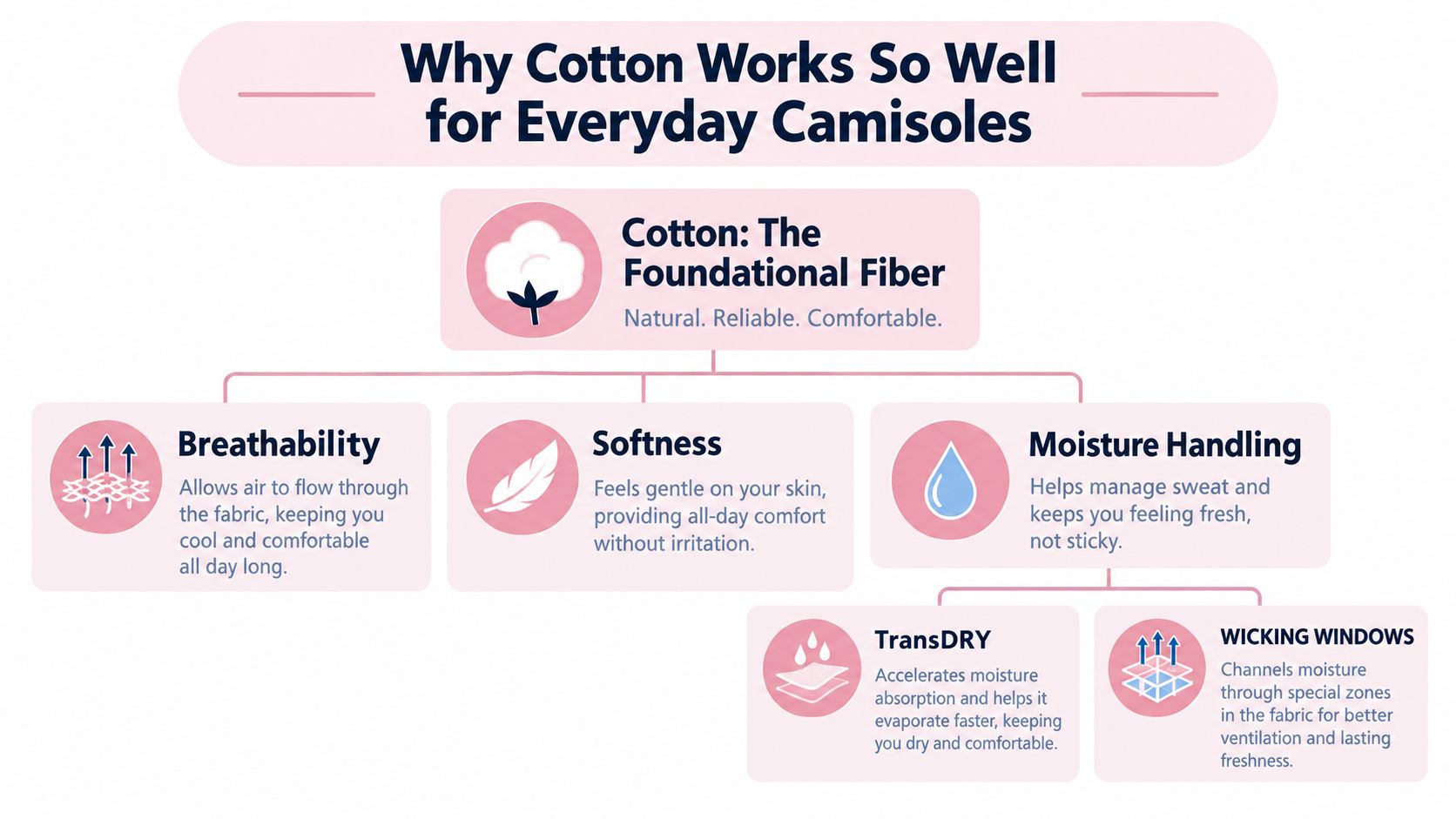
Cotton remains the foundational fiber behind cotton camisoles and shelf-bra camisoles, and its supply supports large-scale apparel manufacturing. The USDA cotton outlook forecasts world cotton production at 119.9 million bales in 2025/26, up 1% from the prior year and representing the second-highest level in 10 years. The same projection places the global average yield at a record 885 kilograms per hectare. For shoppers, that scale helps explain why cotton basics remain widely available across major markets.
The everyday appeal starts with touch. Cotton usually feels soft and breathable, making it a natural choice for a layer that may sit against the bust, underarms, and back for hours. It also has a familiar, less slick hand than many performance fabrics, which some wearers prefer under relaxed clothing or while sleeping.
Untreated cotton has a limitation, though. It can absorb perspiration and feel damp against the skin, especially when the garment fits closely or the weather is humid. That's where engineered moisture handling changes the experience.
Moving moisture instead of simply holding it
Cotton Incorporated describes TransDRY and WICKING WINDOWS technologies as systems that move sweat away from the skin toward the fabric surface, where it can evaporate. That can reduce wet cling and make the garment feel more comfortable during wear, as explained in this overview of cotton moisture-management technology.
Think of untreated cotton as a soft towel. It can hold moisture, but the dampness may remain noticeable. Treated cotton works more like a towel with a better route for moisture to travel outward. The cotton still provides the familiar hand feel, but the fabric can manage perspiration more effectively.
A modest amount of stretch also matters. Cottonworks notes that cotton blended with about 5% to 10% elastane is commonly used to add stretch and recovery, while design elements such as wider bands and structured wireless cups contribute more directly to support. You can explore related ideas in this guide to cotton tanks for women.
What to notice during a real wear test
Try the camisole under the conditions you care about most. For a warm day, notice whether the fabric feels airy or stays damp. For layering, check whether it slides smoothly under a cardigan. After washing, compare the torso length, strap position, and shelf placement with how they felt when new.
Cotton can be an excellent comfort foundation, but softness alone doesn't guarantee thermal comfort or fit stability. Blend composition, moisture treatment, recovery, and cut all shape the final result.
Support Level and Construction That Actually Matters
A cotton shelf bra camisole can feel wonderfully soft and still provide very little hold. During a try-on, the difference becomes clear: fabric affects comfort, while support comes from construction. The shelf needs enough structure to stay in place, spread pressure, and reduce gentle movement without squeezing the torso.
Start with the band. A wider band distributes tension across more of the body, like a broad strap carrying weight more evenly than a narrow one. A slim elastic edge can concentrate pressure in one line. Then inspect the internal bust panel. A shaped wireless cup or double-layered section usually contains more effectively than one flat layer. The outer fabric and inner shelf also need to work as a team. Some designs keep soft cotton against the skin and use a firmer outer layer as the supporting frame.
Light support versus bra-level support
| Feature | Shelf Bra Camisole | Traditional Bra |
|---|---|---|
| Main purpose | Comfort, coverage, and light containment | Defined lift, shaping, and controlled support |
| Support structure | Internal shelf, elastic band, wireless shaping, and fabric tension | Separate band, cups, straps, and more structured support points |
| Best suited to | Sleep, lounging, low-impact wear, and layering | Situations requiring stronger lift or stability |
| Fit sensitivity | Torso length, shelf position, and band comfort matter greatly | Band and cup fit usually guide the support experience |
| Common expectation issue | May disappoint shoppers seeking bra-like lift | May feel more structured or restrictive for relaxed wear |
Review patterns for cotton camisoles often show a split between very positive and very negative feedback around shelf fit and support. One wearer may enjoy the soft, steady comfort, while another may find the shelf too small, too tight, too loose, or unable to provide enough containment. Those responses can all be accurate because the same garment interacts differently with bust volume, torso length, and personal support preferences.
Fit educator's rule: Expecting traditional-bra lift from a light shelf may lead to disappointment. A soft comfort layer that gently reduces movement can still be exactly right for sleep, lounging, low-impact wear, or layering.
Bust size changes the job the shelf must perform. As volume and weight increase, the inner panel carries more of the load. Torso length affects fit drift too. A shorter camisole may pull the shelf upward during movement, while a longer design may stay steadier but feel warmer beneath other clothing. Construction helps determine support, while fit determines whether that construction remains where it belongs.
Use the garment for the activity it was designed to handle. Walking around the house and running errands place different demands on a shelf bra camisole than jumping or high-impact training. For more guidance, review these shelf-bra tank considerations. The right expectation is simple: treat the camisole as a comfort layer system, not an automatic bra replacement.
Finding Your Fit and Styling for Real Life
A camisole can feel fine at first and still drift after you reach, sit, or move through a busy day. Start with the size chart's bust guidance, then check the garment length or torso information if available. The shelf should rest around the intended bust area rather than climbing whenever you raise your arms. Fit determines whether the construction stays useful, while the fabric mainly shapes softness, airflow, and stretch.
Use this quick movement check at home:
- Raise both arms. See whether the lower band climbs toward the bust.
- Bend forward. Check that the shelf stays close without cutting into the chest.
- Reach across your body. Notice strap pulling or twisted side seams.
- Sit for a while. A band that feels comfortable standing may press once your torso folds.
Adjustable straps let you fine-tune shelf placement when your shoulders, bust, and torso do not match a standard pattern. Stretch-to-fit designs can follow natural movement, but the material still needs reliable recovery. If it stays relaxed after wear, the shelf may sit lower and feel less stable.

Match the cami to the day
For sleep and lounging, look for a smooth inner surface, a band that does not dig, and enough room for comfortable breathing. For light layering, choose a length that stays tucked beneath a cardigan, blazer, or open shirt. As a standalone top, check opacity, neckline coverage, and whether the shelf seam looks intentional under the outfit.
Warm, humid conditions shift the priorities. Airflow, moisture handling, and a less compressive cut may matter more than a close fit. Under several layers, a thinner cotton blend or moisture-managed fabric can feel lighter than dense, untreated cotton.
Laundering can also change the fit. Shopper feedback often describes differing experiences with heat, shrinkage, scratchiness, and fit drift. Some wearers report that an older version feels softer, while others note that mostly cotton fabric may shrink slightly. Feedback also describes cotton shelf-bra styles as too short or boxy for a long torso, as reflected in this camisole fit feedback. Check more than the fiber label. The blend, cut, and finished length all affect how the comfort layer behaves after washing.
For a coordinated comfort-first base, a cotton brief such as the NuSoft Classic Cotton Brief can sit beneath the camisole without changing the top's main role. Together, the pieces can provide breathable skin contact, steady placement, and enough ease for the day ahead.
Caring for Your Camisole and Publishing It Beautifully
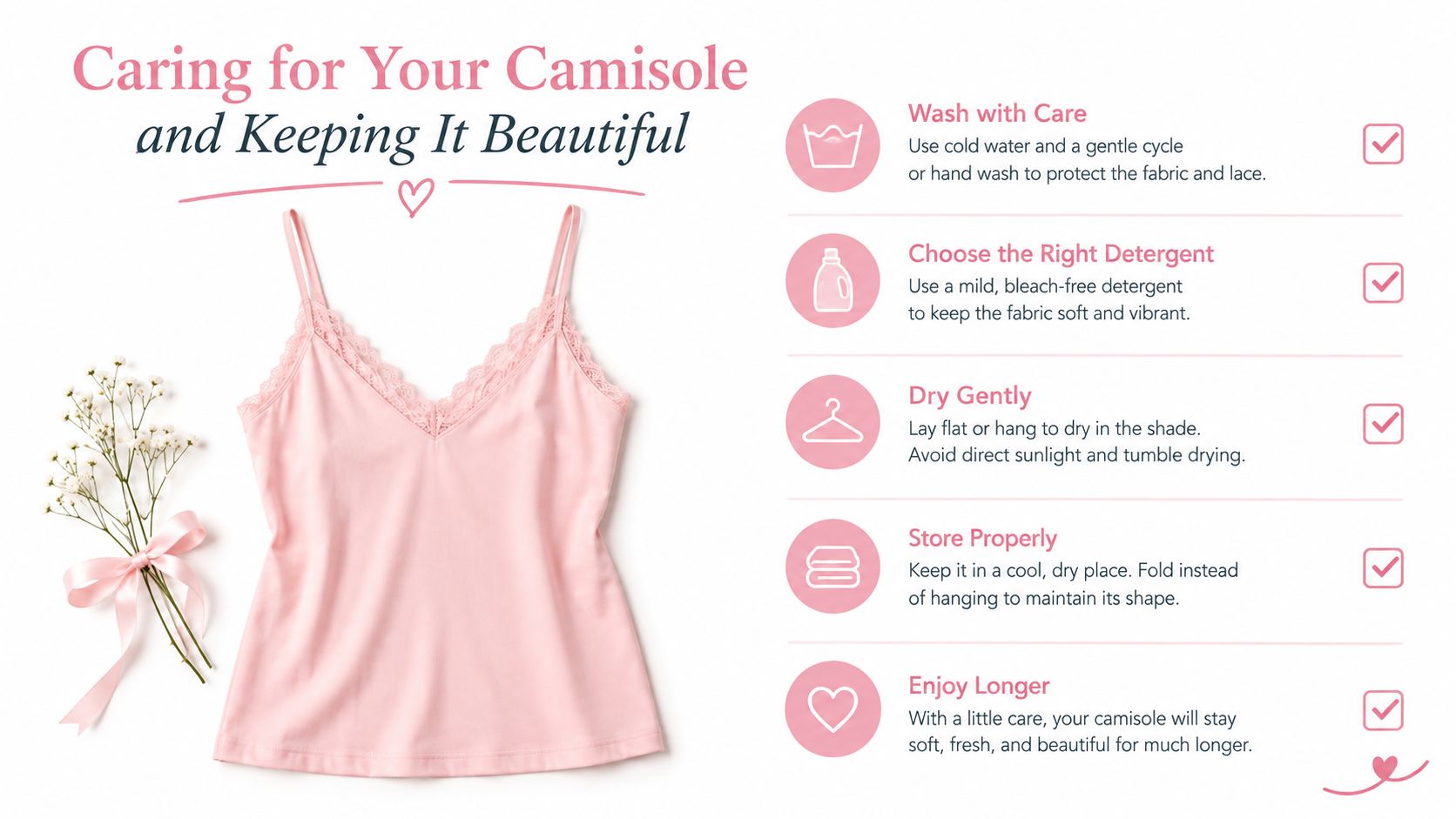
Care protects both the soft feel and the shelf's recovery. Start with a cold wash and turn the camisole inside out if the care label allows it. A laundry bag can reduce stretching and tangling, especially around adjustable straps and elastic sections.
Choose a low tumble setting or air dry. High heat can encourage cotton shrinkage and place extra stress on elastane, which may contribute to changes in length, band tension, and shelf placement. Skip bleach unless the garment's care instructions specifically permit it, since harsh treatment can affect color, fibers, and elastic components.
A simple care routine
- Wash gently: Use cold water and a mild detergent.
- Protect the structure: Place the cami in a laundry bag before washing.
- Control heat: Choose low tumble or air dry rather than high heat.
- Avoid bleach: Keep harsh whitening products away from cotton and elastane unless the label says otherwise.
- Store without distortion: Fold the camisole instead of hanging it by the straps for long periods.
Let the garment dry fully before storing it. If you notice a new scratchy feel, shortened torso, or loose shelf, compare your recent wash routine with the care label. Fit drift may come from laundering rather than a sudden change in your body.
For blog presentation, a 280 by 210 display box uses a 4:3 aspect ratio, because 280 divided by 210 simplifies to 4:3, a standard image ratio listed in WordPress image block guidance. Prepare the cover image in that proportion so the camisole and surrounding styling don't get awkwardly cropped. Match larger images to the actual content column, which many WordPress themes place between 800 pixels and 1200 pixels wide, as outlined in this image sizing guidance.
Keep outbound links modest and directly relevant. Guidance from Seobility's external links resource supports avoiding unnecessary linking, including links to direct competitors when a neutral source can support the same point.
Nuage Wears offers comfort-first underwear, bras, and everyday apparel designed around concerns such as visible lines, wedgies, digging, and overheating. Visit Nuage Wears to explore breathable, stay-put essentials that can complement a cotton shelf-bra camisole in your daily comfort system.