
In many US charts the cup after DDD is G, and brands that already print F for that DDD volume still use G for the next cup. The letter is a local nickname for one extra inch between a snug underbust and the fullest bust, not a size that means the same thing on every tag.
That mismatch is what makes the question feel harder than the tape measure. You can pick up the same volume in two shops and see DDD on one label and F on the other, then watch the following cup stay G. Cracking what comes after DDD bra size means reading the alphabet the product page uses, then checking whether the band can carry that cup.
Table of Contents
- What Comes After a DDD Cup
- US UK and EU Labels After DDD
- How Cup Volume Relates to the Band
- Sister Sizes Around a DDD Cup
- When to Go Up a Cup Instead of a Band
- Measure Then Match the Brand Chart
What Comes After a DDD Cup
G is the usual next cup after DDD on many US charts. Some brands print F where others print DDD, so that shared volume is written DDD/F, and the cup after it is still G.
Double letters here are full steps, not tiny half sizes. DDD/F is one whole cup past DD. The working run beside the inch method is D, DD, DDD/F, G, H, I, and it keeps going. Each step is about one extra inch between a snug underbust and the fullest bust. The bra size chart at Bra Size Convert maps a six-inch difference to US DDD/F and the next seven-inch step to US G.
The inch map on a 32 band
Say the underbust is 32 inches. A 38-inch bust is about 32DDD/F. A 39-inch bust is about 32G. That one-inch jump is the whole decision when the band already fits and tissue is spilling.
| US cup | Bust minus underbust | Example on a 32 band | Role after DDD |
|---|---|---|---|
| D | 4 inches | 36-inch bust, about 32D | Two cups before |
| DD | 5 inches | 37-inch bust, about 32DD | One cup before |
| DDD/F | 6 inches | 38-inch bust, about 32DDD/F | The DDD volume itself |
| G | 7 inches | 39-inch bust, about 32G | Usual next cup |
| H | 8 inches | 40-inch bust, about 32H | Two cups past DDD |
| I | 9 inches | 41-inch bust, about 32I | Three cups past DDD |
Extended US labels continue through J and K. Those later letters are context for the alphabet, not today's shopping decision. If the band already sits level and tissue spills at the neckline or underarm, move one row to G rather than guessing a random letter.
Cup letters stand for larger bust-to-band differences, and the same physical volume can wear a different letter depending on the brand.
Manufacturers don't apply the letters identically. Treat the retailer's own chart as the authority. A generic alphabet is a map. The product page is the street you are on. Pattern grading still differs from brand to brand, so two bras both marked G can feel unlike each other in wire width and cup depth even when the inch gap matches.
US UK and EU Labels After DDD
Three next-cup paths, not one alphabet. On a US page the DDD volume is often DDD or F, and the next cup is G. On a UK page that same volume is usually E, so the next cup is F, then FF, then G. EU charts measure bands in centimeters and commonly call the DDD-level volume F, with G as the following cup.
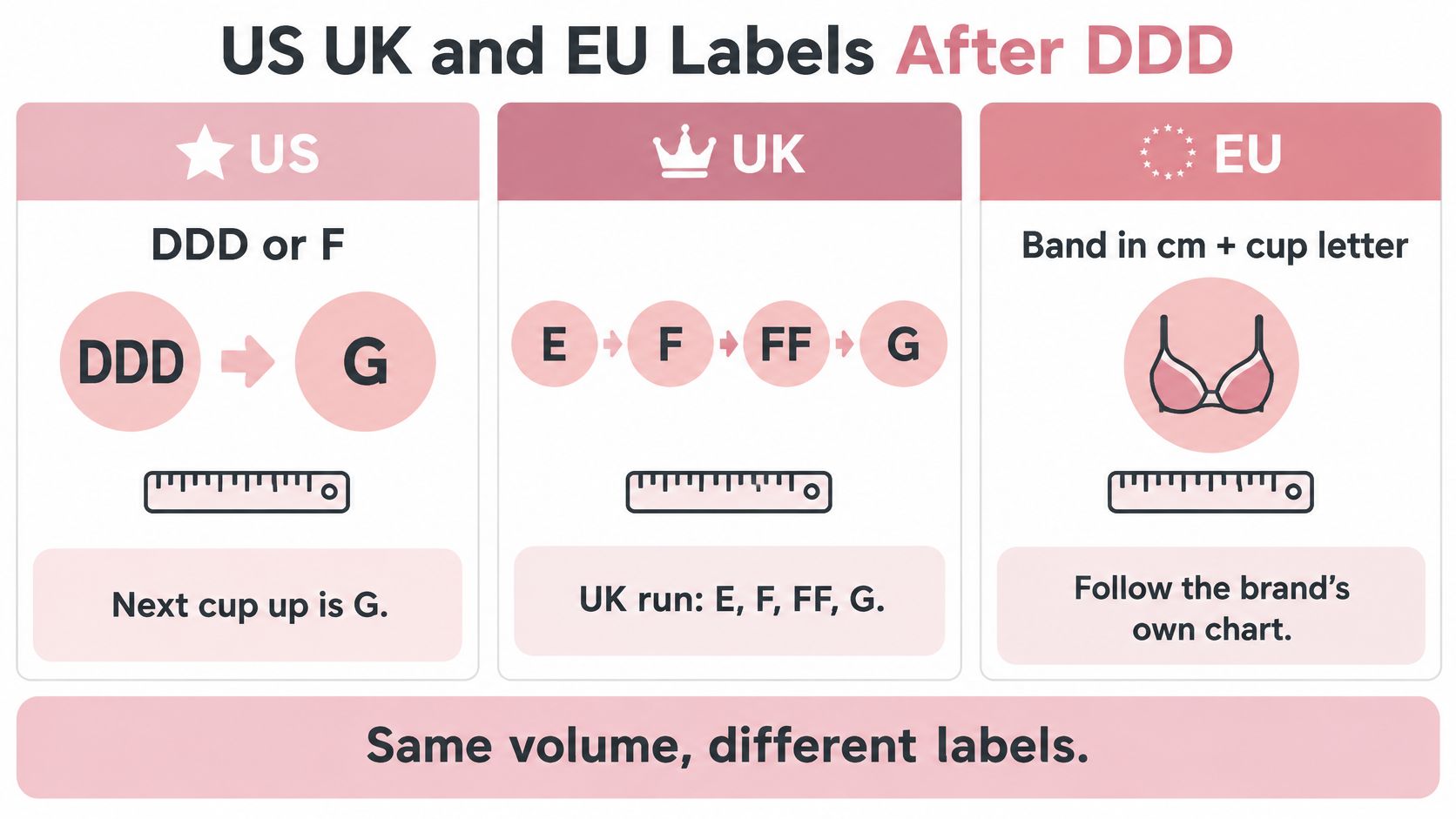
The bra FAQ at Bra Size Calculation lays the US run out as AA, A, B, C, D, DD, DDD/F, G, H, I, J, and K, and the comparable UK run as D, DD, E, F, FF, G, and GG. A US DDD is commonly treated as about a UK E. A US G is about a UK F. The UK sequence also skips I.
Why a UK G is not the next size
Buying a UK G because a US guide said "G comes next" can jump more than one cup. On the UK path you pass F and FF before you reach G. The cup-size order guide at Bra Size Conversion treats US DDD to G, UK E to F, and EU F to G as separate labeling paths. A US G is not automatically a UK G. The tape measure didn't change. The nickname did.
| Step from a US DDD volume | US label | UK label | EU label |
|---|---|---|---|
| Same volume as US DDD | DDD or F | E | F |
| Next cup | G | F | G |
| Two cups larger | H | FF | H |
| Where G sits | One cup past DDD/F | After F and FF, not the next cup | The usual next cup after EU F |
DDD is not one body either. A 32DDD and a 40DDD share a letter and still need different frames, wires, and strap support, because the cup is graded out from a larger ribcage. Before an imported order, read the page for US, UK, or EU, and for whether DDD and F are one size or two. Then take that system's next label. Shoppers comparing a UK F on a larger band can start with a clear walk-through of what a 36F bra actually fits like.
A short fitting clip makes the label split easier to see while you hold a tape.
The next cup is a volume step. The next letter is only a local nickname for it. These conversions are labeling matches, not a promise of identical fit, because makers grade patterns differently. The brand chart still wins.
How Cup Volume Relates to the Band
Picture a belt and a bowl. The band is the belt. It has to sit level and snug, because it carries the weight. The cup is a bowl whose letter only tells you how far that bowl sticks out beyond the belt.
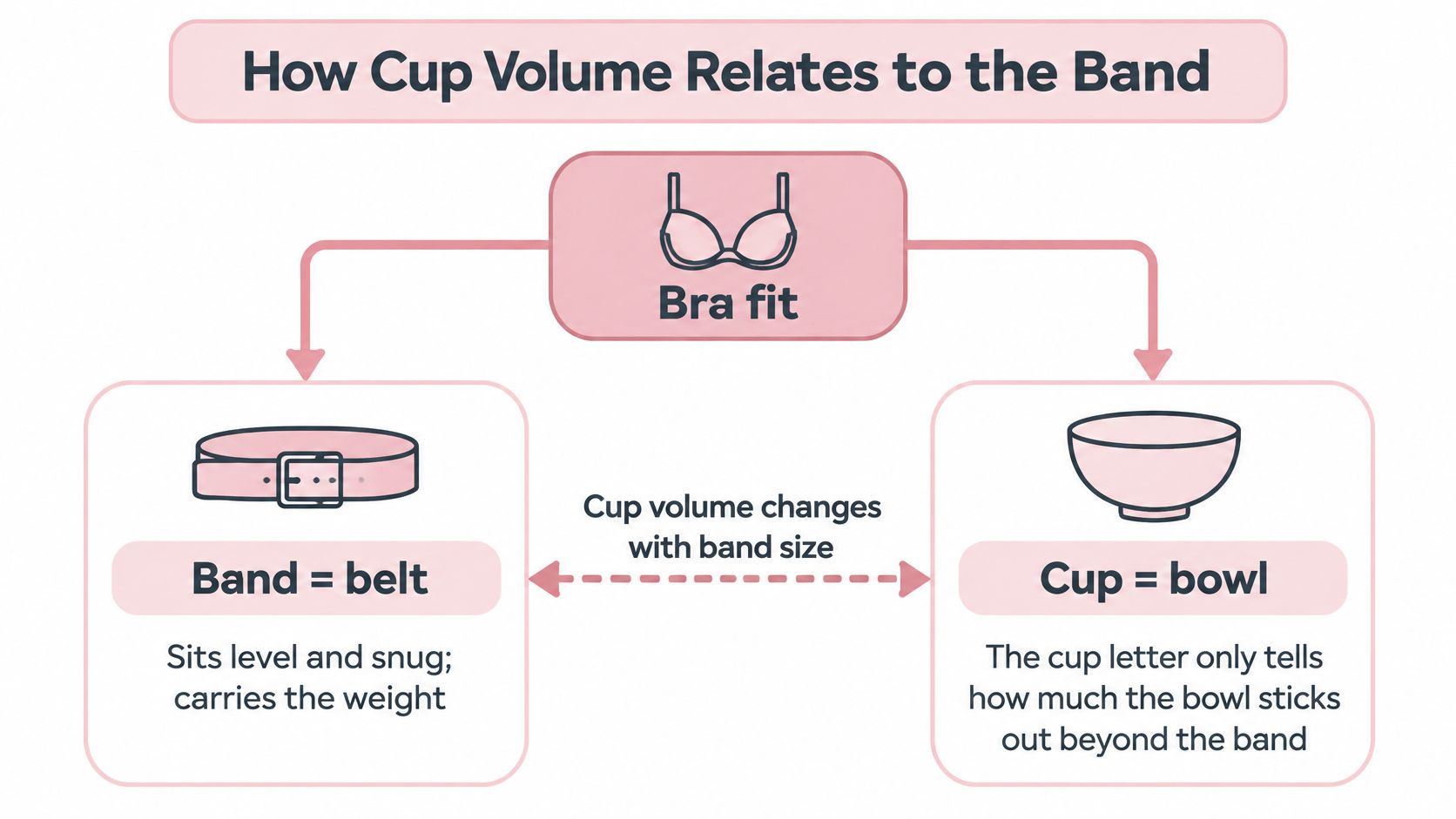
A DDD bowl on a 32 band and a DDD bowl on a 40 band share a letter and not a capacity. The bigger band is cut for a larger ribcage, and the cup is graded out with it. Moving from DDD to G is not "pick any larger letter and ignore the body in front of you."
Two measurements, in order
- Underbust first. Measure snug, on a breath out, with the tape parallel to the floor.
- Fullest bust second. Measure in a light top without compressing tissue.
- Subtract. That inch gap points at a row in the brand's alphabet. It doesn't invent a worldwide letter.
What a bad band fakes
A tight band can shove tissue upward and make a fine cup look too small. You see spill and blame the letter, when the belt was the problem. A loose band lets the wires drop and dumps the load onto the straps. The cups can look empty or the straps can dig, and neither clue is really about cup volume.
Check band pressure first and cup containment second. Those are two jobs, not one letter.
Keep that split in mind when a label changes country, when you try a sister size, or when tissue spills. The bowl only makes sense once the belt is doing its job.
Sister Sizes Around a DDD Cup
Start with a familiar trio, then move it onto DDD. In the US sequence, 34DD, 32DDD, and 36D are sister sizes. One band down goes with one cup step up. One band up goes with one cup step down. The goal is a similar bowl on a different belt.
The cup measurement guide at Bra Calculator applies that same swap to 34DDD: the smaller-band sister is about 32G, and the larger-band sister is about 36DD. Volume is meant to stay close. Band tension, wire shape, cup width, and where the bra sits on the torso all change.
The same move on neighboring bands
- 32DDD: the smaller-band sister is 30G, and the larger-band sister is 34DD, when the brand cuts a 30 band.
- 36DDD: the smaller-band sister is 34G, and the larger-band sister is 38DD.
- Feel, not just the tag: a 32G can feel narrower and deeper. A 36DD can feel wider and shallower.
| Starting size | Smaller band, larger cup | Larger band, smaller cup | What should stay similar |
|---|---|---|---|
| 32DDD | 30G | 34DD | Cup volume, not band tension |
| 34DDD | 32G | 36DD | Cup volume, not wire width |
| 36DDD | 34G | 38DD | Cup volume, not strap load |
Sister sizes are a troubleshooting tool for a band that is too tight or too loose. They aren't a promise that every style will fit the same. If the brand uses UK letters, translate before you shop. A US G is about a UK F, so the 32G sister is not a UK 32G.
Fasten the new band on the loosest hook. You should still have room to tighten it as the elastic relaxes.
Pick the candidate from the table, then judge the new band on that loosest hook. If the wires sit in the right place and the bowl contains you without spill or gap, you've parked the same volume on a better belt. If the wire is suddenly too narrow or the cup too shallow, the volume match wasn't a style match. Try another cut in that sister size before you abandon the band.
When to Go Up a Cup Instead of a Band
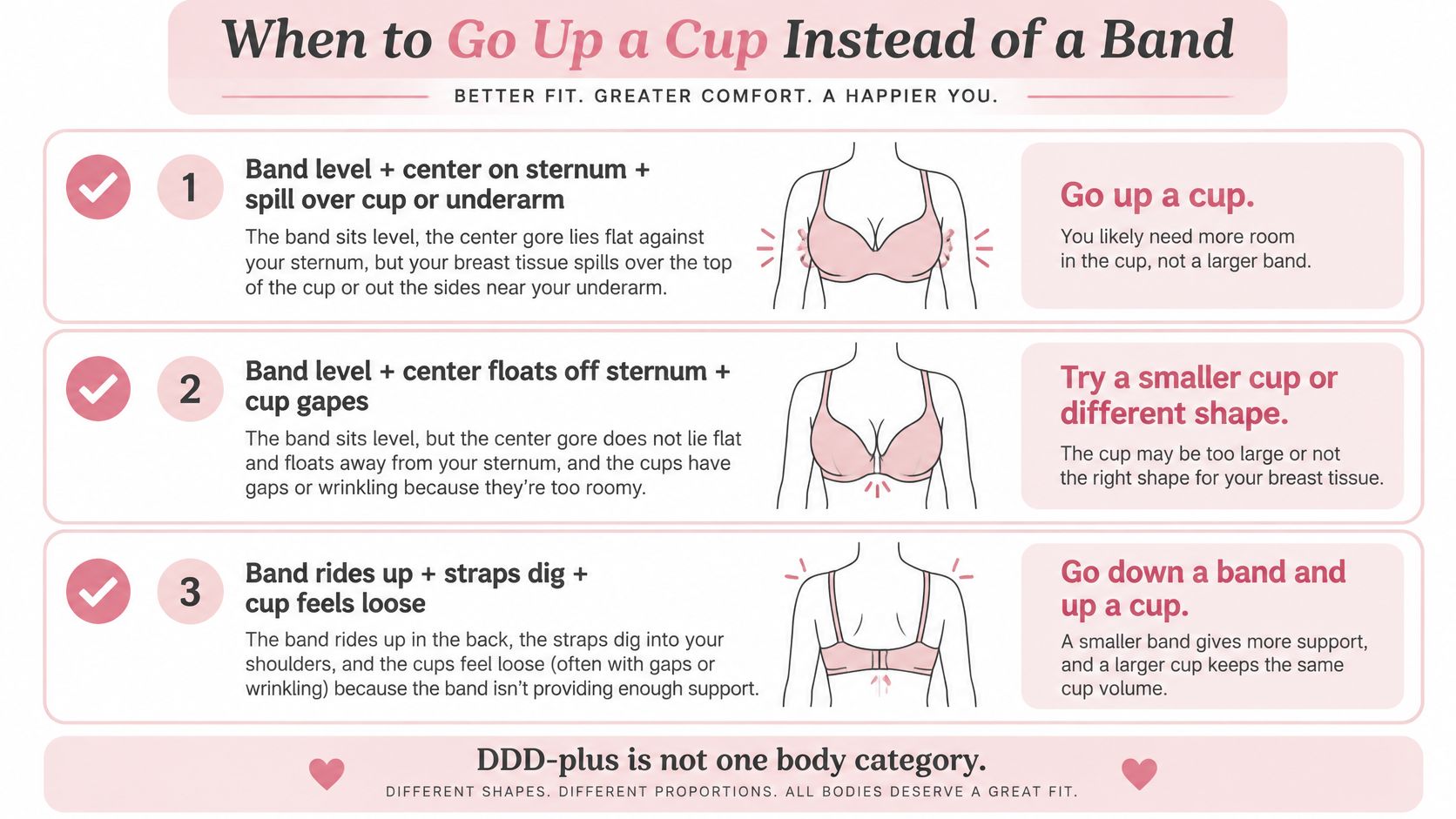
Three try-on stories keep DDD-plus from turning into one body category. The cup size visuals at Bra Calculator separate them cleanly: spill on a band that fits, a band that rides up, and a cup that gaps without compression. Learn to tell them apart and the letter system stops feeling like a puzzle.
Spill on a level band
The band is level, the center sits on the sternum, and tissue spills over the cup or at the underarm. That is a true next cup. From a US DDD, try G on the same band. On a UK chart the volume sitting at DDD level is E, so the next letter is F. On an EU chart that same volume is F, so you look for G. Three label paths, one move: the band stays put and the cup grows.
A band that wanders
The band rides up in back, the straps do all the work, or the cups look small only because the band is sliding. A band works like the belt on a pair of trousers: when it slips, everything above it looks wrong for the wrong reason. Don't add a cup on that loose band. Drop one band and go up one letter, using the sister you already chose. A person in 34DDD compares 32G and stays off an automatic jump to 34G.
Empty fabric, or a band that digs
The cup wrinkles or gaps and nothing is being squashed. That is often a shape mismatch: a cup too tall gaps at the neckline, one too shallow collapses at the fullest point, and one too wide leaves loose fabric at the sides. It is not an order to size down. A too-tight band can also fake a too-small cup by pushing tissue out over the rim. If the loosest hook already digs and the cups are full, test the larger-band sister before you blame the letter.
| What you see | Likely cause | Try next |
|---|---|---|
| Band level and tissue spills | Cup volume too small | Next cup on the same band, often US G |
| Band rides up or straps dig | Band too loose | Smaller band and one cup step up |
| Loosest hook digs while cups are full | Band too tight | Larger band and one cup step down |
| Cup gaps without compression | Shape or style mismatch | Another cut, not an automatic smaller cup |
Read the table row by row and a pattern shows: only the first story earns a new letter on the same band. Larger cups are picky about wire width, cup depth, and strap placement, so judge containment and band pressure apart. UK charts add intermediate doubles such as FF and GG and skip I, which is another reason a "next letter" guess fails.
If wires are the problem rather than the letter, a wire-free option built for fuller busts is the Lace Wireless Barely There Bra, priced at $36.00, which swaps the underwire for a soft, supported lift. If you're between sizes in that style, the brand's note is to take the smaller size for a closer fit and the larger one for a more relaxed feel.
Spill on a level band means the next cup. A wandering band means a sister size. Empty fabric means a different cut.
Measure Then Match the Brand Chart
Turn the maps into one order you can repeat at home. The at-home bra fitting tips from Display Guru are a useful companion while the tape is still in your hand.
- Underbust. Measure snug, on a breath out, tape parallel to the floor.
- Fullest bust. Measure in a light top without compressing tissue.
- Subtract. On a typical US chart, six inches is the DDD/F row and seven inches is the G row. A 32-inch underbust with a 38-inch bust is about 32DDD/F. A 39-inch bust is about 32G.
- Read the system on the product page. If the chart is US and the band already fits while tissue spills, order G on that band. If the chart is UK, the volume matching US DDD is E and the next cup is F. If the chart is EU, the DDD-level volume is commonly F and the next cup is G.
- Fix the band without stacking another cup. If the cups contain the tissue but the band fails, don't add a letter on the same band. From 34DDD, try 32G for a smaller band or 36DD for a larger band.
- Try it on the loosest hook. The band should sit level. Then check neckline and underarm spill, empty fabric, and straps that dig.
Keep it only if both jobs pass
Keep the size only when band pressure and cup containment both pass. If a printed letter conflicts with the tape, use that brand's chart. A second pass on signs of a correct fit is worth doing before you wash the tags off, and our notes on how to know if your bra fits correctly walk through those checks without treating one letter as a body type.
Nuage Wears builds comfort-first bras and everyday underwear for fuller busts and long days, with wireless support, no-dig straps, and fabrics meant to stay smooth under work clothes. If you're sorting the cup after DDD, start with your underbust and fullest bust, then match our chart instead of a generic alphabet. Visit Nuage Wears to compare band-and-cup options and find a fit that holds without digging.