
Hipster underwear is a mid-to-low rise panty that sits around the hips, below the natural waist, with more seat and side coverage than a bikini or thong.
If the cut sounds simple, why do two pairs both labeled "hipster" behave so differently the moment you sit down? One pair stays smooth under fitted pants from breakfast to bedtime, while another rolls below your stomach or cuts a sharp crease across your hip. Shoppers often treat the word on the tag as a guaranteed fit, yet brands measure rise, leg openings, and stretch in completely different ways.
Understanding what is hipster underwear means looking past the label and treating the style as a fit and coverage architecture. Once you know how the waistband height, side panels, and leg line work together on a moving body, you can test any pair with confidence instead of guessing at the rack.
Table of Contents
- What Hipster Underwear Means
- Where the Hipster Came From and Why It Endures
- Hipster Compared With Bikini, Brief and Thong
- How Rise, Side Panels and Leg Lines Shape Fit
- Comfort, Movement and When Hipsters Fall Short
- Choose Your Next Pair by Rise and Measurement
What Hipster Underwear Means
A hipster is a hip-hugging underwear cut that trades a waist-high band for broader sides and steady rear coverage. The Cambridge English Dictionary defines hipster underwear as underwear that "fits around or reaches as far as the hips and not up to the waist," placing it squarely between low-rise styles and high-waisted briefs. In practical terms, the waistband rests below your natural waistline while the fabric wraps farther down the hip and across the seat than a typical bikini.
Here is a visual look at how that low-to-mid hip placement sits on the body compared with higher cuts.
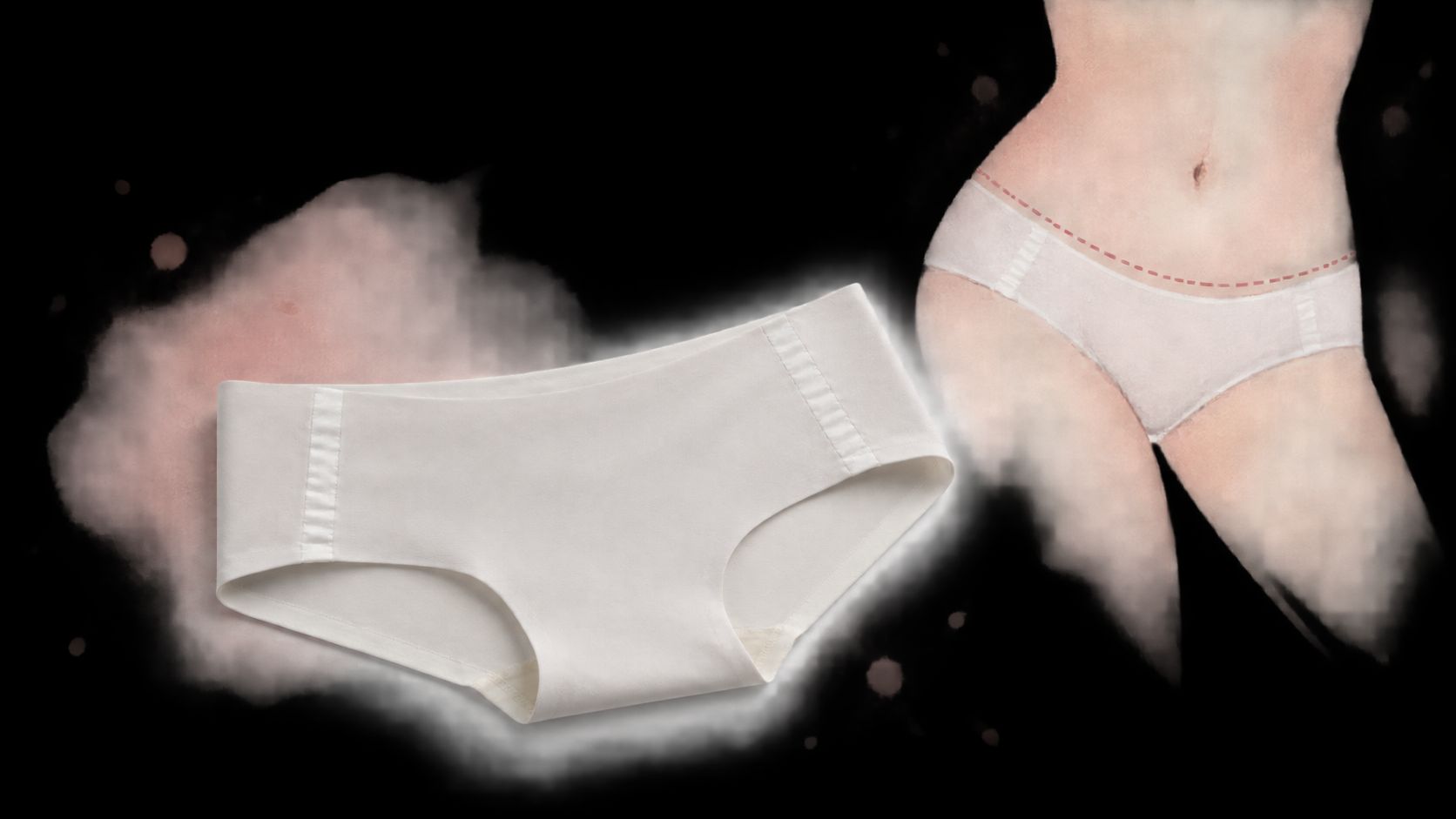
Picture a woman pulling on trousers designed to rest on her hip bones. A high-waisted brief peaks above the trouser line or bunches beneath the belt loops, while a skimpy bikini leaves the back feeling exposed when she leans over her desk. With a well-matched hipster, the waistband lands cleanly beneath the trouser edge and stays out of the way all morning.
Three Details the Word Actually Tells You
When you see "hipster" on a package, it communicates three core pattern choices rather than one rigid template:
- Rise height: The top edge targets the high hip or mid hip instead of climbing toward your belly button, sitting lower than both standard briefs and hi-cut panties.
- Coverage balance: You get moderate to full seat coverage alongside wider side panels, which feels noticeably more secure than a bikini or thong.
- Silhouette geometry: The leg opening is comparatively squared off rather than sharply angled up the thigh, giving the garment a straighter, lower profile around the upper leg.
What the Label Never Guarantees
A common shopping mistake is assuming every hipster shares the same fabric feel or edge finish. Manufacturers cut hipsters from cotton, modal, microfiber, lace, and mesh, and they sew them with traditional stitched elastic or bonded smooth edges. Two pairs in the exact same size can even sit at different heights on your torso, because each pattern maker defines "low rise" relative to its own waist, hip, and seat block.
Fit mindset: Read "hipster" as a starting clue about waistband placement and coverage, never as a promise of soft edges, zero panty lines, or uniform sizing.
Where the Hipster Came From and Why It Endures
The hipster didn't appear out of thin air as a modern marketing label. It grew from a practical change in how clothes sat on the body. As hemlines dropped and jeans settled lower on the hips, underwear had to follow or show where it wasn't wanted. The result was a cut that works like a bridge: low enough for hip-slung clothing, with enough fabric to feel settled.
During the 1960s and 1970s, low-slung skirts and hip-hugger jeans pushed underwear waistbands downward. According to Fashion-Era's history of women's undergarments, 1965 to 1970s hipster briefs grew out of bikini-derived panties that moved progressively lower along the hipline while leg openings crept higher on the thigh. That shift created a hybrid: a low waistband borrowed from bikinis paired with the fuller seat and side coverage familiar from classic briefs.
Construction mattered too. Adding cotton gussets to nylon briefs made daily wear more comfortable and practical. By the 1980s, designer waistbands and named silhouettes helped turn everyday intimates into recognizable fashion staples, which is one reason the hipster stayed in drawers instead of fading with one trend cycle.
Why Everyday Shoppers Still Reach for It
Language varies slightly depending on where you shop, with American English favoring "hipster underwear" and British shoppers often saying "hipsters." Across both markets, interest in smooth hip-sitting cuts remains strong. Accio's 2025 trend analysis reported that the "Hipster & No Show Underwear" category reached a peak search volume of 312 in August 2025.
Modern updates keep the silhouette useful for tight leggings, humid commutes, and long workdays. Resalers pay attention to recovery, stitching, and wearability when judging sellable pieces before buying, and shoppers can use that same construction-first eye. Raw-cut edges, breathable fabric, and a waistband that stays put matter more than the shape name alone.
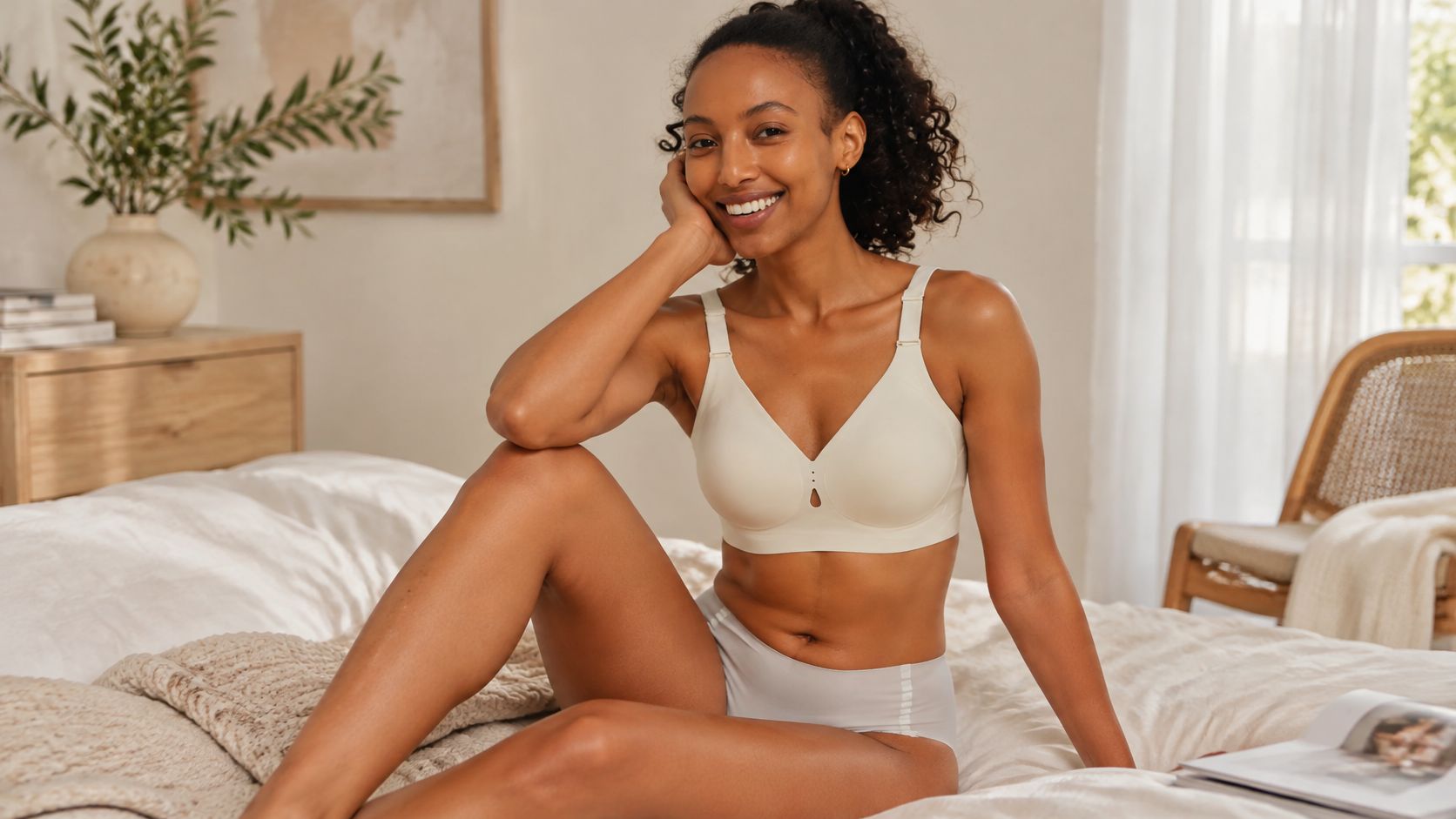
A current example is the NuCloud Original Hipster, part of the NuCloud Original range. It uses raw-cut edges and a 3D glute contour, with calibrated fabric stretch instead of elastic to help prevent wedgies. That is the hipster's lasting appeal: a middle-ground cut that can sit low, cover enough, and move with the body.
Hipster Compared With Bikini, Brief and Thong
Four cuts, four different amounts of fabric. The table below lines them up on the three measurements that shape how a pair wears: where the waistband lands, how much seat coverage you get, and how wide the sides run.
| Style | Waistband position | Seat coverage | Side coverage |
|---|---|---|---|
| Bikini | Low, on the hip | Minimal | Narrow |
| Hipster | On the hip, below the natural waist | Moderate to full | Wide |
| Brief | Near the natural waist | Full | Moderate |
| Thong | On or below the hip | Minimal, narrow strap at back | Narrow |
Read the table row by row and a pattern emerges. A bikini sits low on the hip with narrow sides and minimal rear fabric, leaving more skin uncovered than a hipster or brief. Coverage works like a dimmer switch across these four cuts, and the bikini sits near the low end.
A hipster rests on the hip below your natural waist, adding wide side panels and moderate to full seat coverage so the garment feels anchored. That wide side panel is the detail shoppers overlook most often. It is what separates a hipster from a bikini even when both waistbands land at the same height.
A classic brief climbs near the natural waist with full seat coverage and moderate sides, delivering the most overall enclosure of the four cuts. A thong sits on or below the hip with narrow sides and a slim strap in the back, stripping away rear coverage to keep fitted clothes free of back lines.
How to Read This Comparison for Your Closet
Choosing the right row depends less on habit and more on the exact clothes hanging in your wardrobe:
- Pairing with low-rise jeans or hip-slung skirts: Pick a hipster over a brief so the waistband stays tucked below your outer clothing instead of peeking out when you bend.
- Wanting maximum coverage and hold: Reach for a brief if you prefer full rear fabric and a band anchored near your natural waist.
- Wearing sheer, silky, or ultra-tight bottoms: A thong or thin-edged bikini eliminates back seams more easily than a stitched hipster, unless your hipster uses flat raw-cut edges.
- Shopping across unfamiliar brands: Rise heights vary from label to label, so check the measurements covered later in this guide rather than trusting the style name alone.
Because the hipster lands between the minimal feel of a bikini and the full enclosure of a brief, it suits moments when you need coverage without a waist-high band. A shopper pulling on a fitted knit dress for the office, for example, gets a smooth seat and sides that stay put through a day of sitting and standing, without a waistband digging in at the natural waist.
How Rise, Side Panels and Leg Lines Shape Fit
Three garment engineering variables control how a hipster feels once it's on your body: rise, side coverage, and leg-opening geometry. Changing even one of those measurements alters whether the pair glides under clothes or fights you all afternoon.
This breakdown maps how those three structural pieces combine to create a balanced fit.
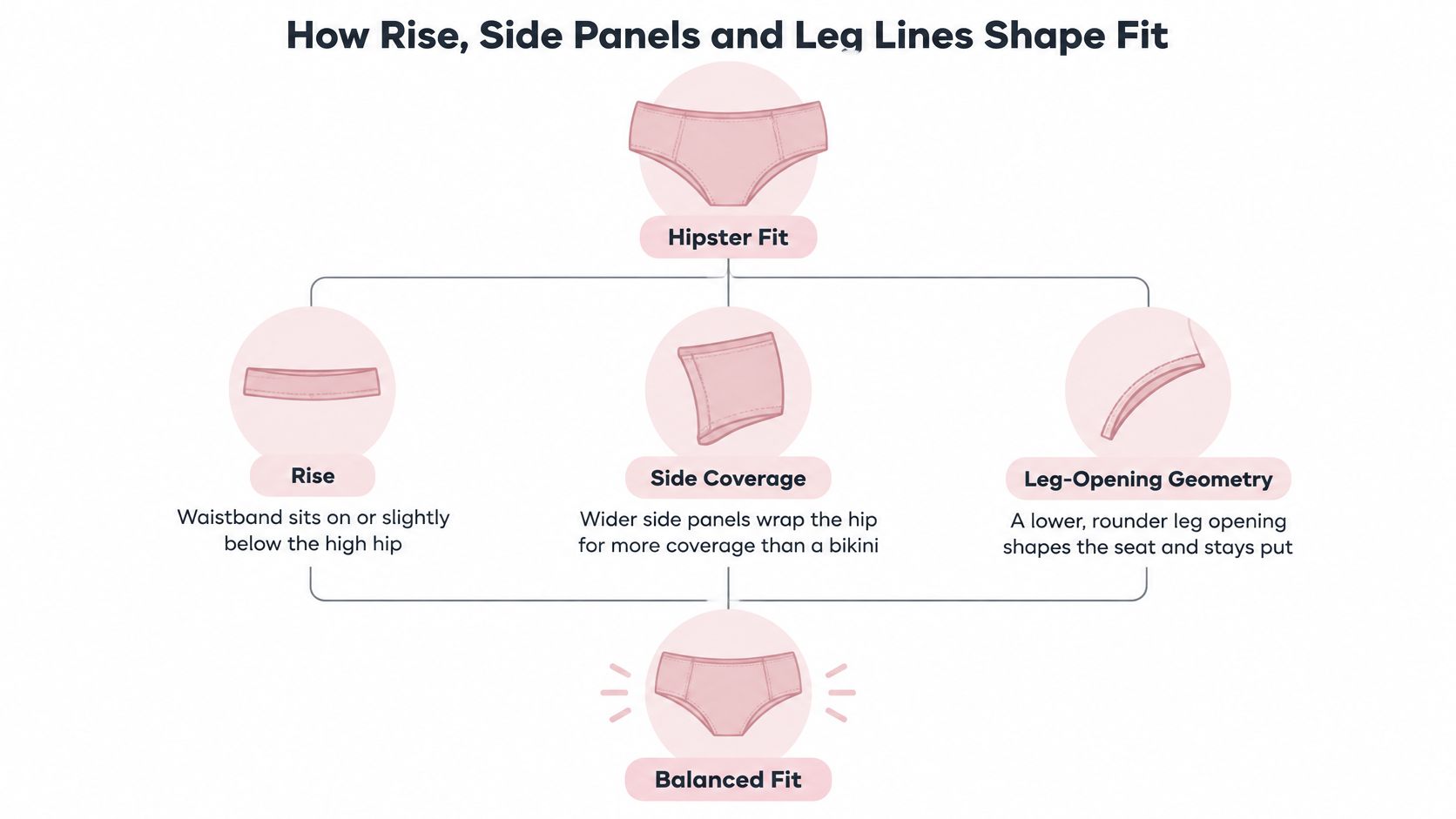
Start at the top with rise. A hipster waistband rests on or slightly beneath the high hip, shifting tension off your stomach. Next come the wider side panels, which wrap farther down the outer hip than a bikini's narrow string of fabric. Finally, the lower, straighter leg line hugs the upper thigh and frames the seat smoothly.
When size and stretch match your proportions, that extra side fabric spreads contact area across your hip instead of pinching all the elastic tension into one thin line. Spreading the load improves anchoring and cuts down on localized digging.
Why Two Bodies Get Different Coverage From the Same Cut
Body proportions vary dramatically even among shoppers who wear the exact same pant size. A 3D body-scanning study of more than 100 women published through the International Textile and Apparel Association documented wide crotch-length variation and argued that real body dimensions should guide underwear-panel sizing rather than relying on generic templates. A shopper with a longer torso or fuller lower stomach will see the same hipster band land noticeably lower than someone with a shorter rise.
A lower waistband isn't automatically gentler. If its circumference is too tight for your hip curve or its rise hits right at a soft bend point, it can dig in and roll faster than a taller cut.
Two Fit Traps to Watch For
Even a great silhouette breaks down when edges or proportions clash with your outfit. Here are two classic ways hipster geometry goes wrong:
- Bulky side hems under thin fabric: Because hipsters place more fabric across the outer hip, thick stitched elastic along the leg or waist can stamp a sharp horizontal crease right through jersey skirts or fitted trousers.
- Mismatched trouser rise: A slightly taller mid-rise hipster stops waistband exposure under standard jeans, yet that same pair will collide with low-rise trousers and fold over every time you sit.
Watch this short clip for a clear visual comparison of how rise and side proportions change the way everyday underwear looks and moves on the body.
Always pair the underwear rise with the waistband height of your bottoms. Check the measured rise, side-panel width, and rear coverage directly; the word on the tag only hints at how those three variables will behave on you.
Comfort, Movement and When Hipsters Fall Short
Touch a silky pair of underwear in a store and it's easy to assume it'll feel effortless for ten hours. Soft hand feel is nice, yet garment pressure and movement stability are what decide whether you forget your underwear is there or spend all day adjusting it.
Stretch fabrics create circumferential pressure around the body as they hug your curves. Research published in the Journal of Fiber Bioengineering and Informatics reports that clothing pressure climbs where body curvature is sharpest, peaking at the garment's sides while remaining lower across the abdomen and center back. That explains why hipster side panels are a double-edged sword: a properly sized panel spreads side pressure comfortably, while too much negative ease or a stiff band concentrates force right on your hip bones.
Standing still in front of a mirror won't catch that problem. A dynamic study of knitted women's underwear published in the Journal of Fiber Bioengineering and Informatics linked real-world comfort to the garment's allowance, the dimensional difference between body and fabric, across multiple movements, proving that static standing fit tells you very little about walking, sitting, or bending.
Why More Coverage Doesn't Guarantee Better Comfort
A shopper may buy a full brief for a long flight, expecting the extra fabric to feel calmer and more secure, then find it stuffy by the time the seatbelt sign goes off. Evidence points to construction and personal geometry instead. As highlighted in Research and Markets underwear fit insights, a comparative study of more than 700 women found statistically significant comfort differences across underwear styles depending on construction, while a separate survey-based study of 170 adult women tied practical panel wearability directly to individual body measurements.
Extra rear fabric still feels stuffy if dense synthetics, thick waistbands, or non-breathable gussets trap heat and sweat against your skin. Long-term care plays a role too. High dryer heat degrades elastane recovery, turning a stay-put hipster into a sagging pair that bunches after repeated washes.
Three Real-World Stress Tests
Soft fabric claims break down fast when you match them against a full schedule:
- Desk-to-dinner trousers: Sitting for six straight hours puts constant bend tension on the front waist. If the band lacks smooth recovery or sits right at your stomach crease, it'll roll down before lunch.
- Long-haul flights: Hours of shifting in a cramped seat expose loose leg openings immediately. Without calibrated stretch and anchored seat contouring, hipsters creep inward, which is why exploring no-ride-up underwear designs for women pays off before you pack.
- Hot yoga or humid commutes: Deep forward folds and heavy sweat punish thick seams and moisture-trapping weaves. A dense cotton-poly band stays damp and chafes along the hip line, whereas airy, moisture-managing construction keeps skin dry.
When to Skip a Hipster
Hipsters fall short in three predictable situations: when a low-rise trouser pushes the waistband into a roll, when heavy fabric or stitched gusset seams trap moisture during exercise, and when thick leg elastic carves visible lines beneath sheer dresses.
Practical wear rule: Pick breathable, moisture-managing fabrics for heat and workouts, check seam placement anywhere thighs rub, and switch to a higher or more anchored cut whenever deep movement causes rear exposure.
Match the fabric weight, edge finish, and stretch recovery to what your body is doing that day.
Choose Your Next Pair by Rise and Measurement
Guessing your size from jeans or trusting a single word on a package is the fastest way to end up with a drawer full of pairs you avoid. A tape measure and five minutes in front of a mirror tell you far more than any letter on a tag. Use this six-step fit test to check any hipster before you commit to multiples.
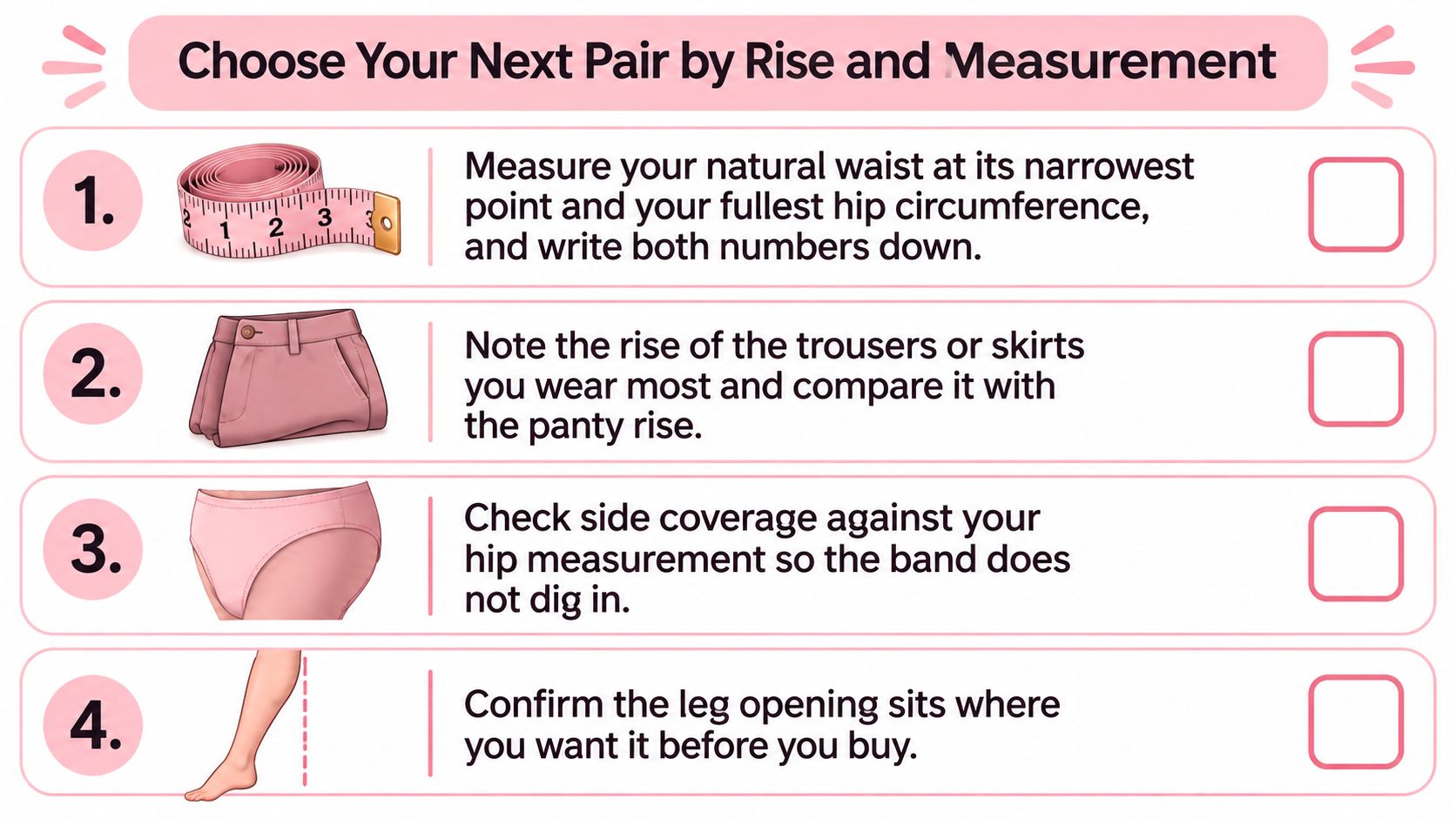
- Take two core body measurements: Wrap a soft tape measure around your natural waist at its narrowest point, then around the fullest part of your hips, and jot both numbers down. The hip number matters most for a hipster, since the waistband sits below your natural waist.
- Measure your go-to bottoms: Lay your most-worn trousers or skirts flat and measure their rise from the top of the waistband straight down to the crotch seam. That number tells you where your clothes sit, and your underwear waistband should land at or just below that line so nothing peeks out when you bend.
- Compare garment specs, not just letters: Line up each pair's measured rise, side-panel width, and rear coverage against your numbers using a detailed women's underwear sizing guide, because a medium hipster from one brand can fit like a small bikini from another.
- Run a live outfit test: Slip the pair on beneath the exact pants or leggings you plan to wear, then sit down in a chair, walk across the room, squat low, and bend forward to tie your shoes. Thirty seconds of movement reveals more than thirty minutes of standing still.
- Inspect the two failure points: Feel along the waistband for any folding or pinching, and check whether the leg openings pull inward or dig into your thigh crease when you stand back up.
- Keep what disappears in motion: Hold onto the cut that stays flat across your seat, holds steady at your hips, and keeps outer fabrics smooth without constant tugging.
Two measurements, one mirror, one honest squat test. That little routine works like a fitting room you carry in your pocket, and it applies to any cut or brand you try next. Grab your tape measure first, check your favorite trouser rise, and pick the cut built for how you dress and move.
Ready to put your measurements to work on everyday basics engineered for motion? Nuage Wears crafts comfort-first underwear with raw-cut edges, calibrated stretch, and breathable fabrics across hipster, mid-rise, high-rise, and thong silhouettes, including the NuCloud Original range, so you can match each rise to your wardrobe without digging, rolling, or visible lines. Explore the full collection and find the cut that fits you at Nuage Wears.