
You're halfway through the morning, your outfit looks fine, and then you feel it. The band has folded over again. You tug it flat in the bathroom, sit back down, and within the hour you're adjusting it once more. If you're asking why does my underwear keep rolling down, you're probably not dealing with one bad pair. You're dealing with a pattern, and that pattern is the best clue you have.
Table of Contents
- Why Your Waistband Loses Its Grip on Your Body
- Measure Your Waist and Hip Before You Buy
- Fit Problems From Size, Rise and Body Shape
- Match the Rolling Pattern to Its Cause
- How Waistband Construction and Fabric Choice Affect Roll
- Movement, Sitting and Travel Triggers
- Check Elastic Wear and Take Action Today
Why Your Waistband Loses Its Grip on Your Body
A waistband works like a tent rope pegged into soft sand. At first, the peg holds. Then the ground shifts a little with every step, every breath, every time you sit down and stand back up. The rope never got longer. The anchor just stopped being stable.
That is what happens on your torso. A band stays put only while it keeps stable contact as your body changes shape, and a garment-pressure research report breaks that contact down into three interacting variables: body shape, the garment's mechanical properties, and how well it follows body movement. Change any one of them, and a pair that felt fine standing up can fail the moment you sit. That is why the same pair can roll for a different reason on Tuesday than it did on Monday.
Two Ways a Band Fails
A band that's too tight buckles or folds because pressure gets concentrated into a narrow strip. A band that's too loose migrates downward because there isn't enough friction or recovery force to hold it. They look similar in the mirror, but they need opposite fixes.
Pressure gives you a useful clue here. The garment-pressure research report classifies 0-15 gf/cm² as generally non-discomforting, 15-25 gf/cm² as slightly uncomfortable, and above 25 gf/cm² as extremely uncomfortable. You can't measure that at home, but you can feel the difference between pinching and sliding.
Rolling is a mechanical fit problem, not a body problem.
Your job is to work out whether your band is folding from excess pressure or drifting from too little grip, and to notice which movement sets it off. Once you know both, the fix gets much clearer.
Measure Your Waist and Hip Before You Buy
Stop guessing from the letter on your current label. Letters change between brands, and your measurements won't lie to you the way an old, stretched pair can.
Take Two Measurements
Wrap a soft tape around the narrowest part of your waist, usually just above the navel. Keep it level, snug, and flat against your skin without squeezing. Then wrap it around the fullest part of your hips the same way.
Write both numbers down in centimetres and inches. Then subtract your waist from your hip. That waist-to-hip difference matters because a large difference often means the band needs to clear a fuller hip before it can settle at the waist. If the cut doesn't allow for that, it'll search for a narrower spot and roll on the way.
Measure the Rise Too
Take a pair you like and measure from the crotch seam to the top edge. Compare that length with your own torso, from the crotch up to where you'd want the band to sit. If the garment's rise is shorter than that distance, the top edge will land mid-slope instead of on stable ground.
Now open the brand's size chart and match your numbers to it, a step the guide to underwear sizing for women walks through in detail. If your numbers fall between two sizes, don't decide yet. Keep both options open and let the movement test decide for you.
Fit Problems From Size, Rise and Body Shape
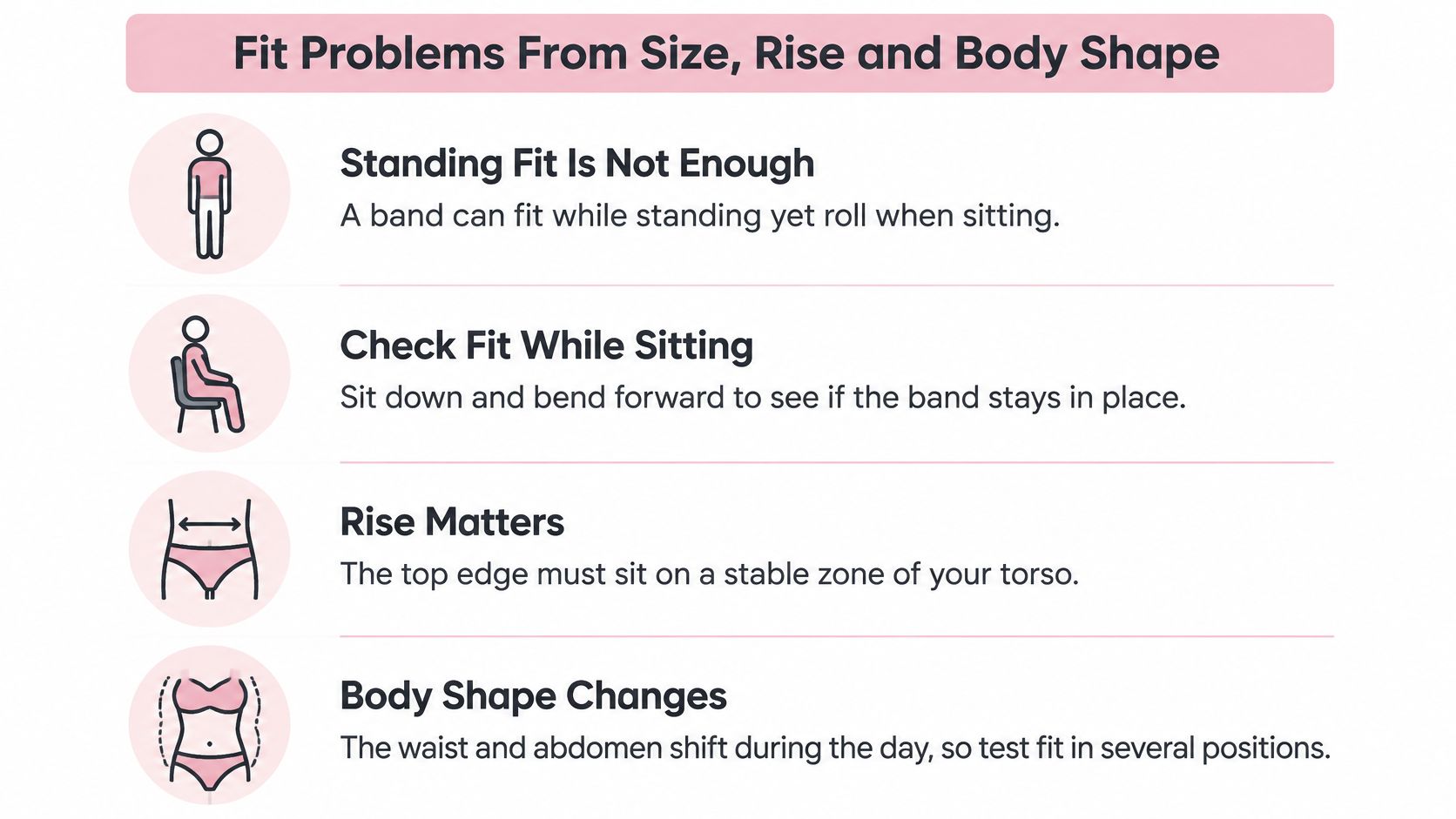
A band can fit perfectly while you're standing in front of the mirror and still roll the moment you sit down. That isn't your imagination. A 2025 study of young women found that sitting and standing create different skin deformation patterns constrained by clothing waistbands, because your waist and abdomen really do change shape between those positions.
Where the Top Edge Lands
Rise decides your anchor point. If the top edge ends on a soft, sloping curve, the band has nowhere firm to grip and it'll migrate. Check these mismatches first:
- Short torso: A standard high rise may overshoot your natural waist and fold at the top.
- Large waist-to-hip difference: The band may fit your waist but strain over your hips.
- Soft landing zone: The band sits on movable tissue instead of a stable anatomical anchor.
Run the Three Position Test
- Stand for two minutes. Look for a deep indentation or a tight ridge.
- Sit for ten minutes. Check whether the band gaps at the back or slides down.
- Walk, bend, and reach. Note the direction, inward, downward, or digging in.
Each direction points somewhere different. Inward suggests excess tension. Downward suggests weak recovery or a rise mismatch. Digging suggests the pressure is too concentrated.
You're far from alone in this, since in 2025, 43% of consumers surveyed by Vogue Business said poor fit deters them from purchasing fashion items, while 36% cited inconsistent sizing, according to Vogue's report on sizing and shopping. That's why the chart matters more than the label.
Nuage Wears gives a NuForme size tip to size up when you're between sizes for the best fit and comfort. Just know the trade-off. Sizing up lowers pressure, but it can also increase slippage if grip was your real problem.
Match the Rolling Pattern to Its Cause
Before you change anything, answer one question. When does it roll? While you're standing, after you sit, during movement, or only after washing? The timing narrows the cause faster than any size chart can.
The symptom looks the same whether the band is too tight or too loose, which is why so many fixes fail. Seven different patterns can all end with a folded band, and the fix that solves one can make another worse.
Rolling Symptoms, Likely Causes and First Fixes
| Symptom | Likely cause | First fix |
|---|---|---|
| Band folds inward within an hour of standing | Band too tight or narrow, so pressure folds over | Size up or switch to a wider, softer band |
| Gaps and slides down when seated | Rise ends too low or too short for your torso | Choose a higher rise or size down |
| Deep red indentation while standing | Compression concentrated in a thin elastic edge | Size up and pick a wider waistband |
| Rolls from the first wear | Wrong size or cut for your waist-to-hip shape | Re-check the seated and standing fit before wearing it again |
| Rolls mainly while walking or working out | Slippery fabric with weak stretch recovery | Choose a bonded or grip-backed band and a snugger fit |
| Sharp fold line at the waist seam | Thick seam edge that creases under pressure | Switch to a bonded band or laser-cut edge |
| Rolls only after washing or months of wear | Elastic fatigue from heat, washing and stretching | Lay-flat check, replace if it stays rippled |
Read your row carefully before you act. Say your band folds inward within an hour but never slides down. Excess pressure is folding it, so sizing down for a snugger fit will only fold it harder. Say it stays flat standing up but gaps when you sit. The rise is ending in the wrong place for your torso, and a different size in the same cut probably won't fix it.
One pair can also show two patterns at once. A band that's slightly too tight can fold inward while you stand and still gap when you sit if the rise runs short. Treat the pattern you see most often first, then retest.
Practical rule: Try the first fix for three wears before you change size. One change at a time tells you what actually worked.
Three wears is enough to test a normal day, a long sitting day, and a moving day. If the pattern shifts but doesn't disappear, you've still learned something useful. You've ruled out one cause, and that gets you closer to the actual one.
How Waistband Construction and Fabric Choice Affect Roll
Elastic works like a spring: it only grips while it can still pull back. That one idea explains why two pairs in the same size behave so differently. One spreads force over a wide area and rebounds after every bend, while the other concentrates everything on a thin line that creases and stays creased.
Waistband Construction and How Each Resists Rolling
| Band type | How it's built | Recovery and friction | Heat response |
|---|---|---|---|
| Narrow folded elastic | A thin strip folded inside fabric | Grips along a small contact line and creases instead of snapping back | Softens fastest in heat and sweat, so rolling often starts mid-afternoon |
| Wide soft band | Elastic spread over a taller band | Shares pressure across more skin, so each movement shifts it less | Runs warmer under fitted clothes on long days |
| Bonded band | Fabric and elastic fused into a single sheet | Stretches and rebounds as one piece, with no edge to fold | Keeps its shape through washing, though it still needs the right size |
| Silicone interior grip | A silicone strip on the inside face | Adds friction against the skin instead of relying on tension alone | Can dig when the fit is too loose or too tight |
| Seamed waistband | Panels joined at one thick seam | A single rigid line folds in the same place every time you bend | The crease sets deeper with repeated wear |
That last row is the same hinge the pattern table flagged: one rigid line, one predictable fold. Bands without a folded edge remove the crease point entirely, and our comparison of bonded versus stitched underwear shows how much that join changes day-long behaviour.
Stretch That Feels Secure, Then Gives Up
Controlled clothing-pressure testing described in a Seoul National University repository record compared garments reducing body circumference by approximately 6-8% with garments reducing it by 12-17%, and the tighter garments produced higher measured pressure plus stronger sensations of tightness and thermal discomfort around the waist and thigh.
So a very snug band can feel secure at 8 a.m. and fold by noon. Excess stretch creates high tension, and heat plus movement encourage the band to settle into the softer tissue below your waist. Fabric finish decides the rest. Smooth, slick weaves slide more readily across skin, while blends with genuine recovery snap back instead of creeping.
Run this screening test before you commit to a size:
- Stretch the waistband to your intended body circumference.
- Hold it for 30 seconds.
- Release it and watch what happens.
- Check for even return without ripples.
- Repeat after laundering exactly as the care label directs.
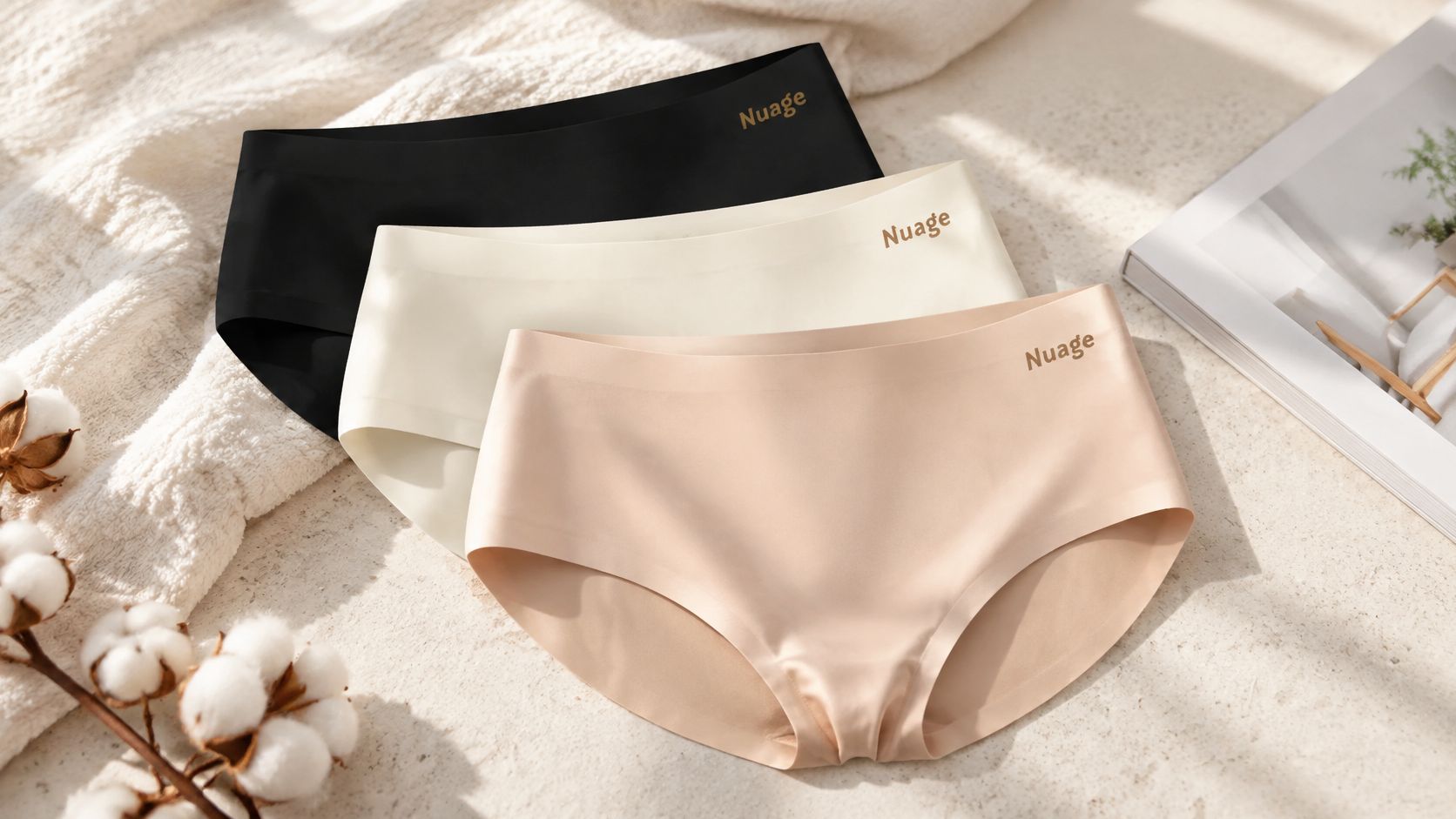
A band that returns flat and fast has the recovery to survive a full day of sitting, standing and walking. The NuCloud Original Mid-Rise Brief(3-Pack) uses a silky, PFAS-free stretch fabric with raw-cut, seam-free edges and a no-dig fit that sits at the natural hip, which is the kind of construction worth comparing against a folded elastic when you run that test.
Movement, Sitting and Travel Triggers
The same pair can behave beautifully at home and fail completely at your desk. That's not inconsistency. Each activity loads the band differently, so the pair isn't changing. The job you're asking it to do is.
Eight Hours at a Desk
Say you sit through a full workday, leaning forward over a keyboard. Your waist and abdomen hold a compressed shape for hours, and the band sits in that fold the whole time. If that's when your rolling starts, run the seated test and consider a higher rise or a wider band that reaches firmer ground.
Workouts and Sweat
Now say the same pair is fine all day but slips during a class. Heat and perspiration change friction, so the grip you had when your skin was dry is gone. Prioritise a bonded or grip-backed band, and look for breathable mesh panels where a design uses them. Our NuAir styles use targeted mesh zoning for airflow and moisture management, which helps the fabric keep its hold.
Flights and Packed Bags
Travel stacks three triggers at once. You sit for long hours, your bag strap presses across your waist, and your spare pairs get compressed in a suitcase. Pack a spare pair, and fold the waistband flat instead of rolling it tight, so you don't crease a hinge into it before you even wear it.
Name the activity where the rolling starts, then pick the feature that matches that activity.
Browsing by context helps more than browsing by colour. Our scenario groupings, Desk to Dinner, Long-Haul Ease, and Made to Move, are a sensible starting point for sorting styles by the day you have.
Check Elastic Wear and Take Action Today
A waistband's elastic works like a rubber band: stretch it past its limit often enough and it stops returning to shape. So before you buy anything, work out whether the pair has just worn out. Lay the suspect pair flat next to a new pair in the same size and look at the band. If it stays rippled or wavy instead of snapping back evenly, that's elastic fatigue, and no size change will rescue it.
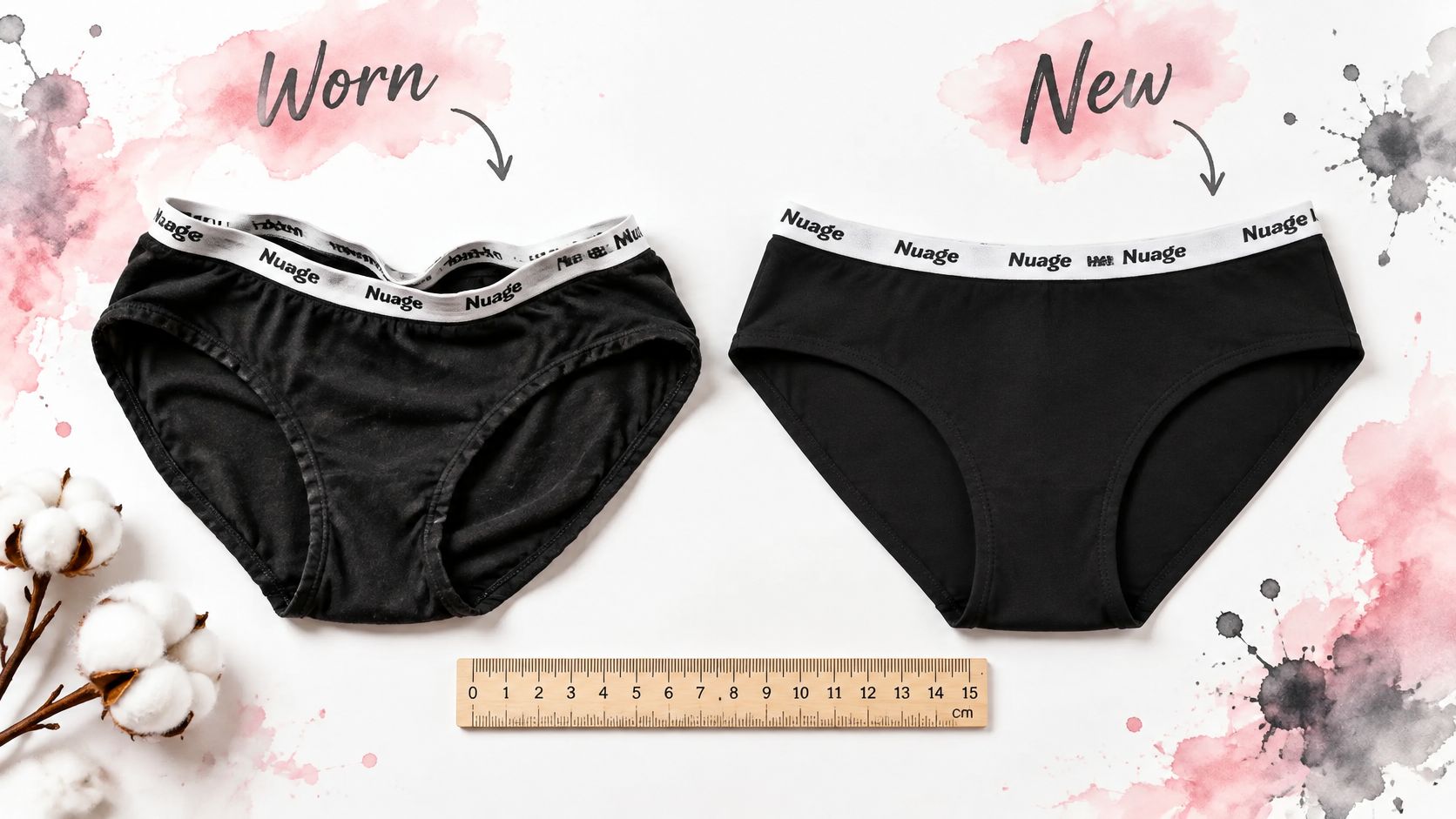
Next, ask when the rolling started. Rolling that began after laundering or months of wear points to fatigue. Rolling from the first wear points to fit, which sends you back to sizing and rise. That timing cue is how many people call a pair done: in a 2024 Talker Research survey of 2,000 Americans, 39% said stretched-out waistbands were a sign that underwear should be replaced.
Care habits decide how fast fatigue arrives. Follow the care label, keep elastic away from high dryer heat, and use a laundry bag for delicate pairs, since heat and agitation are what wear down a band's ability to recover. Skip the exact wash count. A pair earns retirement when its recovery is visibly degraded; fabric that merely feels softer can still grip.
Your Action List for Today
- Pull out the pair that rolls and run the stand, sit, and walk-and-reach test.
- Match the result to the symptom table and try the first fix for three wears.
- Lay the band flat, and retire the pair if it stays rippled.
For your next purchase, check four things: a bonded or grip-backed band, a rise that lands on a stable part of your torso, enough band width to spread pressure, and recovery that passes the screening test. The NuFit Perfect Fit Mid Rise Brief uses bonded bands designed to resist rolling, and the no-rolling filter at nuagewears.com narrows the list to styles built around that fix.
You now have a way to diagnose the roll by its pattern instead of guessing at sizes, and Nuage Wears builds its briefs around these same fixes, with bonded bands, stable rises, and breathable mesh for long days. Head over, use the no-rolling filter, and pick the pair that matches the pattern you found today.