
Bra straps digging into shoulders usually means the load has climbed off the band and onto two narrow strips of elastic. In a survey-based study of women's breast health and bra use, 59% of participants reported at least one bra-related issue, including shoulder straps digging into the skin, rubbing or chafing, upper-body pain, poor posture, and underwire discomfort, as set out in this breast-support biomechanics paper. The same review estimates that approximately 85% of women wear an ill-fitting bra. That second figure is not a headcount of shoulder grooves. It means the fit is off often enough that the straps start doing a job they were never built for.
I would start with the band, not a pad. The straps should steer. They shouldn't haul.
Table of Contents
- Why Shoulder Straps End Up Carrying the Weight
- How to Reset the Fit Step by Step
- Diagnose the Fit Problem Behind the Dig
- Compare Strap Widths, Shapes and Cushions
- Fix the Bras You Already Own This Week
- Know When Shoulder Marks Need a Professional Look
Why Shoulder Straps End Up Carrying the Weight
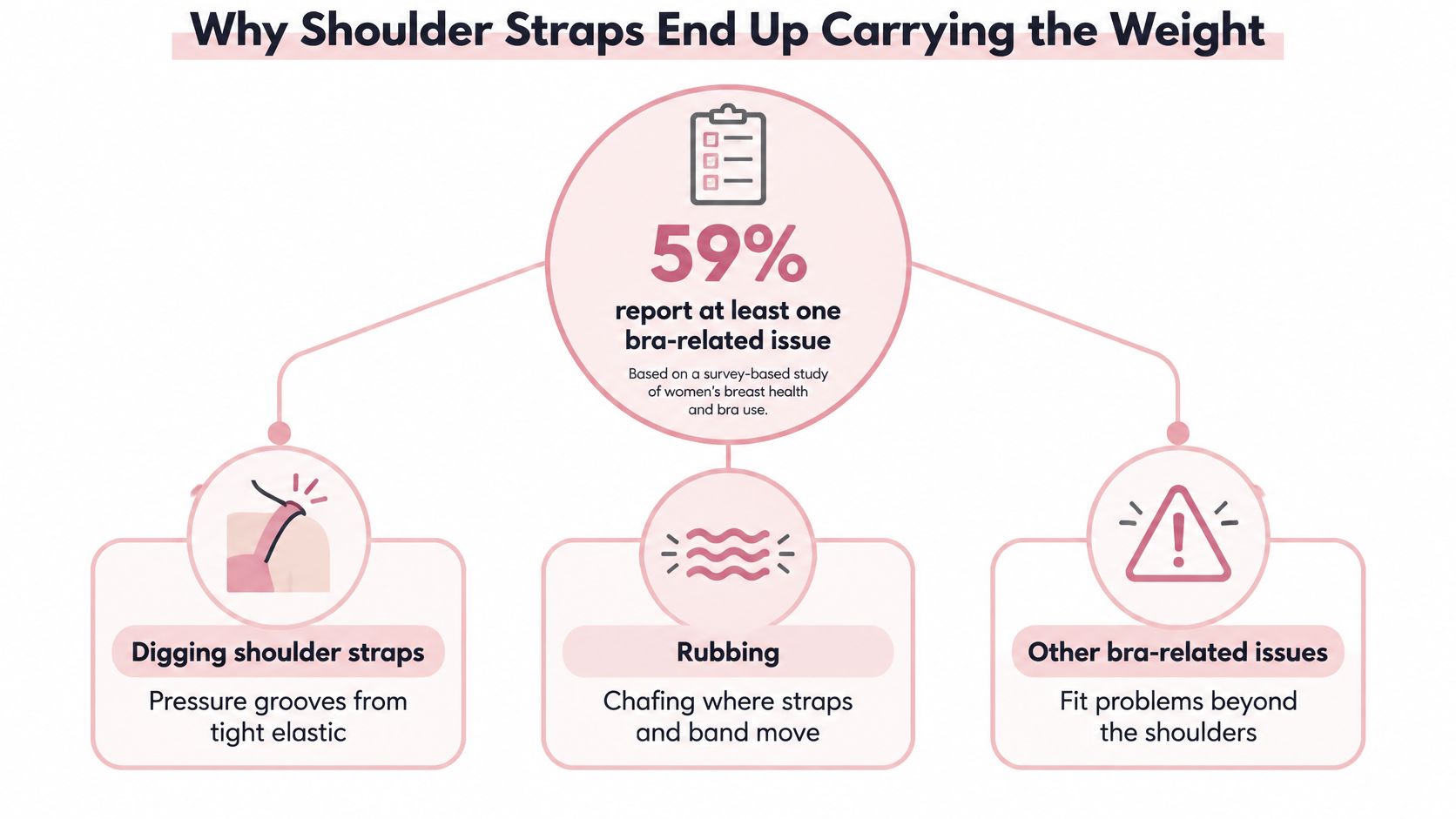
Think of a heavy tote carried by two thin drawstrings. The base of the bag is what should take the weight. Pinch the handles and your fingers pay for it within a block. A bra works the same way. The band anchors under the bust and carries most of the weight. The cups shape and hold the tissue. The straps only fine-tune position. When that chain breaks, bra straps digging into shoulders is the band filing a complaint.
Four pressure sources show up on almost every fitting stool:
- A band that rides up. It's loose, stretched, or too large, so the bust weight transfers upward.
- Cups that are too small or the wrong shape. Tissue pushes forward, and the straps get dragged toward the neck.
- Straps overtightened to compensate. Extra tension concentrates force on a small patch of skin.
- Narrow or tired strap elastic on a fuller bust. D-plus cups meet higher forces, and a lot of everyday styles weren't cut for that load. A supportive cut for a larger bust is covered in our bras for large breasts guide.
In 2025, 33% of women in a survey reported shoulder-strap marks as an issue associated with wearing a poorly fitted bra, a figure Sustain Health published from Pour Moi survey data. Marks alone aren't a diagnosis. Breast Cancer Now's fitting guidance is clear that straps should fit closely without digging, give extra support, and not carry the full weight of the breasts.
Practical rule: If the only change you make is cranking the adjusters, you're treating the messenger.
Heaviness through the neck, shoulders, and back can also sit alongside breast size itself. OC Breast Surgery's notes on macromastia symptoms and pain relief are a useful read when the discomfort is bigger than a red line on the skin. Reset the fit before you touch an adjuster.
How to Reset the Fit Step by Step
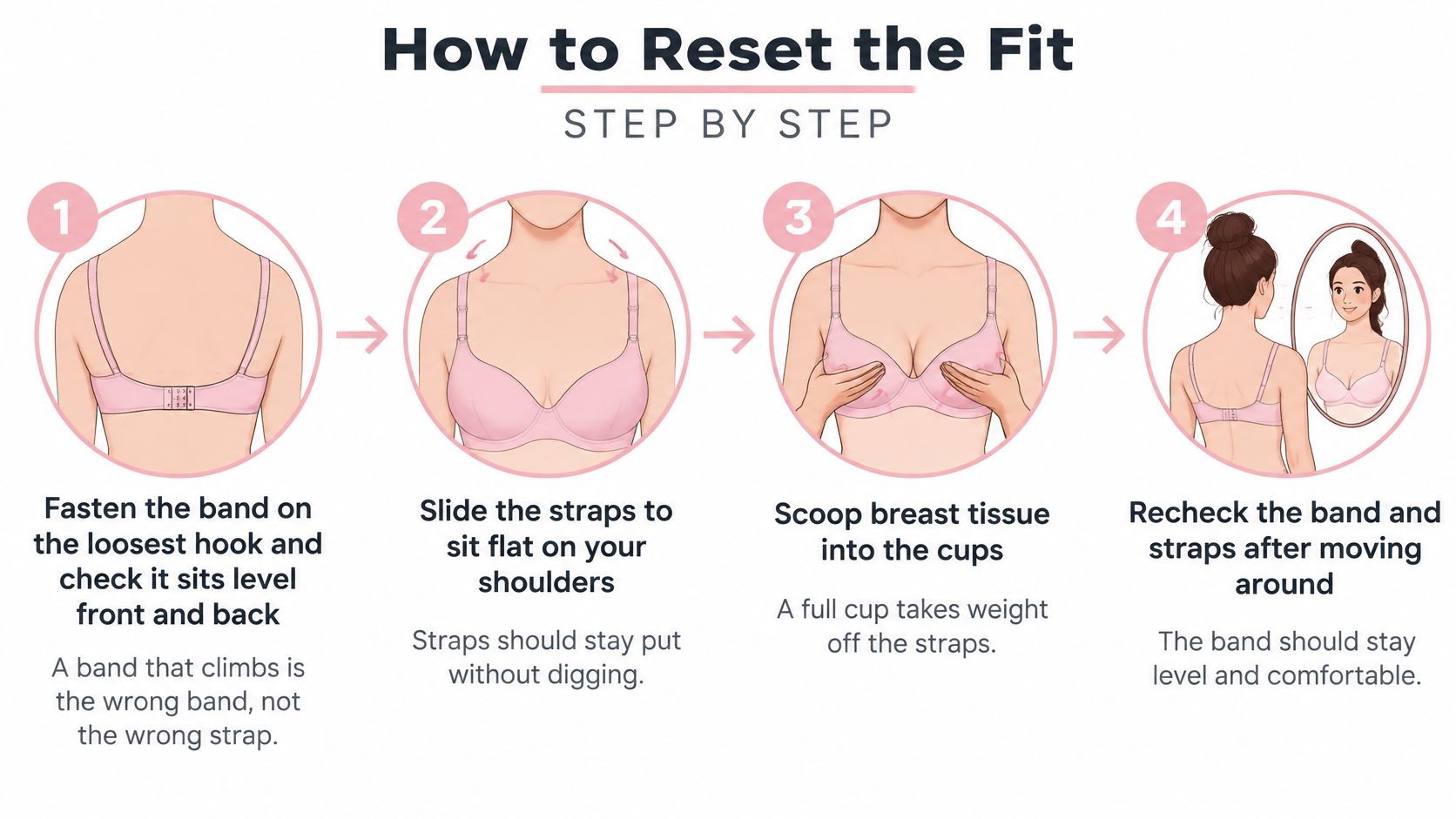
Work in the order a fitter would, not the order the pain suggests. Tightening first hides a bad band.
- Fasten the band on the loosest hook and check it sits level front and back. A band that climbs is the wrong band, not the wrong strap. You should feel a firm hug that stays put when you raise your arms.
- Swoop and scoop. Lean forward and pull all breast tissue into the cup so the band rests at the breast root. The underwire or cup edge should sit in the crease, not on breast tissue.
- Check the center gore. It should lie flat against the sternum. A floating gore means the cup or the band is off, and the straps will try to close the gap.
- Look for spill at the top of the cup or gaping when you move. A small cup pushes the bust forward and drags the straps toward the neck. The cup should be smooth, with no brim of tissue over the edge.
- Loosen both adjusters all the way, then tighten each only until the strap lies flat with no indentation. Two fingers should still slide underneath. If you can't, it's too tight.
- Centre each strap on the shoulder, away from the neck and away from the outer edge. A strap parked on the slope will slip, and you'll tighten it all afternoon.
- Run a five-minute wear test: sit, reach overhead, walk a hallway, roll the shoulders. Static mirror checks miss the pressure spikes that show up once you move.
- Retire any bra you're already fastening on its tightest hook. That band has given you its last useful inch.
Pressure-mapping work recorded average bra-strap pressure of about 1,838.8 Pa, while the band averaged 2,556.8 Pa, which is why support isn't improved just by yanking the straps, as detailed in this bra pressure study. The band is supposed to read higher. If your shoulders feel the load and the band feels slack, the numbers have flipped in real life.
Why the mirror lies
A front-on glance shows straps that look even and a band that looks straight while you're standing still. Sitting, reaching, and walking change the contact. Recheck after about ten minutes of ordinary movement. If grooves appear only then, the elastic is fatiguing or the cup is emptying as you move.
One study found no significant difference in upper-trapezius-region pain between bra-wearing and non-wearing conditions. Shoulder marks aren't automatic proof of a medical problem, and they also aren't something to keep "fixing" with tighter straps. Persistent pain, numbness, headaches, or broken skin needs a clinician, not another afternoon of adjuster clicks.
A short walk-through of the same sequence helps if you'd rather watch the hands than read the list.
Diagnose the Fit Problem Behind the Dig
If the reset didn't settle it, match the pattern before you buy anything. The strap is often the symptom. The National Breast Cancer Foundation bra fit guide notes that a band that's too large can make straps dig because the straps compensate for missing support. Tighter isn't automatically better. Excess strap tension piles load on a small area, and an unstable band sends more of it upward.
| What you notice | Most likely cause | Sizing verdict |
|---|---|---|
| Band rides up at the back and straps dig | Band too large or elastic stretched out | Down one band size, up one cup |
| Red marks under straps with spill at the top of the cup | Cup too small or too shallow | Keep the band, go up one or two cup sizes |
| Straps slip off the shoulders and get tightened all day | Straps set wide apart or band sliding down | Fix the band first, then shorten each strap equally |
| Digging on one shoulder only | Shoulder slope or one strap shortened more | Adjust each side separately; a strap stay holds the flatter side |
| Comfortable at 8 a.m., digging by 3 p.m. | Elastic fatigue through the day | Rotate bras; replace any bra you already wear on the tightest hook |
| Digging only during workouts | Insufficient support for movement on narrow straps | Higher-support style with wide vertical straps |
| Straps cut in close to the neck | Cross-back or racerback pulling inward | Try vertical straps for sustained wear |
| Center gore floats off the sternum | Cup too small or band too loose | Down one band size, up one cup |
Two patterns I see constantly
Say the band climbs between your shoulder blades by lunch and both straps have left a groove. That's row one. Sister sizing keeps cup volume and firms the anchor. A 34C becomes a 32D when you go down a band and up a cup. A 36DD becomes a 34E. Same tissue, a band that can hold.
Say you have red marks plus tissue spilling at the neckline, and the band feels fine. Don't drop the band. Go up one or two cups and leave the rib size alone. A shallow cup shoves the bust forward, and the straps pay for the geometry.
A third pattern is the 3 p.m. dig on a bra that felt fine at 8 a.m. The elastic has relaxed through the day. Rotating bras gives it a rest. If you're already on the tightest hook, replacement beats another shorten-the-strap session.
A 2025 U.S. National Institutes of Health-funded project, described in that same fit guide, links neck, shoulder, arm, and back pain strongly to bra cup size and notes that many commercially available sports bras are designed for C cups or smaller, so D-plus wearers are often under-supported once they move. Fix one row at a time, wear the bra for an hour, and only then change the next thing. Our checklist for how to know if your bra fits correctly walks the same checks without jumping straight to new straps.
Compare Strap Widths, Shapes and Cushions
Width helps. Orientation and padding are not automatic upgrades. Pick the construction for the day you're having.
| Strap design | Typical width | What testing shows | Best for | Trade-off |
|---|---|---|---|---|
| Standard straight strap | Narrower than 4.5 cm | Higher discomfort and higher shoulder pressure than wide straps in treadmill tests | Smaller busts and short wear | Load sits on one narrow strip |
| Wide straight strap | About 4.5 cm | Lowest discomfort and significantly lower shoulder pressure than standard-width and gel straps (p < 0.001) | D-plus cups and all-day wear | Can look sporty under thin clothes |
| Gel or padded strap | Pad thickness, not a wider base | Did not reliably lower pressure when the pad failed to enlarge contact area | A single event or temporary marks | Bulk without a wider load path |
| Cross-back or racerback | Same strap, pulled inward | Less vertical breast movement and less slippage, but higher shoulder force and mean pressure than vertical straps | High-impact exercise and straps that fall off | Pulls toward the neck and is harder to adjust |
| Vertical strap | Standard to about 4.5 cm | Significantly less discomfort than cross-back even when pressure was similar | Desk, commute, and long wear | Can slip on sloping shoulders if the band is unstable |
In treadmill testing with D-cup and larger participants, the wide strap produced the lowest discomfort scores and significantly lower shoulder pressure than both standard-width and gel designs, at p < 0.001, and vertical straps generated significantly less discomfort than cross-back straps even though people often preferred the cross-back look, according to this strap-pressure trial. A controlled sports study of women with large breasts found that straps of approximately 4.5 cm lowered strap pressure and discomfort versus standard-width straps, while crossed-back straps raised shoulder force and mean pressure and strap cushions failed when they didn't enlarge the contact area, as reported in this sports-bra strap comparison.
What the peaks actually mean
A lab test of 14 women with C-or-larger cups, running on a treadmill, recorded maximum shoulder-strap pressures from 0.83 to 2.67 N/cm² and mean pressures from 0.52 to 1.06 N/cm², in this treadmill strap study. Crossed straps cut vertical breast displacement and helped both pain and slippage versus no straps. They also concentrated more force on the shoulder. That's the racerback trade-off nobody puts on the hangtag. Slippage down, a new hotspot near the neck.
Shortening the strap is not a support upgrade. One sports-bra pressure study found shoulder pressures as high as 4.66 kPa before exercise and 4.41 kPa after exercise when strap length was reduced, in this interface-pressure paper.
For a desk day, commute, or long travel day, I'd choose wide vertical straps. For high-impact work and straps that won't stay on, a cross-back can be the right tool, then you recheck the neck. Use a cushion only when it widens the skin contact, and only for a short stint. Whatever the shape, keep the strap centred on the shoulder.
On days a separate bra strap keeps wandering, a Holder Cami Top with a built-in bra, 3D breathable cups, and anti-slip construction can hold position under a top. It still needs the band idea underneath. A halter neck that hauls the bust is the same mistake in a prettier cut.
Fix the Bras You Already Own This Week
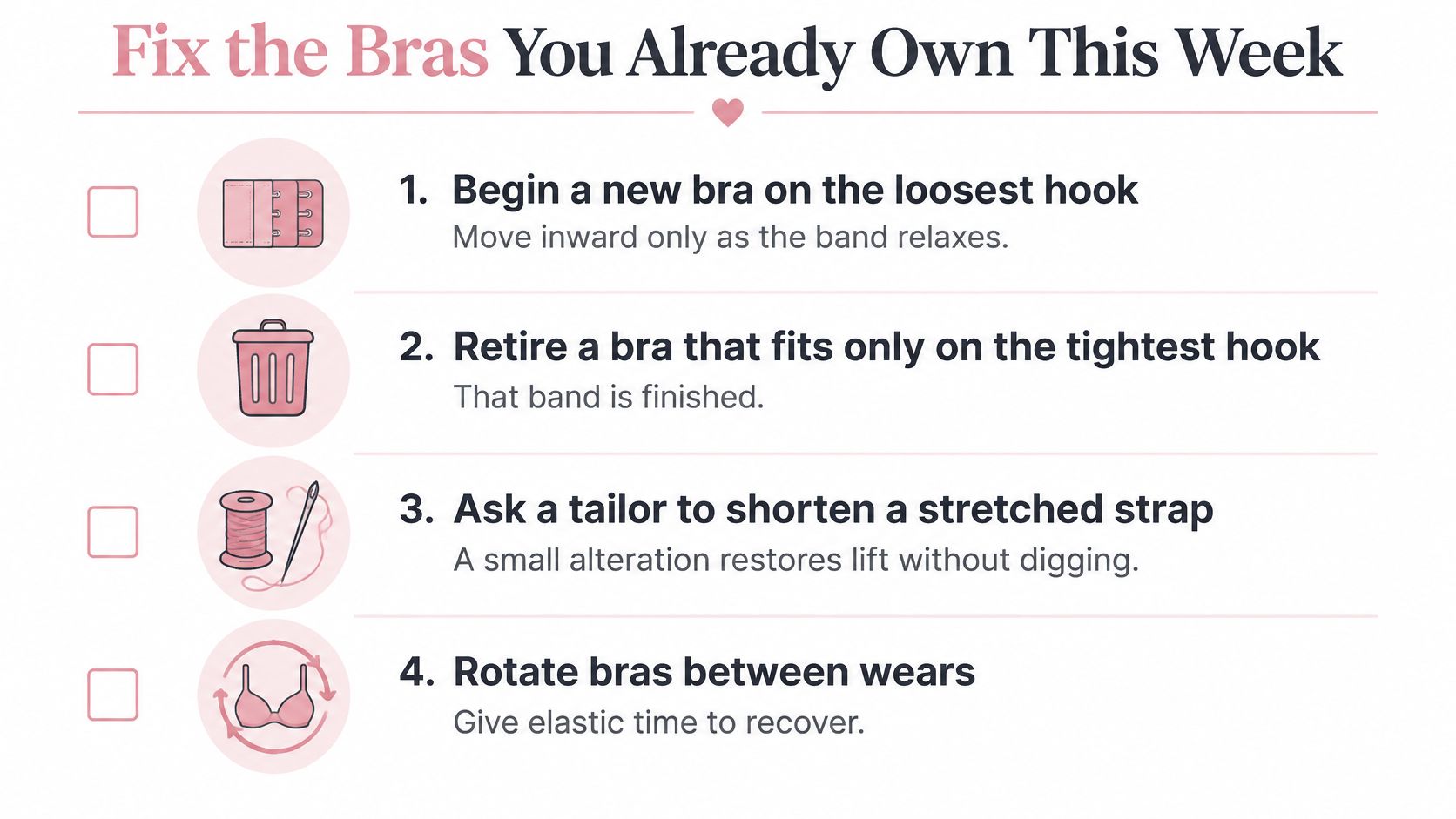
You don't need a new drawer before Friday. Start with what's already there, and know the catch on each fix.
- Begin every newer bra on the loosest hook and move inward only as it relaxes. Cost is nothing. The catch is honesty: a bra that fits only on the tightest hook is finished.
- Ask a tailor to shorten a loose band by 2 to 3 cm so the anchor comes back. That's usually less than a new bra. The catch is a band with crunchy, wavy elastic. Shortening dead elastic doesn't restore it.
- Clip on a racerback converter only when straps fall off, never to stop digging. The clip is cheap. It pulls both straps toward the neck, which is how a slippage fix becomes a new groove.
- Use a pad for one event only if it widens the contact patch. A thick gel blob that doesn't spread the load is just bulk on the same line.
- Match the free tail on each adjuster so one shoulder isn't shorter. Uneven tails are the quiet cause of one-sided digging.
- Rotate three or four bras, hand wash in cool water, and don't tumble dry. Heat and daily wear are what kill the band.
In 2025, 72% of respondents to an initial LinkedIn survey by Dr. Aditi Madan said they adjusted their bra straps during the day to get through work, which she shared in this strap-adjustment note. Constant adjusting means the band or the cup is wrong. The strap is the thing you can reach, so it gets the blame.
This week's pass
Run the band check and the five-minute wear test on every bra you reach for. Retire anything with twisted, crunchy elastic. When you replace one, shop the band first, then strap width.
Our Perfect Coverage Push Up Back-Hook Bra is built with 2 cm adjustable straps and a U-back that spreads load across the shoulders, priced at $36. If you're between sizes, size up. A strap that starts wider still can't rescue a band you had to crank shut.
Know When Shoulder Marks Need a Professional Look
A mark that fades within 20 to 30 minutes is ordinary pressure from a snug band and straps that are doing a light job. Change nothing if that's the only trace and the bra felt stable through the day.
Grooves that last for hours, numbness or tingling in the fingers, headaches, skin that breaks down or stays tender, and pain on one side only deserve a clinician's look. Another round of loosening won't sort a nerve or a skin injury. The pain evidence is mixed enough that I won't tell you a red line equals a diagnosis, and I also won't tell you to keep self-treating symptoms that outlast the bra.
If the mark is the only symptom, fix the fit. If there's pain, numbness, or skin damage, get it checked.
A professional fitting is the sensible middle step. A fitter sees a band that rides and a cup that gaps in ways a bathroom mirror hides, especially once you sit and reach. Full-bust shoppers should be picky about activity bras, because a style cut for a smaller cup leaves the straps hauling as soon as you move.
Bring the bra that hurts, not your "good" one. Say when the dig starts, whether it's one shoulder, and whether it shows up only at your desk or only when you train. That timeline is more useful than another pad.
Nuage Wears builds underwear, bras, and bralettes around the problems that show up by midafternoon, including straps and bands that dig. If your shoulders are carrying the bust, start with a band that holds and straps that only steer. Visit Nuage Wears and try a fit that keeps the weight off your shoulders.