
You're getting dressed for work, and your underwear waistband sits above your trousers. You change into a lower pair, but now the leg edges shift whenever you sit. The briefs vs hipster decision suddenly feels less like a style preference and more like finding the right foundation for the clothes you wear.
Choose by outfit and movement, not by the name on the label. Briefs and hipsters can both earn a place in your drawer, but they solve different fit problems.
Table of Contents
- Choosing Between Briefs and Hipster Cuts
- How Brief and Hipster Cuts Are Defined
- Coverage Rise and Everyday Fit
- Match Your Cut to Body Shape and Movement
- Style Both Cuts for Real Outfits
- Apply Nuage Cut and Construction Details
- Make Your Final Cut Decision
Choosing Between Briefs and Hipster Cuts
Start with the trousers on your bed. If they're high-waisted and you want coverage across your stomach and seat, I'd reach for a brief. If you're wearing low-rise denim and don't want your underwear peeking above it, I'd start with a hipster.
That's a starting recommendation, not a comfort ranking. A beautifully fitting brief can be wrong for low-rise jeans, just as a comfortable hipster can land awkwardly beneath the waistband of trousers.
| Your immediate priority | Start with | What to check |
|---|---|---|
| Coverage beneath high-waisted trousers | A mid- or high-rise brief | Whether the waistband feels comfortable when seated |
| A discreet waistband beneath lower-rise denim | A hipster | Whether it remains covered when you bend |
| Fewer visible edges under fitted clothing | Either cut with a flat finish | Where the leg openings meet the outer fabric |
| Less adjusting during a busy day | The cut that fits your proportions | Whether the seat stays covered during movement |
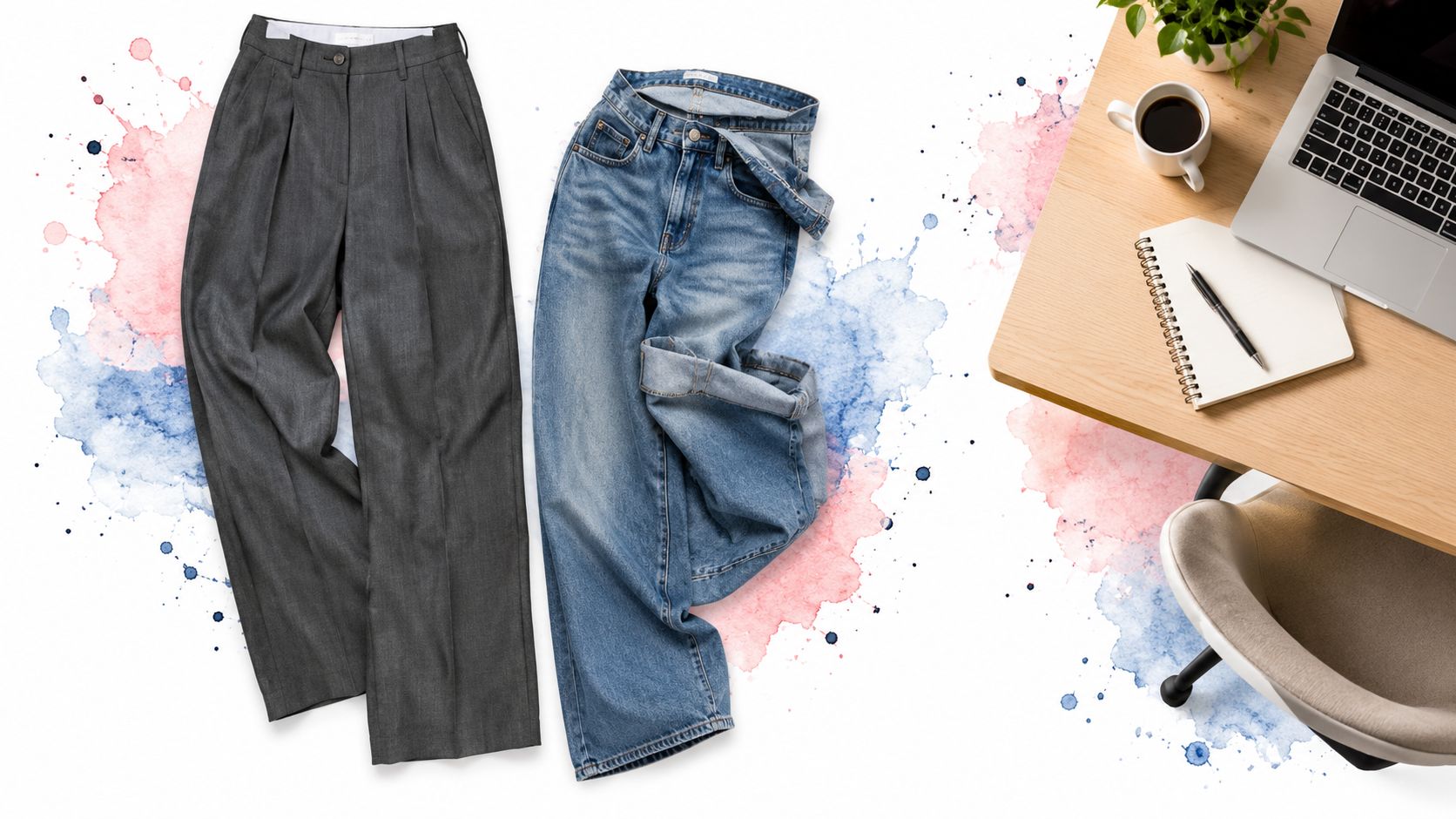
Match the whole outfit
My advice is to judge underwear while wearing the clothes it needs to work beneath. A pair that feels unobtrusive on its own may create an edge under close-fitting trousers or sit above a lower waistband.
Use the outer garment's waist position, fabric, and closeness of fit as your first filters. Then consider your day: desk work, walking, commuting, or repeated bending.
Practical rule: Don't ask which cut is more comfortable in general. Ask which pair lets you wear today's outfit without adjusting it.
For the blog cover, preserve the 280:210 aspect ratio rather than stretching the image to fit another shape. Specifying dimensions or responsive image behavior also follows image presentation guidance.
How Brief and Hipster Cuts Are Defined
Briefs are the established fuller-coverage family, with variations that include high-rise, mid-rise, full, and high-leg cuts. Their long commercial history helps explain why the word describes a broad category rather than a single shape, as outlined in this history of underwear terminology and development.
Hipsters generally sit lower across the hips. They offer a lower-profile alternative to fuller briefs without adopting thong-style minimal coverage. Their association with low-rise clothing is central to the distinction between bikini, brief, and hipster silhouettes.
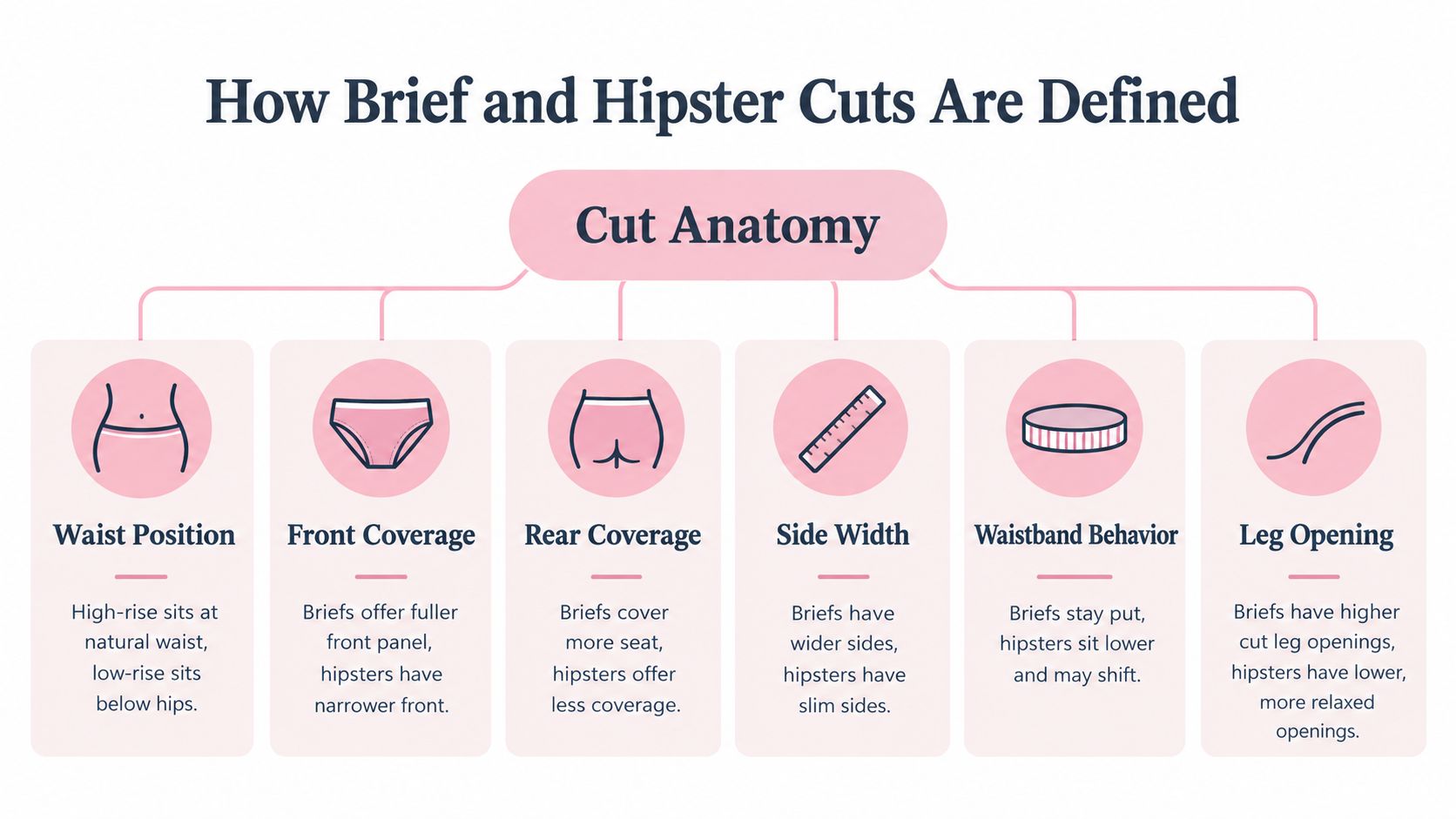
Read the anatomy, not just the category
Use the diagram as an orientation, not a promise about every garment. Neither label guarantees side width, leg height, rear coverage, or stability. A high-leg brief and a full brief can feel very different, while a hipster can have substantial side panels.
- Waist position: Identify where the top edge is intended to sit relative to your natural waist and hip bones.
- Front coverage: Look at the panel's height and width, not just the waistband.
- Rear coverage: Check how much of the seat the garment encloses and where the lower edge finishes.
- Side width: Inspect the actual panel. Don't assume every hipster has narrow sides or every brief has broad ones.
- Waistband behavior: Notice the band's construction and tension rather than assuming a higher waistband will stay put.
- Leg opening: Compare the curve and placement around your thigh and seat.
Separate rise from leg height
A high-rise garment reaches farther up the torso. A high-leg garment has a higher-cut opening around the leg. Those features can appear together, but they aren't interchangeable.
When shopping, I'd prioritize a clear photograph, a useful size guide, and construction details over a familiar category name. If a description says “hipster” but the photograph shows proportions you don't usually enjoy, trust what you can inspect. Your body wears the garment's dimensions, not its label.
Coverage Rise and Everyday Fit
The useful comparison isn't “more fabric versus less fabric.” It's where that fabric sits, how firmly it holds, and whether its edges interfere with you.
Briefs and hipsters compared
| Criterion | Brief | Hipster | Decision Question |
|---|---|---|---|
| Front and rear coverage | A fuller starting point, depending on the variation | A lower-profile option with coverage that varies | Which areas do you want enclosed? |
| Rise | Available in several waistband heights | Usually positioned across the hips | Where do you prefer the top edge? |
| Smoothing | Broader coverage may create a more continuous foundation | Less fabric above the hips | Do you want coverage or actual compression? |
| Waistband feel | May sit closer to the abdomen | Applies tension lower on the torso | Where does pressure bother you? |
| Leg-edge placement | Depends on full, high-leg, and other variations | Depends on the seat and leg cut | Does the edge cross a tightly fitted area? |
| Movement | Fuller coverage can suit those seeking enclosure | A lower profile can suit those avoiding torso fabric | Which pair needs less adjustment? |
| Heat and moisture | Evaluate fabric and construction | Evaluate fabric and construction | Does the pair remain comfortable through your day? |
| Visible edges | Possible with either cut | Possible with either cut | Are the finish and placement discreet beneath your outfit? |
Coverage and smoothing aren't compression
Choose a fuller brief if you dislike feeling exposed across your stomach or lower seat. Choose a hipster if that extra torso fabric feels unnecessary beneath your usual clothes. Neither preference needs defending.
Be precise about smoothing. An everyday brief can provide a continuous layer beneath clothing, but don't treat it as a promise of body reduction. If you want compression, look for a garment explicitly designed for that purpose rather than buying ordinary underwear too small.
A hipster can reduce excess fabric above the hips, but that doesn't make its waistband automatically gentler. A lower band that feels restrictive is still the wrong fit.
Pressure matters more than the label
A technical review identifies covered area, respiration, and compliance with body movement as influences on waist pressure. That makes pressure distribution and movement response more useful comfort criteria than the cut name alone, according to the review of clothing pressure and comfort.
For everyday shopping, translate that into a simple standard: the waistband shouldn't demand your attention whenever you breathe or change position. Reject persistent pinching instead of assuming you'll get used to it.
More coverage isn't automatically more comfortable. Less coverage isn't automatically less restrictive.
The same reasoning applies to leg edges. I'd choose the pair whose opening follows your body without pulling tightly across the seat, even if it isn't the cut you expected to prefer.
Is either cut better for vaginal health?
Neither label establishes a health advantage. Available reporting describes limited research on underwear style and vaginal health, while noting that tight-fitting underwear can contribute to friction and irritation. Fit, fabric, moisture, and wear duration deserve more attention than a simplistic style ranking, as discussed in this overview of underwear and intimate health.
For hot or active days, prioritize breathable construction and change out of damp underwear rather than expecting a particular silhouette to solve everything. Seek medical advice for persistent irritation or recurrent symptoms.
Match Your Cut to Body Shape and Movement
Start with the area you keep adjusting. If you're pulling fabric back over your seat, assess rear-panel shape and coverage. If you're folding the waistband down, reassess its position and tension before deciding that all briefs are unsuitable.
Body-shape labels are shopping clues, not fitting rules. A pear-shaped or peach-shaped body doesn't automatically need a hipster, a brief, or a particular leg line.
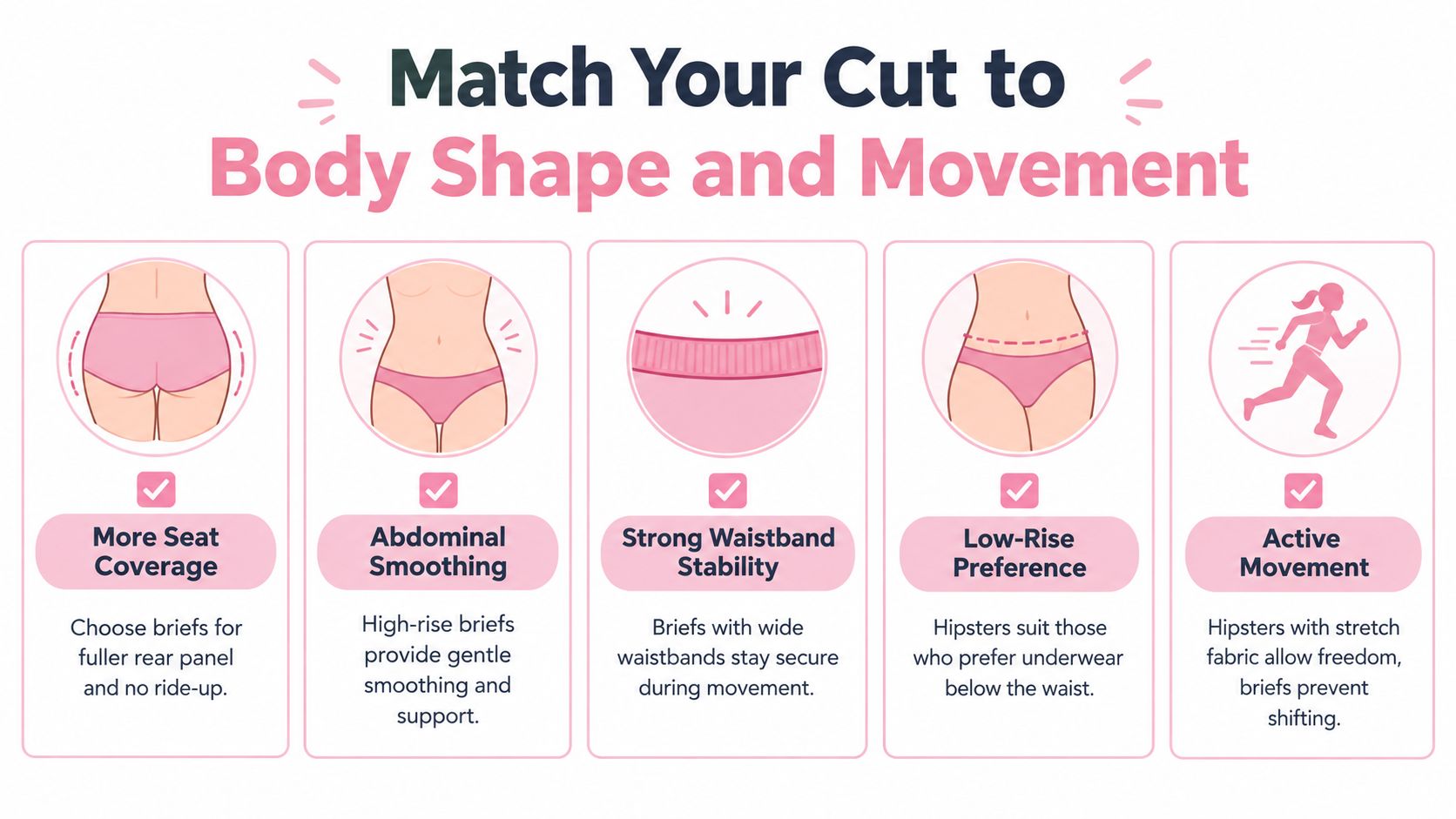
Fit the seat and torso separately
For more seat coverage, I'd begin with a fuller rear panel rather than moving up to a higher waistband. For abdominal coverage, start with a mid- or high-rise brief, then check whether its top edge sits somewhere you enjoy wearing a band.
A shaped seat is worth investigating if flat panels repeatedly pull across your curves. For pear- and peach-shaped bodies, a contoured rear panel plus enough coverage is a sensible feature combination to try, not a guarantee of no ride-up.
- Check the size first: Use the women's underwear sizing guide rather than assuming your usual clothing size will transfer.
- Inspect the front and back: Don't accept a comfortable waistband if the seat feels stretched or the front panel bunches.
- Keep your preference: If you dislike fabric near your natural waist, begin with a lower cut instead of forcing yourself into a fuller silhouette.
Make the fitting room move
Stand naturally, sit in a chair, walk, and bend to reach something. Notice what happens during each transition, not just once you've settled into the position. Don't pull the underwear back into place between checks, because you want to see whether it needs rescuing.
If you already use guided mobility sessions, the GrabGains stretching app from GrabGains can be a contextual resource for your movement routine. Keep underwear assessment separate from exercise performance: you're checking whether your clothing accommodates familiar, comfortable movement, not testing your flexibility.
Fit checkpoint: A pair that looks right standing up still has to earn its place when you sit down.
Pay attention to the location of any discomfort. A band problem, a seat problem, and a leg-opening problem call for different changes. Try another size when the overall garment feels wrong; try another construction when only a particular edge or panel keeps bothering you.
Style Both Cuts for Real Outfits
For a workday in high-waisted trousers, I'd start with a brief that sits comfortably beneath the trouser waistband. For an evening in low-rise jeans, I'd switch to a hipster. That's wardrobe planning, not inconsistency.
The most useful outfit comparison considers garment rise and fabric together. Broader market coverage also emphasizes comfort, moisture management, breathability, and seam-conscious construction, but those priorities still need translating into your own wardrobe, as reflected in this underwear market overview.
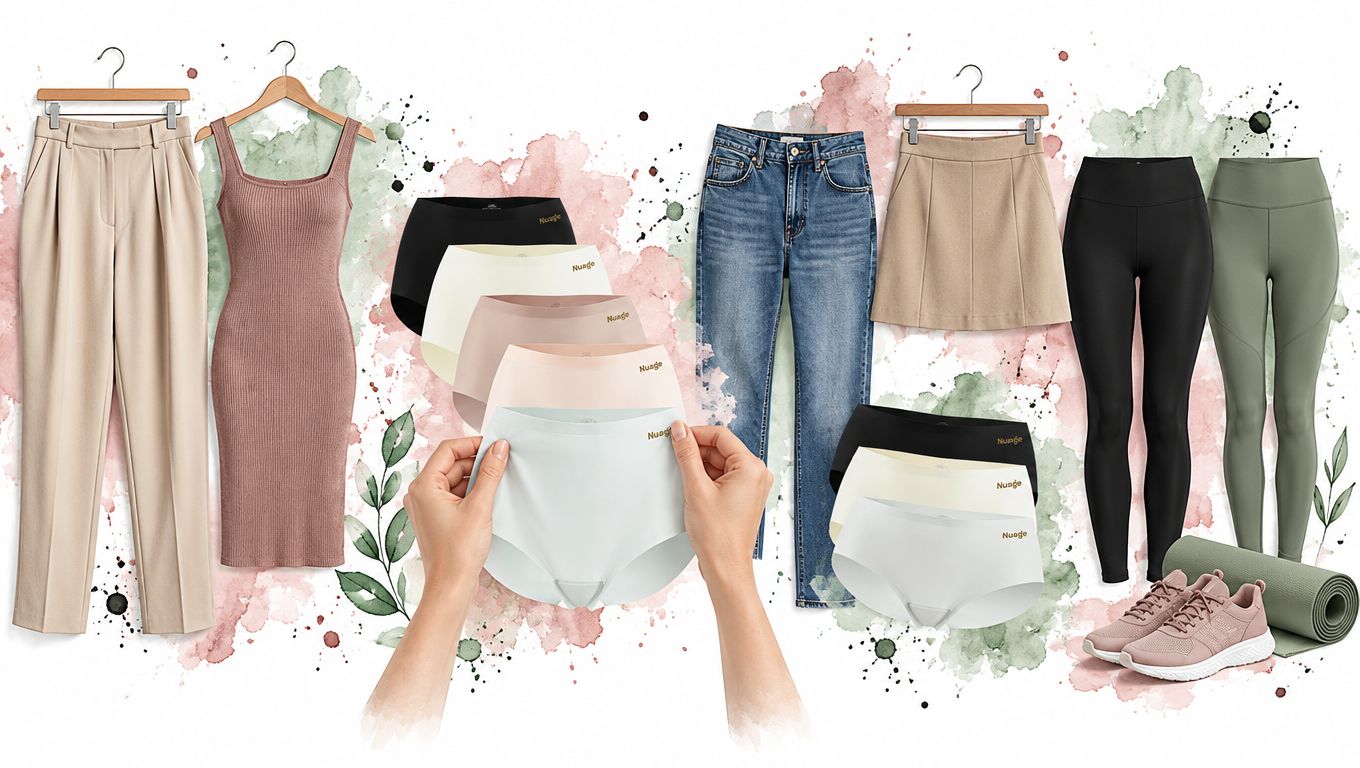
Work trousers and denim
High-waisted work trousers: Begin with a mid- or high-rise brief if you want a fuller foundation. Sit at your desk before committing to the combination, especially when the trousers have a firm waistband.
Low-rise jeans: Start with a hipster and check the back while bending. You want the underwear covered during ordinary movement, not merely while standing in front of the mirror.
Mid-rise denim: Try both. I'd decide by where the combined waistbands feel least intrusive rather than assuming they must align perfectly.
Dresses skirts and leggings
For fitted dresses and narrow skirts, inspect the silhouette from the side and back in ordinary light. Choose the edge placement that's least noticeable under that particular fabric. A smaller cut isn't automatically more discreet if its leg opening crosses the tightest part of the garment.
Under leggings, I'd prioritize a flat finish and a seat that doesn't require adjustment. Before switching cuts entirely, use this guide to avoiding panty lines to distinguish an edge-finish problem from a sizing or placement problem.
For a loose dress, you have more freedom to choose by coverage preference. Don't sacrifice your preferred fit to solve a visibility issue the outfit doesn't have.
Activewear and travel clothing
For exercise, test underwear beneath the activewear you'll use, including familiar bending and stepping movements. If fuller coverage feels secure, choose it; if a lower waistband feels less distracting, start there.
For travel, I'd choose around the longest seated stretch of the journey, not just the walk to departure. A breathable brief such as the NuAir Mesh Raw Brief is a construction reference to investigate, but the name alone doesn't establish how it will fit you.
If you're assembling a travel wardrobe and need help coordinating outfits, personal shopping help from Approved Experiences, from Approved Experiences Traveler, is a relevant resource. Decide on the clothing combinations first, then choose underwear for those actual outfits rather than packing speculative alternatives.
Apply Nuage Cut and Construction Details
Product descriptions become useful when you turn each feature into something you can inspect. Low rise, contoured coverage, raw-cut edges, and breathable construction describe different decisions. Don't bundle them into an automatic promise of comfort.
Read the low-rise example carefully
The NuCloud Original Hipster is described in its catalog copy as a low-rise bikini, despite the Hipster product name. That overlap is a good reminder to inspect the garment's proportions instead of relying on terminology alone.
Its listed construction includes stretchy, PFAS-free fabric, a contoured seat, raw-cut waistband and leg edges, and a cotton-lined gusset. Treat those as selection cues, not proof that it will be invisible or stay perfectly positioned on every body.
- Coordinate the rise: Try the low waistband beneath your lower-rise bottoms before making it your everyday default.
- Inspect the contoured seat: Look for fabric that follows your shape without pulling the leg edges inward.
- Check the raw-cut finish: Confirm that the edges remain flat beneath your chosen clothes.
- Follow the fit guidance: The catalog recommends sizing up if you're between sizes.
The catalog also describes a breathable, moisture-wicking weave. That makes it a relevant option to assess for warm days or travel, but personal comfort still requires a wear test. Avoid translating a fabric feature into a medical claim or an unconditional performance guarantee.
Assess a brief with the same discipline
For the mesh brief mentioned above, I'd use the same purchasing process rather than assuming the fuller silhouette makes it the stronger choice. Confirm its stated rise, examine the waistband, and inspect where seams or finished edges will sit beneath clothing.
If airflow is your priority, read the actual fabric and panel details. If waistband stability is your priority, look for construction information that addresses that concern. A product name is not a substitute for either.
Buy the feature you need, then verify that the garment delivers it on your body.
Keep the comparison fair by testing potential pairs beneath the same outfit. Changing the trousers, underwear size, and cut at once makes it harder to identify what improved. A deliberate comparison gives you a useful answer for the next purchase, not just a hopeful first impression.
Make Your Final Cut Decision
Choose a brief first when your priority is fuller front and rear coverage, a higher waistband, or a continuous foundation beneath higher-waisted clothing. Choose a hipster first when you want a lower waistband and less fabric above the hips.
Switch when the outfit or your comfort priorities change. You don't need a single winning silhouette for workdays, flights, workouts, and weekends.
Make the decision with your clothes on
Set aside the idea that one cut should solve every problem. Use your preferred starting silhouette, then let the fit checks decide whether to keep it, change size, or try another construction.
- Seat coverage: Does the rear panel cover what you want without repeated adjustment?
- Leg-edge visibility: Are you comfortable with how the edges look beneath the actual outfit?
- Waistband pressure: Can you sit and breathe comfortably without folding or repositioning the band?
- Movement stability: Does the pair remain acceptable through walking, sitting, and bending?
- Fabric comfort: Does the construction suit the heat, activity, and wear time you expect?
Keep what works for a clear reason
A successful fitting should give you a specific conclusion: this pair works beneath fitted trousers, this lower cut suits denim, or this breathable construction feels preferable for a long day. That's more useful than deciding you're permanently a brief person or a hipster person.
The strongest briefs vs hipster recommendation is therefore practical: build a small rotation around your real outfits and recurring fit needs. Keep the pairs you stop noticing, and stop making excuses for the ones you constantly adjust.
Nuage Wears offers comfort-first underwear across lower-rise and fuller-coverage cuts, with construction options focused on visible lines, digging, and movement. Visit Nuage Wears, choose the rise that suits your most-worn outfit, and compare the sizing and edge details before selecting your next pair.