
You're standing in front of the mirror five minutes before you need to leave. The cut out shoulder shirts in your drawer look great on the hanger, but the one you've picked keeps sliding, your bra strap is showing through the opening, and the sleeve is already drooping. You don't need a new trend. You need a cutout that stays centered, a bra that disappears, and fabric that recovers when you move. Judge every style below by binding, sleeve drop, fabric recovery, and bra placement, not by whether someone calls it in or out.
Table of Contents
- Cut-Out Shoulder Shirt Styles Compared
- Construction Details That Make a Cutout Look Intentional
- Fabrics That Keep the Opening in Place
- Bra Options That Work With Open Shoulders
- How to Test the Opening Through Movement
- Styling Cut-Out Shoulder Shirts by Occasion
- Choose the Cutout Shirt and Bra Pairing for Your Week
Cut-Out Shoulder Shirt Styles Compared
A cut-out shoulder shirt keeps a full sleeve and adds a deliberate opening at the shoulder. An off-the-shoulder top does something different, because its neckline sits below the shoulder line and leaves you with no sleeve structure at all. Pick by opening shape and coverage first, occasion second.
| Style | Opening Shape | Sleeve Coverage | Best For |
|---|---|---|---|
| Small shoulder window | Narrow oval at the deltoid | Full sleeve kept | Office, travel, layering |
| Sleeve slit | Vertical opening along the upper arm | Partial | Weekend and casual days |
| Asymmetric cutout | One shoulder open, one covered | Partial | Dinner and evening |
| Architectural cutout | Clean geometric panel with straight edges | Full sleeve kept | Smart casual and events |
| Off-the-shoulder top | Neckline falls below the shoulders | None | Evenings and parties |
How to Read the Five Styles
Start with the small shoulder window. It's the most wearable option because the narrow oval shows a controlled flash of skin while the full sleeve, neckline, and bra strap zone stay covered. It layers under a blazer without bunching and it reads polished at the office.
The sleeve slit runs vertically along the upper arm, so it moves more as you bend your elbow. That movement makes it relaxed and airy for weekends, but it also means the opening can flare if the fabric is floppy. Choose it when casual is the goal.
An asymmetric cutout opens one shoulder and covers the other. That imbalance is the point, and it's strong for dinner because it looks deliberate from across a table. It's also the least forgiving with bra straps, since one side has nowhere to hide hardware.
The architectural cutout uses straight, clean edges and keeps the full sleeve. It looks modern because the geometry feels planned, not accidental. If you worry a cutout will look dated, this is your safest shape.
The off-the-shoulder top is your comparison point, not your default. You give up sleeve coverage, structure, and easy bra compatibility. Save it for evenings when you won't be reaching, carrying, or layering much.
This controlled exposure is why the style scaled so fast. The NZ Herald report on the 2016 shoulder trend says fashion analytics firm Edited reported arrivals of cold-shoulder tops and dresses rose 218% year over year in the first quarter of 2016, while off-the-shoulder arrivals rose 110% year over year. You get a visible fashion detail while keeping sleeve coverage and garment structure.
Ask three questions before you choose. How much skin do you want to show? Where will you wear it? Which bra will go underneath? Answer the bra question in the bra section below, then pick one style to try first.
Construction Details That Make a Cutout Look Intentional
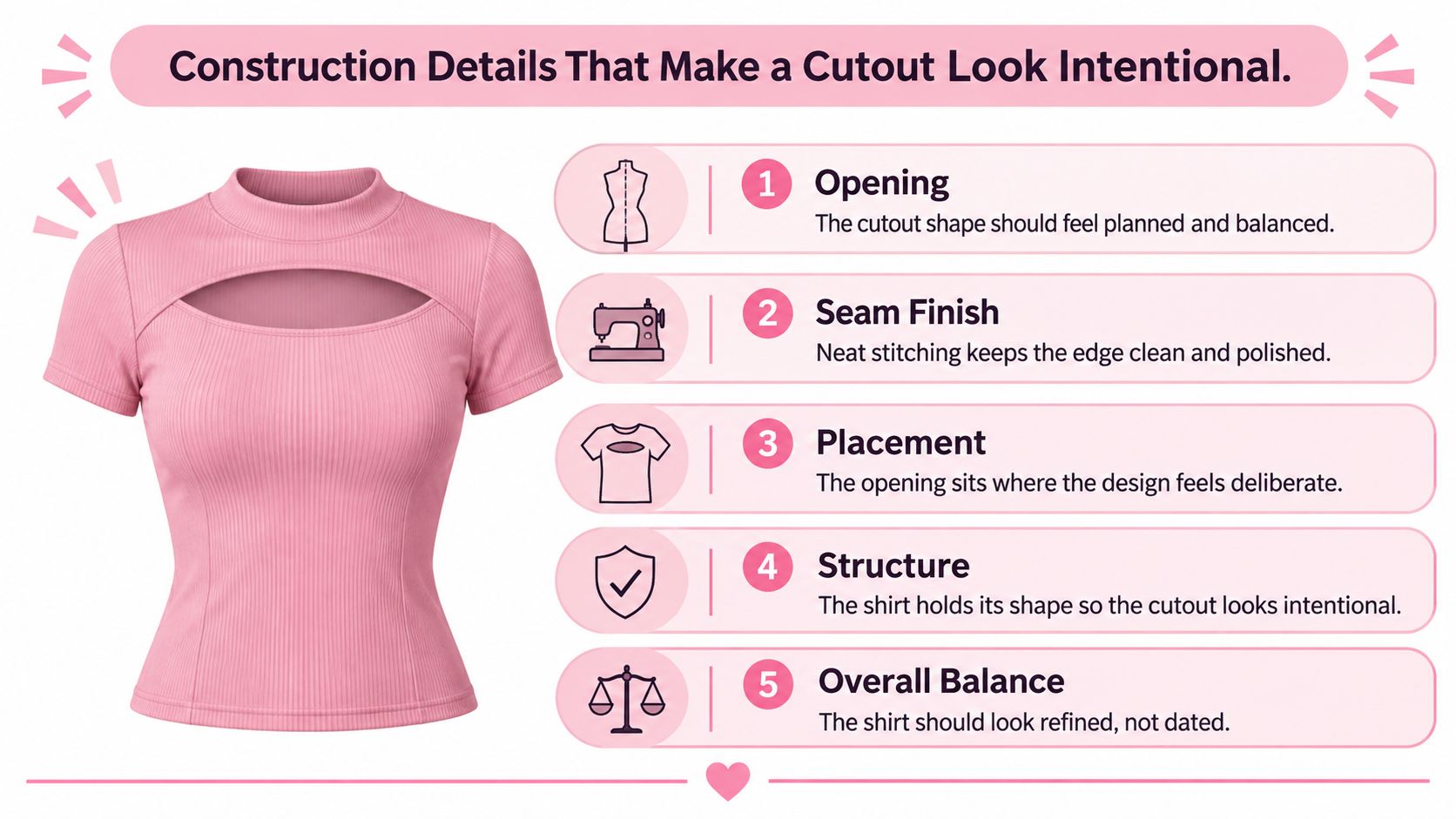
Construction, not skin, makes a cutout look intentional. A small opening with wavy edges looks sloppy. A larger opening with flat binding and stable placement looks designed. Run these seven checks on any shirt before you trust it.
The Seven-Point Checklist
- Opening placement: The cut should sit centered over the deltoid, not drifting toward the front, the back, or the armpit. If it's off-center standing still, movement will make it worse.
- Binding: The edge around the opening should lie flat against your skin. Rolling, curling, or wavy stitching signals weak finishing and usually stretches out further.
- Sleeve drop: With your arms relaxed, the sleeve should hang straight without drooping over the opening. Droop closes the cutout and makes the shirt look too big.
- Upper-arm coverage: Keep enough fabric around the opening to frame the shoulder. Too little fabric leaves a bare patch that reads exposed rather than styled.
- Neckline height: A neckline rising close to the collarbone reads polished and gives the opening visual balance. A neckline dropping toward the sternum competes with it.
- Edge finish: Look for clean-stitched or raw-cut edges that hold their shape after washing. Stretch the edge gently in store. It should spring back, not stay rippled.
- Layering: Put a blazer or cardigan over it and check the shoulder line. The shirt should sit smoothly, with no binding ridge or bunched sleeve showing through.
A cutout looks planned when every edge stays where the designer put it for a full day, not just for the fitting room photo.
Compare two shirts. A crisp architectural panel with flat edges holds its rectangle through lunch, meetings, and the commute home. A loose, oversized opening with thin binding slides off the shoulder by lunchtime and forces you to tug it back all afternoon. Same skin, completely different result.
Hold the garment up to the mirror on your body, not on the hanger. Run the checklist top to bottom before you buy it or wear it out.
Fabrics That Keep the Opening in Place
The fabric decides whether the opening stays put. A beautifully placed cutout in weak fabric will sag, rotate, and gape within an hour. You need stretch recovery plus enough body to hold the edge where it belongs.
Garment pressure comes from garment weight, material tension, and how stretch fabric deforms around your body. The garment-pressure study published in PMC reports a commonly used comfort range of approximately 20 to 30 mmHg and found the shoulder experienced the greatest pressure increase when external load was added. In practice, recovery that's too weak lets the opening migrate, and recovery that's too strong digs at the edge.
Fabric Behavior From Most Stable to Most Fluid
| Fabric | Stretch and Recovery | Breathability | Drape | Best Use |
|---|---|---|---|---|
| Cotton jersey | Stretchy; recovery depends on elastane | High | Soft, relaxed | Casual days |
| Modal blend | Smooth stretch with good recovery | High | Fluid, smooth | Work and travel |
| Viscose | Moderate stretch; can lose shape | High | Very fluid | Evening and relaxed styling |
| Polyester-spandex knit | Strong recovery | Moderate | Structured, smooth | Fitted and active wear |
| Linen | Little stretch | Very high | Crisp, relaxed | Warm weather with loose openings |
Polyester-spandex knit holds an opening most reliably in fitted styles because the recovery is strong and the surface stays smooth. Watch the edge pressure, though, since strong recovery can bite on a narrow binding. Modal blends are my work and travel pick, because they recover well, breathe, and drape without collapsing over the opening.
Cotton jersey feels familiar and breathable, but check the label for elastane. Without it, a cotton opening grows through the day and won't come back until it's washed. Viscose drapes beautifully for evening, yet it can lose shape around a precise cutout, so choose it for relaxed openings rather than sharp geometry.
Linen breathes best in heat and has almost no stretch, which means the pattern has to do all the work. Buy linen cutouts loose, with generous openings that don't need recovery to stay comfortable.
Care protects all of this. Bleach and fabric softeners should be avoided when washing Nuage Wears to keep the fabric soft and the edges intact. The same gentle approach shows up in practical guidance on caring for your equestrian shirts, where preserving performance fabric matters more than heavy treatment.
Check the fiber blend and care label before you buy. Stretch the fabric near the opening, release it, and watch it return. Buy recovery you can see, not stretch you only feel in your hand.
Bra Options That Work With Open Shoulders
Strap placement, band visibility, and neckline height decide the pairing long before shirt size does. A cutout works with a bra when the straps and band either vanish under the fabric or route deliberately through the opening. Pick the bra first, then judge the shirt against it.
Match the Bra to the Opening
| Bra Type | How It Works With the Opening | Watch Out For | Best Opening |
|---|---|---|---|
| Strapless bra | Leaves no straps visible in the cutout | Slipping in heavy knit; needs a firm band | Asymmetric and off-the-shoulder styles |
| Convertible bra | Straps re-route to halter, criss-cross or one strap | Clips must sit inside the opening | Small windows and sleeve slits |
| Smooth-cup T-shirt bra | Smooth cups under fitted knits | Straps show through wide openings | Small shoulder windows |
| Bralette or unlined bra | Soft and flexible with a low profile | Less support for fuller cups | Sleeve slits and casual openings |
A strapless bra keeps wide and asymmetric openings completely clean. Choose a firm band, because a heavy knit pulling downward will test a weak band all day. If you fall between two sizes, take the smaller one for a closer, smoothing fit. A band you're already tugging up in the fitting room will not survive dinner.
A convertible bra earns its place under small windows and sleeve slits, but only when you re-route the straps before you get dressed. Set the clips so they sit inside the opening or fully clear of it. A clip landing on the binding edge will show and can irritate your skin.
A smooth-cup T-shirt bra disappears under fitted knits and gives you a clean chest line. It's the best match for a small shoulder window where the strap stays covered by design. Don't force it under a wide opening and then blame the shirt.
A bralette or unlined bra is soft, flexible, and low-profile, which suits sleeve slits and casual openings. It gives less support for fuller cups, so skip it under structured evening pieces that need lift and stability. Readers rebuilding support after body changes will also find useful context in guidance on postpartum bra fit and support, since band fit matters as much as cup shape.
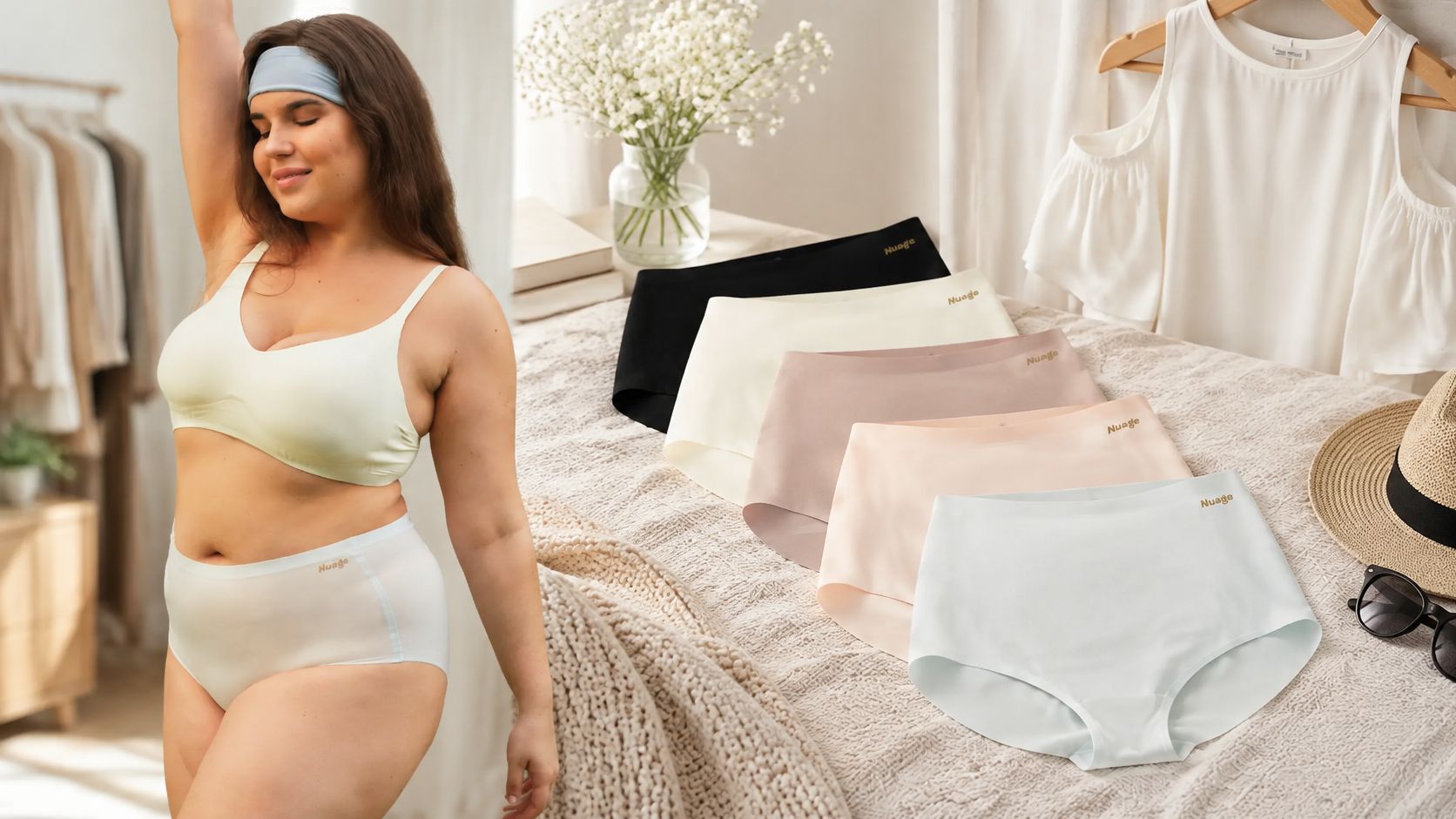
Under the shirt itself, a smooth foundation finishes the job. The NuCloud Original High Rise(5-Pack) is made with buttery-soft fabric and raw-cut edges that stay smooth and invisible under clothing without fraying or rolling, so nothing below the hemline competes with a clean shoulder line. If your main goal is invisibility up top, start with our guide to a no-show bra under fitted clothing and match its principles to your opening width.
The right pairing reads as one garment. When strap, band, and opening share the same edges, the cutout looks planned instead of accidental.
How to Test the Opening Through Movement
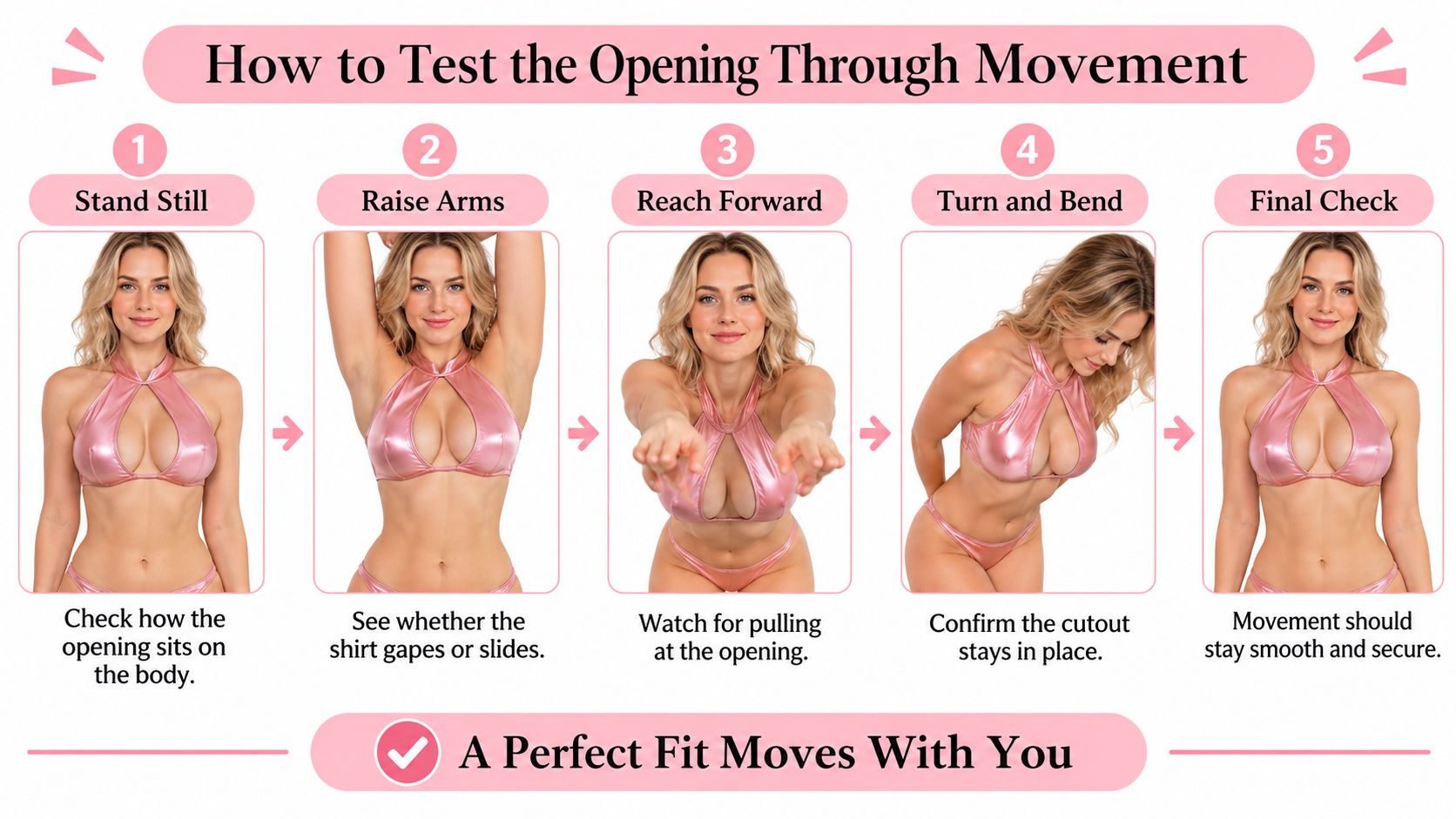
A shirt that looks right standing still can gape, slide, or pull the moment you reach for a shelf or lift a bag. Test it in the bra you plan to wear, in front of a mirror, and don't be gentle with it. Real movement is the fitting room that matters.
The Five-Movement Test
- Stand with arms relaxed: Check that the binding lies flat and the cutout sits centered over the deltoid. This is your baseline. A recent styling guide on wearing cold-shoulder tops identifies fabric droop as a common complaint when the sleeve opening is too large for the wearer's arm, and recommends checking binding, deltoid placement, and pulling across the chest and upper back.
- Raise both arms overhead: Watch whether the opening gapes open or digs at the edge. Lower your arms and see if it returns to center on its own.
- Cross your arms over your chest: Look for fabric pulling across the chest and upper back. That tension will drag the opening out of place within the hour.
- Reach forward as if lifting a bag: Note whether the opening rotates toward the front or the back. Rotation means the sleeve and shoulder aren't balanced on your frame.
- Hold the reach for about 30 seconds: Check for slipping, edge pressure, or irritation. Discomfort that shows up in half a minute will dominate a full day.
Diagnosis rule: Droop means the opening is too large, digging means the edge is too tight, and pulling across the bust means the body of the shirt doesn't fit.
Don't confuse shoulder fit with body fit. If the shirt pulls across the bust or upper back, size up or change the cut. A smaller shoulder opening won't fix a torso that's too tight, and it'll usually add edge pressure on top of the original problem. If your bra shifts during the test, fix that first using our guide on how to know if your bra fits correctly, because a moving strap makes every opening look misaligned.
Size for Your Shoulder Width
Measure from shoulder point to shoulder point and compare that figure with the opening width on the garment or its size chart. An opening sitting more than a finger width off the deltoid on your frame will droop or gap, so choose the size whose opening lands centered over your arm. Narrow shoulders usually need the smaller opening and broad shoulders the larger one.
When you're between two sizes, choose the smaller size for a closer, smoothing fit, or the larger size for a relaxed, airier feel. Then make the decision the test demands. Keep the shirt, resize it, or change the bra.
Styling Cut-Out Shoulder Shirts by Occasion
You leave for work in a cold-shoulder knit, reach for the overhead rail, and the opening slides down your arm. That is a construction problem wearing occasion clothes. A cutout earns its place when the opening sits centered on the deltoid and stays there as you move, so build each outfit around that stable shoulder line. Keep the opening as the focal point, then choose pieces that support it rather than compete with it.
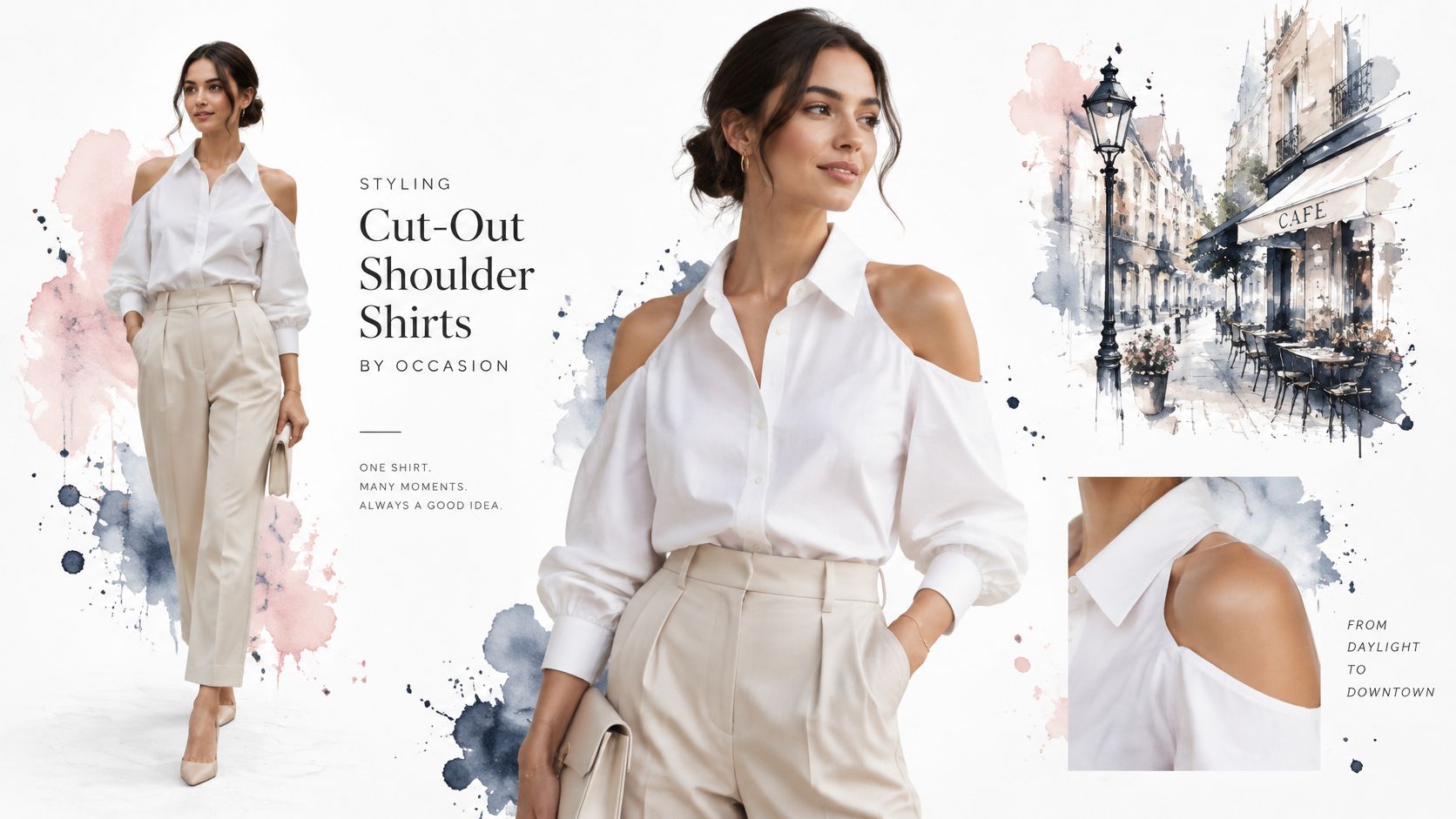
| Occasion | Pair With | Layer | Finishing Touch |
|---|---|---|---|
| Office | Pleated trousers or a midi skirt | Blazer over the cutout | Structured bag and pointed flats |
| Weekend casual | Jeans or denim shorts | Open overshirt or denim jacket | Canvas tote and white sneakers |
| Travel | Wide-leg trousers or soft leggings | Light cardigan for cool cabins | Crossbody bag and slip-on shoes |
| Evening | Wide skirt or slim straight-leg slacks | Structured jacket | Statement earrings and a clutch |
| Summer event | Linen trousers or flowy midi skirt | Light wrap or kimono | Woven sandals and simple jewelry |
Why Each Pairing Works
At the office, pleated trousers or a midi skirt keep the proportions professional while a blazer lets you cover the cutout for meetings and reveal it after. Choose a small window or architectural cutout with a flat, bound edge; a wide drooping opening reads accidental under a jacket. Pointed flats and a structured bag reinforce the polished signal.
For weekend casual, jeans ground the shirt and an open overshirt frames the opening without hiding it. A sleeve slit works especially well because its movement suits an unstructured day. White sneakers and a canvas tote keep the energy relaxed.
Travel demands comfort through temperature swings and long stretches of sitting. Wide-leg trousers or soft leggings won't fight the shirt, and a light cardigan handles a cool cabin while covering the opening when you want warmth. Slip-on shoes and a crossbody keep your hands free. Pick an opening with enough edge recovery to spring back after hours against a seat back.
For evening, a wide skirt or slim straight-leg slacks give an asymmetric cutout the clean base it needs. A structured jacket sharpens the shoulder line when you arrive, then comes off at the table. Statement earrings work because bare shoulders give them room, so skip the necklace and let one detail lead.
At a summer event, linen trousers or a flowy midi skirt match the ventilation a cutout already provides. A light wrap handles shade and breeze without trapping heat. Woven sandals and simple jewelry finish it without competing.
Run the closing checklist before you leave. The opening sits centered on your shoulder and stays put when you reach. The bottom half carries one clear silhouette. The layer either frames the cutout or covers it cleanly. If one check fails, change the cutout or the layer before you add another accessory.
Choose the Cutout Shirt and Bra Pairing for Your Week
Decide once and commit. Pick one cut-out style matched to your main occasion this week: a small window for the office, an asymmetric cutout for dinner, a sleeve slit for an unstructured Saturday.
Then run it through the checks you already have. Put the shirt through the construction checklist, set the bra for the opening's width, and finish with the full movement test in that exact bra.
Don't wear the piece until all three pass. A cutout that sits perfectly while you stand still can still gape the moment you reach for a shelf, and a shirt you adjust all day is a shirt that failed.
Our range holds up under the same scrutiny. Our laser-cut collection uses edges that vanish under leggings, silk and other clothing, and every piece is built around invisible seams, no wedgies, no digging, and breathable fabric. Those raw-cut edges stay smooth without fraying or rolling, which matters under a fitted cutout where every ridge shows.
One style, one bra, one occasion. Wear that pairing this week and let how it moves decide whether it becomes your default.
Build your cutout outfit on foundations that stay invisible, from smooth bras to laser-cut underwear made for no digging and no visible lines. Shop the comfort-first range at Nuage Wears and test your next pairing the way this guide teaches: in motion, in the bra you'll really wear.