
You've checked your outfit in the mirror, smoothed your trousers, and headed out feeling comfortable. Halfway down the block, there's that familiar tug at the back. Before you write off minimal underwear, notice what changed between standing still and walking: your movement, the garment's tension, and possibly moisture. A g string wedgie isn't an inevitable price of wearing less fabric. It's a fit problem you can investigate.
Table of Contents
- What a G String Wedgie Really Means
- Match the Tug to Its Cause
- How Friction Pulls the String In
- Cuts, Fits, and Four Everyday Scenes
- Irritation Is Not the Same as Infection
- Choose a Stay-Put Pair and Test It Moving
What a G String Wedgie Really Means
You stop walking, make a discreet adjustment, and carry on. If the string settles comfortably, that's different from a pair that keeps pulling inward until you're thinking about it at every step.
A g-string wedgie happens when the narrow rear panel slides deeper into the gluteal cleft, the fold between the buttocks, during walking, sitting, or bending at the hips. The important distinction isn't whether fabric sits between the cheeks. That's intentional. It's whether the fabric stays comfortably positioned or develops unwanted pressure and rubbing.
Three kinds of rear-panel behavior
- Designed placement: The thin rear strip rests between the cheeks without an increasing pulling sensation.
- An initial shift: You reset the garment after dressing, and it stays comfortable afterward.
- Persistent wedging: The strip repeatedly climbs inward, bringing pressure, rubbing, or an urge to keep adjusting.
Only the last pattern needs troubleshooting. You don't need to train yourself to tolerate discomfort, and you don't need to abandon a cut you enjoy just because an unsuitable pair moves.
Minimal underwear certainly has willing wearers. In its results published in 2026, Underwear News Briefs' reader survey reported that 38.3% of 206 respondents in 2024 identified thongs as their favorite underwear style.
Fit checkpoint: Intentional contact is normal. Increasing pressure and repeated adjustment aren't the goal.
Your useful clues are the location of the tug, when it starts, and whether perspiration changes it. Those clues help distinguish a tension problem from a moisture problem, choose a more suitable cut, and separate mechanical irritation from infection concerns. Judge the pair after movement, not from a still pose in the mirror.
Match the Tug to Its Cause
G-string wedgie symptoms, causes, and first fixes
| What you feel | When it shows up | Likely cause | First fix |
|---|---|---|---|
| Steady climb into the cleft | Walking a block | Narrow back with weak recovery | Choose a pattern with more rear anchor or better stretch return |
| Waist digs and the string is pulled down | All day, worse when seated | Waistband too tight or too small | Size up or move to a softer high-rise band |
| Sides gap, then snap inward | Stairs and longer strides | Leg opening too loose for the hip | Choose a closer-fitting leg line or add side coverage, such as a cheeky |
| Fine standing, bad once you sit | Hip flexion and squats | Unstable gusset-to-back transition | Retest rises; keep the one that stays through sitting |
| Sticky, then it migrates | After sweat or a workout | Moisture raised skin friction | Use a breathable zone and change the damp pair |
| Redness or rub without other symptoms | After repeated wear | Concentrated pressure and shear | Lower tension and switch to a smoother face fabric |
Use the chart before buying another size. These are working diagnoses, not guarantees: similar sensations can have different causes, so change the feature that matches your experience rather than assuming every wedgie means too small.
For a practical home test, stand comfortably, walk a block, climb stairs, sit for five minutes, and squat. Note whether the rear panel stays positioned, shifts initially and settles, or keeps climbing. Stop if it hurts rather than completing a test through discomfort.
Read the clues in order
Start at the waistband. Pinching combined with a downward pull through the string suggests the band is too small or too stiff. Check whether you've pulled a lower-rise garment above its intended position, too. Forcing extra height can create tension through the entire garment.
Next, inspect the side and leg openings. If the sides stand away from your hips and then snap inward with a longer stride, the opening may be too loose for your shape. Sizing up could make that instability worse. Try a closer leg line or additional side coverage instead of tightening the string itself.
Then consider timing. A pair that becomes sticky only after perspiration hasn't suddenly changed size. Treat moisture as the first variable to investigate, particularly if the same garment felt settled while dry.
Finally, compare standing with sitting. If the waistband feels reasonable but the rear panel pulls sharply when you sit, examine the gusset-to-back join, where the crotch panel narrows into the rear strip. A different rise or transition shape may follow your hip movement better.
The Conversation's discussion of underwear and health provides useful context for separating garment fit, friction, and irritation rather than treating the underwear category as the whole explanation.
Account for the garment's condition
A new pair can feel different after laundering according to its care label, but washing isn't a reliable cure for an unsuitable pattern. Conversely, elastic that already looks wavy or remains stretched after gentle handling may no longer provide useful recovery.
A fitting-room success can also fail on a commute. Your standing silhouette tells you little about how the garment behaves through repeated strides and seated pressure.
For another useful example of diagnosing individual fit components rather than blaming an entire garment, Robosize's guide to better bra fit applies that thinking to bras. The transferable habit is simple: identify where support or tension goes wrong before changing everything.
Choose the chart's matching first fix. Don't buy a larger size to solve loose leg openings, or a tighter pair to solve weak fabric recovery.
How Friction Pulls the String In
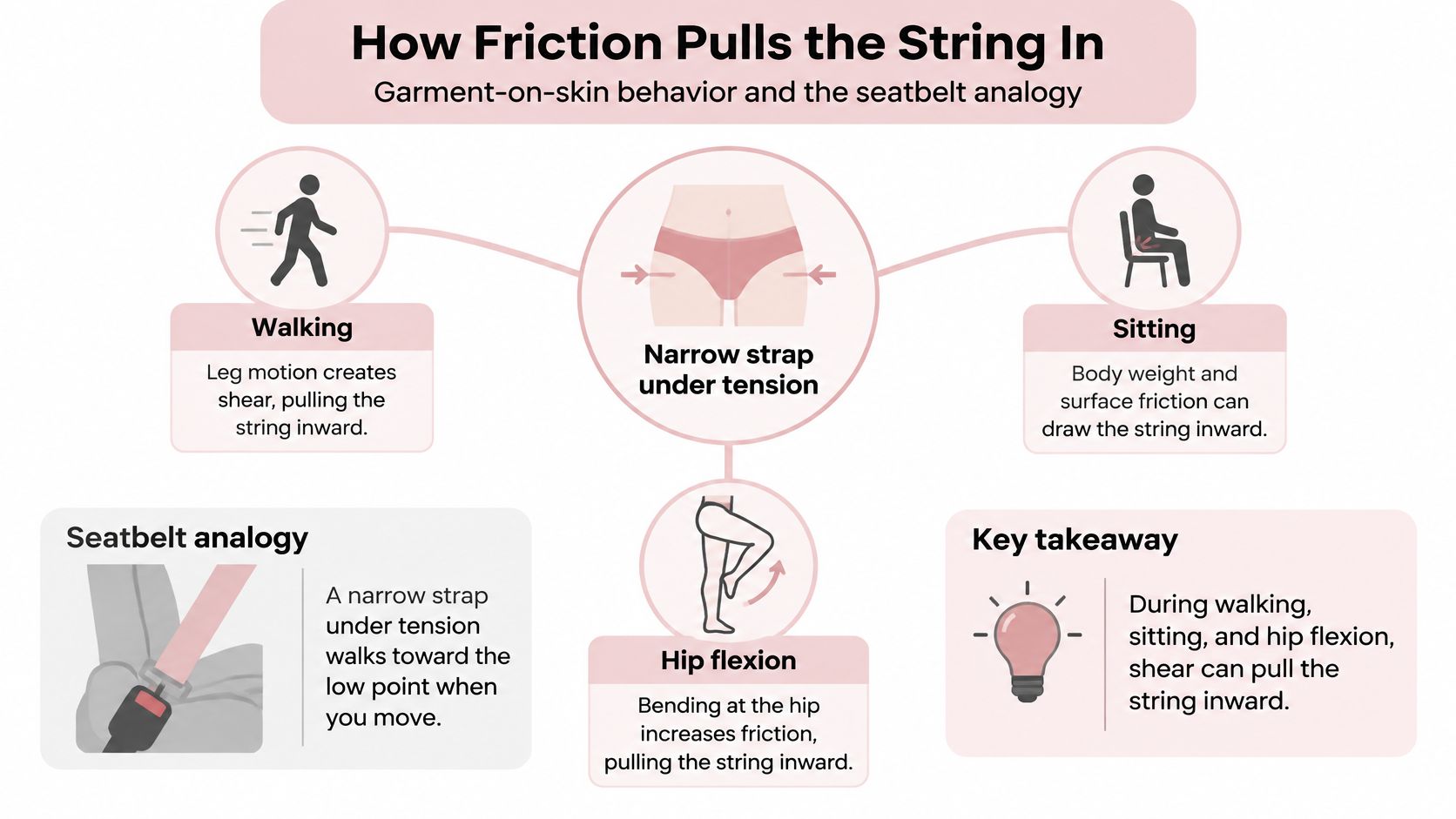
Think about a seatbelt strap crossing your lap. As you shift, the strap's contact position changes. A narrow underwear strip behaves similarly: a strap under tension can work toward a lower point as you move, especially when its shape and recovery don't keep it positioned.
That's an analogy, not an exact mechanical model. Your skin stretches, the garment flexes, and pressure changes with each step. But it explains why a soft-feeling string can still become uncomfortable once it's pulled taut.
Why dry softness isn't enough
Shear is the sliding force acting along a surface. During walking, sitting, and hip flexion, shear can pull the string inward when garment tension and inadequate recovery overcome its ability to stay positioned.
Textile-on-skin friction isn't determined by a cotton or synthetic label alone. Contact pressure, yarn direction, surface texture, and skin hydration all matter. The textile-friction paper published through IOP Conference Series describes friction coefficients increasing by about 43% in women as skin changed from very dry to normally moist, and wet-fabric friction exceeding dry-textile friction by more than twofold.
Those findings explain why your dry fitting-room impression can differ from your experience after perspiring. They don't mean your particular underwear will become uncomfortable by a predictable amount. They mean moisture belongs in the comfort assessment.
Consider a pair that feels silky when you first dress. If its rear strip is already stretched tightly, a warm walk may add enough stickiness that movement starts dragging the fabric instead of allowing small, comfortable shifts.
Interrupt the pressure and friction loop
The sequence is straightforward:
- Tension concentrates pressure: A narrow strip bears against a small contact area.
- Movement adds shear: Your hips and surrounding fabric move relative to the strip.
- Sweat increases stickiness: Damp contact can make sliding feel less smooth.
- Repeated dragging adds discomfort: The strip migrates, rubs, or gathers at an edge.
Good construction interrupts that sequence rather than relying on softness alone. Look for a stable gusset-to-back transition, stretch that returns after extension, and a rear shape that follows your gluteal curve. Edges should maintain placement without feeling like taut cords.
Stretch and recovery aren't interchangeable. A fabric can stretch easily yet remain elongated afterward. That slack can allow movement, while excessive stiffness can create pressure. The useful middle ground is enough give to follow your body and enough return to maintain the garment's intended shape.
Our guide to anti-chafing underwear offers additional context for assessing skin-contact surfaces and rubbing. Breathability can help with moisture, but airflow can't rescue an undersized pattern.
Use observable pass checks: the rear panel doesn't visibly migrate after walking or repeated squats, the edges don't roll, and stickiness stays low. A fabric description is a starting point. Moving comfortably is the evidence that matters to you.
Cuts, Fits, and Four Everyday Scenes
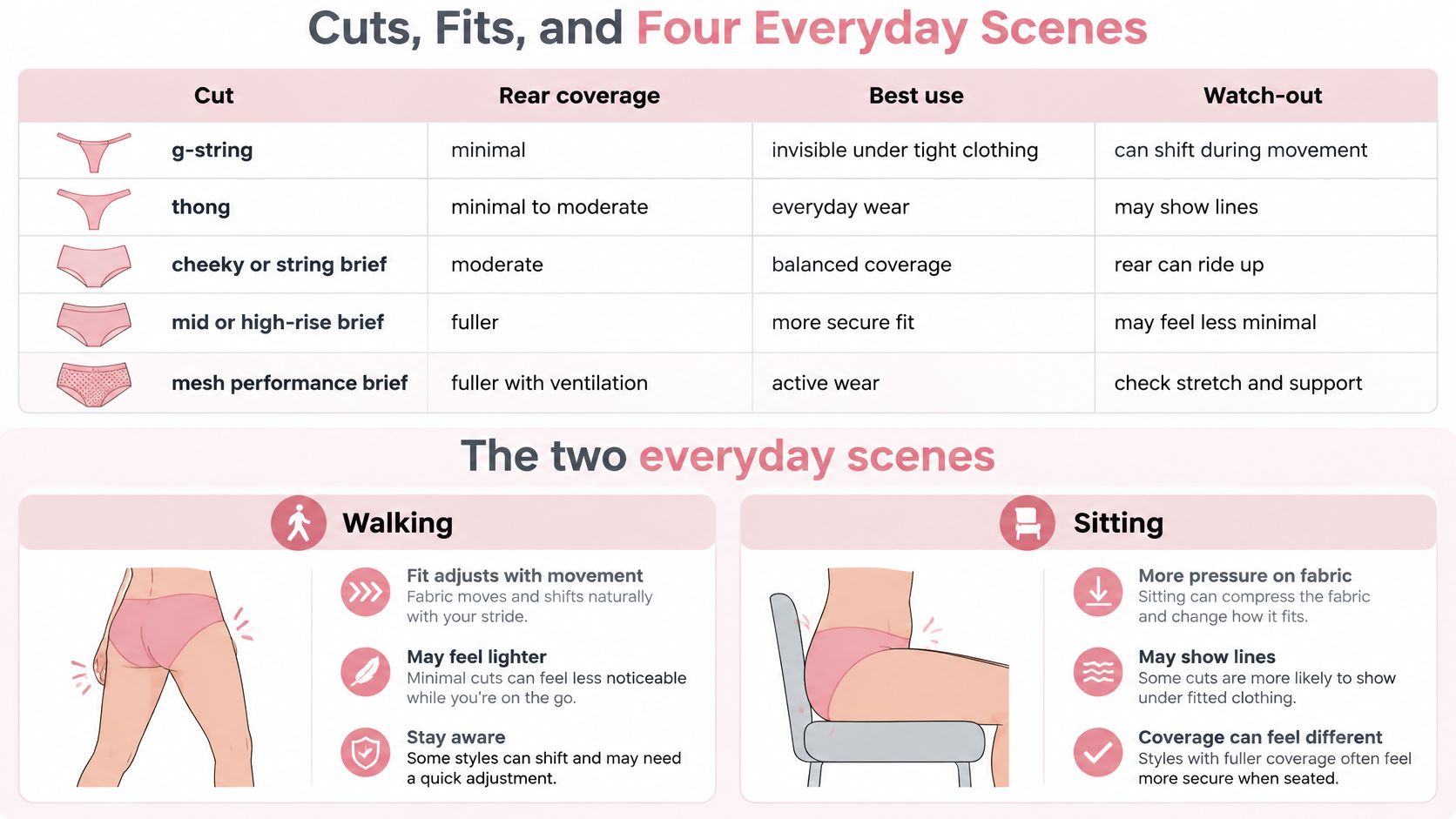
Underwear cuts compared for wedgie control
| Cut | Rear coverage | Best used for | Watch-out |
|---|---|---|---|
| G-string | Single thin rear string | Minimal lines under fitted clothes | More likely to migrate when tension or recovery is poorly matched |
| Thong | Narrow rear triangle | Daily wear with a little more anchoring | Can climb if the size is small or the leg openings gap |
| Cheeky or string brief | More side and cheek fabric | Walking and mixed errands | May show under very tight knits |
| Mid or high-rise brief | Full seat | Long sitting, travel, intense movement | A stiff waistband can dig even if the seat stays in place |
| Mesh performance brief | Zoned open fabric | Sweat, workouts, hot commutes | Coarse mesh can chafe despite its airflow |
Coverage helps anchor a garment, but cut alone can't guarantee comfort. Seam position, waistband stiffness, fabric recovery, and the way the garment fits your body all matter. A well-fitted g-string can stay comfortable, while a brief with poorly placed seams can rub.
Tension and fabric decide the result
Fit sets the garment's tension. A size that is too small can concentrate pressure and pull the waistband downward. If the size is too large, the leg opening may float away from the hip, then shift inward as you move. Use the size that keeps the edges in place without pressing like a taut cord.
Rise affects where contact sits on your body. A higher band may distribute pressure comfortably for one wearer; another may prefer a lower position. Choose a rise that rests where the pattern is designed to sit.
Check the fabric's surface where it touches your skin. A smooth face, an absorbent cotton gusset, and stretch that returns after movement can all support a comfortable fit. Run a fingertip across the gusset join and rear edges to check for bulky transitions or scratchy finishing.
The gusset is only one part of the garment. Airy mesh can still rub if its surface is coarse or an edge presses into a fold, so assess the whole pair by touch and fit.
Desk to dinner
For trousers, try a smooth thong or cheeky that lies flat without needing to be pulled tight. Sit in your usual working posture for five minutes, lean forward, then stand. Notice whether the rear panel or waistband shifts through those changes.
A rolling waistband points to a placement or construction issue. Check whether your trousers are pushing the band down or causing it to fold. If the garment stays put, its edges lie flat, and no pressure hotspot develops, it is a reasonable match for desk wear. Choose another cut if sitting makes you rearrange it repeatedly.
The commute
Test your ordinary walking pace, including stairs if they are part of your route. Longer strides can reveal loose side openings that seemed fine while you were standing still.
A single early adjustment may be ordinary settling. If you need to tug again shortly afterward, try a cheeky or a thong with more rear anchoring for your next commute. The right cut should let you walk naturally, without shortening your stride or repeatedly reaching for the rear panel.
A workout or long walk
Choose a breathable pair with a smooth surface, then check how it feels during bends and strides. If you expect substantial perspiration, bring a dry replacement instead of wearing a damp pair for the rest of the day.
Warm, damp folds merit attention. The Journal of Wound Care review on intertrigo describes inflammation associated with skin-on-skin friction and trapped moisture where air circulation is inadequate. If a fold feels hot and rubbed, loosen the tight layer and let the skin dry.
A stable garment with little stickiness or rubbing is a good sign. If moisture turns comfortable contact into a persistent hotspot, change the cut or fabric for that activity.
Travel and extended sitting
For long periods of sitting, a stay-put brief or comfortable high rise offers more coverage across the seat. Make sure the waistband still feels comfortable in your seated posture.
Try the pair with the trousers you plan to wear. Lean forward as if reaching under a seat, then lift one knee as if stepping onto transport. A thin rear string can feel different when your hips stay flexed for longer.
Use the home trial to check for migration, rolled edges, and localized pressure. If you need relief before leaving, pick another cut. For travel, judge the pair by the movements and posture your day requires, not only by how it looks while standing.
Irritation Is Not the Same as Infection
A g-string wedgie can cause mechanical irritation, but the tug alone cannot tell you whether you have a yeast infection, bacterial vaginosis, or a urinary tract infection. Research on thong use has not established that it independently causes these infections.
A survey of 986 women, including 186 regular thong wearers who wore thongs more than half the time, found similar reported urinary and vaginal infection rates over the previous 12 months, as summarized in Natural Womanhood's review of underwear and vaginal health. The review also describes a 2005 study of 32 women that compared thong and non-thong underwear with corresponding liners. It found no statistically significant difference in the vulvar skin environment and no support for greater contamination by anorectal microorganisms.
The cross-sectional study indexed by PubMed found that thong use was not an independent predictor of urogenital infection. Yeast vaginitis was associated with a non-cotton crotch rather than thong use itself. That association does not show that any particular gusset prevents infection, and the findings do not establish that every thong suits every wearer.
Judge the fit by how it feels after walking, sitting, and sweating. A string that shifts or rubs points to a mechanical comfort problem; infection concerns require attention to symptoms beyond the garment's movement.
What persistent rubbing can still do
Repeated wedging can contribute to abrasion, redness, ingrown hairs, or blisters. Stop wearing the garment if it keeps rubbing, even if you have no other symptoms.
Location and timing can help you describe discomfort to a clinician. Notice whether it follows an edge, starts after sweating, or continues after you change clothes. These clues can clarify the pattern, but irritation and other conditions can feel similar.
Respond without treating underwear as medicine
- Change damp clothing: Put on a clean, dry pair rather than staying in sweat-soaked layers.
- Remove avoidable pressure: Skip overly tight underwear and outer layers while the area is uncomfortable.
- Follow the care label: Wash the garment as directed and let it dry fully before wearing it again.
- Seek medical evaluation: Get advice for persistent pain, unusual discharge, sores, or symptoms that keep returning.
If your skin is already sore, pause the garment trial. Repeatedly testing a troublesome string against irritated skin won't show how comfortable it is during ordinary wear.
A different cut may remove a rubbing trigger, while persistent or unusual symptoms still call for care from a qualified clinician. Comfort and construction are fit choices; symptoms are a separate reason to seek medical guidance.
Choose a Stay-Put Pair and Test It Moving
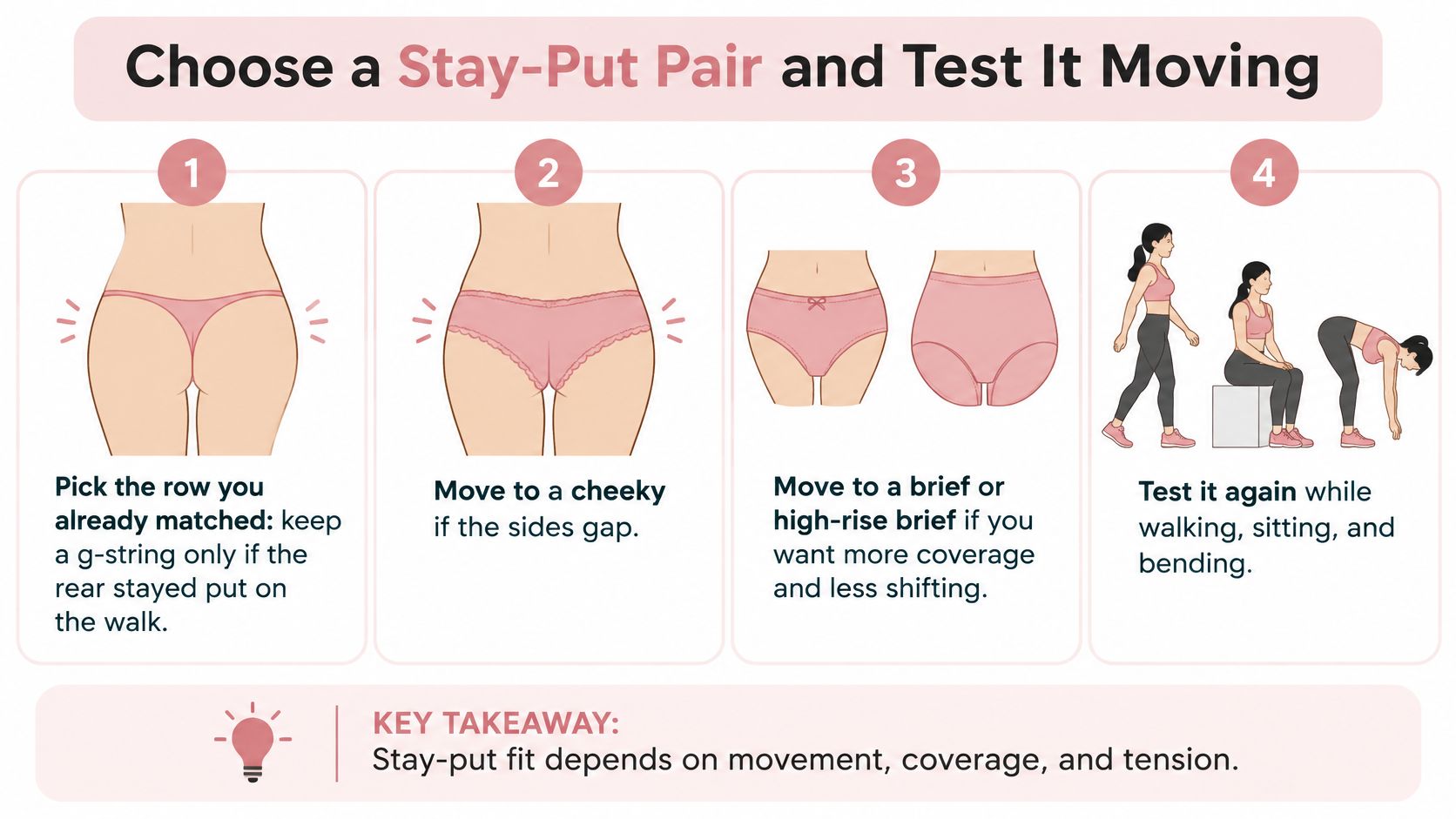
- Choose based on the symptom you experienced. Keep a g-string in consideration if the rear stayed positioned on your walk. Try a cheeky when the sides gap, or a brief or high rise when sitting and perspiration repeatedly make minimal coverage uncomfortable.
- Inspect the contact points. Require smooth edges, a cotton gusset, and recovery that doesn't depend on harsh elastic tension. Feel the rear join as carefully as the main fabric, because a soft body fabric won't cancel a rough transition.
- Run a home trial before a demanding day. Walk, climb stairs, sit for five minutes, and squat. Your pass standard is no repeated tugging, no uncomfortable waist groove, and no sticky hotspot. Keep the outer clothing consistent with what you intend to wear.
- Change a variable, not your whole approach. If the string still climbs, alter size or cut first, rather than changing both together. That makes the next result easier to interpret and helps you avoid collecting pairs with the same unresolved problem.
Put the construction to a real-life test
Our women's underwear sizing guide can help you approach fit deliberately rather than relying on the size label from an unrelated pair. Product-specific sizing still matters, particularly when a style has an unusually generous fit.
At Nuage Wears, we use calibrated fabric stretch instead of elastic and a 3D glute contour to create our wedgie-proof design. The NuCloud High Waist Thong is $11.20, comes in XS through XXXL, and runs very large, so order two sizes down. Designed for everyday wear, travel, movement, and vacations, it combines smooth raw-cut edges, gentle high-waist shaping, and a 100% cotton gusset.
Those features give you concrete construction details to evaluate, not a reason to skip your own comfort test. Check the seated waist first, then the rear placement during strides, and finally how the contact feels as you warm up.
The right minimal pair should disappear under your clothes and stop demanding attention during an ordinary day. Movement is the verdict, and comfort is a good reason to be selective.
Nuage Wears offers comfort-first underwear in thong, cheeky, hipster, and high-rise cuts, with options designed to address wedgies, digging, and visible lines. Visit Nuage Wears to choose a cut for your next workday, walk, or trip, then put it through your own moving fit test.