
You're halfway through a workday when you notice it: the waistband has folded under your navel, one leg opening has crept upward, and your trousers are revealing a faint line you didn't see in the morning mirror. You tug everything back into place, sit down, and repeat the process later. High waisted briefs womens shoppers often aren't looking for more coverage alone. They're looking for underwear that stays where it was put.
The useful way to judge a pair is to treat it like a small piece of wearable engineering. Rise-to-torso ratio, pressure distribution, knit porosity, stretch recovery, and hip fit all influence whether briefs feel supportive or irritating. The right pair shouldn't merely reach higher. It should spread tension sensibly, manage heat, follow your curves, and remain stable when you sit, bend, walk, and move through a normal day.
Table of Contents
- Why High Waisted Briefs Deserve a Second Look
- Understanding the Rise, Waist, and Hip Zones
- How a No Digging Waistband Actually Works
- Fabric Choices That Change How They Feel
- Measuring Yourself for a Pair That Stays Put
- Matching Briefs to Real Day Scenarios
- A Quick Checklist Before You Buy
- Care, Wear, and Common Fit Questions
Why High Waisted Briefs Deserve a Second Look
A mid-rise waistband can land on the soft area below the navel and create a narrow pressure line. That's why a pair may feel fine while standing but start pinching as soon as you sit. A properly anchored high-waisted brief moves that contact point toward the natural waist, where the torso is often more stable and the garment can distribute its holding force across a broader area.
The style also has a practical history. Women's drawers became shorter and more fitted during the 1920s, and by the 1930s these reduced garments were commonly called briefs. Many women still wore girdles or corselets beneath clothing during that period, so high-waisted briefs sit on a continuum between everyday coverage and foundationwear designed to smooth the torso. The Fashion Institute of Technology's lingerie-history exhibition describes this progression and the full brief as a style with a waistband at or above the natural waist, while the high-waist brief extends above the navel.

Coverage is only half the job
A taller rise can smooth the transition between underwear and high-rise trousers, skirts, or dresses. It can also reduce the need to keep pulling a waistband upward. But rise height isn't the same as quality. A tall, rigid band can still dig. A soft, unstable band can roll. Thick seams can show beneath fitted knit even when the waist feels comfortable.
Practical rule: Judge the whole garment, not the centimetres of coverage. The waistband, body fabric, leg edge, gusset, and rise must work together.
For the blog cover, the intended display ratio is 280:210, or 4:3, which prevents distortion at the displayed size. The same proportion can scale responsively, and matching image dimensions in page markup helps the browser reserve space before the image loads, supporting a more stable layout. Google's image guidance discusses suitable image ratios, while Google's Discover documentation explains why retaining a larger source image is useful even when the fixed blog display is smaller.
Understanding the Rise, Waist, and Hip Zones
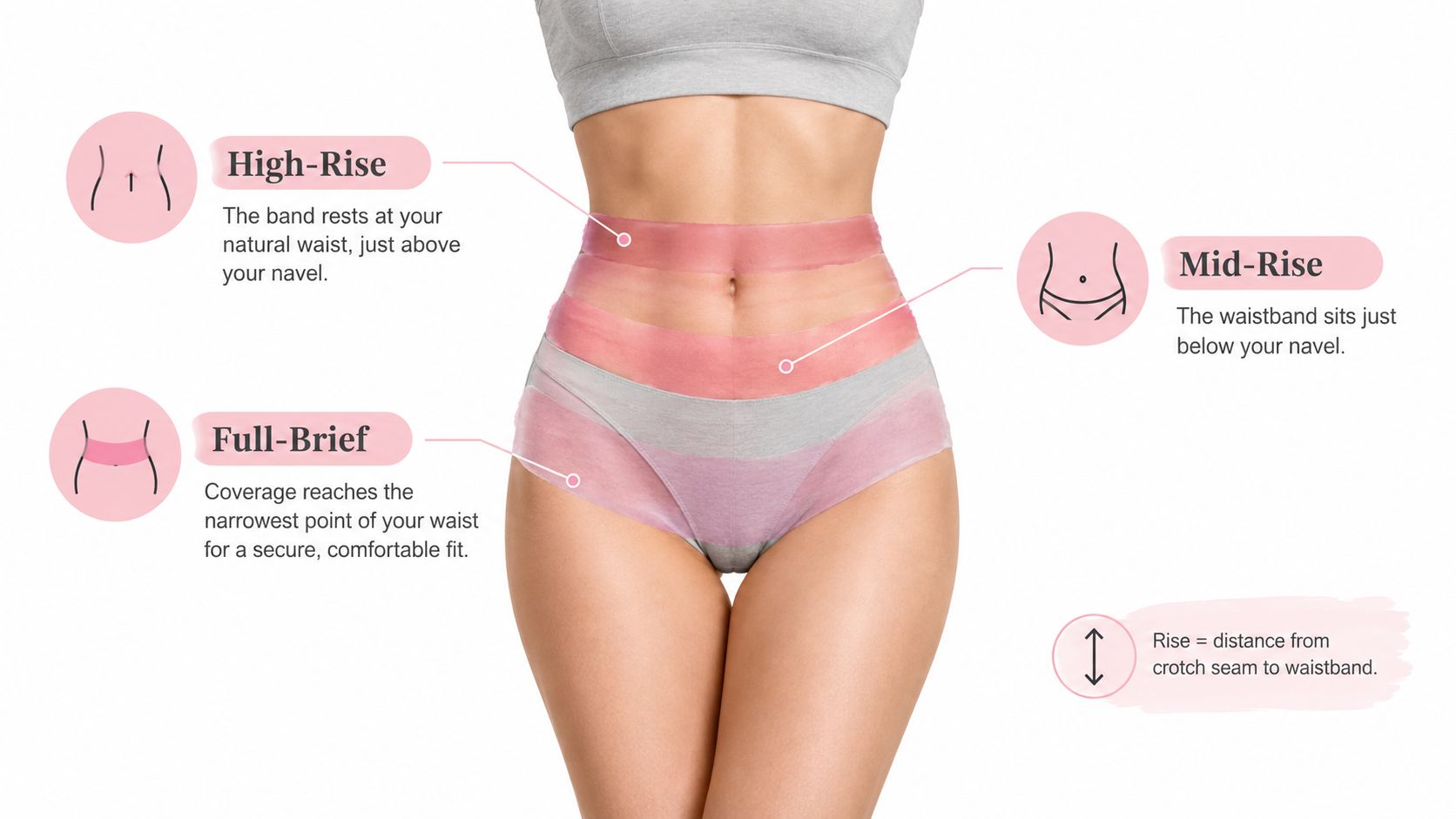
Start with the word rise. It's the distance from the crotch seam to the top of the waistband. That measurement tells you where the garment is designed to finish, but your body landmarks tell you whether that position will feel secure.
- Mid-rise usually lands just below the navel.
- High-rise reaches the natural waist, often at or just above the navel.
- Full-brief rise travels farther upward toward the narrowest part of the torso and may approach the area below the bust.
The natural waist is the place where your torso bends most easily from side to side. If you place your hands on your waist and lean sideways, you can usually feel that bend. A waistband that sits there may feel more anchored than one resting on the softer abdomen beneath it.
Read the three contact zones
Think about the waistband as it travels around three areas:
- The lumbar curve, at the lower back, can create a gap if the back rise is too short or too straight.
- The iliac crest, the upper rim of the pelvic bones, offers a firmer landmark that can help the garment stay positioned.
- The soft abdomen changes shape as you sit, bend, and breathe, so a narrow or overly firm band can feel restrictive there.
When your current underwear feels uncomfortable, identify the location rather than blaming your entire size. A pinch at the front may indicate concentrated pressure. A gap at the lower back may suggest insufficient rise depth. A waistband that slides down can point to poor recovery or a shape mismatch.
The best high-rise brief doesn't push every part of the torso equally. It uses its height to distribute contact across a wider zone, while the hip and seat sections provide enough tension to stop the garment from drifting. That's the foundation of a no-dig fit. A higher rise helps only when its top edge lands where your torso can support it.
How a No Digging Waistband Actually Works
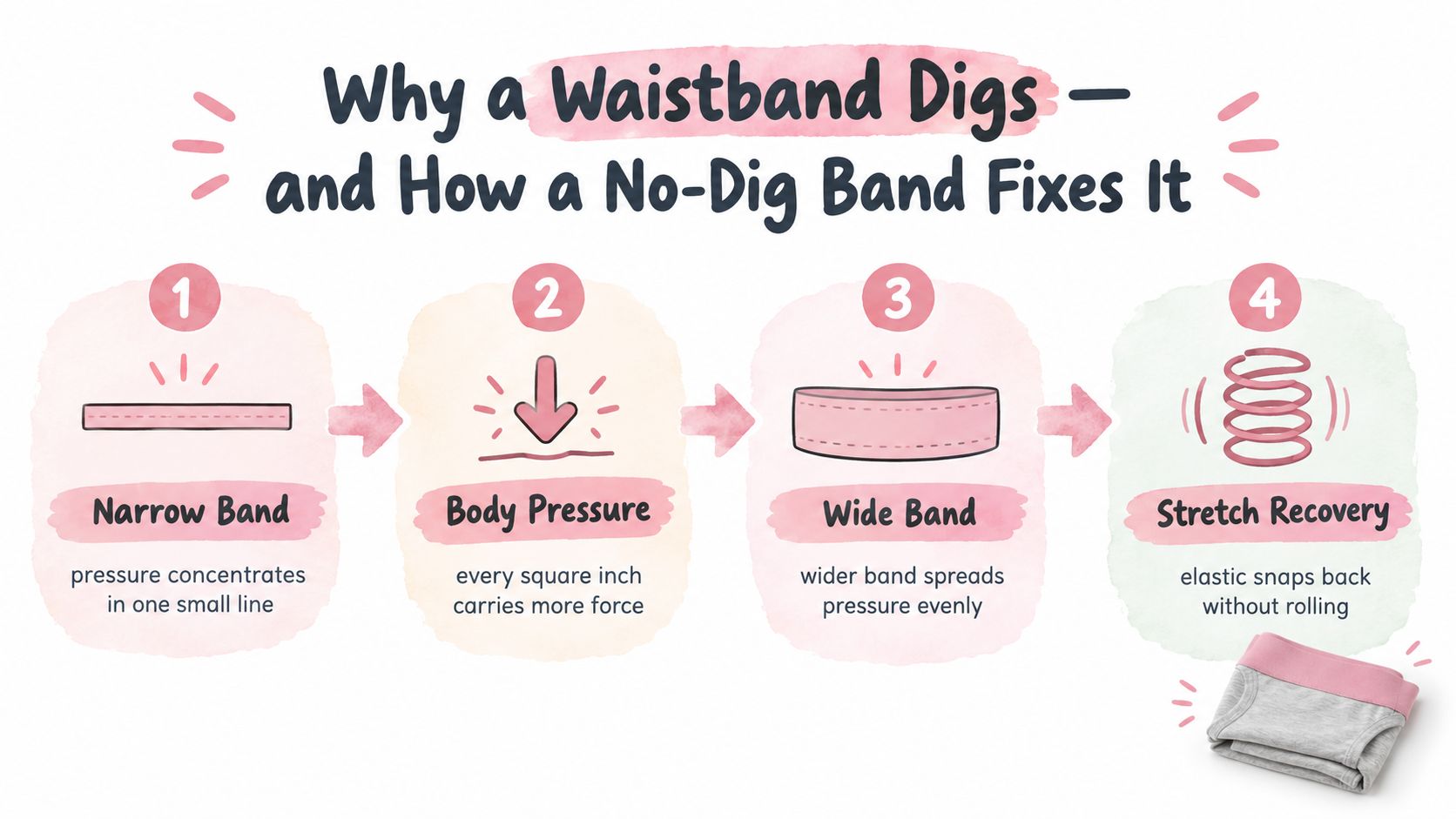
A waistband digs when it applies too much force to too little skin. A narrow elastic strip concentrates pressure along one line, so even moderate tension can leave a visible indentation. A wider, softer band spreads that same holding force over more surface area, which generally reduces the sensation of pinching.
Width isn't the only variable. Stretch recovery determines what happens after you sit or bend. A waistband with controlled stretch expands around the abdomen and returns to its original shape when the posture changes. If recovery is weak, the band may stay slack and roll. If recovery is too aggressive, it may snap back with uncomfortable pressure.
Why bands roll
Rolling often gets blamed on choosing the wrong size, but the mismatch may be structural. A band can roll when its stiffness doesn't suit the curve of the torso, when the rise is too short, or when the fabric underneath compresses and pushes the top edge outward. Extra height won't fix a band that can't remain flat.
Look for a waistband that feels broad enough to distribute force, has a soft skin-facing finish, and returns smoothly after stretching. Test it with movement rather than only standing still. Sit, bend at the hips, and walk a few steps. The goal isn't maximum compression. It's stable placement without a hard pressure ridge.
The underlying design principle is supported by textile research on pressure distribution. A wider, softer waistband can reduce peak pressure by spreading force over more body surface, while controlled stretch accommodates changes in abdominal circumference during movement. Product testing should examine extension force, pressure distribution, roll-down after flexion, and recovery after laundering, as described in the available research on waistband comfort and pressure.
A good diagnostic is simple. If the band cuts in at the front but the rest of the brief fits comfortably, the waistband is probably too tight or too concentrated. If it rolls while the hips and legs fit correctly, investigate band stiffness and torso curvature before moving to a different size.
Fabric Choices That Change How They Feel
The rise decides where a brief sits. The fabric decides how it handles heat, moisture, stretch, and friction. Two pairs can have the same cut and feel completely different after a long day because their knit structures transport air and perspiration differently.
| Fabric | Breathability | Moisture Handling | Best For |
|---|---|---|---|
| Modal | Soft, with performance depending on knit openness | Strong moisture movement in suitable constructions | Long desk days and travel |
| Cotton | Comfortable and familiar, but construction affects airflow | Absorbs moisture but may dry more slowly | Low-movement days and home wear |
| Engineered mesh | Often increases airflow through open zones | Can move moisture well, though evaporation depends on outer layers | Humid commutes and activity |
| Seamless knit | Smooth against clothing, with airflow varying by density | Depends heavily on porosity and finishing | Fitted dresses and low-line outfits |
Modal deserves attention because the fiber and knit structure can support both softness and moisture management. A peer-reviewed comparison of modal, bamboo, cotton/bamboo, and cotton fabrics found that fiber type affected air permeability, water-vapor permeability, thermal conductivity, and vertical wicking. In that comparison, the materials ranked for overall heat and moisture comfort as modal, bamboo, cotton/bamboo, and cotton, as reported in this study of underwear-relevant knitted fabrics.
Match the construction to the day
Modal is a sensible choice for sitting, commuting, and travel because it can spread moisture rather than leaving one damp patch against the skin. A comparative test using the AATCC 195-2009 Moisture Management Tester found that modal had the shortest wicking time and greatest horizontal wicking radius among the tested samples. One modal sample wicked moisture in approximately 50% less time than comparison fibers, although yarn count, elastane, knit density, and fit still affect the finished garment. The modal moisture-management study makes the important point that not every modal brief will perform identically.
Cotton can feel pleasant for quiet days, especially when softness and familiar texture matter more than rapid drying. Mesh can help in heat-prone zones, but open construction isn't magic if trousers or other layers block evaporation. Smooth knit removes bulky stitched seams, yet a dense smooth fabric may feel warmer than a lighter, more porous body.
Pay attention to the gusset, too. A breathable outer fabric can't compensate for a gusset that traps heat or feels rough. A cotton-lined gusset remains a practical everyday choice, while modal can also provide a soft skin contact when the construction and care instructions support it. For a plain-language explanation of modal's feel and common uses, see this modal underwear guide.
Measuring Yourself for a Pair That Stays Put
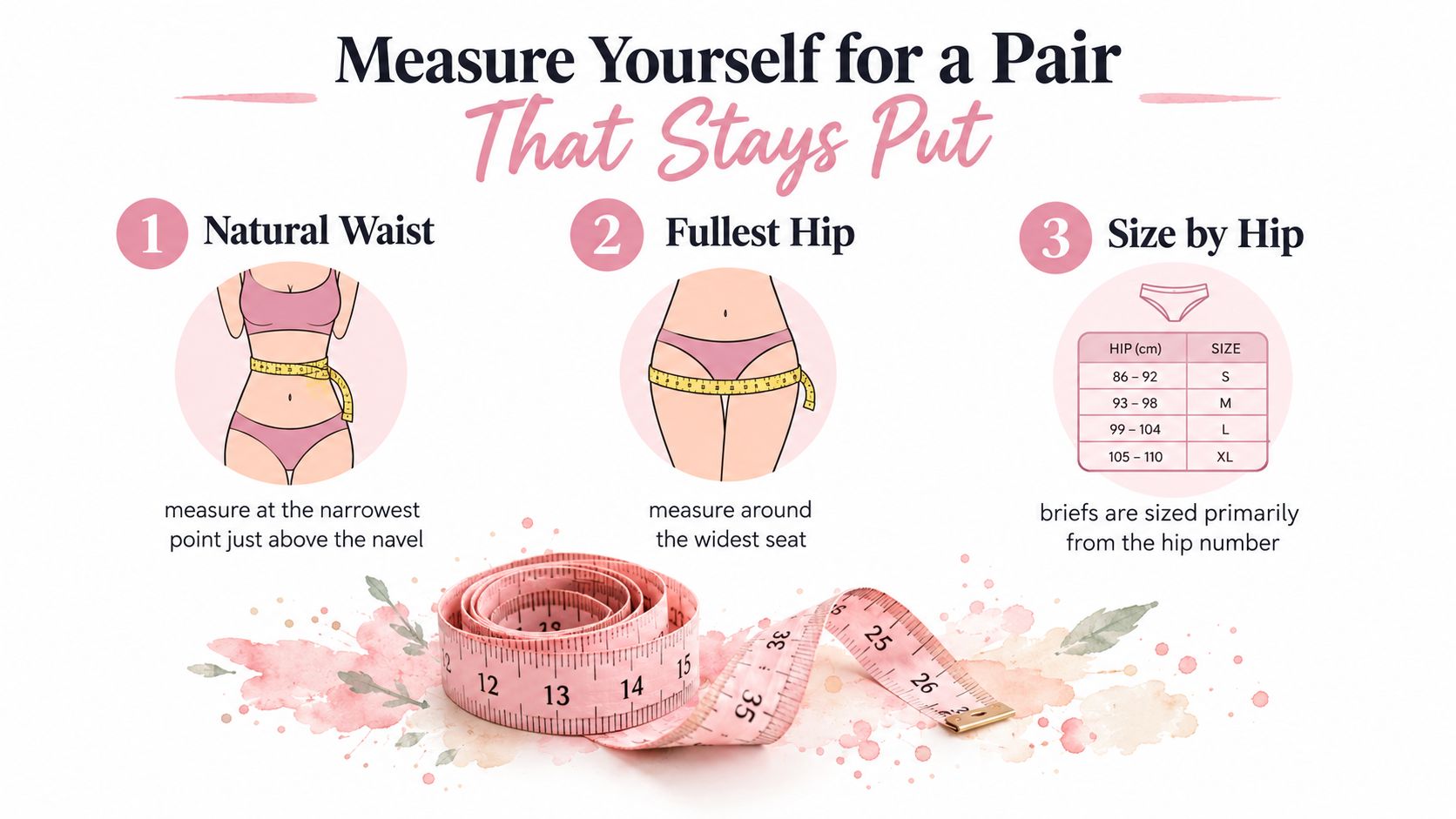
Use two measurements, not one. Wrap a flexible tape around your natural waist, at the narrowest point above the navel, without pulling it tight. Then measure around the fullest part of your hips and seat, keeping the tape level across the widest point.
Briefs are usually selected primarily from the hip measurement because the garment must cover and stay around the seat. High-waisted styles add another consideration: the waistband must reach the torso comfortably without compressing it. If your waist and hip measurements fall into different size bands, start with the hip number and then examine the waistband's stretch and construction rather than trusting the label alone.
A 2025 analysis of 1,261 women's body scans found that only 19% matched the bust, waist, and hip measurements used by high-street clothing. That finding helps explain why a nominal size can mislead, especially when a shopper has fuller hips, a straighter waist-to-hip ratio, or a different torso length. The analysis of women's body-scan fit supports using garment-specific charts and fit notes instead of relying on a generic size label.
Troubleshoot the garment, not your body
- Rolling at the top: The band may be too narrow, too soft, or paired with a rise that's too short for your torso.
- Bunching at the back: The rise depth may not follow the curve of your seat.
- Cutting at the waist: The waistband is likely too tight, even if the brief isn't too small through the hips.
- Front pulling: The rise, torso length, or front coverage may not match your proportions.
Check recovery before buying when the product page allows it. Stretch the waistband gently, release it, and watch whether it returns smoothly or remains loose and rippled. Repeat the movement once more. A slow, uneven return suggests that the band may lose placement with wear or washing.
A size chart is only useful when it explains where to measure, which measurement takes priority, and how the waistband should sit. If it gives one waist number and says little about hip depth or rise, treat it as incomplete.
This short video provides a visual reminder of the measuring process:
For more guidance on interpreting waist and hip measurements together, use this women's underwear sizing guide.
Matching Briefs to Real Day Scenarios
A brief can feel perfect in one outfit and wrong in another. Consider a typical week rather than asking which fabric is universally best.
At a desk, soft modal with a stable waistband can disappear beneath trousers because the fabric follows the body without adding unnecessary structure. Under a silk slip skirt, however, a dense body or raised seam may become visible. A smooth knit without seaming is usually the more sensible choice when the outer layer is thin and close to the skin.
For dinner, a darker modal brief with a flat waistband can work beneath wool, where you want coverage without a bulky outline. The deciding details are the finish and seam profile, not the colour alone. A smooth leg edge can matter as much as the fabric body.
Travel exposes moisture problems quickly. Long sitting, changing temperatures, and limited opportunities to change clothes make slow-drying fabric less forgiving. A modal body with targeted mesh can offer a useful balance, but check whether the mesh sits where your outer layers still allow evaporation. The 2025 review of personal moisture management emphasizes that comfort involves directional transport, evaporation, heat transfer, durability, washability, and the surrounding conditions.
For movement, choose a rise that remains anchored when you bend. Yoga, school runs, and brisk walking can expose a weak top edge faster than standing in a fitting room. A useful rotation might include:
- One smooth pair for fitted clothing.
- One modal pair for long wear and travel.
- One cotton-rich pair for low-stretch days at home.
- One mesh-zoned pair for warmer or more active routines.
That small rotation lets you match the construction to the day instead of asking one pair to solve every comfort problem.
A Quick Checklist Before You Buy
Use this checklist on any product page. Answer each question with yes or no.
- Is the waistband broad and soft? Look for construction details, not only language such as “supportive.”
- Does the band recover smoothly? It should return after stretching without rippling, twisting, or staying slack.
- Will the rise sit at your natural waist? Check the garment measurements against your torso, not just the model's appearance.
- Is the gusset substantial and skin-friendly? Cotton or modal can be more comfortable for daily contact than a rough or heat-trapping panel.
- Does the leg opening lie flat? A narrow edge can cut into the hip or ride upward even when the waist fits.
- Is the fabric weight suited to your climate? Dense knits may smooth well but feel warm, while open mesh may need breathable outer layers to dry effectively.
- Are the seams low-profile? Flat, bonded, or carefully placed seams reduce visible lines and friction.
- Do repeated reviews mention rolling? A pattern across reviews matters more than one isolated complaint.
- Does the product clearly describe the high-rise measurement? A listed waistband height below 9 cm is a red flag if you want a true high-rise design.
- Do the smallest-size reviews mention rolling? That can signal a construction problem rather than an individual sizing mistake.
You don't need to compare every detail forever. Narrow your choices to three to five plausible pairs, then apply the same questions to each. A clear answer beats a flattering product photograph.
Care, Wear, and Common Fit Questions
Wash modal and cotton-rich briefs on a cool cycle, ideally inside a mesh bag, and follow the care label for drying. Heat and harsh handling can weaken elastic recovery, while fabric softener can leave a coating that changes the hand of the fabric and may shorten the useful life of stretch components. Air-drying is usually kinder to delicate underwear than high heat.
Replace a pair when the waistband no longer returns smoothly, the leg edges have lost placement, or the fabric has become thin and unstable. Visible wear isn't the only signal. If the garment looks acceptable but rolls, slides, or needs repeated adjustment, its engineering has already changed.
Why higher isn't always smoother
A high rise can smooth the torso when the waistband anchors a flat layer. It can make smoothing worse when the band is too soft, the rise is too long, or the circumference is too tight. In those cases, fabric gathers beneath the top edge instead of lying evenly, creating a thicker ridge under clothing.
Check the wash for tiny fibres, pilling, or loose strands. Microfibre shedding can indicate abrasion from the machine, rough garments in the same load, or a fabric surface that is breaking down. A laundry bag helps reduce friction, but it won't restore a waistband that has lost its recovery.
Fit complaints in reviews are most useful when they repeat. Several people describing the same rolling point, leg-edge irritation, or seat bunching may be identifying a pattern in the cut. One person's sizing experience can be personal. A recurring construction complaint deserves more weight.
For skin discomfort after shaving or hair removal, it also helps to distinguish fabric friction from other causes. This guide to bikini line bump causes offers context on why bumps can appear, so you can assess whether the issue is the brief, the grooming routine, or both.
Keep enough clean pairs in rotation that each garment gets time to recover between wears and washes. The right care routine won't fix an unsuitable rise, but it can preserve the stretch, softness, and moisture-handling performance you chose in the first place.
Nuage Wears offers high-rise briefs alongside modal-based everyday cuts, breathable mesh styles, flat-finished edges, and no-dig waistband designs for different wear scenarios. Visit Nuage Wears to compare the construction details and choose a pair based on your waist, hip, clothing, and daily movement needs.