
You know the moment. It's 11 a.m. on a Tuesday, you're halfway down a corridor or wedged into a train seat, and the underwear that felt fine when you dressed has relocated. You do the discreet tug through your skirt. Ten minutes later, you need to do it again.
A wedgie isn't a verdict on your body, and it usually isn't about buying cheap underwear either. It's a fit-and-movement problem, and the movement part gets far less attention than it deserves. Fabric migrates when your body moves, so the thing that triggers yours, whether that's walking, sitting, squatting, sweating or a tight pair of jeans, tells you more about the fix than the size on the label.
That's the whole method for how to stop getting wedgies: find the movement that causes yours, then change one thing that matches it. Pairs that stay put through a full day of desk work and a workout aren't magic. They're cut, sized and tensioned for the way you move.
Table of Contents
- Find the Cause Behind Your Wedgies
- Choose a Size That Stops Movement Without Digging
- How to Test Underwear Before You Wear It
- Pick a Cut and Fabric That Stay Put
- Dress for Outfits, Heat and Sweat
- Build a Wedgie-Free Drawer With Your Results
Find the Cause Behind Your Wedgies
Start with the trigger. The table below pairs what you notice with the most likely cause and the first change worth trying.
| Symptom | Likely cause | Fix to try |
|---|---|---|
| Rides up while walking | Rear panel too narrow or rise too short | Choose a fuller-back brief or hipster |
| Migrates during squats or bending | Shear with short rear coverage | Pick a higher rise and longer back panel |
| Leg edges roll or cut in | Leg band too tight or elastic stretched out | Size up one step or try a looser leg opening |
| Bunches and slides after sitting | Excess fabric from a size that is too large | Go down one size |
| Shifts only under tight jeans | Outer layer compressing the fabric | Test with the outfit or add a lining |
| Moves more when sweaty | Moisture raises friction against skin | Choose moisture-managing fabric and change damp underwear |
| Waistband rolls down | Waistband too loose or wrong rise for your shape | Re-measure waist and hips against the size chart |
Read down the left column and find the row that sounds like your week. If two of them do, pick the one that happens more often, because the fix for short rear coverage won't do anything for a waistband that's too loose.
The reasoning behind each row comes from movement-based fit practice. When a waistband slides, the rear panel is usually too short or the rise is wrong for your shape. When leg openings roll or cut in, tension or lost elastic recovery is pulling the garment upward instead of holding the edge flat. When the problem only appears in a deep squat, shear and thin rear coverage are the likelier culprits, not the waist measurement (movement-based fit guidance for no-ride-up underwear).
Fit problems are also far more common than the underwear aisle suggests. An apparel-fit review hosted by the University of Manchester reports that 77% of survey respondents had experienced garment-fit problems tied to particular body locations such as the bust, waist or hips (apparel-fit research from the University of Manchester). Underwear has less fabric to absorb a mismatch than a dress does, so the same gap between a standard size and a real body shows up faster.
Quick diagnostic: if the problem appears in one activity only, treat it as a fit-and-shear issue for that activity. It is not a reason to buy a smaller size.
Change one variable at a time, then live in the pair for a day. Keep a note on your phone for a week: which activity, which pair, what happened. That record is what turns a drawer of guesses into a short list that works.
Choose a Size That Stops Movement Without Digging
Your usual clothing size doesn't transfer to underwear. It barely transfers between clothing brands: in a 2025 survey of 687 US and UK consumers by Vogue Business, 91% said their clothing size depends on the brand (Vogue Business consumer sizing survey). A tag reading M means whatever that label's maker decided it means, and a stretchy knit forgives a size that's slightly off far more readily than a leg band does.
Sizing is a measurement job, not a guess. A gardener picking gravel doesn't reach for a familiar bag; the grade has to match the gap it fills or the path shifts underfoot. A waistband works the same way.

Three steps get you a working size.
- Measure your waist at its narrowest point and your hips at the fullest part. Use a soft tape held level and snug, not pulled tight, and write both numbers down. Guessing from memory is how the wrong size gets bought twice.
- Match both numbers to that brand's own chart. Our underwear sizing guide walks through the measurement points, and the Fit & Size Guide works the same way: you measure your waist and hips, then match those measurements to the chart rather than to the size you wear in jeans.
- If you fall between sizes, follow your hips first. Hips decide whether the rear panel has enough fabric to stay over the crease. Waistbands have more give than leg openings do, so a hip match plus a movement test tells you more than the waist number alone.
Where sizing goes wrong in both directions
A pair that's too small has too little fabric to anchor. The leg edge sits tight, gets drawn into the crease on the first flight of stairs, and the waistband digs while it happens. A pair that's too large fails differently: the extra fabric has nowhere to go, so it folds, bunches and gets dragged inward as you walk.
The signals are easy to read once you know what you're looking at.
- Too tight: deep pressure marks that last after you undress, leg edges that roll or cut in, and fabric that keeps climbing.
- Too large: loose folds across the seat, a back panel that slides sideways when you sit, and bunching you can feel through your trousers.
Don't size up or down automatically when a pair rides up. Neither direction is the default answer, and repeating the same move after a failed experiment just costs you another purchase. If the pair still migrates at a measured size, change the cut instead: a fuller back, a higher rise, or a longer leg panel does more than a second size change.
How to Test Underwear Before You Wear It
The mirror test is the one that fails you. Standing still, almost any pair looks right, because nothing is pulling at it. Wedgies happen in motion, so that's where a new pair earns its place or loses it.
Six checks cover most of what a day will throw at you.
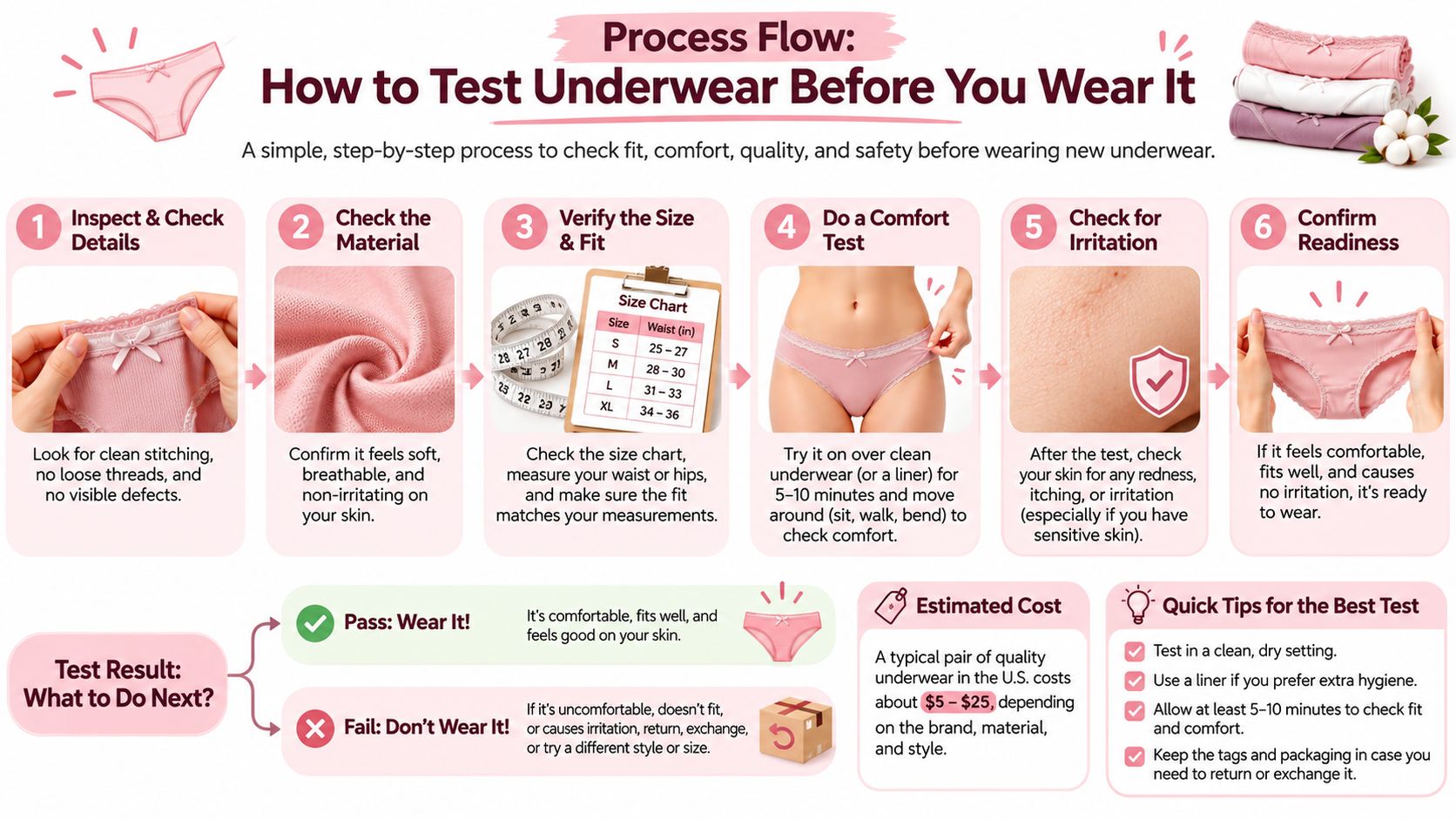
- Put the pair on dry, with the back panel flat. A folded or twisted panel gives the fabric a crease line to settle into, and it finds it fast. Smooth it into place with your hands before you stand up.
- Stand and check the rear coverage. The panel should cover the full crease rather than stopping at the top of it. If you can see cheek below the edge while standing still, walking will push that edge inward.
- Walk for two or three minutes. Walking generates most of the friction and shear a pair will meet all day. If the edge creeps while you pace a hallway, it will travel further on a commute.
- Sit down, then stand up. Sitting compresses and stretches the back panel, then releases it. Watch whether the waistband stays level instead of rolling forward, and whether the back edge has climbed when you rise.
- Do a deep squat and bend forward. A squat loads the rear panel harder than anything else in a normal day. If the fabric slides only here, the cause is coverage and shear, not the waist size.
- Give it 20 to 30 minutes of real movement. Fabric that stretches out under body heat shows it in half an hour, not in ten seconds. Count every adjustment you make.
Garment ergonomics research treats fit, fabric tension, pressure distribution and skin-to-fabric friction as the core determinants of comfort and movement performance, and recommends pressure measurement plus pattern changes when peak pressure gets too high (Journal of Textile and Apparel, Technology and Management). Translated into getting dressed: if a band presses hard anywhere, that's a design or size problem, and no amount of tugging will settle it.
A pair that needs adjusting twice in half an hour has failed, however good it looked on the hanger.
Tight isn't the same as stable
Compression does add grip, which is why sizing down feels logical. It also adds pressure. A waistband or leg band that leaves a groove is holding on with the wrong tool, and the upward pull that comes with it often creates the migration you were trying to stop. Digging, red marks and a band that rolls under tension are all signs you've traded one problem for another.
A pass is unglamorous: no adjustments during the test, no marks when you take the pair off, no rolled edges, and nothing to fix when you stand up.
Pick a Cut and Fabric That Stay Put
Rear coverage is the biggest single lever on whether a pair stays where you put it, and the gap between cuts matters more than the gap between brands.
| Cut | Rear coverage | Movement stability | Best for |
|---|---|---|---|
| Thong | Minimal | Stable only when sized correctly; leg openings can shift | Under leggings, bodycon dresses and hot yoga |
| Hipster | Medium to full | Stable through sitting and walking | Desk days and commuting |
| Mid-rise brief | Full | Stable with a level waistband | Long days on your feet and walking |
| High-rise brief | Full, higher waist | Stable at the waist and smooths the midsection | Under dresses and fitted tops |
| Shield brief | Full with a front panel | Stable with a front smoothing panel | Skirts and thin dresses |
That looks like this on the body: a full-coverage brief, made to hold its shape through a long day.
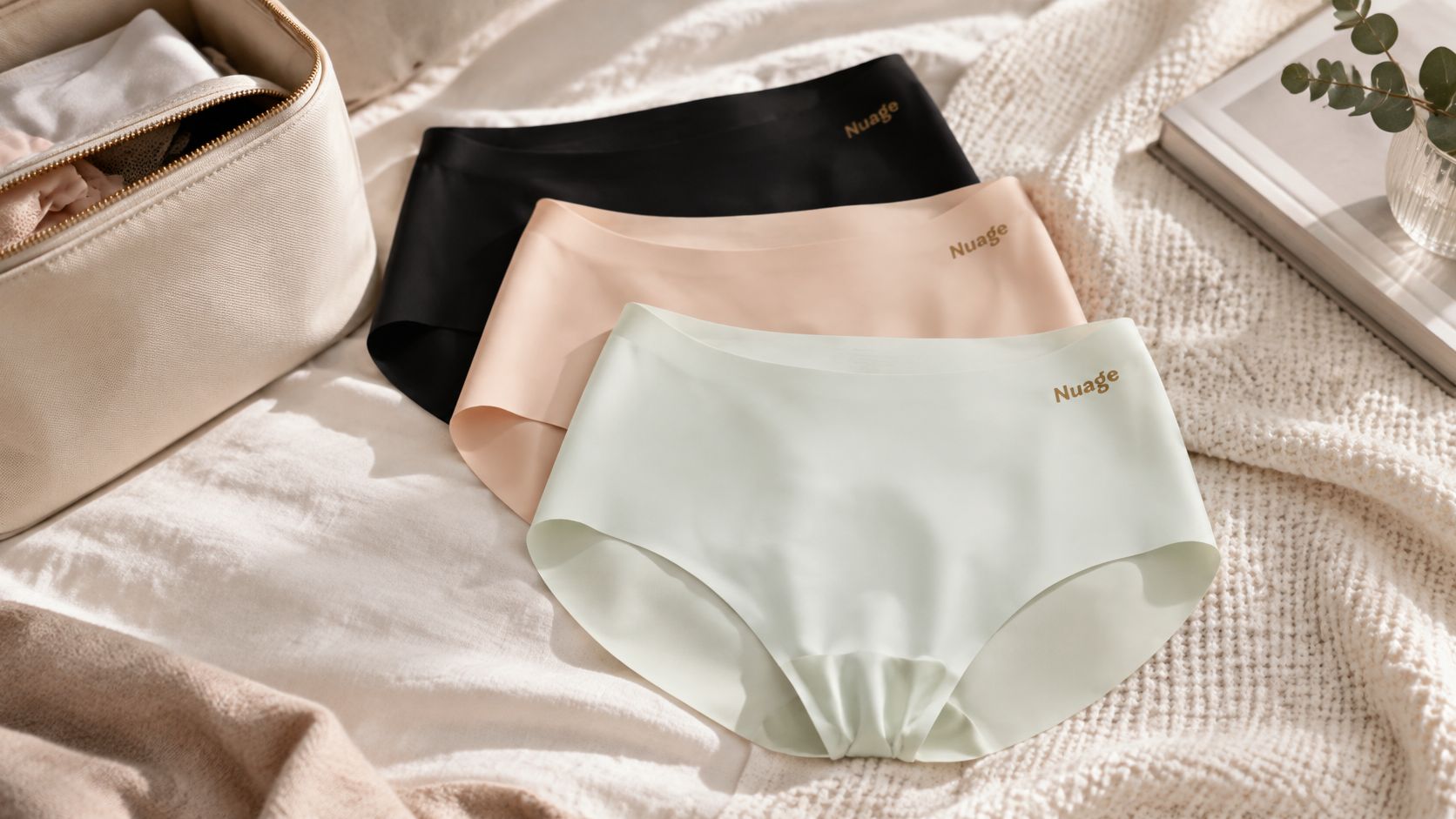
Elastic doesn't hold underwear in place by itself. Balance does. Too much tension pulls fabric upward into the crease, while too little lets the whole garment drift and bunch, so the answer is a design that puts moderate tension in the right places: a back panel wide enough to sit flat before the edge reaches the crease, a leg opening that lies smooth without compressing, and a waistband that stays level instead of rolling (fit guidance on briefs and wedgies).
Recovery matters as much as tension. Fabric or elastic that springs back after stretching helps a pair return to position as you move; elastic that has stretched out permanently lets the garment wander and never pulls it home.
Match the cut to the day
- Desk days and commuting: a hipster or mid-rise brief gives you enough rear coverage to survive eight hours of sitting plus the walk to the station.
- Workouts, travel and long stretches of sitting: look for a full-coverage brief in a fabric that recovers, because a slack panel under a seatbelt is where the day goes wrong.
- Skirts and thin dresses: a shield brief with a smooth front panel keeps the line clean, and the rear coverage does the rest.
Thongs get a bad reputation for a reason that's easy to fix. A correctly sized thong has no loose fabric to bunch, which makes it a good choice under leggings and bodycon dresses, but slack leg openings will slide. It's the cut that rewards accurate sizing more than any other.
Run the test above before a long day, not after. And if a cut still rides up at the right size, move one step up in rear coverage before you change size again.
The NuCloud Original Mid-Rise Brief Set sits in that hip-level, full-coverage territory, with a 3D-cut seat and raw-cut edges designed to lie flat, and it's the kind of pair worth putting through six checks before you commit to a long day in it.
Dress for Outfits, Heat and Sweat
Your trousers are part of the problem. Close-fitting outer layers press the underwear against the body and push fabric toward the crotch, where it bunches, while looser pants leave room for the garment to stay where you put it. Repeated transitions, walking, sitting, bending and squatting, add friction and shear between skin, underwear and outer layer each time (outfit guidance on preventing ride-up).
So test the outfit, not just the underwear. Put on the jeans, trousers or dress you plan to wear, then walk, climb a flight of stairs and squat. If the pair shifts only under one outfit, the outer layer is the cause, and a different cut will fix more than a different size will.

Thin skirts and dresses need a buffer. A lining, tights or leggings between skin and outer fabric reduces direct friction and limits how far the underwear can migrate, and it's the cheapest fix in this article. Say you're wearing a silky bias-cut skirt on a humid day. The skirt has no structure to hold anything in place, so a lining does the job a heavier fabric would.
Heat, sweat and friction
Moisture changes the arithmetic. Damp fabric adheres to skin more readily, friction rises, and edges that were stable at 8 a.m. start creeping by lunchtime. Contact-stress research on clothing during joint flexion traces part of that discomfort to friction generated when stretched fabric moves relative to skin (Journal of Biomechanical Science and Engineering).
The fix isn't a tighter waistband. Choose moisture-managing construction for exercise and humid travel, change out of damp underwear as soon as you can, and start the day in a dry pair rather than one that came out of a gym bag. If humidity is your main trigger, our guide to breathable, moisture-wicking underwear goes further on fabric choice, and the NuAir Mesh Flex Brief applies the same idea with featherlight mesh, an elastic-free waist and reinforced thigh bands.
Sweat management is a whole-body job too. The logic behind breathability tips for hot gym feet is the one that governs your base layer as well: move moisture away from skin and the friction that drives migration drops with it.
Heat rule: when a narrow back keeps riding inward in the heat, switch to broader coverage. Tightening the waistband makes it worse.
Before a long day or a workout, do the two-minute check: dry pair, positioned correctly, then walk the length of your hallway. If it moves now, it will move more by noon.
Build a Wedgie-Free Drawer With Your Results
By this point you have data few shoppers collect: which trigger is yours, which cut passed, and how a pair behaved across a full day. Spend it on the drawer you already own.
Work through every pair once.
- Keep the pairs that came through the movement test with no adjustments and left no marks.
- Retire the ones that roll, bunch or leave grooves, even if the fabric still looks new.
- Sort what's left into three groups: desk and everyday, workouts and travel, and under skirts and dresses.
- Record which cut passed in each group, so the next purchase starts from your own results rather than a review you read at midnight.
Two rules make the sort honest. A pair that needs a safety pin or a strategic tug before you leave the house belongs in the retire pile. And a style that only fails in one context, like a thong that stays put at a desk but creeps during squats, gets filed under the context where it works instead of written off entirely.
Care that keeps a pair in service
Wash cool, skip the fabric softener, and air dry rather than tumble. Heat and softener are hard on stretch fibers, and a band that has lost its spring is the usual reason a favorite pair starts drifting a few months in. Rotate pairs so each one gets time to recover between wears, and check the leg openings in a mirror before a pair goes back in the keep pile.
When a group comes up short after the purge, buy for the trigger you recorded. Some designs take the waistband question off the table entirely: calibrated fabric stretch does the work of elastic, and a 3D glute contour puts the hold in the cut. Everyday Briefs built on stay-put cuts hold their position through movement, and the NuCloud Original Thong (3-Pack) covers the minimal end for days when nothing can show under leggings.
Give every new pair the movement test before its first full day. Match the cut to the cause you identified in the first table, check the size chart against your own waist and hip measurements, and let half an hour of real walking and sitting decide whether it earns a place in the drawer. If a gap still needs filling, browse the underwear range and put your first pair through the same test.