
Underwear (also known as no-show underwear) is underwear made to disappear under clothes by removing bulky stitched seams through circular knitting or laser-cut bonded edges. It has grown far beyond a niche style, with one market estimate valuing the category at USD 46.7 billion in 2023 and projecting 6.4% CAGR to USD 92.3 billion by 2034, while another report projects the women's version at about USD 14.5 billion in 2024 rising to USD 22.1 billion by 2033.
You know the moment. You pull on leggings, fitted work trousers, or a slinky dress, turn sideways in the mirror, and there it is. A waistband ridge, a leg opening line, or that faint outline that makes the whole outfit feel less polished.
That's the problem this underwear is built to solve. Not by magic, and not always by being seam-free, but by using smarter construction so the fabric lies flatter against your body. The whole idea is simple: if the underwear doesn't create bumps, ridges, or pressure points, your clothes skim over it instead of tracing every edge.
What confuses people is the word itself. Some pairs are knitted in one continuous piece. Some are cut from smooth fabric with raw laser-cut edges. Others use bonded finishes instead of stitched hems. They can all live under the umbrella, but they don't all behave the same way once you wear them.
That's where things get interesting, because the answer isn't just one. It's a small family of construction methods, and each one changes how invisible, breathable, and stay-put a pair feels.
Table of Contents
- Introduction That Makes Invisible Underwear Click
- How Seamless Underwear Is Actually Made
- Seamless Versus Traditional Seams Under Clothes
- Materials Edges and Breathability That Change the Feel
- Where Seamless Underwear Shines in Everyday Life
- How to Choose, Care for, and Love Your No-Show Pair
Introduction That Makes Invisible Underwear Click
A lot of underwear frustration starts with a perfectly normal outfit. You put on soft ponte pants for work, or a body-hugging knit skirt for dinner, and suddenly your underwear becomes part of the outfit in the worst possible way. Not because it's bad underwear, necessarily, but because thick seams and stitched edges create little raised borders that fabric can grab onto.
Underwear that avoids visible lines became popular because it solves that exact mirror test. Instead of building a pair from several panels with obvious joins, it uses construction methods that reduce those hard lines and make the edges less visible under clothing. That's why it works so well under leggings, slip dresses, trousers, and other pieces that don't forgive much.
This isn't some fleeting fashion quirk either. Underwear now sits in a global market measured in the tens of billions of dollars, which tells you it has moved into everyday wardrobes rather than staying a specialty fix for occasional outfits. One market estimate places the category at USD 46.7 billion in 2023, with projected growth to USD 92.3 billion by 2034, and another projects the women's segment at about USD 14.5 billion in 2024 rising to USD 22.1 billion by 2033 according to global market estimates for seamless underwear.
Practical rule: If your outer layer is smooth, fitted, or lightweight, underwear construction matters as much as the cut.
The reassuring part is that you don't need a textile engineering degree to understand it. Think of this underwear as a design choice aimed at one goal: making the base layer behave under clothes. Once you understand how that's done, shopping gets much easier.
How Seamless Underwear Is Actually Made
Underwear that disappears under clothes can be built in a few very different ways. That is the part many labels skip. One pair may get its smooth look from the body of the fabric, another from the edge finish, and another from how the edges are attached.
That is why it helps to treat this category as a spectrum of construction methods, not one magic formula.
Circular knitting shapes the body in one piece
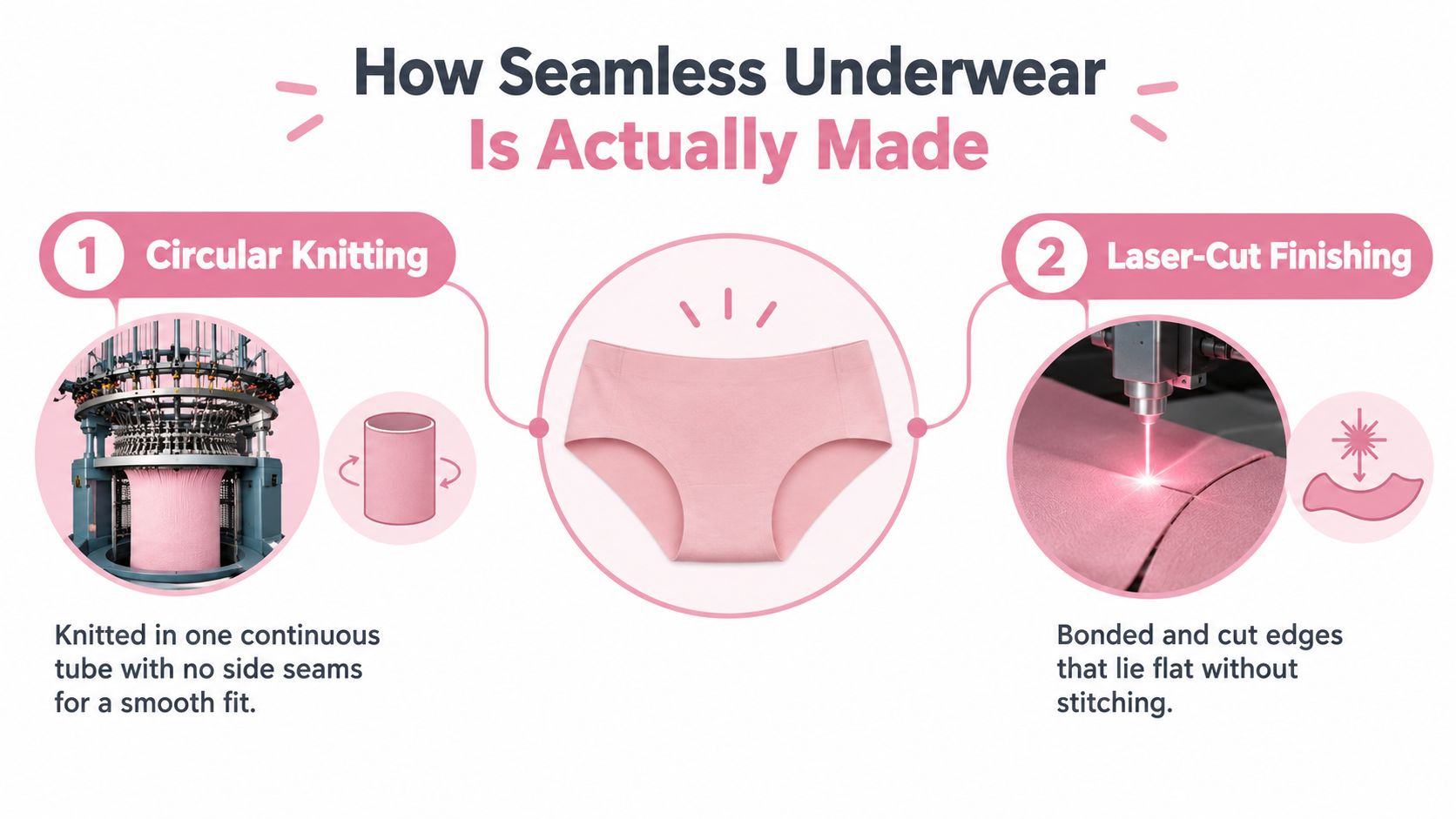
Some no-show styles are made on circular knitting machinery, which creates a tube-like body instead of cutting separate front, back, and side panels and stitching them together. The result is a garment with fewer joins through the main body, which can reduce rubbing and bulky ridge lines. It also gives makers room to build different knit zones into the fabric itself, such as stretchier areas or firmer areas for light support.
This method changes how the body behaves. It often feels more flexible and less segmented because the fabric is doing more of the shaping work.
Laser-cut and bonded finishes change the edges
Other pairs begin as flat fabric. Their no-show effect comes mostly from the perimeter. Laser-cut edges remove the bulky folded hem you get with stitched finishing, while bonded edges use an adhesive process to secure and flatten the edge instead of building up a raised seam.
Those two methods may look similar on a hanger, but they do not always wear the same way. Laser-cut edges can feel very light and nearly disappear under thin clothes. Bonded-edge pairs often stay flatter and more anchored if the bonding is done well.
A simple way to sort the methods is this:
- Circular knit changes the body of the garment.
- Laser-cut changes the edge profile.
- Bonded changes how the edge is secured.
If you want a shopper-friendly example, this guide to seamless laser-cut underwear shows how laser-cut construction is described in practical terms.
Here's a quick visual explanation of the manufacturing idea in motion:
A better question than “Is this pair called seamless?” is “Which part was engineered to disappear. The body, the edge, or both?”
The method changes breathability, invisibility, and grip
Construction gets interesting. A circular-knit pair may feel smooth across the hips because there are fewer side joins, but it can still have a more noticeable edge if the leg opening is finished with stronger elastic. A laser-cut style may vanish under a clingy skirt because the edge is so flat, yet feel less secure if the fabric is too slick or the size is off. A bonded-edge pair can offer a middle ground, with a low-profile look and a bit more hold at the openings.
So the label alone does not tell you enough.
Many pairs still include some sewn elements, especially in the gusset or waistband. The promise usually means fewer visible joins and flatter edges where clothes tend to reveal them, not an entirely seam-free garment from top to bottom.
Reading the construction details gives you a much clearer picture than the front-of-package wording.
Seamless Versus Traditional Seams Under Clothes
Under a drapey cotton skirt, many underwear styles disappear. Under leggings or a thin knit dress, construction starts to behave like topography. Every raised join, folded hem, and stitched elastic edge has a chance to show up as a line or shadow.
Traditional pairs are built with cut-and-sew panels. That usually means folded edges, visible stitching, and elastic secured with thread. Those features often give the underwear a more anchored feel, a bit like a cuffed sleeve that stays put because it has more structure built in.
By contrast, no-show styles flatten the areas clothes tend to trace most closely. But this is not one single method. A circular-knit pair may reduce side joins yet still have a firmer leg opening. A laser-cut pair can nearly disappear at the edge but may shift more if the fabric is slick. A bonded-edge style often sits between those two, with a flatter finish and a little more grip.
No-Show vs Traditional Stitched Edges at a Glance
| Feature | Bonded / Laser-Cut Construction | Traditional Stitched Construction |
|---|---|---|
| What usually shows first under clothing | Edge shadowing if the cut edge lifts or rolls | Hem ridges, elastic lines, and seam outlines |
| Best match for outfit type | Thin jerseys, body-skimming dresses, leggings, tailored pants | Looser pants, denim, fuller skirts, thicker fabrics |
| What affects stay-put performance most | Fabric grip, correct size, edge finish, body movement | Elastic tension, seam placement, panel shape |
| How the line looks through fabric | Softer fade from skin to edge | Sharper stop line where fabric thickness changes |
| Common tradeoff | Lower visibility can mean less hold if the finish is too minimal | More security can mean more print-through |
| What to check before buying | Whether the openings are raw-cut, bonded, or reinforced | Whether hems, side seams, or lace edges add bulk |
Why labels can still confuse shoppers
A package label does not tell you which part was engineered to disappear. The body might be smooth while the waistband is still thick. The leg opening might be laser-cut while the gusset seam is more noticeable under clingy fabric.
That is why two pairs with the same label can perform very differently under the same outfit. As noted in this plain-English breakdown of whether no-show panties are really invisible, raised details like thick waistbands, decorative trim, and bulky finishing are often the parts that give the underwear away.
A better fitting-room question is simple: where is the highest point?
A quick mirror test that works
Use the outfit that gives underwear the least room to hide.
- Thin knit dress: Check the back leg opening and lower hip first.
- Fitted pants: Look for waistband ridges and side-hip outlines.
- Leggings: Watch for a hard line at the leg opening and any shifting after a few squats.
If you can trace the edge under the outer fabric, that pair is too raised, too tight, or too structured for that outfit.
Materials Edges and Breathability That Change the Feel
A pair can disappear under clothes in the morning and still become annoying by lunch. The reason is simple. Construction affects the outline, but materials and edge engineering decide whether the pair feels cool, dry, and steady on your body.
That helps clear up a common confusion. Underwear in this category is not one single build. Circular-knit styles, laser-cut styles, and bonded styles can all feel smooth under clothing, but they behave differently once heat, movement, and moisture enter the picture.
Fabric changes cling and comfort
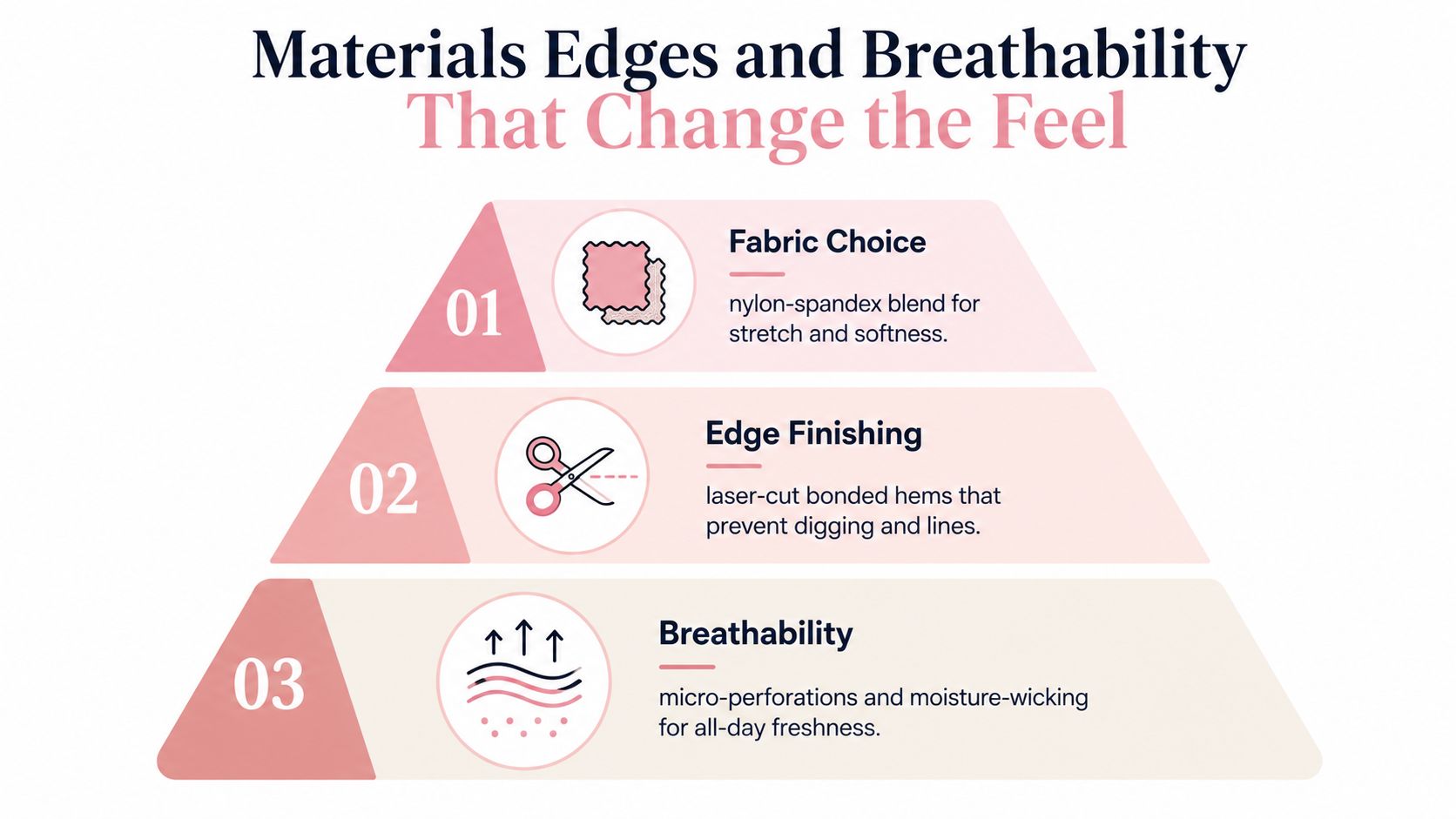
Fabric is the part touching your skin for hours, so it often shapes comfort more than shoppers expect. A smooth surface can look polished in the mirror, yet still trap warmth or hold dampness against the body.
Modal is a good example because its moisture behavior differs from basic cotton. A textile explainer notes that modal typically has about 11 to 13% moisture regain, compared with cotton's roughly 7 to 8%, and may dry faster in comparative testing, according to this modal underwear materials guide.
In plain language, modal often feels less sticky once your day gets warm. That can mean less cling under dresses, less dampness during a commute, and a cooler feel during long wear.
Other fabrics create different tradeoffs. A silky synthetic blend may slide beautifully under trousers but feel warmer. A knit with more body may offer better coverage but hold onto more heat. The right choice depends on whether your priority is invisibility, airflow, or a more secure feel.
Edge finishing changes both outline and hold
Edges work like the frame around the fabric. Even when two pairs use a similar body material, the finish at the waist and leg opening can change how the pair behaves.
Laser-cut raw edges are the flattest option in many cases because there is no folded hem stacked on itself. They usually work best under slinky skirts, thin knits, and trousers that show every ridge. The tradeoff is that very minimal edges can shift more on some bodies, especially if the fabric is slippery.
Bonded edges add another layer of engineering. Instead of relying on a thicker stitched hem, they use a fused finish that stays relatively flat while giving the opening more structure. That often improves stay-put performance without creating the firm outline of traditional elastic.
Circular-knit styles add a different feel again. The body tube may be very smooth at the sides, but the openings still matter. If the waistband or leg edge is reinforced more heavily, the pair can feel steadier while also becoming a little easier to spot under clingy clothes.
Breathability is its own job
Breathability and invisibility are related, but they are not the same thing.
A pair designed mainly to vanish under fabric may use dense, very fine material and ultra-clean edges. That can look excellent under a fitted skirt. It may not be the pair you want on a humid day if the fabric does not release heat well.
By contrast, a pair built with lighter yarns, mesh zones, or a more airy knit may feel better during long wear, even if it gives up a bit of smoothing or edge control. Eco-friendly no-show underwear often follows this path too, with more attention on material choice and comfort over time rather than on the flattest possible finish alone.
A useful way to compare options is to ask three questions:
- Does the fabric stay comfortable when warm or slightly damp?
- Are the edges flat enough for my clothes, but stable enough for how I move?
- Is this pair built more for disappearing, for breathing, or for staying put?
Those three answers usually explain why one smooth pair becomes a favorite and another ends up forgotten in the drawer.
Where Seamless Underwear Shines in Everyday Life
You pull on slim work trousers in the morning, check the mirror, and everything looks smooth. By midafternoon, after commuting, sitting, and walking a few blocks, the pair underneath starts to shift, trap heat, or show at the edge. That is why this category helps to view as a range of constructions, not one promise on a label.
Fitted outfits and polished workwear
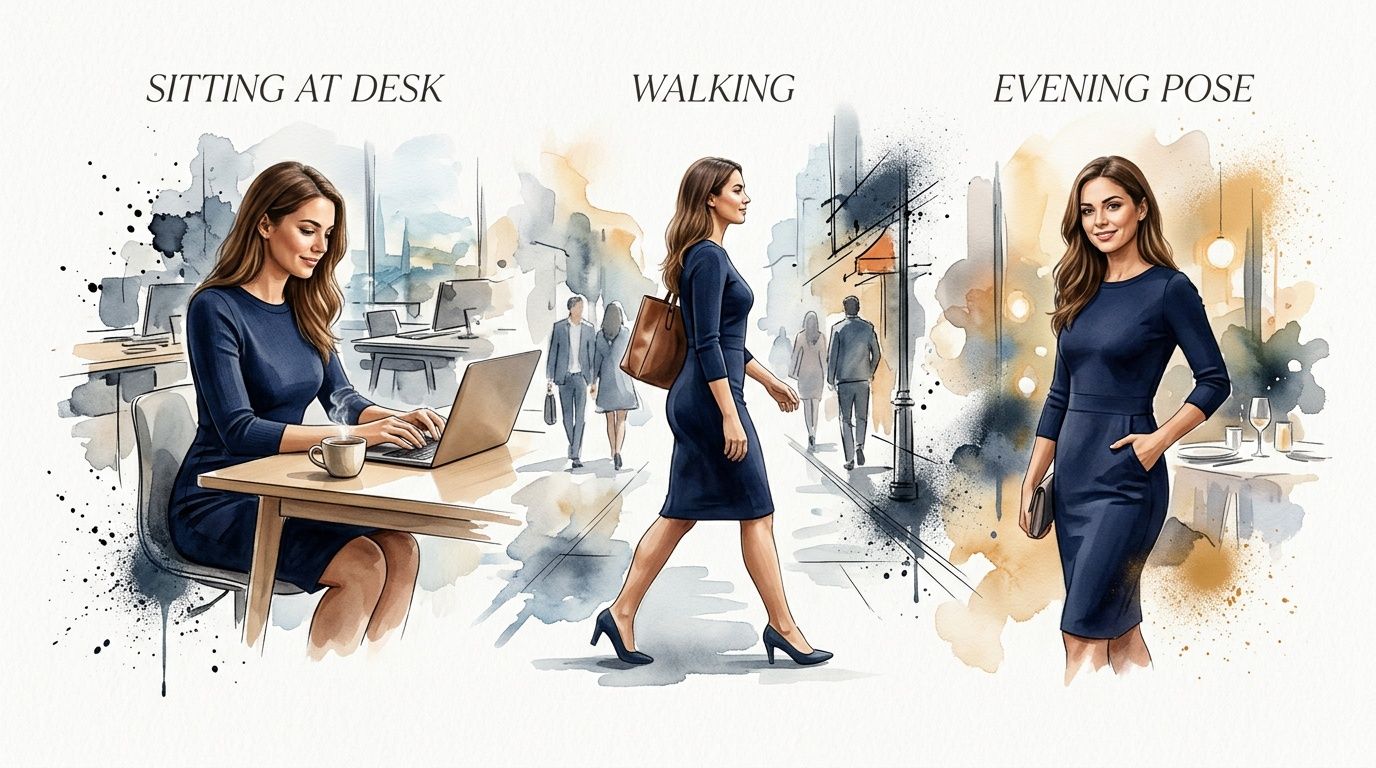
Smooth trousers, knit skirts, and close-cut dresses usually ask for the flattest edge finish. Laser-cut or bonded pairs often do well here because the outline stays quiet under fabric that likes to reveal every ridge.
Cut still matters. A pair can have very clean edges and still bunch when you sit if the rise or leg shape fights the garment. If visible lines are the problem you run into most often, this guide on how to avoid panty lines can help you match the cut and edge style to your clothes.
Travel and long days out
A long wear day asks a different question. The goal is not only to disappear under clothing. The pair also has to stay comfortable after hours of sitting, walking, warming up, and cooling down again.
Construction choice becomes practical here. A circular-knit style can feel a bit like a soft tube that moves with you, which some people love for flights or desk days. A bonded style may hold its shape better around the openings. That can feel steadier during a busy day, especially if you do not want to keep adjusting.
Movement and warm weather
Hot days and active plans usually expose tradeoffs quickly. The flattest possible edge is helpful under leggings or light shorts, but airflow and grip matter just as much once you start moving.
Some bodies do best in a minimal laser-cut pair that feels barely there. Others need a little more structure at the waistband or leg opening so the fabric stays in place. A modal-based high-rise style like NuCloud Original High Rise sits on the soft, second-skin side of that spectrum. Another shopper may prefer a lighter or more engineered pair for walks, errands, or heat.
Dresses and skirts that show front texture
Back lines get all the attention, yet front smoothing often matters just as much. Lightweight skirts and body-skimming dresses can reveal ripples across the lower stomach or high hip even when the leg edge stays hidden.
Here, the best choice is often the pair that balances three jobs at once. It needs enough surface smoothness through the middle, a cut that stays aligned, and edges that do not print through. Very stretchy underwear can vanish at the border and still lose that flatter look across the center panel.
That is the useful real-life test. Ask what your outfit needs most: the least visible edge, the coolest feel, or the most stay-put support. The answer usually points you toward the right construction method much faster than the label alone.
How to Choose, Care for, and Love Your No-Show Pair
You pull on a fitted skirt, check the mirror, and everything looks good. Then you sit down, walk a block, or reach for your bag, and suddenly the pair underneath starts to shift, press, or peek through. That is usually not a body problem. It is a construction match problem.
Choosing well gets easier once you stop shopping by label alone. A circular-knit pair often feels softer and more forgiving, like a tube of fabric shaped to hug the body with fewer interruption points. A laser-cut pair usually gives the flattest edge under clingy clothes. A bonded pair can add a little more grip or structure, which helps some cuts stay in place longer. Each method changes three things in real life: how invisible the edges look, how airy the fabric feels, and how well the pair stays put once you start moving.
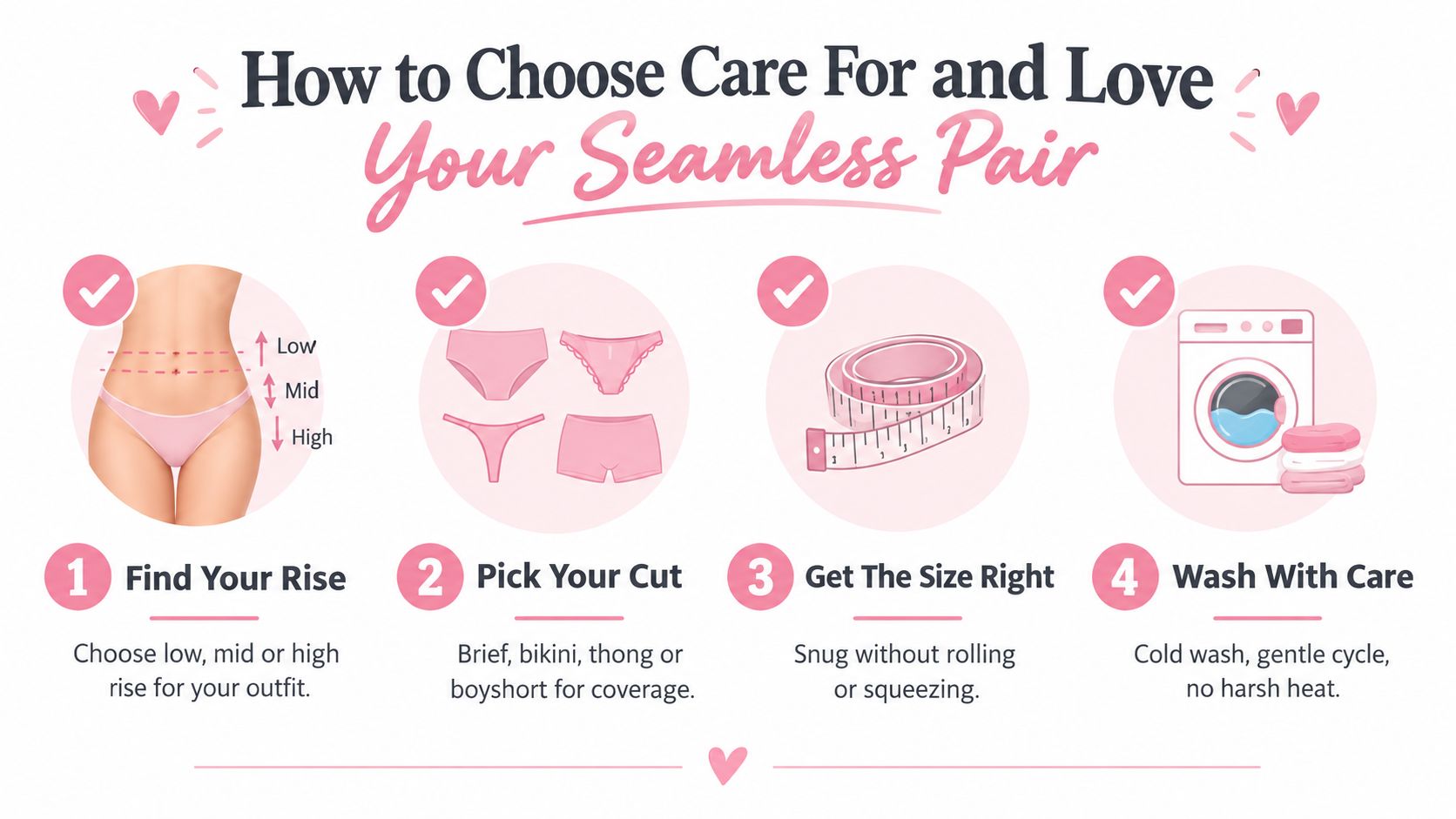
A short checklist for buying
- Check the rise against the outfit. Low, mid, and high rise disappear differently depending on where your pants or skirt sit.
- Match the cut to the reveal point. If your outfit shows side hip texture, solve for that. If the issue is back lines or front smoothness, choose with that exact problem in mind.
- Size for a smooth lay, not pressure. A too-tight pair creates dents at the edge. A too-loose pair can drift, wrinkle, or bunch.
- Use the hard test first. Try it under your clingiest dress, sleekest trousers, or lightest skirt, not the outfit that hides everything anyway.
- Move before you decide. Sit, walk, bend, and turn sideways. A pair that only works while standing still is not doing the full job.
One quick tip helps here. If you run warm, breathability may matter more than the flattest possible edge. If your clothes are very clingy, edge finish may matter more than softness. If you spend all day in motion, a little structure at the waistband or leg opening can beat a barely-there feel.
Care habits that protect the finish
These pairs rely on small construction details. Heat, friction, and rough washing wear those details down first.
- Wash cold. It is gentler on stretch fibers, glued finishes, and recovery.
- Skip high dryer heat. Heat can weaken elastane and shorten the life of bonded edges.
- Rotate pairs. Giving each pair a day off helps the fabric spring back.
- Keep rough items separate when possible. Zippers, hooks, and coarse fabrics can nick thin edges or snag fine knits.
If a favorite pair starts rolling or printing, the problem is not always age alone. Sometimes the fabric still has life, but the edge has lost its grip or rebound. That is common with very flat styles because the parts that make them disappear are also the parts that need the gentlest care.
If you like solving wardrobe problems outfit by outfit, variety packs can be useful. They let you test different rises, cuts, and construction styles instead of expecting one pair to do every job.
Nuage Wears focuses on comfort-first intimates built around common fit problems, including no visible lines, no digging, no rolling, and more breathable wear. If you want to apply everything above to real styles, filters, and fabric options, visit Nuage Wears and explore pairs designed for smooth workwear, active days, and long-haul comfort.