

You've finished a long day, changed out of your structured clothes, and now you're standing in front of the bedroom wondering why your old T-shirt still feels uncomfortable. The waistband twists, the fabric traps heat, and the robe you reach for is either too heavy or too short. A women's pajama set with robe should solve those problems, not just look coordinated in a product photo.
The best sets work as a two-part comfort system. The pajamas manage the conditions next to your skin, while the robe adds removable warmth when you're making coffee, answering the door, or moving through a cooler room. Choose the layers for how your body and home typically behave, then treat matching color as a welcome bonus.
Table of Contents
- Why a Coordinated Sleepwear and Robe Combo Elevates Your Routine
- The Science of Thermal Comfort and Layering
- Choosing the Right Fabric for Your Base Layer and Robe
- Navigating Sizing and Fit Across Three Separate Garments
- Matching Your Loungewear to Your Lifestyle and Environment
- Maximizing Value Through Bundles and Proper Garment Care
Why a Coordinated Sleepwear and Robe Combo Elevates Your Routine
At the end of a busy day, the transition into sleep rarely happens in one clean movement. You close the laptop, tidy the kitchen, check one more message, and drift from room to room before finally getting ready for bed. Changing into a dedicated pajama set gives that transition a physical signal. You're no longer wearing the clothes associated with commuting, errands, or work. You've chosen a uniform for slowing down.
The robe makes the set more useful than pajamas alone. Wear the base layer while reading or sleeping, then add the robe when the floor feels cold or the morning air comes through an open window. That flexibility matters because your comfort needs can change within the same evening. A matching set gives you a polished appearance without requiring the stiffness of daytime clothes.
Practical rule: Buy the pajama layer for sleep and the robe for movement between temperatures.
A well-cut set also handles the small social moments that happen at home. The robe can provide coverage for a delivery, a casual video call, or an unexpected guest, while the pajamas remain comfortable underneath. Look for details that support this dual use, such as secure ties, pockets that don't pull the robe forward, and sleeves that stay clear when you're washing your face.
The category itself sits between coordinated pajama separates and robe-style homewear. Market estimates vary because researchers include different combinations of sleepwear, loungewear, channels, and regions. One 2025 estimate valued the global sleepwear and loungewear market at approximately USD 34.1 billion, projecting USD 49.9 billion by 2031 at a 6.8% CAGR, with women representing 53.12% of global market value in 2025. A separate estimate placed the broader sleepwear market at USD 17.8 billion in 2024, forecasting USD 27.2 billion by 2033 at a 4.8% CAGR. These figures describe different market scopes, not one perfectly standardized category, as explained in Mordor Intelligence's sleepwear and loungewear market overview.
If you want a particularly luxurious version of this ritual, you can browse women's cashmere pajama sets, then apply the same practical checks for weight, fit, and layering. Softness feels wonderful, but it shouldn't be the only reason you buy.
The Science of Thermal Comfort and Layering
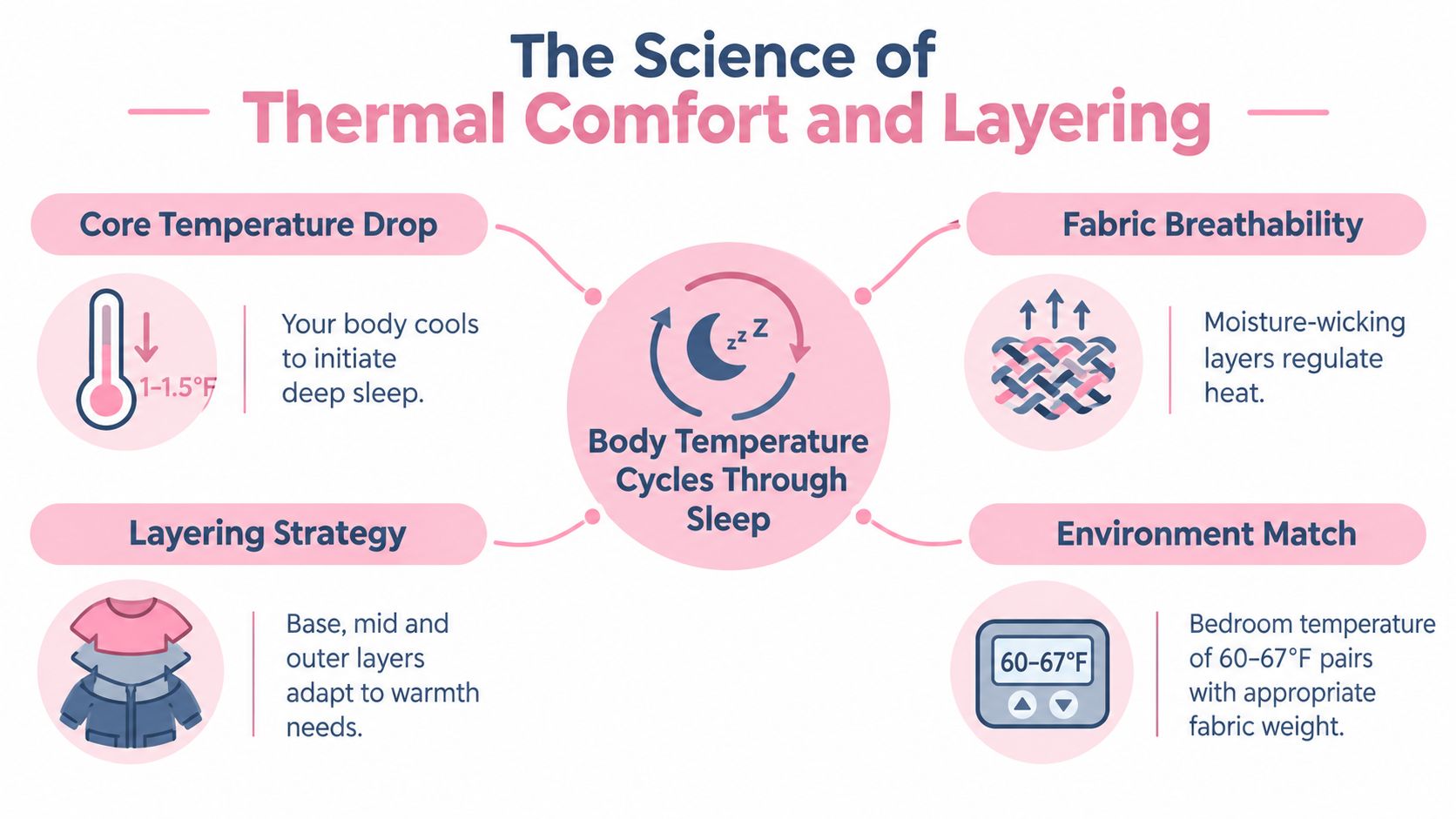
Your body doesn't experience a garment by fiber label alone. Fabric thickness, yarn structure, thermal conductivity, air permeability, and resistance to water vapor all influence how warm, dry, or clammy a set feels. A soft fabric can still overheat you if its construction holds moisture against the skin.
Sleepwear research reviewed in the Journal of Sleep Research links pajama and bedding fibers with skin temperature, body-temperature regulation, and thermal comfort. The review found that wool sleepwear appeared most beneficial for sleep quality in cooler conditions, while cotton suited warmer conditions better for young adults. It also noted that some synthetic blends produced more deep sleep than cotton among adolescent girls. The practical message is simple: the best fabric depends on the sleeper and the environment, not on a universal “best” material. Read the systematic review of sleepwear, bedding fibers, and sleep quality for the full evidence.
The base layer controls the immediate environment
The pajama top and bottoms sit against your skin, so their first job is managing moisture and friction. A breathable construction allows air movement and supports sweat evaporation. A close but non-binding fit prevents excess fabric from bunching under your body, while enough ease lets you turn without pulling at the shoulders or hips.
Heat is the main problem to avoid. Physiological research has found that heat exposure increases wakefulness and reduces both slow-wave and rapid-eye-movement sleep. Another study summarized in Sleep and Biological Rhythms found that wearing pajamas in hot, humid conditions suppressed the usual nighttime decline in rectal temperature, reduced certain sleep stages, and increased arousal. That's why a thick pajama layer can work against you even when the room feels comfortable at bedtime.
The robe should be adjustable insulation
Think of the robe as removable insulation, not a second pajama layer. A moderate-weight robe can add coverage during a chilly morning, then come off before you become overheated. A dense, plush robe may feel comforting in a cold room, but if it restricts vapor release, it can trap sweat and create a clammy microclimate.
For that reason, pair a lightweight, breathable pajama base with a robe that adds warmth without becoming cumbersome. A long-sleeved sleep tee can offer another useful reference point when comparing base-layer coverage and movement, so review this guide to the long-sleeve sleep tee before choosing sleeve lengths.
Choosing the Right Fabric for Your Base Layer and Robe
Fabric selection should follow a division of labor. Your pajama set needs to feel comfortable during extended skin contact, while the robe needs to provide flexible coverage between sleep, lounging, and household tasks. Buying one heavy fabric for every piece usually reduces versatility.
Modal is a strong choice for a base layer when you want a fluid drape, smooth hand feel, and good everyday comfort. Its value comes from the finished construction, though, not just the word on the label. Check whether the fabric clings, whether the waistband stretches back after pulling, and whether seams remain flat after laundering.
Cotton offers familiar comfort and can work well in warmer conditions when the fabric is light and sufficiently open. Heavy or densely woven cotton can feel substantial but may dry slowly after absorbing moisture. Linen blends can feel airy and crisp, although their lower stretch may frustrate sleepers who move frequently. Fleece-like fabrics provide warmth, but they're best reserved for very cold environments or for robe use rather than a warm bedroom.
| Fabric Type | Breathability | Best For |
|---|---|---|
| Modal | High when made in a lightweight, open construction | Warm sleepers, direct skin contact, fluid drape |
| Lightweight cotton | Moderate to high, depending on weave and weight | Everyday sleepwear, warmer rooms, easy care |
| Linen blend | High, with a cooler and crisper feel | Dry climates, warm-weather lounging, relaxed fits |
| Fleece-like fabric | Lower because of loft and heat retention | Cold rooms, winter robes, extra coverage |
Read the construction, not only the fiber name
Look for air permeability and water-vapor transmission when a brand makes cooling or breathable claims. Finished-fabric testing matters because laundering can change pore structure, surface texture, and moisture transport. A fabric that feels cool in your hand may not release vapor effectively once worn.
Also inspect the places where comfort often fails. Flat seams reduce rubbing. Bonded bands can avoid the pressure created by bulky elastic. Laser-cut edges may reduce visible lines under fitted clothing, but they still need to remain stable after washing. If you're comparing warmth and softness across household textiles, this guide to blanket fabrics offers useful background on how construction changes performance.
For a closer look at modal's role in close-to-skin clothing, use this explanation of what modal underwear is. The same principle applies to pajamas: prioritize the finished fabric, stretch recovery, seams, and care instructions over a seductive softness claim.
Navigating Sizing and Fit Across Three Separate Garments
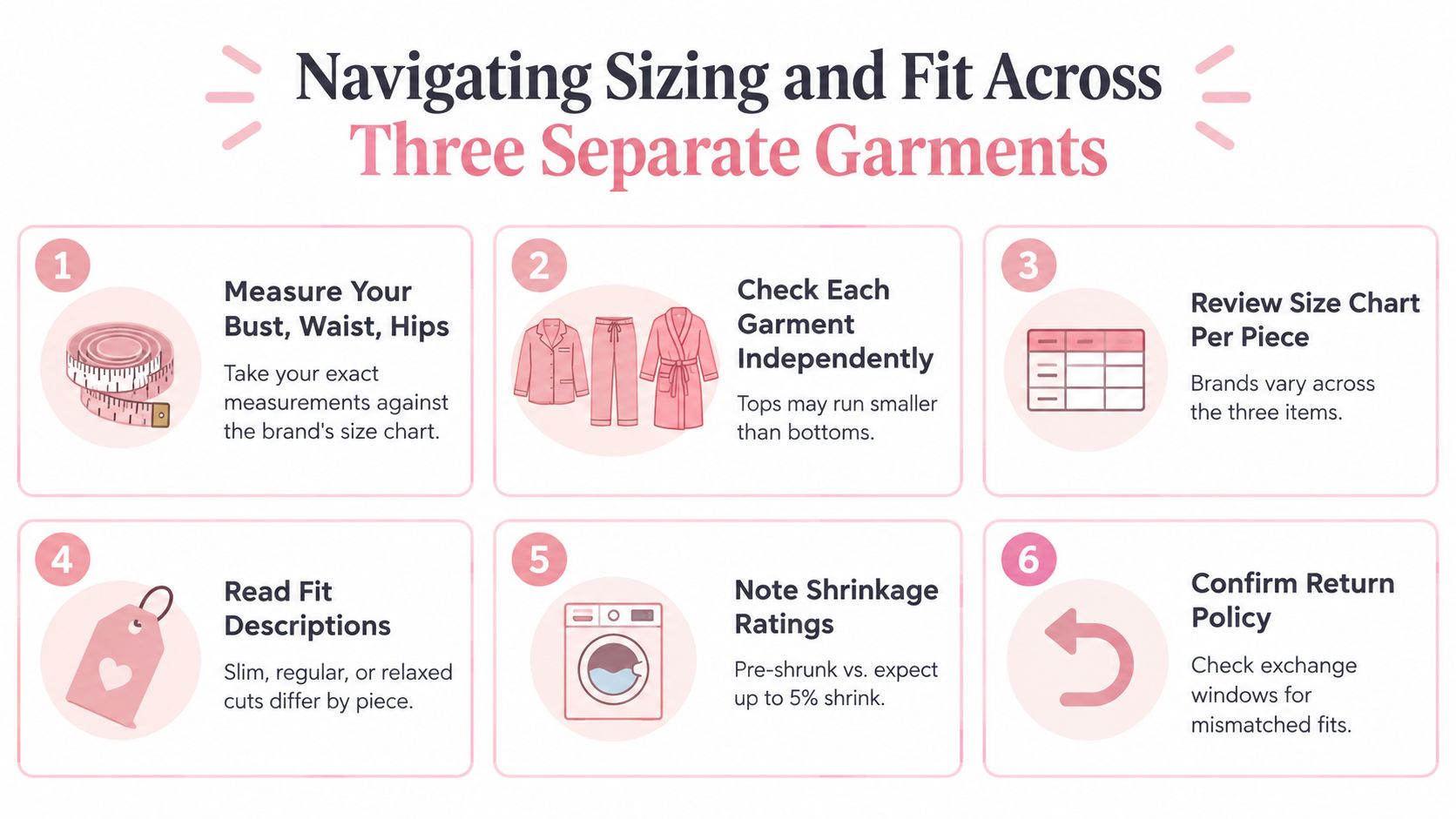
A set can be sold as one package while behaving like three different garments. The pajama top may fit neatly through the shoulders, the bottoms may feel tight at the hips, and the robe may lack enough room to close over both. Don't assume one label guarantees a good fit across every piece.
A 2025 Vogue Business survey of 687 readers in the United States and United Kingdom found that 91% said their clothing size changes by brand. The survey also reported that 38% often return clothing because it fits poorly, with shoppers describing garments that feel too small in one area and too large in another. See the Vogue Business report on inconsistent apparel sizing for the underlying findings.
Measure before you choose
Take your bust, waist, and hip measurements while standing naturally. Compare each measurement with the brand's chart, and check whether the chart describes body measurements or garment measurements. If the set includes separate size choices, use them. A smaller top and roomier bottoms may be the correct combination for your proportions.
The pajama top should allow you to lift your arms, turn your shoulders, and lie on your side without the neckline pulling. Check the shoulder seam, armhole, and chest ease first. A close fit can look tidy, but sleepwear shouldn't press across the bust or restrict breathing.
For bottoms, assess the rise, waistband pressure, hip ease, and inseam. Sit down, bend your knees, and rotate your legs as you would in bed. A waistband that feels acceptable while standing may dig when you curl up. The robe should have enough shoulder and upper-arm room to sit over the pajama top without pulling across the back.
Use descriptions and reviews as fit evidence
“Relaxed,” “regular,” and “slim” describe different amounts of ease, even when the size label stays the same. Reviews are most useful when shoppers mention height, proportions, sleeve length, rise, and whether the fabric stretches. Give more weight to repeated observations than to one vague comment about sizing.
Before buying, confirm whether pieces can be exchanged individually, whether the garment is pre-shrunk, and how the return window handles a mismatched set. Fit is part of comfort engineering, not an afterthought.
Matching Your Loungewear to Your Lifestyle and Environment
The right set depends on what happens after you put it on. A frequent traveler needs pieces that pack easily, resist looking rumpled, and work across changing temperatures. A person working from home may care more about a robe that looks presentable on a video call and closes securely when the doorbell rings. Someone in a humid climate needs moisture release before extra plushness.

Build for hot and humid conditions
Choose a lightweight base with good air movement, short or loose sleeves, and a waistband that doesn't compress your middle. Keep the robe as an occasional layer for the first and last part of the day. If night sweats are an issue, select fabrics that release moisture rather than a thick pile that holds it close to the body.
Hot sleepers shouldn't automatically choose the thinnest possible garment. A very clingy fabric can feel warmer when it stays pressed against damp skin. Look for a smooth, breathable knit with enough room for air circulation and movement.
Add structure for cold or air-conditioned homes
Cold sleepers can use the robe more strategically. A longer robe with fuller sleeves provides coverage while you're reading or preparing breakfast, but you may still prefer a lighter pajama base once you get into bed. This approach gives you warmth when moving and less bulk when sleeping.
In a dry climate, a linen blend can feel pleasantly airy but may need more careful laundering to retain its shape. In a humid climate, prioritize vapor release and quick drying. For a home with strong air conditioning, choose a moderate robe and breathable long pajamas rather than wrapping yourself in one excessively heavy layer.
Choose for travel and daytime visibility
Travel sets should have secure pockets, a tie that stays flat, and fabrics that recover from folding. Avoid decorative hardware that digs when you sit for long periods. A robe with a clean neckline and controlled volume can double as a cover-up in shared accommodation without becoming bulky in luggage.
For more practical ideas on building a comfortable homewear routine, these relaxation wear tips are a useful complement to the climate-based approach. The best set is the one that matches your actual schedule, not an imaginary evening spent motionless in a perfectly heated bedroom.
Maximizing Value Through Bundles and Proper Garment Care
A bundle only creates value when every piece earns space in your routine. A robe that overheats you, bottoms that twist, or a top that loses shape after washing isn't a bargain because the pieces arrived together. Choose a coordinated set when the fabric weights, fit philosophy, and care requirements make sense as a system.
Multiple sets can make sense for rotation. One can be in use while another is being washed, which reduces the temptation to wear stretched-out clothing night after night. Prioritize interchangeable colors and consistent cuts if you want to build a small wardrobe rather than collect isolated outfits.
Protect the features you paid for
Follow the care label instead of treating every fabric like a basic cotton T-shirt. Use a gentle cycle when recommended, avoid excessive heat that can damage stretch recovery, and reshape knit garments while damp. Close fastenings before washing so they don't catch on delicate surfaces.
Modal and other smooth knits usually retain their feel better when washed with similar lightweight garments rather than rough towels. Don't overload the machine. Friction, heat, and aggressive drying can encourage pilling, distort bonded bands, and weaken fine edges.
Inspect the garment after laundering
The first wash tells you more than the product photograph. Check whether the waistband rolls, whether the robe tie pulls the front out of alignment, and whether the sleeves remain even. Look for twisting at side seams and shrinkage that changes the balance between top, bottoms, and robe.
Care principle: A garment that needs special treatment is worth keeping only if its comfort justifies the routine.
Before purchasing, read the full care instructions and return policy. A high-quality bundle should deliver reliable shape, comfortable movement, and a robe that remains useful beyond bedtime. It should also fit your willingness to launder it properly. The smartest purchase combines durable construction with care you'll actually follow.
Nuage Wears offers comfort-first women's underwear and everyday apparel built around practical fit concerns such as visible lines, rolling, digging, wedgies, and overheating. Visit Nuage Wears to explore breathable fabrics, problem-solving cuts, smooth finishes, and value sets that complement a thoughtful approach to comfort from bedtime through the rest of your day.