
You're getting dressed, and the underwear that felt wonderfully soft yesterday is suddenly rolling under your trousers or showing through your skirt. Meanwhile, the pair you trust is waiting in the laundry basket. That's the shopping problem: finding underwear that feels good during an ordinary day and after repeated washing, not just when you first touch it.
Modal is an exciting place to start if you love silky fabric and a light, flexible feel. But the best modal underwear still needs the right cut, gusset, edges, and care routine for your wardrobe. Choose for the situation you wear it in, then let a practical wear test decide whether it deserves drawer space.
Table of Contents
- The Best Modal Underwear by Need at a Glance
- Read the Modal Label Before You Buy
- Five Criteria That Separate Good Modal Underwear From Average
- How NuCloud Stacks Up Against Typical Market Features
- Matching Modal to Heat, Activity and Sensitive Skin
- Care, Durability and Cost Per Wear for Modal Underwear
- Start a Two-Week Modal Trial
The Best Modal Underwear by Need at a Glance
The best modal underwear is the pair that matches your main need, not the one with the longest feature list. A smooth finish under silk calls for different construction than a hot commute or a long day sitting at a desk.
The selections below reflect the brand's descriptions of its designs, not independently tested performance rankings. Check the current product label and description before ordering, especially when moving between collections.
Quick-pick guide by shopping priority
| Your Priority | Best Pick | Why It Fits | Check Before Buying |
|---|---|---|---|
| All-day softness | NuCloud Original, in hipster, mid-rise, high-rise, or thong cuts | Modal-based fabric the brand describes as cloud-soft | Pick the rise and cut that suits your waistline |
| Invisible finish under leggings or silk | Seamless / No Visible Lines collection | Laser-cut edges designed to disappear under fitted garments | Test under your most fitted outfit |
| Breathability for heat and workouts | NuAir Mesh Pivot+ | Targeted mesh zoning for airflow and moisture management | Mesh is less opaque, so choose it for layered looks |
| Stay-put coverage on long days | NuFit Perfect Fit Mid Rise Brief | Bonded bands designed to resist rolling | Bonded bands can feel firmer during initial wears |
| Smooth front under skirts and dresses | Shield Briefs | Integrated front shield panel designed to smooth the outline | Designed for a smooth front, not extra coverage |
| Value across a full drawer | NuSoft Modal Brief 5-Pack | Brand-described 60S Lenzing modal blend with elastic fibers and a 100% cotton gusset | Confirm you like a cotton gusset before buying five |
| Travel and long-haul comfort | Long-Haul Ease grouping | Scenario-based edit for flights and long days | Compare the individual cuts inside the group |
Choose the problem before the pair
Don't assume that every option here has the same fabric composition. A mesh style or a design without visible seams may offer a useful alternative to modal, rather than just another version of it.
For desk days, prioritize comfortable pressure at the waist while seated. For fitted clothing, start with the leg opening and front outline. For travel, consider coverage and how readily you can wash and dry the garment using its permitted care method.
Quick shopping rule: Identify your top two priorities, match them to the table, and try one pair in your closest everyday cut before committing to a multipack.
A drawer doesn't need one universal winner. It needs dependable choices for the clothes and activities you repeat.
Read the Modal Label Before You Buy
Start with the composition label rather than the softness claim. Modal is a regenerated cellulose fiber: manufacturers begin with wood-derived cellulose, chemically process it, and form textile fibers rather than spinning the raw plant material directly.
The EU Textile Fibre Regulation 1007/2011 defines modal as “a regenerated cellulose fibre obtained by a modified viscose process,” with high breaking force and high wet modulus, properties relevant to strength and shape retention during wet use and washing, as described by Lenzing's modal fiber information.
Run these label checks
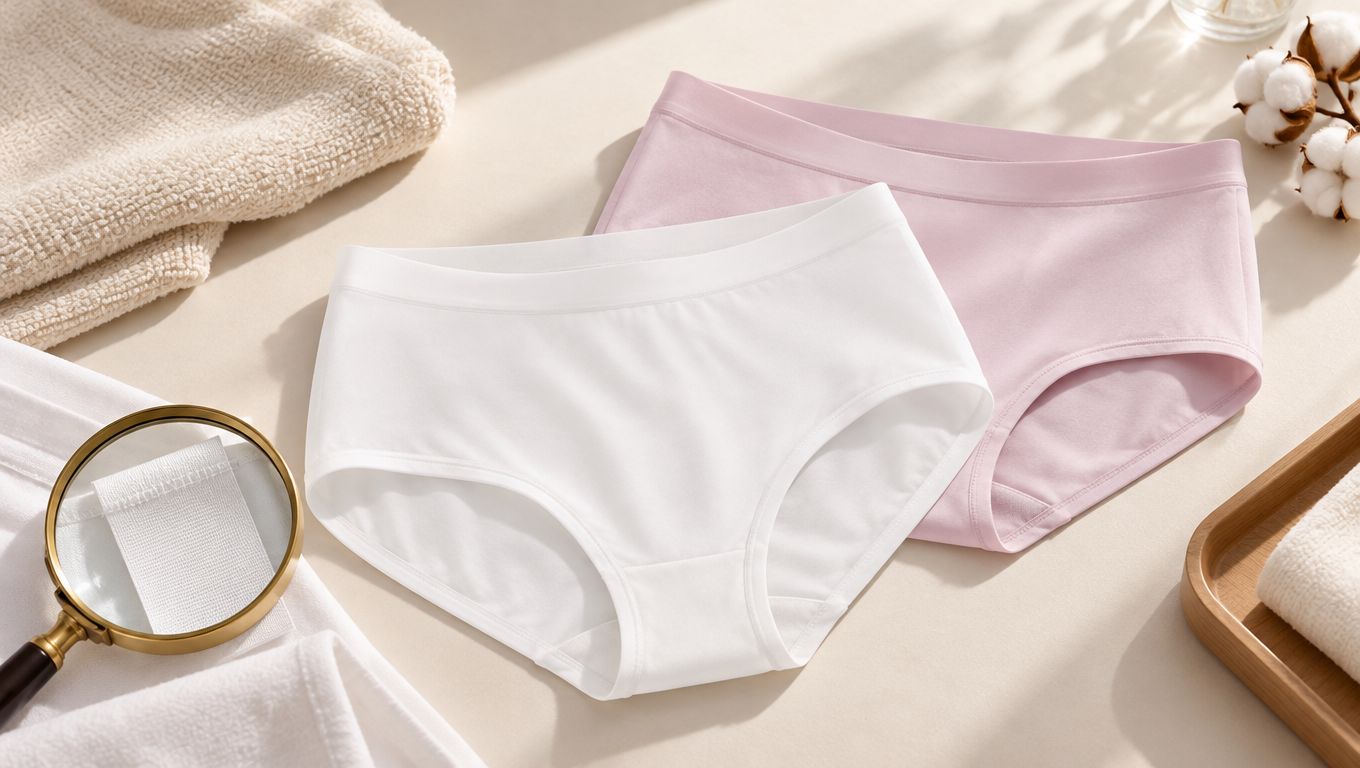
- Read the modal percentage. A small modal share doesn't tell you how the rest of the fabric will behave. Look at the complete blend.
- Check the elastane share. It helps explain stretch, but more stretch fiber doesn't automatically mean better recovery or a more comfortable fit.
- Find the gusset composition. The fabric against the vulva may differ from the body fabric. Check both rather than assuming they match.
Modal names a fiber and manufacturing route, not a guarantee of softness, durability, breathability, or sustainability. Fiber grade, knit construction, elastane content, dyeing, finishing, seam design, and garment fit all affect the finished brief.
If you're also considering synthetic stretch blends, the guide to nylon and spandex underwear helps distinguish those material choices from a modal-rich construction.
Fiber options for everyday underwear
| Fiber | Feel and fit | Breathability and abrasion | Best for |
|---|---|---|---|
| Regular-fine modal | Soft; dimensional stability depends on fabric treatment and construction | Can offer higher porosity and abrasion resistance than micro-modal in comparable constructions | Everyday wear and active days |
| Micro-modal | Often lighter and thinner, with greater moisture absorption | Can have slightly lower breathability and abrasion resistance | Fitted clothing and smooth lines |
| Cotton | Familiar, absorbent feel; stretch depends on the knit and blend | Breathable and absorbent under common clinical guidance | Sensitive skin and heavy-discharge days |
Treat these as selection cues, not a ranking of every finished garment. A well-made regular-fine modal brief can be a better purchase than a poorly constructed micro-modal one.
Five Criteria That Separate Good Modal Underwear From Average
An arrival-day inspection can catch a poor choice before you build a drawer around it. Keep labels attached until you understand the return rules, and only try garments in ways the retailer permits.
Check the fabric and construction
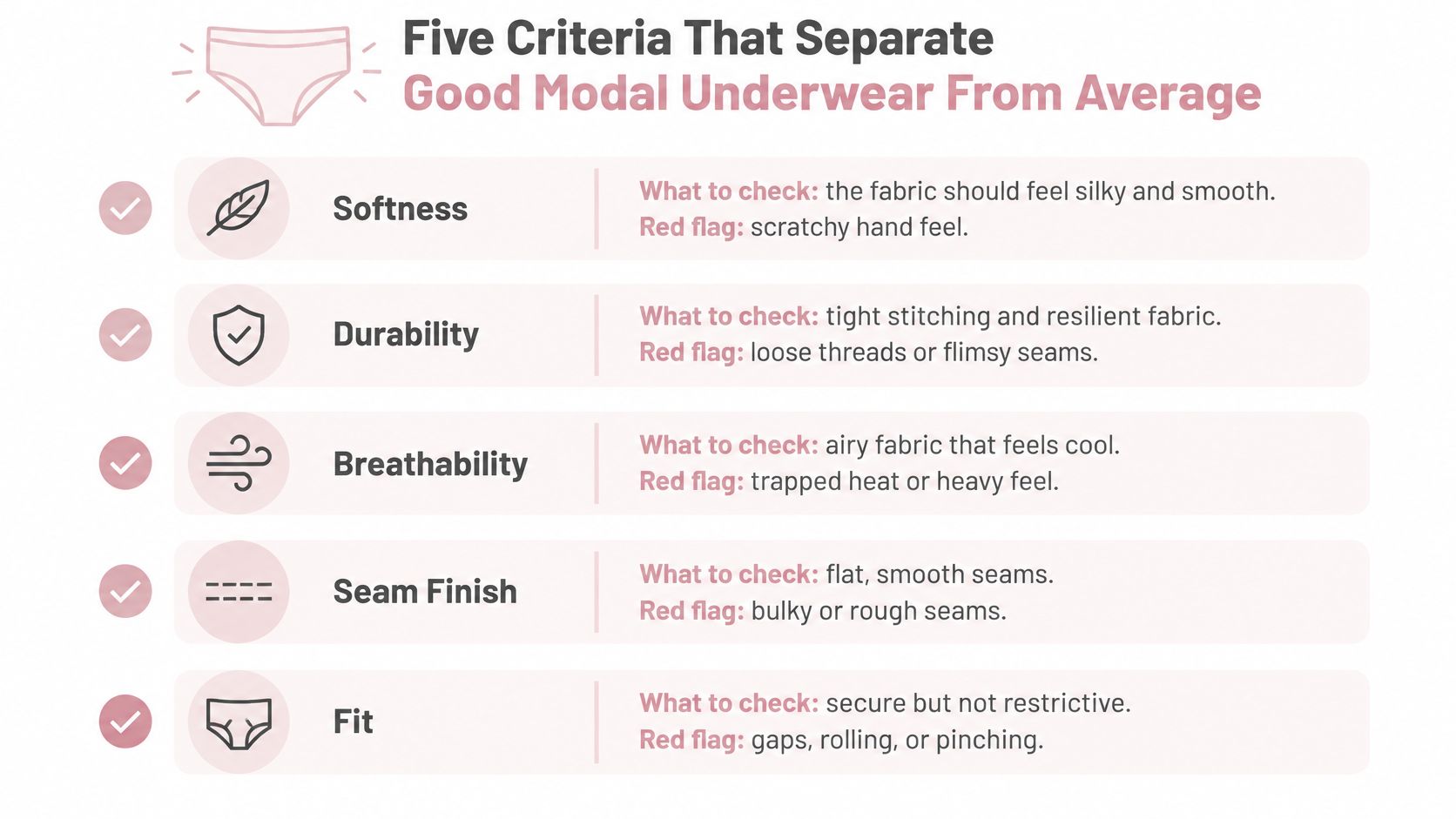
Softness needs more than a palm test. Brush the inside surface lightly against your inner forearm, including the gusset seam and label area. A silky body fabric won't compensate for a scratchy edge, and an unusually slick finish shouldn't be mistaken for proven long-term softness.
For durability, inspect the knit against a light background. Look for uneven loops, loose threads, missed stitches, or a bond that's already lifting. A dense knit can feel substantial, but density alone doesn't establish quality.
Try a 30-second stretch check: gently extend the waistband and leg opening within a normal wearing range, release them, and watch their recovery. Don't pull to the limit. Rippling, persistent distortion, or a slow return is a reason to investigate the construction.
Breathability is harder to judge by hand. Look for open-knit areas, mesh placement, and a gusset that isn't heavily layered; don't treat a cool first touch as proof of airflow.
Test the garment with your clothes
Run a fingertip over side seams and leg openings. Compare a flat stitched seam with a laser-cut edge under your actual fitted layer, because a smooth-looking finish in hand may still create a ridge when stretched.
For the no-show test, wear the intended leggings or skirt and check the back and sides in ordinary daylight. Bend, sit, and walk, then check again. Fabric transparency, edge placement, and garment tension can change the result.
Fit deserves the same movement-first approach as finding the right work T-shirt fit from Outrig Supply Co.: clothing should accommodate the positions you use, not merely look correct while standing still. With underwear, assess rise, back coverage, and waistband pressure separately.
A pair that stays in place by squeezing harder isn't necessarily a better fit.
Before keeping it, confirm:
- Surface comfort: No scratchy labels, rough bonds, or raised seams against sensitive areas.
- Movement comfort: No repeated adjustment after sitting, bending, and walking.
- Outfit compatibility: The outline works under the clothes you bought it to wear with.
These checks screen construction and fit. They don't establish how the garment will perform after laundering.
How NuCloud Stacks Up Against Typical Market Features
A product page can call a fabric cloud-soft without stating the modal percentage or telling you how the waistband behaves after ten washes. NuCloud Original is described as modal-based and cloud-soft. That description doesn't establish its exact fiber content or prove how it will fit a particular body.
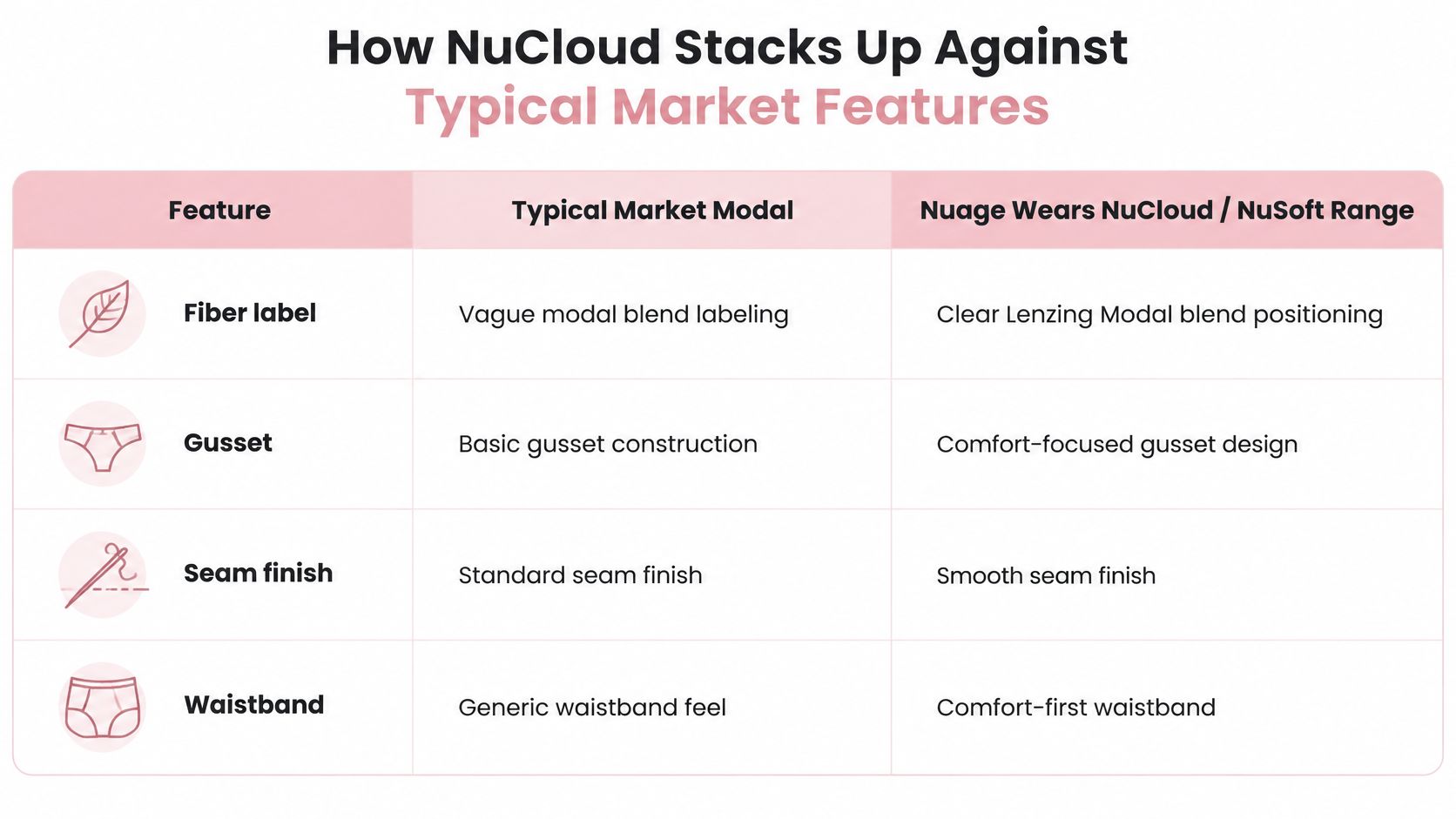
The comparison below places the brand's stated features beside common designs, not a tested sample of rival products. Other modal underwear can include similar details, so verify each item on the garment label or current product page.
Compare details you can verify
Nuage Wears construction compared with typical market features
| Feature | Typical Market Modal Underwear | Nuage Wears Range |
|---|---|---|
| Fiber label | Modal blends with brand-specific percentages | Brand describes NuCloud as modal-based and NuSoft as a Lenzing modal blend with elastic fibers |
| Gusset | Modal, cotton, or synthetic gussets | Brand specifies a cotton gusset for NuSoft |
| Seam finish | Standard stitched seams are common; stitch-free options also exist | Brand describes laser-cut edges in its No Visible Lines collection |
| Waistband behavior | Elastic or bonded constructions, with fit affecting rolling | Brand describes bonded bands designed to resist rolling in relevant styles |
| Breathability | Knit density, thickness, and panel placement affect airflow | Brand describes targeted mesh zoning in NuAir styles |
| Front construction | A conventional front panel is common | Brand describes an integrated front shield panel in Shield Briefs |
| Leg edges | Elasticated, folded, bonded, or cut-edge openings | Brand describes NuSoft leg bands as feather-light and non-binding |
| Care and support | Garment-specific care and retailer-specific policies | Brand publishes NuSoft care instructions, a Best Pair Guarantee, and shipping policies |
The NuSoft Modal Brief listing describes a modal blend with elastic fibers, a cotton gusset, and a full-coverage silhouette. Those are concrete details to compare, although a blend description doesn't state the exact modal percentage on its own. Its listed care instructions are machine wash cold, use a laundry bag, tumble dry low or air dry flat, and don't bleach. Instructions like these matter when you judge a fabric on how it holds up in the wash: a pair that prefers air drying will wear differently by week eight than one that tolerates the dryer without complaint. The feather-light, non-binding leg-band wording is the brand's own description, so treat it as a starting point rather than a guaranteed pressure level for every wearer.
Verify each construction detail on the label or in hand before you buy.
Keep collection claims separate
Laser-cut edges, mesh panels, bonded bands, and a front shield aren't interchangeable features. Don't assume the modal brief you select includes all of them just because they appear elsewhere in the range. NuCloud, NuAir, NuFit, and Shield lines each target a different problem, and a feature listed under one collection won't automatically show up in another.
The same discipline applies to support policies. Read the Best Pair Guarantee terms, including any eligibility conditions, before treating the guarantee as part of the value calculation.
Confirm the fiber percentage on the actual label, then decide which construction addresses your wardrobe problem. A brief bought for no-show wear under leggings needs laser-cut edges; a brief bought for long sitting days needs a waistband that stays comfortable under sustained pressure. Judging the range this way, by construction matched to use, tells you more than a family-wide softness claim.
Matching Modal to Heat, Activity and Sensitive Skin
Modal can move moisture impressively in controlled fabric testing. A comparative study of cellulosic knitted fabrics found that modal had the shortest wicking time, largest wicking radius, and fastest spreading speed among the samples, requiring approximately 50% less time to wick moisture than the other tested fibers.
That's encouraging, but it isn't proof that any modal brief will keep you dry through a workout. Yarn size, stitch length, thickness, and porosity affect performance, and a dense garment can still feel warm.
Match the situation, then check the caveat
| Situation | Useful starting choice | Caveat |
|---|---|---|
| Desk day under tailored trousers | Smooth modal brief in a comfortable rise | Check seated waistband pressure, not just standing fit |
| Long workout or hot commute | Mesh-zoned NuAir style, or a suitable brief with a cotton gusset | A cotton gusset isn't a quick-drying guarantee; change out of damp underwear |
| Flight or long-haul day | Stay-put cut with bonded bands | Firm bands may become uncomfortable during extended sitting |
| Skirt or dress day | Shield Briefs for a smoother front outline | Check the panel under the actual garment, including while seated |
Wicking describes liquid movement, not necessarily drying speed or airflow. Tattoo Golf's explanation of how moisture-wicking fabric works is useful background for understanding that distinction, rather than a test of any underwear listed here.
Prioritize symptoms over fabric enthusiasm
For intimate comfort, Cleveland Clinic's underwear-material guidance recommends breathable cotton because it absorbs moisture and is less likely to trigger allergic reactions. Modal may suit comfortable everyday wear, but softness isn't a medical benefit.
- With heavy discharge: Prioritize a comfortable, absorbent gusset and change when damp. Aggressive wicking claims don't establish that a design is better for you.
- With heat or friction: Consider looser outer clothing and less restrictive openings. Tight jeans, leggings, or a narrow gusset can undermine an otherwise suitable fabric.
- With recurring sensitivity: Consider dyes, finishes, seams, and detergent residue, not just the fiber name.
Underwear cannot treat infections. Persistent itching, odor, pain, or unusual discharge needs a clinician's evaluation, especially if changing garments doesn't resolve the discomfort.
The practical goal is comfortable ventilation with minimal friction and prolonged dampness. Sometimes that means modal; sometimes cotton, mesh, or a different cut makes more sense.
Care, Durability and Cost Per Wear for Modal Underwear
What matters after the first ten washes is whether the garment still feels comfortable, recovers its shape, and stays intact. In a study of rib lingerie fabrics, microfiber modal structures were lighter and thinner with greater moisture absorption, but had slightly lower porosity, breathability, and abrasion resistance than regular-fine modal structures; comparable dimensional stability, tensile strength, and pilling performance were reported mainly after wet-relaxation treatment.
That trade-off makes wash performance more useful than initial delicacy when judging value. Check the waistband, gusset attachment, side seams, and leg edges once the garment is fully dry.
Use a gentle, repeatable care routine
- Wash cold in a laundry bag. Keep delicate briefs away from exposed hooks, zips, and abrasive garments.
- Avoid bleach. Don't substitute a harsh treatment for identifying a residue or washing problem.
- Tumble dry low or air dry flat, where permitted by the garment label. Avoid sustained high heat around elastic components.
- Rotate pairs. Don't repeatedly wash and wear the same favorite while the rest of the drawer sits unused.
- Store folded or flat. Avoid hanging garments stretched over a hanger.
Heat can compromise elastic components, while unsuitable products or excess detergent can change the fabric's feel and moisture behavior. Skip fabric softener unless the care information permits it, and measure detergent rather than pouring freely.
For handling stains and different fabric types, use the practical guide to washing underwear.
Calculate comfortable wears, not just purchase price
Use cost per wear = purchase price ÷ total comfortable wears before retirement. For a hypothetical five-pair pack priced at P, where each pair provides W comfortable wears, the calculation is P ÷ (5 × W); for a single pair priced at S lasting V wears, it's S ÷ V.
Don't assume equal lifespans. Count only wears you'd willingly repeat.
Replacement signals for modal underwear
| Wear Signal | Likely Cause | What to Do |
|---|---|---|
| Waistband or leg band no longer grips | Elastic recovery may be fading | Retire the pair or reserve for lounging if comfortable |
| Pilling or thinning at seams | Friction and abrasion | Stop using for active wear and rotate out |
| Stays damp longer than it used to | Possible residue, knit deformation, or finish changes | Check the care routine; replace if it persists |
| Odor remains after washing | Possible residue or detergent buildup | Try a suitable cold wash with less detergent; retire if it persists |
| Gaping at the leg or shape loss | Stretch recovery may be lost | Replace the pair |
| Fabric feels rough after washing | Surface wear or residue | Wash gently and monitor; replace if it doesn't recover |
Environmental claims need similar specificity. Lenzing's environmental reporting distinguishes branded fiber-production impacts from generic modal comparisons, not finished-underwear footprints. Ask for the fiber producer, sourcing evidence, and lifecycle scope before paying a sustainability premium.
Start a Two-Week Modal Trial
Choose the pair that solves the problem you're dealing with this month. A new fabric feeling lovely against your fingertips is no reason to replace your entire drawer.
A two-week trial gives you a manageable way to compare ordinary wear, laundering, and outfit compatibility. Fourteen days of desk hours, commutes, and two wash cycles won't prove decade-long durability, but they will show whether a pair earns repeat wears or migrates to the back of the drawer.
Build around your most-used outfit
- Daily starting set: Begin with NuCloud Original in the cut you already know suits you, and pick the rise that sits right under the trousers you wear most.
- Heat starting set: Add NuAir Mesh Pivot+ when workouts or hot commutes make targeted ventilation the priority.
- Front-smooth starting set: Consider Shield Briefs for skirt and dress days, when the front outline matters most.
Treat these as gradual additions, not a basket to fill at once. A multi-pair value pack only makes sense after you know you like the cut, leg opening, and gusset.
Run the trial before expanding
- Buy one pair in your most-used cut. Testing an unfamiliar rise and a new fabric at the same time muddies the comparison.
- Wear it on a normal day and a warmer day when practical. Note comfort while seated, walking, and changing positions.
- Wash it twice using the permitted care routine. Check the waistband, leg edges, and fabric surface once the pair is completely dry.
- Score softness, breathability, seam finish, band recovery, and fit. Pass, uncertain, or fail notes are enough.
- Add the next pair only if it passes. Persistent adjustment or discomfort points to another cut, not automatically a smaller size.
Log the date, outfit, activity, and any wear signal that appears. "Comfortable at desk, leg edge visible under thin trousers" tells you far more at reorder time than "nice fabric."
Read the current return and guarantee terms and confirm shipping conditions on the product page before ordering. Worn or washed garments may not qualify for a return.
Start with one pair and judge it on your own wear test, not first-day softness. The right choice earns repeat wears without repeated adjustment.
Nuage Wears offers modal-based everyday underwear alongside mesh-zoned and front-smoothing designs for different wardrobe needs. Visit Nuage Wears to compare the cuts and construction details, choose one pair for your most-used outfit, and put it through your own two-week trial.