
You're halfway through the afternoon, and you've already tugged your waistband back into place twice. Or maybe you're peeling off damp fabric after a warm commute and wondering why a pair that felt perfect at breakfast feels tired by dinner. That little tug, that damp cling, that's your underwear telling you a story about its fibers.
Table of Contents
- Why Two Fibers End Up in One Pair of Underwear
- How Nylon and Spandex Became Underwear Staples
- How Nylon and Spandex Actually Perform in Wear
- Nylon and Spandex Compared to Modal and Mesh
- Caring for Nylon and Spandex Without Ruining the Stretch
- Matching Nylon-Spandex Underwear to Real Wardrobe Days
- Common Assumptions Worth Rethinking
- A Quick Decision Checklist Before You Buy or Wash
Why Two Fibers End Up in One Pair of Underwear
Think about the last time a leg opening rode up mid stride. You didn't think about chemistry. You thought, why won't you stay put? The answer lives in a partnership. Nylon and spandex underwear isn't one fabric doing everything. It's two fibers splitting the work, and you feel the quality of that split all day.
The Visible Partner and the Hidden Engine
Nylon is the surface you see and touch. It gives a pair its smooth face, light weight, and resistance to scuffing against jeans, seatbelts, and chair edges. It also dries relatively quickly, which is why a nylon rich pair tends to feel less soggy than a heavier alternative after you've been warm.
Spandex, also called elastane, works inside the knit. It's the stretch engine. It lets the waistband open as you pull the pair on, lets the leg opening flex as you sit, and then pulls everything back toward its original shape. Without it, a close fitting style would bag out. Without nylon, you'd have stretch but little coverage, surface strength, or hand feel.
Think of nylon as the sail and spandex as the elastic cord holding the sail's shape. One provides the surface, the other provides the snap.
Designers juggle those roles long before you shop. If you're curious how a product team turns early ideas into specifications a factory can follow, the process of going from sketch to production-ready brief shows how material jobs get assigned on paper first. In your drawer, the result is simpler. When the partnership is balanced, you forget you're wearing anything. When it isn't, you notice digging, riding, or sagging within hours.
How Nylon and Spandex Became Underwear Staples
This pairing wasn't planned in one moment. Each fiber arrived to solve a different problem, and underwear inherited both solutions.
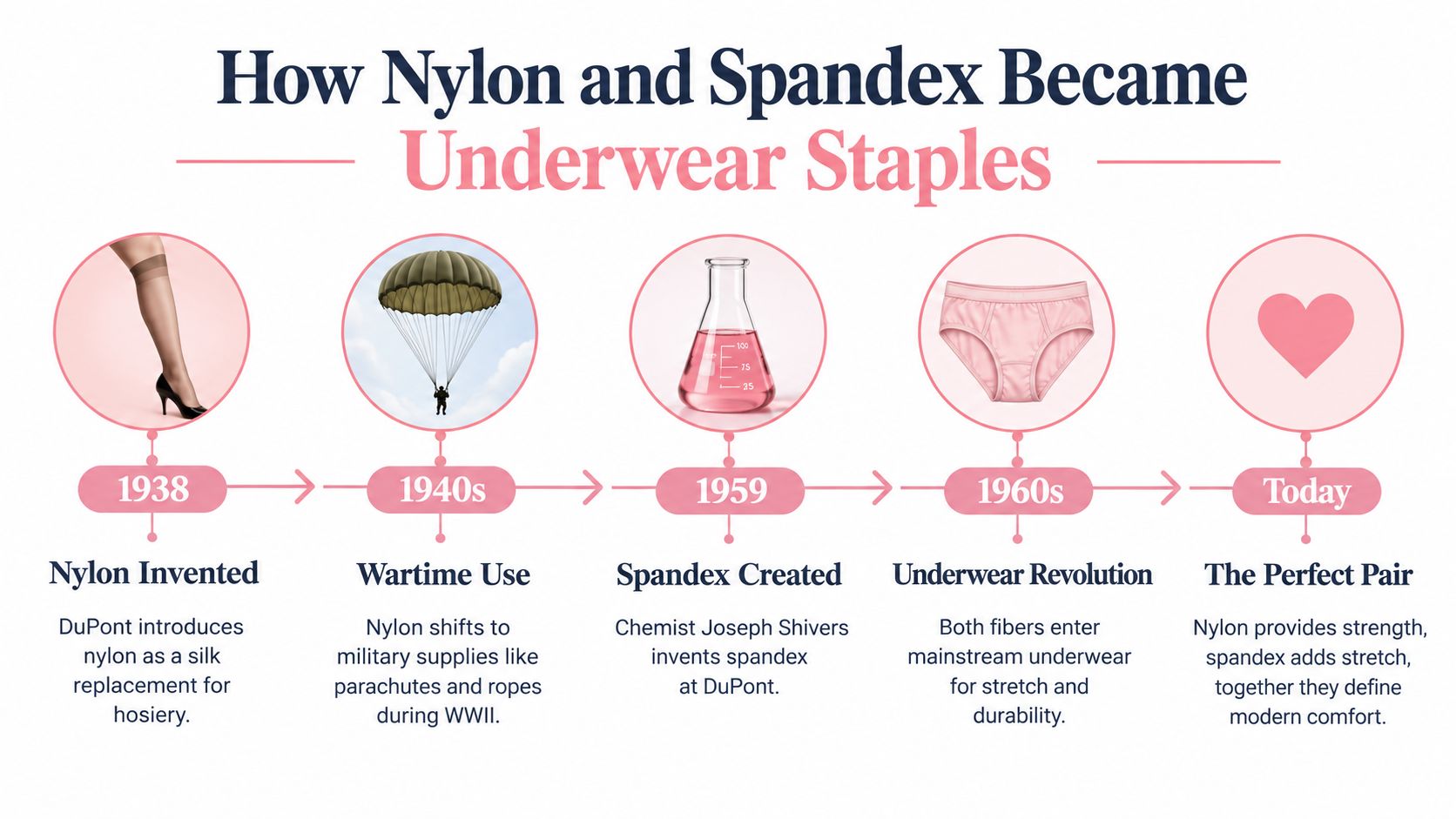
Nylon came first, developed in 1935 by Wallace H. Carothers and his team, and reached nationwide U.S. sales in May 1940, when approximately 4 million pairs of stockings at about $1.15 per pair sold out within roughly two days, as recounted in Smithsonian Magazine's history of wartime rationing and the nylon riots. Shoppers weren't chasing novelty. They wanted silk like smoothness with better durability, and hosiery proved nylon could deliver it at scale.
World War II then redirected nylon toward parachutes, ropes, and nets, restricting civilian supply. Production still expanded rapidly, and by 1945 output reached approximately 25 million pounds annually, cited in the same Smithsonian history overview above. That industrial scale matters for you because it turned a laboratory fiber into an affordable, repeatable base for close fitting garments.
The Missing Stretch Arrives Later
Smooth and tough weren't enough for a waistband that must expand, hold, and recover. Joseph C. Shivers invented spandex in 1959 after roughly a decade of research into synthetic elastic materials, and full scale manufacture began in 1962, according to George Mason University's current chemistry history of spandex. Developed as a polyurethane based alternative to rubber, it spread through foundation garments, pantyhose, swimwear, and intimate apparel during the 1960s.
Watching original material demonstrations helps the timeline click into place.
That's why the blend became the default. Nylon contributed the durable, lightweight surface. Spandex made fitted, body contouring underwear commercially practical.
How Nylon and Spandex Actually Perform in Wear
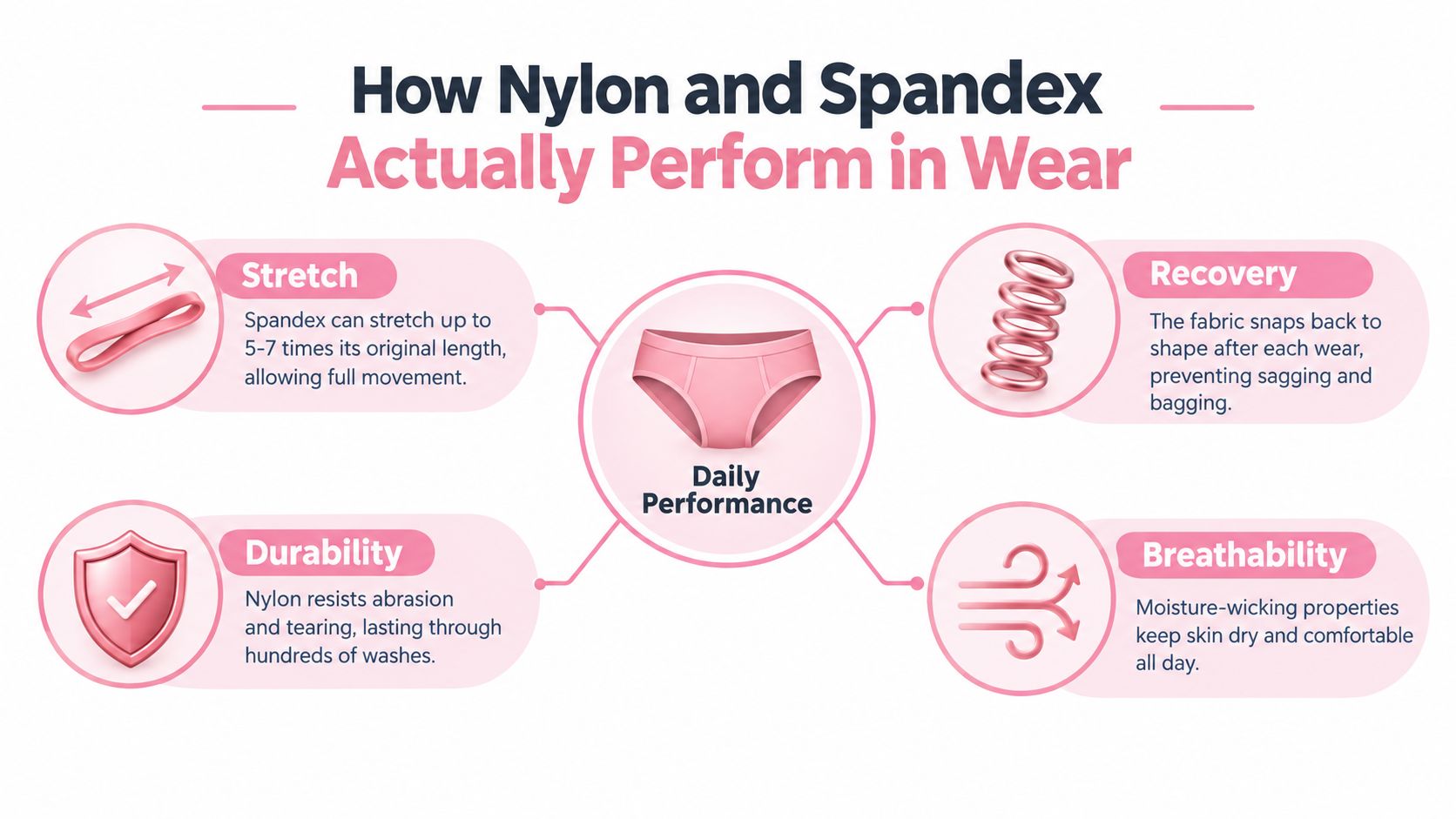
Labels list fibers, but your body tests four jobs. Learn to name them, and you'll diagnose a disappointing pair in seconds.
Four Jobs You Can Feel
- Stretch: You bend to tie a shoe, and the fabric gives instead of cutting in. That's spandex allowing movement without forcing you to size up.
- Recovery: By evening, does the waistband still hold, or has it relaxed into a wavy edge? Good recovery means the garment returns toward its starting shape after each stretch.
- Durability: A seatbelt rubs, denim seams chafe, laundry tumbles. Nylon's abrasion resistance helps the surface stay smooth instead of thinning or roughening quickly.
- Breathability and drying: On a warm commute, air and water vapor need escape routes through the knit. If they don't get them, heat and sweat linger against skin.
Here's the part shoppers often miss. Those last two jobs depend heavily on how the yarns are knitted, not just which fibers are present. In a peer-reviewed comparison of sports fabrics in Industria Textila, a 58% polyamide and 42% elastane knit combined good air permeability, thermal conductivity, moisture management performance, and short drying time, with the fastest drying sample finishing in 13.6 minutes under its test conditions. Polyamide is the family name that includes nylon, so that result speaks directly to this blend.
Those laboratory minutes aren't a promise for your laundry rack. They're a benchmark showing that construction changes outcomes. Finer yarns, lower thickness, and more open structures generally improved air and vapor movement in that comparison. If you want a plain language refresher on how moving moisture away from skin changes comfort, this overview of moisture wicking fabric benefits connects the mechanism to everyday wear.
Practical rule: Read the fiber label for the cast, then look at knit density, thickness, and paneling for the actual performance.
So a hipster that climbs usually points to weak recovery, poor edge stability, or a cut fighting your shape. A pair that feels clammy points to a dense knit with nowhere for vapor to go. Different problems, different fixes.
Nylon and Spandex Compared to Modal and Mesh
You're rarely choosing between good and bad fabrics. You're choosing which trade off suits your day. Modal led blends and mesh panels answer different needs, so compare them on the same criteria you'll feel.
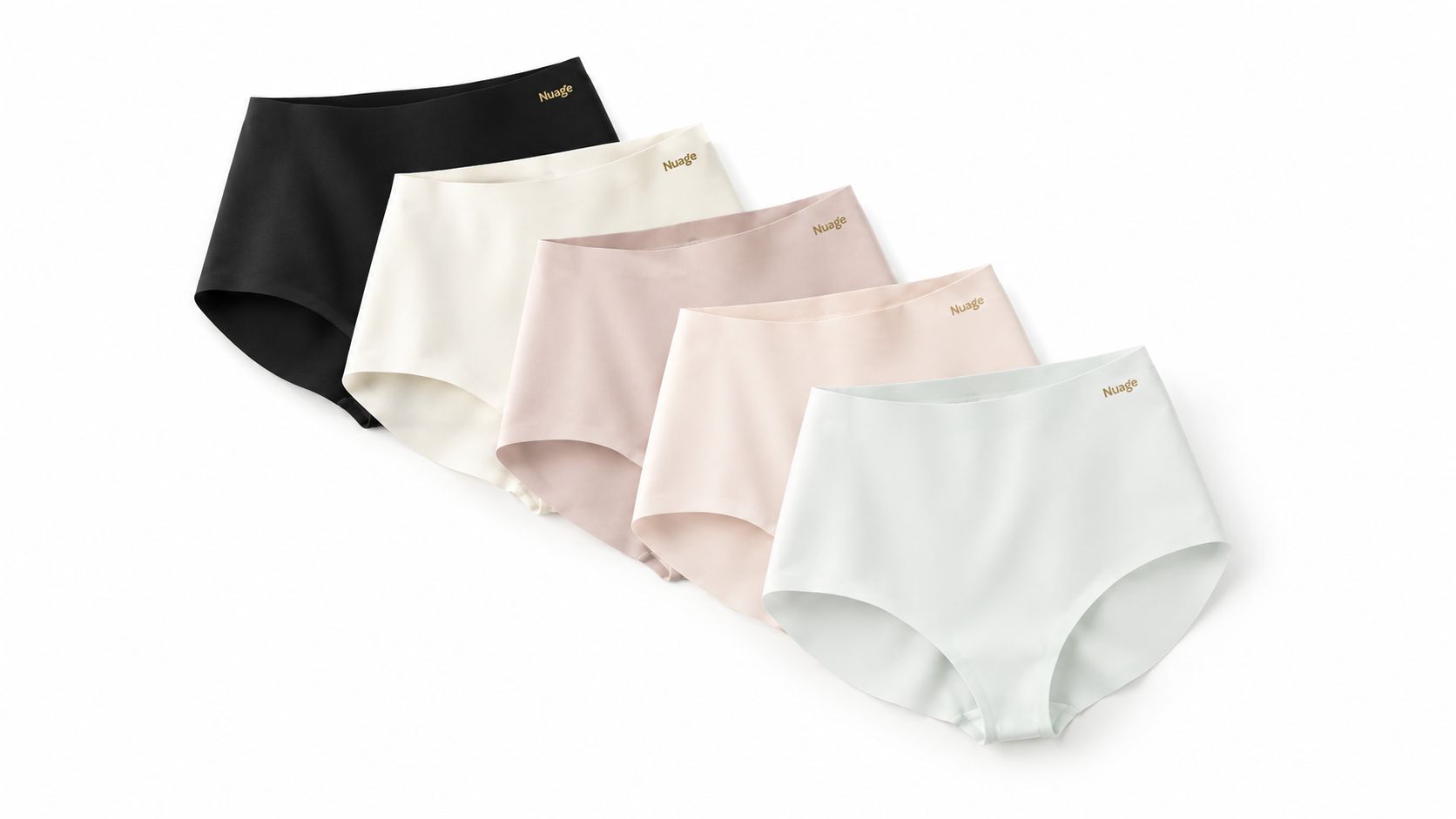
Hand feel is where modal shines. It tends to feel soft and cushioned against skin, which many people prefer for long desk days. If you want the fuller backstory before deciding, this guide explaining what modal underwear is walks through that fiber on its own terms. Nylon spandex feels smoother and slicker, so clothing glides over it more easily.
Mesh isn't a rival fiber at all. It's a construction choice, an open knit placed where airflow matters most. That distinction is liberating because a single pair can use a dense nylon spandex body for opacity and support, then add mesh zones where you run warm.
How nylon-spandex stacks up against modal and mesh
| Property | Nylon and Spandex | Modal-led Blends | Targeted Mesh Panels |
|---|---|---|---|
| Hand feel | Smooth, light, low friction | Soft, plush, cushioned | Airy, textured where placed |
| Stretch behavior | Strong give with firm snap back | Gentle give, softer hold | Depends on the base yarn |
| Breathability | Varies with knit density | Comfortable for steady wear | Highest airflow in zoned areas |
| Opacity under clothing | Reliable in dense knits | Reliable, with a matte look | Lower, so placement matters |
| Care demands | Protect the stretch from heat | Protect softness, avoid rough loads | Protect open knit from snags |
For fitted office outfits, workouts, and travel, nylon spandex usually earns its place through recovery, a smooth outline, and comparatively quick drying. For all day sitting and skin that prefers a softer touch, modal led styles often feel kinder. As one concrete modal based example, the NuCloud Original High Rise(5-Pack) uses raw cut, seam free edges, a 3D contoured full coverage cut, and a cotton lined gusset, which shows how cut and finishing shape comfort alongside fiber choice.
Treat mesh as an upgrade you place, not a wholesale replacement. Airflow where you sweat, density where you need coverage, that's the smart combination.
Caring for Nylon and Spandex Without Ruining the Stretch
Most nylon spandex pairs don't die from wear. They die in the laundry, slowly, one hot cycle at a time. The good news is that protecting them takes less effort than rescuing them.
Remember recovery from the performance discussion. Every care choice below exists to preserve that snap back. Heat is the main villain because repeated high temperatures tire the elastic component, so waistbands relax and leg openings stop gripping.
A Routine That Preserves Recovery
- Wash cold and contained: Turn pairs inside a mesh laundry bag, choose a cold, gentle cycle, and keep hooks and rough denim away from the knit.
- Use mild detergent sparingly: Harsh products and heavy residue can coat yarns, dulling hand feel and interfering with moisture movement.
- Skip fabric softener: Softener buildup leaves a film on synthetic knits, which works against the clean, dry surface you're paying for.
- Dry flat or hang in shade: Lay pairs flat or hang them away from direct sun and radiators, and skip the hot dryer.
- Never wring: Press water out gently with a towel instead of twisting, since wringing strains edges and elastic.
If you'd like a fuller step by step routine for sorting, washing, and drying delicates, this practical guide on how to wash underwear covers the complete habit in one place. Keep it by the machine until the routine becomes automatic.
Cold water, gentle handling, air instead of heat. If you remember only three things, make it those.
You'll know the routine is working when a favorite pair feels the same at the end of the month as it did on day one. Edges lie flat, the waistband holds without digging, and the fabric still lets go of moisture instead of holding it. That's not luck. That's protected recovery, and it applies just as well to leggings and shaping styles hanging nearby.
Matching Nylon-Spandex Underwear to Real Wardrobe Days
Silhouette shopping asks, brief or thong? Material shopping asks a better question. What will this pair be doing for the next several hours?
Desk to Dinner Days
You need invisibility first. Look for a smooth, dense nylon spandex body with flat or bonded edges, since trousers and knit dresses reveal every ridge. Recovery matters here too, because a waistband that stays level through sitting, standing, and a long meal won't need adjusting under evening clothes.
Long-Haul Travel Days
Flights combine hours of sitting with cabin temperature swings and very little chance to change. Choose lightweight fabric that dries comparatively quickly, packs down small, and keeps its shape after being folded. A stay put leg opening earns its keep when you're crossing terminals, then settling in again.
Workouts and Warm Commutes
Movement plus heat demands airflow and positional stability at the same time. Prioritize thinner knits, zoned openness in high sweat areas, and edges that grip without biting. Change out of a damp pair when you can, since even a well built knit feels better dry.
Off-Duty Days
At home, structure matters less and softness matters more. A gentler blend or a modal led option may suit you better, and that's not a downgrade. It's matching the tool to the job, the same logic you'd use for shoes.
Notice how each scenario ranks the same properties differently. Invisibility wins at dinner, drying wins in transit, airflow wins in training, softness wins on the sofa. Shop by that ranking, and your drawer starts working like a small, well organized team instead of a pile of near misses.
Common Assumptions Worth Rethinking
Two beliefs steer shoppers wrong more than any others. Both sound logical, and both fall apart once you look at construction.
More Spandex Always Feels Better
It doesn't. Extra spandex can add firmness and hold, but it can also make a garment feel tighter, heavier, and less forgiving if the knit is dense. Feel comes from the balance among elastane content, yarn fineness, knit tightness, and garment cut. A moderate amount of stretch in a well shaped pattern often feels better than maximum stretch fighting your body all day.
Coverage enters the trade off too. Pushing stretch without enough supporting structure can let edges curl or let fabric sheer out when it extends. You're after controlled recovery, not the highest number on a label.
Synthetic Always Means Sweaty
This one confuses fiber with architecture. A thick, tightly closed knit traps heat regardless of marketing language, while an open, porous structure lets air and vapor pass. Earlier performance evidence showed exactly that pattern, where openness, finer yarns, and lower thickness improved air permeability and water vapor transport.
Panel zoning puts that principle to work. Open knit in warm zones, denser knit where you need opacity and support, and suddenly the synthetic pair breathes where it counts. The reverse is also true. A poorly ventilated natural fiber pair that absorbs moisture and holds it can feel damp for hours.
So retire the blanket claims. Ask where air can move, how thick the knit is, and how the garment recovers after you stretch it by hand. Those answers predict comfort far better than any single word on a tag.
A Quick Decision Checklist Before You Buy or Wash
Keep this short list in your head at the rack and at the machine.
Before you buy
- Dominant fiber: Is nylon providing the smooth surface, with elastane in a supporting role?
- Construction: Where do mesh or denser panels sit, and does that match where you need airflow or coverage?
- Edges: Are waist and leg finishes bonded, raw cut, or elastic, and will they lie flat under your clothes?
- Stretch test: Does the fabric extend easily and return promptly when you let go?
Before you wash
- Care fit: Cold wash, mesh bag, no softener, air dry. Does that fit your real routine?
Answer those five, and you'll choose with confidence in under a minute.
Ready to put this know-how to work in your own drawer? Explore styles that stay put, built around smooth surfaces, reliable recovery, and breathable zoning at Nuage Wears, and pick the pair that matches the day you've got planned.