
If two pairs of underwear both say modal on the label, why does one feel airy at hour nine while the other feels like a damp washcloth by lunchtime? Most of us were taught to shop by fiber name, as though "cotton" or "modal" were a performance rating stamped on the fabric. It isn't. A breathable underwear fabric is the result of two things working together: what the fiber does with water, and how the yarns are arranged to let air and vapor move. Once you can read both, a hangtag stops being a guessing game.
Table of Contents
- Breathable Fabrics Compared by Fiber Type
- How Airflow and Moisture Transport Really Work
- How Weave, Thickness and Mesh Change Airflow
- Matching Fabric to Your Day and Skin
- What Antimicrobial Fabric Claims Can and Cannot Do
- Check Any Breathability Claim and Choose Your Pair
Breathable Fabrics Compared by Fiber Type
Fiber names tell you how a material handles water, not how much air crosses it. The most useful starting number is moisture regain, the share of water a fiber holds from the air under standard conditions, and it separates the usual underwear fibers sharply.
| Fiber | Moisture regain | What it does for airflow |
|---|---|---|
| Modal | about 11.0% | Absorbs and holds moisture in the fiber; soft, absorbent feel |
| Cotton | about 8.0-8.5% | Absorbs readily; can stay damp longer once saturated |
| Polyester | about 0.4% | Absorbs little; moves moisture along the surface and dries fast |
| Mesh (knit construction) | No single value, since mesh can be knitted from modal, cotton, nylon or polyester | Airflow depends on open structure, not the fiber name |
A technical textile reference on conventional moisture regain lists approximately 11.0% for modal fiber, 8.5% for cotton fiber and only 0.4% for polyester fiber, with cotton fabric reported at about 8.0%.
What those numbers feel like against skin
Modal drinks moisture into the fiber itself, which is why it feels soft and dry to the touch early on. Cotton soaks up sweat happily, then holds it, so a saturated cotton pair stays clammy. Polyester barely absorbs anything, so sweat travels along the fiber surfaces and evaporates instead of pooling. Mesh isn't a fiber at all, it's an open knit, which is why it has no regain figure of its own.
Shopping shortcut: for hot days and workouts, lean toward a fast-drying synthetic mesh. For all-day softness under fitted clothes, choose modal or a modal blend.
Those are fiber-level values, not garment promises, so treat the table as a starting point rather than a verdict. If you sew your own pairs, More Sewing's guide to sewing with bamboo and modal covers needle choice and handling for these slippery cellulosic knits, and our notes on nylon and spandex underwear explain what stretch content adds to the mix.
How Airflow and Moisture Transport Really Work
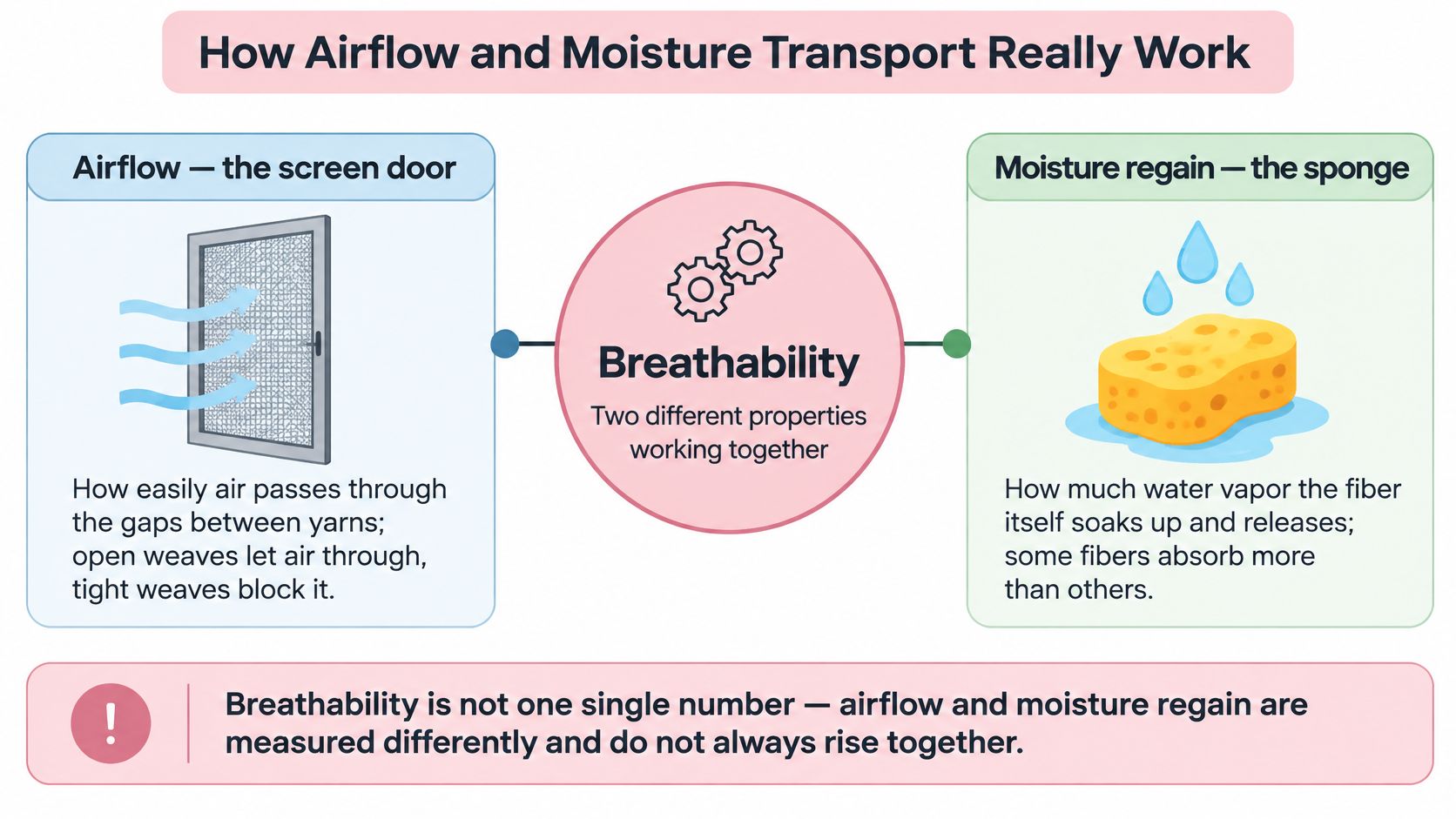
Think of a screen door and a kitchen sponge. The screen door lets breeze through its gaps but soaks up nothing. The sponge holds plenty of water and lets almost no breeze pass. Underwear fabric is both at once, and the two jobs are measured separately.
Three measures, three plain questions
- Air permeability: how readily air passes through the fabric under specified test conditions. This is the screen door part, the breeze you feel on a humid platform.
- Water-vapor permeability: how much vapor transmits through the material, which is the sweat leaving as gas rather than as liquid on your skin.
- Drying time: how quickly the fabric gives up the water it already holds, so the next hour doesn't start damp.
A textile transport study in Vlakna a Textil identifies yarn fineness and the diameter of the spaces between yarns as important structural variables, and reports that fabric void spaces strongly affect air permeability while yarn filling has greater influence on water-vapor permeability. In plain terms, the holes govern the breeze and the yarns govern the vapor.
That's why a tight cotton jersey and an open mesh panel can share a fiber name and behave nothing alike. Say a brand knits the same modal yarn into a dense body panel and a loose vented panel: identical regain, very different air exchange, because the gaps changed size.
Two fabrics can tie on airflow and still differ on how fast sweat vapor escapes, so a single "breathable" badge hides the half that matters most when you're sweating.
When a product claims to breathe, ask three things: how much air passes through, how much vapor gets out, and how fast the panel dries. If a listing answers none of them, you're buying a word.
How Weave, Thickness and Mesh Change Airflow
Fiber names are only half the label. Construction decides whether air can move, because airflow behaves like traffic through a doorway. A wide doorway lets people pass easily. A narrow one slows everyone down, even if the people are dressed for speed.
| Construction feature | Effect on airflow | Trade-off |
|---|---|---|
| Finer filament yarns | Higher air and vapor permeability | Less structure to hold shape |
| Lower fabric thickness | Better moisture transport and faster drying | Less coverage and opacity |
| Shorter stitch length | Higher air permeability | Less stretch and give in the knit, so fit needs precise patterning |
| Coarser yarns | Higher wicking and air permeability, lower vapor transmission | Slower vapor release |
| Open mesh panels | Targeted airflow where heat builds | Bonded or sewn seams can reduce the airflow |
A study of knitted underwear fabrics in Industria Textila, covering cotton, polyester-cotton blends, nylon, viscose, bamboo and modal, reports that finer filament yarns, more open and porous structures, shorter stitch lengths and lower fabric thickness are associated with higher air permeability, higher water-vapor permeability and stronger overall moisture-management capacity. Read that as a construction map: small yarns and shorter stitches change the size and number of pathways through the knit.
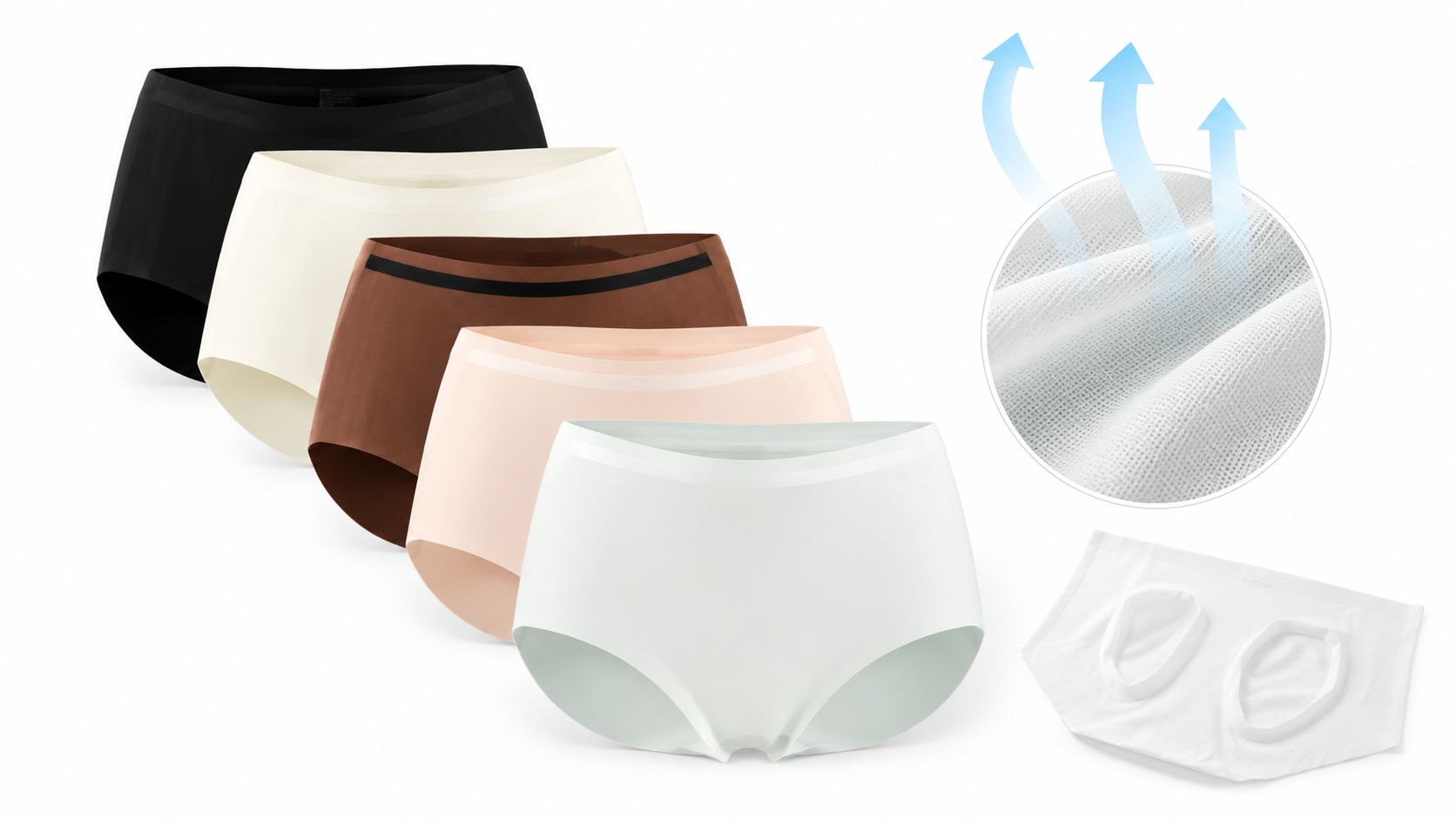
The image shows how a mesh-based brief is built for air movement across the fabric surface. In performance underwear, mesh works like vent slots in a jacket. It does not make heat disappear, but it gives warm air and sweat a faster route out.
What the wetting numbers actually tell you
Liquid moisture testing puts numbers on how fast sweat spreads. A textile study of knitted underwear fabrics published in Industria Textila reported one fabric with a mean top wetting time of 55.53 seconds and a top absorption rate of 245.49% per second, while another recorded a top wetting time of 32.67 seconds and a top absorption rate of 351.06% per second. The second fabric takes the drop in sooner and spreads it faster, which is the difference between a panel that wicks and a panel that beads.
Wetting time answers one question: how long does liquid sit on the surface before it enters the fabric? Absorption rate answers another: once liquid enters, how quickly does it spread through the structure? A fabric can do one well and the other less well, so a single word like "wicking" leaves out useful detail.
Where more airflow costs you something
Airflow and vapor release do not always climb together. In testing of cotton, nylon and cotton-nylon woven fabrics published in Fashion and Textiles, coarser yarns increased wicking, moisture regain and air permeability across the samples, but water-vapor transmission decreased. A breezier fabric can still trap vapor.
That is why mesh belongs in a garment plan, not just a marketing line. Place mesh where heat builds, such as zones that trap warmth during movement, and the effect is useful. Add too much openness without support, and the garment can lose coverage, opacity and shape recovery. A panel that feels airy on a hanger can look sheer or sag after repeated wear if the knit has too little structure.
Nuage Wears uses this construction idea in the NuAir collection, which pairs breathable mesh with moisture-wicking comfort. The NuAir Mesh Flex Brief uses high-stretch mesh that maximizes airflow, draws sweat away and dries rapidly. It is made from featherlight mesh with no seams, digging, pinching or wedgies, and it has an elastic-free waist, reinforced thigh bands and 3D contouring for pear, apple and peach body shapes. The NuAir Mesh Flex Brief also has a 100% cotton-lined antibacterial gusset and is machine washable.
Panel rule: airflow is set by the whole garment, so a bonded waistband, a doubled gusset or a heavy seam can cancel much of what the mesh zone promises.
A breathable label becomes easier to judge when you look past the fiber and inspect the build. Ask where the open areas sit, whether the knit has enough structure to recover, and whether the panels around it allow the same movement. Air needs a route in, through and out. Mesh can help create that route, but the whole garment decides whether the route stays open.
Matching Fabric to Your Day and Skin
A ninety-minute hot yoga class and a nine-hour desk day under fitted trousers ask opposite things of the same garment. One needs sweat moved out and evaporated fast. The other needs a smooth, soft, low-bulk layer that never announces itself under wool trousers.
| Situation | What matters most | Fabric to look for |
|---|---|---|
| Hot yoga or training | Fast drying and airflow | Open mesh zones in a quick-drying knit |
| Long office day under fitted clothes | Coverage and softness | Modal or modal-blend knit |
| Humid travel | Quick drying and low bulk | Thin, quick-drying knit with mesh panels |
| Everyday comfort | Balanced softness and breath | Modal or cotton-blend knit |
| Sensitive skin or recurrent irritation | Low friction and dry skin | Soft, low-friction knit; change damp garments promptly |
Read the priority before the fiber
Notice that each row names a job first. For training, the job is evaporation, so an absorbent fiber that stays loaded with sweat works against you even if it feels lovely. For a desk day, the job is a clean line and a soft hand, so a smooth modal knit wins and aggressive venting adds nothing you'll notice.
Travel is its own case because you're washing in a sink and hanging things over a shower rail. Thin, quick-drying knits with mesh panels pack small and are wearable again by morning, while a heavy cotton pair may still be damp when you check out.
Sensitive skin needs friction control first
If you're prone to irritation, the fabric's smoothness and the cut's seam placement matter as much as any airflow claim. Look for flat, low-profile edges, avoid tight leg openings that saw at the same spot all day, and get out of damp garments as soon as you can. Our guide to anti-chafing underwear goes deeper on cut and seam placement.
Pick the one or two priorities that genuinely describe your week, then use that row. Chasing every property at once usually means paying for ventilation you'll never use.
What Antimicrobial Fabric Claims Can and Cannot Do
The promise is familiar: underwear treated with an antimicrobial finish that stops odor, prevents yeast infections and keeps irritation away. It sounds like a fabric that does your healthcare for you.
A 2026 review indexed in PMC reported that empirical evidence on antimicrobial underwear's effects on vaginal symptoms and vaginal microbiota remains limited despite widespread commercial promotion. No single fabric has been clinically proven to prevent infection. That doesn't make breathable underwear pointless, it just moves the claim from medicine to comfort.
The environmental approach you can act on
The defensible goal is a drier, cooler, lower-friction environment next to your skin. Three habits do more than any finish:
- Change damp garments promptly: after a workout or a humid commute, swap out rather than sitting in wet fabric for two hours.
- Choose breathable knits with open zones where heat builds: ventilation belongs at the gusset and the seat, not just on a hangtag graphic.
- Skip tight, friction-heavy cuts for long sitting or exercise: pressure plus moisture plus rubbing is the combination that leaves skin sore.
When fabric choice isn't the answer
See a clinician for recurring itching or burning, unusual discharge, odor that persists after washing and changing, or pain during sex or exercise. Those are symptoms to be assessed, not a shopping problem, and no knit structure substitutes for a diagnosis.
Breathability is comfort engineering, not treatment. Expect a cooler, drier day and less rubbing, and be skeptical of any label promising protection.
Check Any Breathability Claim and Choose Your Pair
You can verify most breathability claims in a few minutes, without a lab. Work through these in order.
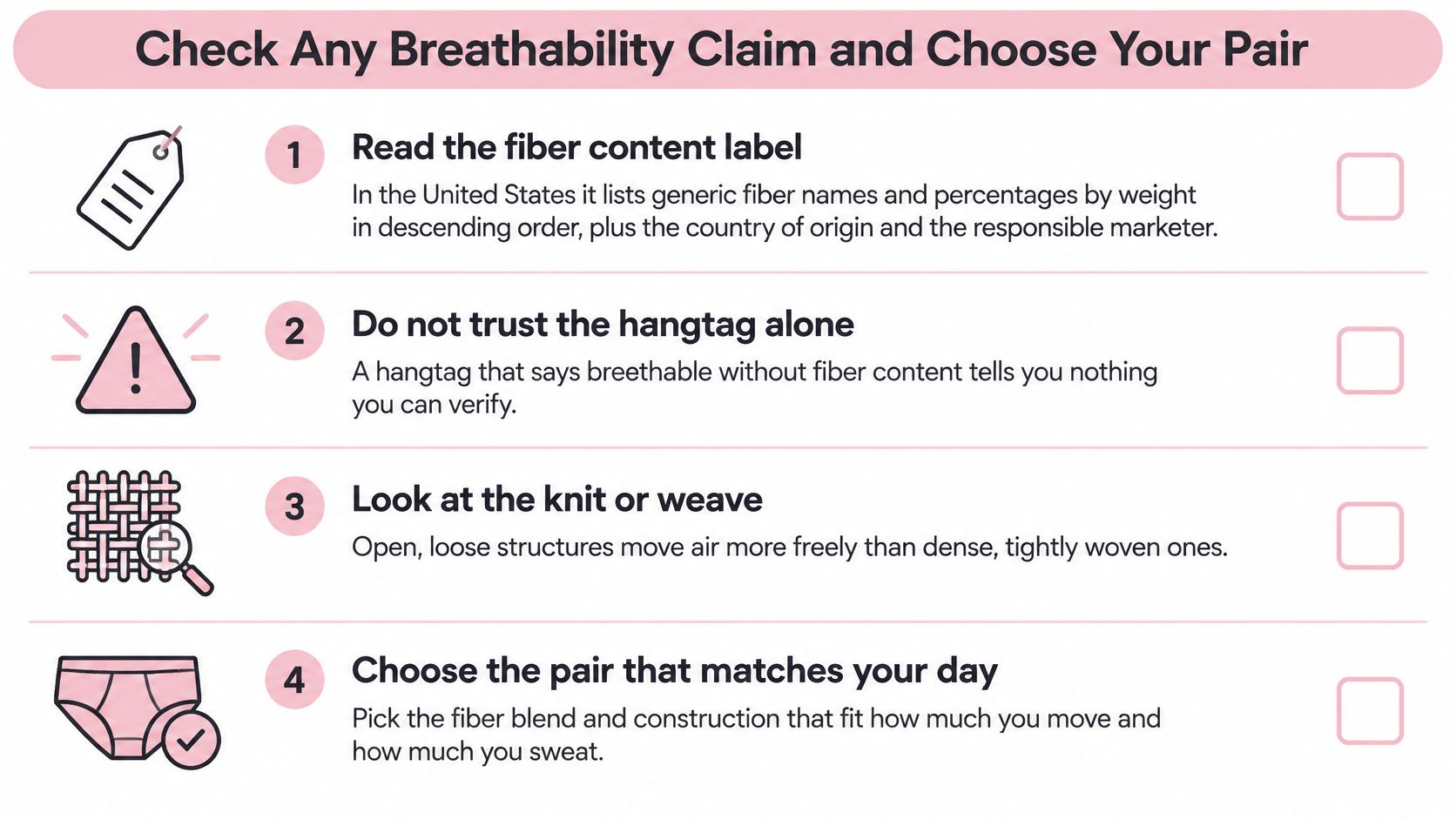
- Read the fiber content label. Under the FTC's textile labeling guidance, most textile products sold in the United States must disclose generic fiber names and percentages by weight in descending order of predominance, plus country of origin and the responsible manufacturer or marketer. The common slip is trusting a style name like "AirCool Modal" over the actual content list.
- Map the panels. Hold the garment up to a window and see which zones are open mesh and which are solid body fabric. A single vented back panel doesn't make the whole brief airy.
- Check thickness and density. Ask for mass per unit area if it's listed, and compare panels by feel and light transmission. Thin, open, low-density knits generally move more air.
- Look for a standard test method. ASTM D737 measures the volume of air passing perpendicularly through a known fabric area under a prescribed pressure differential, and the underwear fabric research published in that IOP conference paper found moisture transfer governed mainly by thickness, density and fiber moisture regain, with thermal transfer influenced primarily by air permeability and density. Confirm the test pressure, specimen conditioning, fabric direction and unit before comparing two numbers, otherwise you're comparing measurements taken differently.
- Ask whether the finished garment was tested. Bonded bands, gussets, dyes, elastane content, laminations and seam constructions can materially change airflow, so raw fabric results may not describe what you wear.
- Run a home drying check. Wet a small panel with a teaspoon of water, press it between towels to remove excess, then hang it and time how long it takes to feel dry. Compare two pairs side by side in the same room.
- Match the result to your week. Fast drying and open zones for training and humid travel, soft coverage for long days under fitted clothes.
Here's a walkthrough of how mesh construction and fit are evaluated in practice.
Choosing the pair, then testing it
Three things decide the outcome: the fiber content label, the construction and mesh placement, and the fit with your actual day. For hot training, humid travel or long active days, a fast-drying mesh brief is a strong fit. The NuAir Mesh Flex Brief from Nuage Wears is one example: high-stretch mesh that maximizes airflow, draws sweat away and dries rapidly, an elastic-free waist, a 100% cotton-lined gusset, machine washable, and designed for hot yoga, training, outdoor work, hiking and humid travel.
Buy one pair before you commit to a multi-pack. Wear it through a real workout or a full desk day, note where you feel damp or rubbed, then decide. Wash it cool, skip bleach and fabric softener so the knit and edges stay intact, and repeat the drying check after a few cycles to see whether the fabric still performs the way it did new.
Nuage Wears builds comfort-first underwear around the two things that decide breathability: fiber choice and construction, from cloud-soft modal NuCloud styles to airy NuAir mesh panels placed where heat builds. If you're ready to match a pair to your own week, browse the collections at Nuage Wears, start with one pair for your hardest day, and let the fabric prove itself before you stock the drawer.