
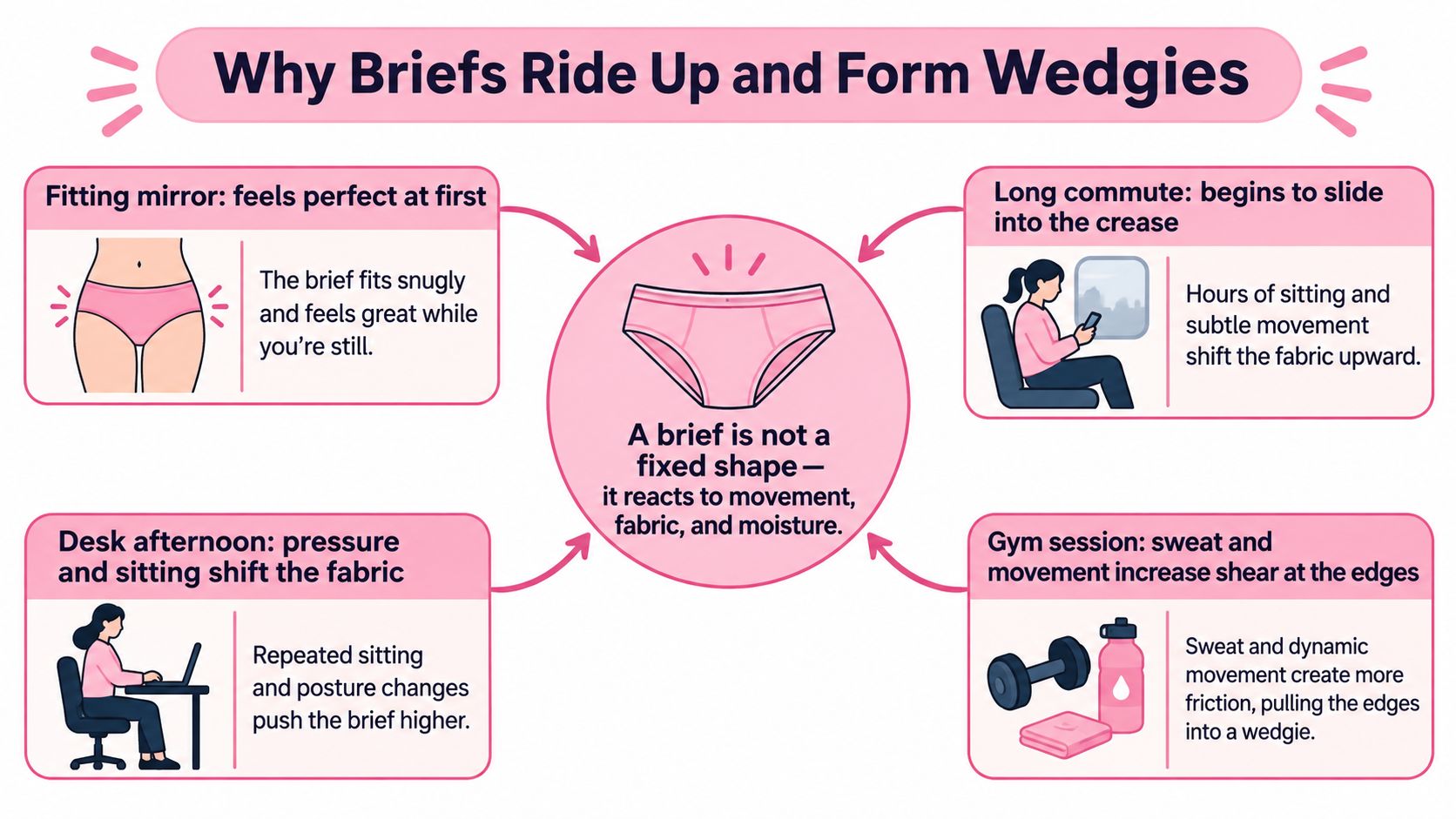
You left the house in a brief that felt perfect in the mirror. By the time the train doors opened, the rear edge had crept into the crease. A desk afternoon pushed it further, and the gym made the fabric bunch. That's the everyday story of briefs and wedgies, and it's a movement problem with a diagnosis, not a verdict on your body.
A brief isn't a fixed shape. Friction, tension, waist pressure, gravity, and shear all act on it at once. Name which force is winning and you can change one thing instead of fishing fabric out of your clothes in public.
I would start with the cheapest fix. Match the symptom, then run a short wear test before you commit to a cut for the week.
Table of Contents
- Why Briefs Ride Up and Form Wedgies
- Match Your Symptom to Its Cause and Fix
- Brief Cuts and How Each One Holds Its Place
- How to Test a Brief Before You Trust It
- Why Fabric and Moisture Make Briefs Shift
- Three Myths About No-Wedgie Underwear
- Choose One Pair and Prove It This Week
Why Briefs Ride Up and Form Wedgies
The pair looks calm at the fitting mirror. A long commute, a desk afternoon, and a gym session rewrite that fit. Nothing about your body changed. The forces on the fabric did.
Comfort research treats the garment and skin as one loaded interface. Friction, tensile force, elasticity, pressure, compression, gravity, and body-shape shear all act together, which a peer-reviewed clothing-comfort review lays out in practical terms. A brief migrates into the gluteal crease when rear coverage, the leg opening, the rise, or stretch recovery can't keep stable contact while you walk, sit, bend, or exercise.
Think of the brief like a tent pinned at four corners. Rear coverage, the leg bands, the rise, and stretch recovery are the pegs. Pull one peg and the whole canopy slides. The free edge then tucks into the crease, which is the wedgie you feel.
What moves and what stays
Standing is the easy test, and it lies. The anchors and the fabric are at rest together, so the pair feels secure. Sitting, bending, or cycling shifts the fabric while those anchors stay put. The rear edge has nowhere stable to land, so it walks inward a little with each cycle.
Three levers you can judge without a lab:
- Rear panel width: A broader rear panel gives the edge more fabric before it can enter the crease. A narrow panel has almost no buffer once you sit.
- Leg-opening tension: A band that's too tight, or one that has lost its spring, rolls or cuts and then climbs the thigh.
- Stretch recovery: Elastic that springs back after a stretch returns the brief to place. Elastic that stays stretched lets the garment drift.
A wedgie is a fit problem in motion, not a fabric-softness problem.
If the edge moves only when you move, the cause is geometry, tension, or recovery. It isn't your body. Check that in motion, not on a still mannequin. Watch rear-edge displacement, leg-opening roll, waistband migration, and how much coverage remains after squats, a walking loop, and a seated stretch. Softer fabric can feel nicer and still fail every one of those checks.
Match Your Symptom to Its Cause and Fix
You arrive with a feeling, not a diagnosis. This table is the fastest route from what you notice to the one change worth making.
| Symptom | Likely cause | Fix |
|---|---|---|
| Edge sits in the crease after sitting down | Rear panel too narrow or rise too short | Choose a fuller rear panel or a higher rise |
| Leg band rolls or cuts in at the thigh | Leg opening too tight or band lost recovery | Move up a size or choose a reinforced, bonded leg band |
| Waistband slides down while walking | Lost elastic recovery or waistband too loose | Choose a bonded waistband and check the waist fit |
| Fits standing but shifts during squats | Shear during bending and squatting | Wear-test in squats before wearing for a full day |
| Fabric clings and bunches when damp | Sweat increases friction and adhesion | Choose mesh zones and fast-drying fibers |
| Waistband digs and leaves marks | Pressure concentrated at the waist, worst during movement | Choose a wider, softer waistband and avoid sizing down |
| Front outline shows under thin skirts or leggings | Seam placement or a visible front edge | Choose seamless edges or a smoothing front shield |
The most common path first
An edge that slides into the crease after you sit is the complaint I hear most. The rear panel is too narrow, or the rise is too short, so sitting shortens the only fabric that was holding the edge out. Confirm it in ten seconds. Sit, stand, and look in a mirror. If the edge has moved inward and the waistband hasn't rolled, coverage is the variable. A fuller panel or a higher rise usually shows on the first wear.
A leg band that rolls or cuts at the thigh is next. The opening is too tight, or the band has lost recovery and curls instead of lying flat. Pinch the band. If it stays folded, or if a red line appears in seconds, size up or switch to a reinforced, bonded opening. A size change shows on the first wear. Dead elastic means replacing the pair. Washing won't bring that spring back.
A waistband that slides while you walk has lost recovery, or the waist is too loose for the rise. Walk ten steps and check the back. If the band has dropped and the rear panel is slack, fit at the waist is the lever, not the leg.
When standing isn't the real test
A brief that feels fine upright and shifts in a squat is shear during flexion. The pattern can't follow the hip as it folds. Ten squats tell you more than a mirror pose. Damp fabric that clings and bunches is a friction problem once sweat raises grip. A waistband that digs and leaves marks is pressure piled on a narrow band, and it gets worse once you move, so a wider, softer band beats sizing down. A front outline under a thin skirt is seam placement or a hard front edge. Smooth edges or a smoothing front shield clean that line without changing the rear cut.
Two rules keep the experiment honest. Change one variable at a time, or you won't know what worked. Retest after the first wash, because washing can reduce stretch recovery in some fabrics and a fresh pair can lie about how it will behave next week.
Brief Cuts and How Each One Holds Its Place
The cut decides how much fabric is available to hold the edge in place. The same fit problem looks different on a full brief and on a cheeky, because one has a wide anchor and the other doesn't.
| Cut | Rear coverage | Best for | Wedgie risk |
|---|---|---|---|
| Full brief | Full rear panel | All-day sitting and travel | Low |
| Mid-rise brief | Moderate rear panel | Desk to dinner and everyday wear | Low to moderate |
| High-rise brief | Longest rise and full rear panel | Workouts and movement-heavy days | Low when sized correctly |
| Hipster | Smaller rear panel and lower rise | Low-rise jeans and light layering | Moderate, rises up if too small |
| Thong | Minimal rear fabric | Smooth lines under fitted clothing | Higher, depends on strap and fit |
| Cheeky | Partial rear coverage | Warm days and fitted dresses | Moderate |
Coverage you can actually use
A full brief carries a full rear panel, so the edge sits farther from the crease during long sitting and travel. A high-rise brief adds the longest rise to that full panel. Both suit workouts and movement-heavy days, provided the size is right. A correctly sized high-rise can outperform a badly fitted full brief, because extra fabric that's too small still pulls inward.
A mid-rise brief is the everyday middle. Moderate rear coverage handles desk-to-dinner outfits without the bulk of a full panel under slim-cut trousers. If your day is mostly sitting with one walk home, this is the cut I'd try before a more extreme shape.
Less fabric, faster failure
A hipster uses a smaller rear panel and a lower rise. It looks smooth under low-rise jeans and light layers, and it rises quickly if you size down, because there's less fabric left to hold position. A cheeky keeps only partial rear coverage. It's a fair choice on warm days and under fitted dresses, with a moderate risk once you sit for long stretches.
A thong minimises visible lines because it carries the least rear fabric. The strap, the fit, and where the edge is placed decide whether it stays put. There's no wide panel to save a poor size. If you want the smoother look of less fabric without giving up a brief's coverage, the trade-off is real, and the briefs versus hipster comparison is worth reading before you switch cuts for a low-rise outfit.
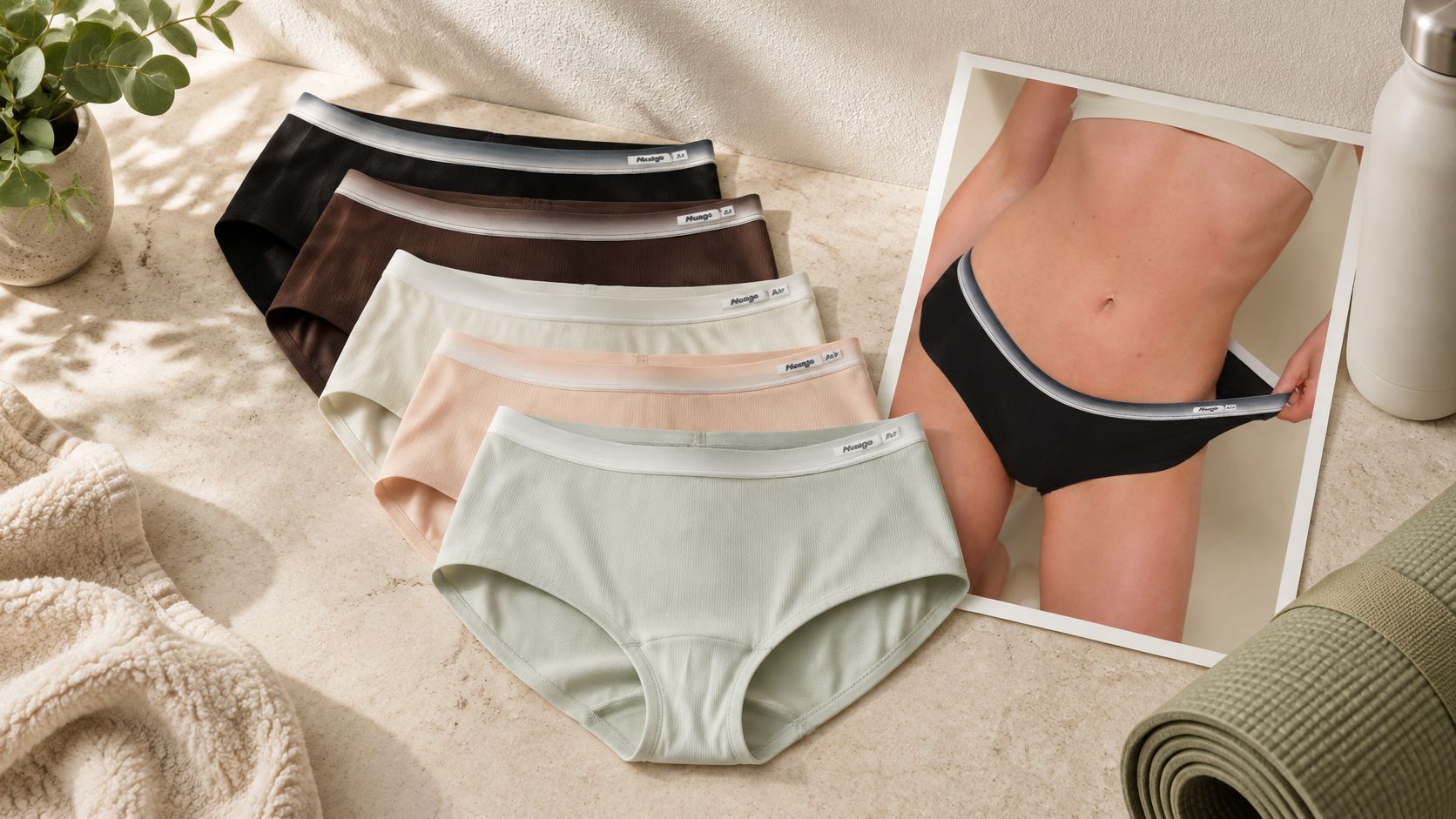
Shield briefs add a front panel when the problem is a line under skirts and dresses rather than a rear edge. Cut is still only a starting point. Which of your three daily situations, desk, travel, or workout, needs the most rear coverage? Buy for that day, not for the outfit in the photo. A featherlight mesh option such as the NuAir Mesh Pivot+ (5-Pack) pairs a non-dig woven waistband with reinforced leg openings for workouts and long travel days, which is one way to test stay-put construction without guessing from a label.
How to Test a Brief Before You Trust It
A relaxed standing check can flatter a brief that will fail by lunch. A peer-reviewed waistband-comfort study found that a waistband with a 5.0% reduction rate produced an average pressure of 17.5 ± 2.1 mmHg while subjects stood upright and breathed naturally, and the same waistband study reported pressure could exceed 35 mmHg as posture, movement, and respiration changed. Subjects wearing brassieres and girdles complained of discomfort at that higher level. Static pressure can sit well below the pressure you generate once you move, so the test has to include movement.
Seven steps, each with a reason
- Put the brief on in your usual size and stand before a mirror. The rear panel should cover the full crease. The common slip is admiring the waist and never looking at the rear edge.
- Check the leg openings. They should lie flat without cutting in or rolling. A band that curls now will climb once you walk.
- Check the waistband. It should hold without leaving deep marks. A pale line is contact. A red groove is concentrated pressure, and movement will raise it.
- Walk for five minutes at a normal pace and recheck the rear edge. Walking is where gravity and a loose waist show up. Standing still hides both.
- Do ten squats and a forward bend, then recheck the rear panel and the leg bands. Flexion is where shear pulls fabric into the crease. Skip this and you'll trust a pair that only works upright.
- Sit for 20 minutes, stand, and check whether the waistband has rolled or slid. Long sitting is the commute and the desk, compressed into one check.
- Note what moved and match it to the symptom table. An edge in the crease points to coverage. A rolling band points to tension. A sliding waistband points to recovery.
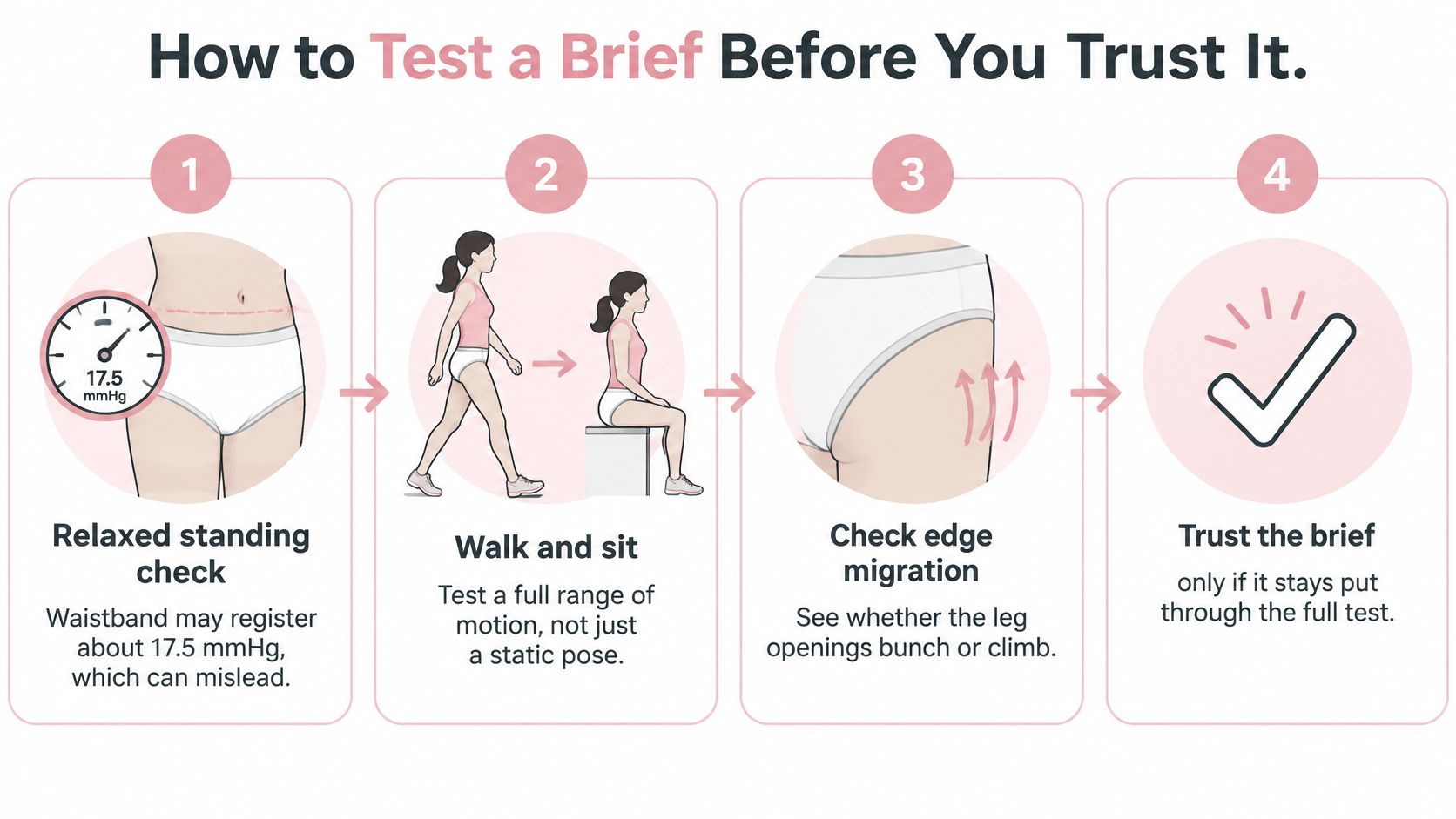
Practical rule: Trust the brief only if the rear edge, the leg bands, and the waistband are all in the same place after the walk, the squats, and the sit.
Repeat the whole sequence after the first wash. Heat and a rough dry can dull recovery, and a pair that passed on day one can roll on day four. If only one zone moved, change that zone. Don't throw out a good rise because the waistband was the weak peg.
Why Fabric and Moisture Make Briefs Shift
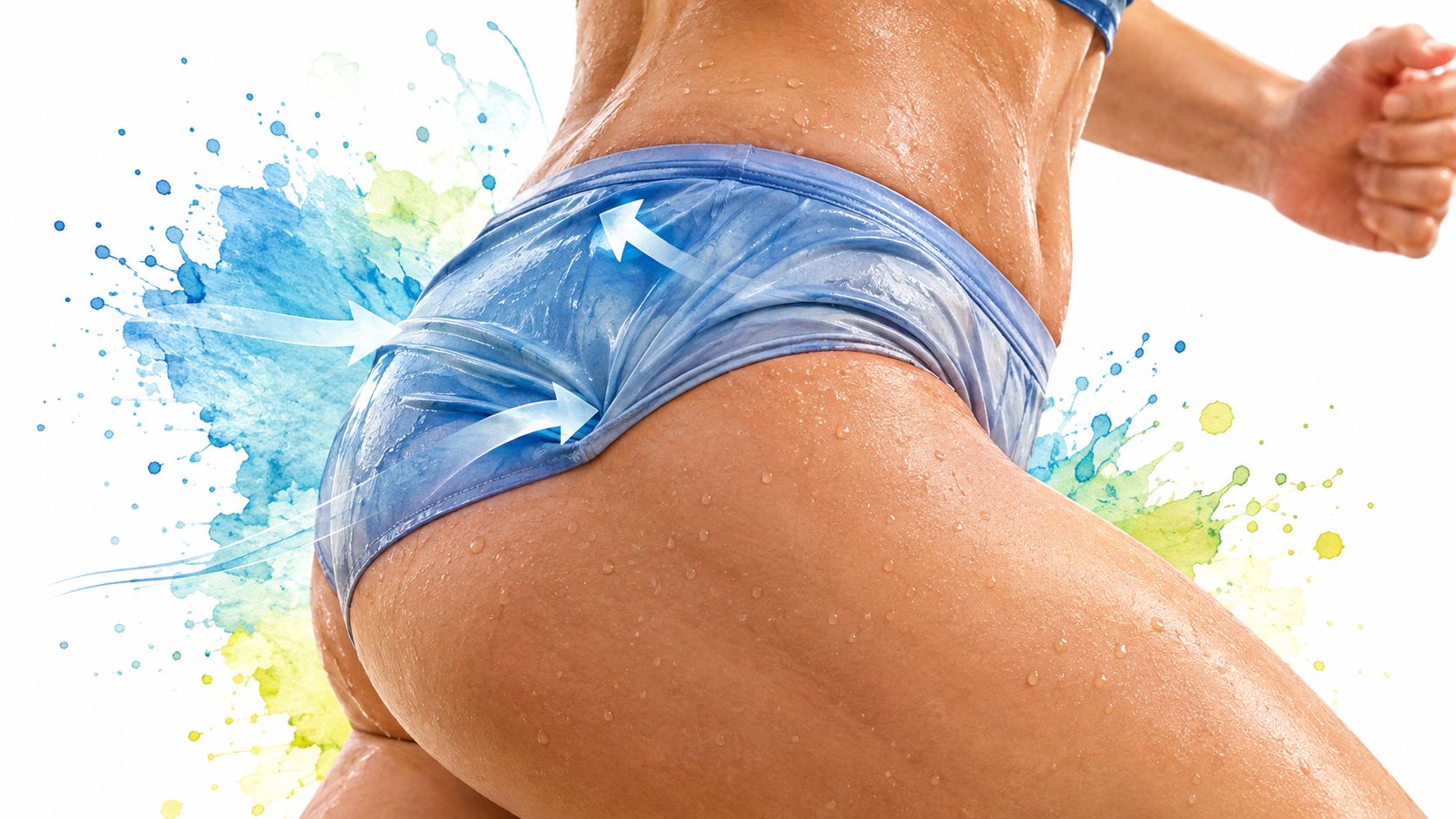
Sweat changes the physics before you notice the cling. Wetness increases adhesion and friction, so textiles feel sticky or clammy, and sweat can add garment weight and strengthen contact with the body. A fabric and skin interaction review traces that path clearly. Perspiration raises textile adhesion. Adhesion raises resistance to sliding. Movement then pushes greater shear into the brief's edges, and those edges bunch or migrate.
Inadequate water transport leaves sweat near the skin. Transplanar wicking moves moisture away from the surface instead. That's the chain you want to break, and a dry-fabric claim won't show you whether it breaks under the pressure of a close fit.
What actually interrupts the chain
Four construction details do the work together. Mesh zones move air. Low-retention fibers don't hold water against the skin. Smooth edge construction reduces grip where the wedgie starts. Fast drying shortens the damp phase so shear has less time to act. Judge them as a system. A cool hand-feel on a dry pair doesn't predict how the edge behaves once you're damp and the fabric is loaded.
Hot yoga and hiking reward airflow and quick drying, because the damp phase is long and the movement is constant. Humid travel rewards fabric that stays flat when it's damp, even if it isn't the airiest knit in the drawer. Long desk days reward softness against the skin more than maximum ventilation, because you're not generating enough sweat to justify a very open cloth.
The most breathable fabric isn't always the most stable under fitted clothing. A very open knit can slip once it's wet. A very soft modal can feel excellent and still need gentler care to keep its recovery. A useful primer on how breathable moisture-wicking underwear behaves across those situations beats ranking fibers as natural or breathable.
The NuAir Mesh Flex Brief Set is one mesh construction built for that damp, high-movement window. It's featherlight, with mesh that wicks and dries quickly, reinforced thigh bands, and an elastic-free waist, aimed at hot yoga, training, and humid travel.
Check the edge after 20 minutes of real activity, not after a rinse in the sink alone. Note drying time after a rinse anyway, because a pair that stays wet will keep gripping. Then wash it the way you'll wash it all month. Care changes stretch and hand-feel, so a fabric that only behaves before the first laundry day isn't a fabric you can trust. Choose by the situation first and the marketing word second.
This short clip shows the same idea in motion, moisture moving off the skin instead of sitting in the cloth:
Three Myths About No-Wedgie Underwear
Tighter means more stable
Heavier elastic can contribute to wedging. One expert cited in recent reporting argues exactly that, which undercuts the idea that more compression automatically improves stability, as covered in Retail Times reporting on underwear complaints. A band that grips too hard creates a ridge. Movement walks that ridge inward. Controlled stretch and reliable recovery hold a brief in place. A tourniquet at the leg does not. Test a slightly easier leg opening before you size down again.
One cut solves it for every body
Wedgies are a common complaint, not a rare fit quirk. In that same consumer reporting, 39% of surveyed women listed wedgies among their biggest underwear "icks," behind general discomfort at 53%. The same cut will fail for some bodies and succeed for others, because anatomy, clothing friction, and activity all change the result. A hipster that disappears under jeans can climb during cycling. A high-rise that survives squats can feel like too much fabric under a slip dress. Test the cut in the clothes and the movement you use, not in a fitting-room pose.
A stay-put claim is a guarantee
A line like "never rides up" is a hypothesis until you've moved in the pair. Review coverage usually scores whether a product stays put. It rarely tells you how to diagnose a narrow leg opening, thin rear coverage, fabric friction, waistband migration, or a size mismatch. Honest guidance pairs a performance claim with testing or with carefully qualified wording. If a label can't tell you what was tested, your own walk, sit, and squat are the evidence.
A no-wedgie promise is a starting point, and the test is the proof.
Treat every promise as a hypothesis. Run the seven-step wear test. Judge the brief by where the edge, the leg band, and the waistband sit after walking, sitting, and squatting. If one of those moved, you have a cause. You don't have a mystery, and you don't need a tighter pair to hide it.
Choose One Pair and Prove It This Week
Match the brief to the day you're about to live, then prove it with the seven-step wear test. A label isn't that proof.
For a desk-to-dinner day, start with a mid-rise or everyday brief, a bonded waistband, and enough rear panel for sitting. Everyday Briefs use stay-put cuts that never ride up, no matter how much you move, and they're still worth proving on your own commute before you buy a stack.
For a long travel day, start with a fuller rear panel, an easy-care fabric, and some mesh. Hours of sitting plus cabin humidity are exactly when edges creep, and a pair that only feels good in dry air will bunch by the second flight.
For a workout, start with a high-rise or a mesh brief and reinforced leg bands that dry quickly. Squats, sweat, and repeated bending are the triggers. The NuAir Mesh Flex Brief is made from featherlight mesh with no seams, digging, pinching, or wedgies, and it's sold as a Single, a 3-Pack, or a 5-Pack. Buy one pair before a set. Treat that mesh brief, and the everyday cut, as options to wear-test, not as a result you can skip proving.
At home, run the mirror check, the five-minute walk, the squats, and the twenty-minute sit. If an edge, a leg band, or a waistband fails, change one variable from the symptom table and use the return window. After the first wash, write down the cut and the size that stayed put.
This week, pick the single situation that matters most and wear-test one pair in it.
Nuage Wears builds comfort-first briefs for the problems in this guide, from stay-put cuts and no-dig waistbands to mesh that manages heat when you move. If wedgies, digging, or lines under clothes are the issue you're solving, start with one pair and prove it on a real day. Visit Nuage Wears and choose the cut that matches the day you're about to live.