

You're rushing out the door in a fitted blouse, and your camisole looked perfectly smooth when you put it on. An hour later, the straps have slipped, the cups have shifted, and you're adjusting the bust line every time you reach for your phone. That isn't a styling problem. It's a construction problem.
Camisoles with built in padded bra support can work beautifully, but only when the garment is engineered for more than modesty. The band, pad placement, straps, fabric recovery, and cup shape decide whether you get dependable support or just another soft layer under your clothes.
Table of Contents
- Why Your Camisole Support Is Failing You
- Choosing Between Removable and Integrated Pads
- The Engineering Behind Real Support
- Sizing for Your Specific Bust Size
- Styling Camisoles for Everyday Scenarios
- Your Final Checklist for Buying
Why Your Camisole Support Is Failing You
A camisole under fitted workwear must stay stable through sitting, walking, bending, and reaching. Start with the underbust band. A narrow band or weak seam leaves your body carrying the garment's weight, which leads to straps digging into your shoulders, cups settling too low, and the bust line changing by lunchtime.
A camisole can feel comfortable at a desk and still fail during a busy day. Movement exposes weak engineering quickly. The shelf-bra section may roll upward, the pads may sit below the bust, or the neckline may pull forward while you reach overhead. These problems come from the support zone, especially its band width, seam strength, pad placement, and strap adjustment, rather than the color or softness of the outer fabric.
Judge the support zone, not the appearance
A built-in bra can smooth the outline and reduce show-through while offering only light control. That may suit layering, but replacing an everyday bra requires a defined shelf-bra section with enough structure to manage movement.
Look for a band that sits flat beneath the bust and has enough width to distribute pressure. Check that the pads cover the bust rather than stopping too low or drifting toward the side seams. Straps should adjust independently, and the fabric should recover after you stretch it. An evenly stretchy garment from neckline to hem usually offers comfort before it offers control.
Practical rule: Pull the underbust section away from your body. If it moves several inches with little resistance, expect light coverage rather than all-day support.
The design history helps explain why this category feels inconsistent. Camisoles developed from earlier garments, including corset covers and bust bodices, with references placing the form in the early 1840s. They later served as a layer over bras by the 1910s, while integrated underwire or similar support appeared in some camisoles in 1989, according to this history of bras overview. That mixed heritage remains visible today. Many camisoles still function primarily as layering pieces, so inspect the band and cup construction before trusting one for a full day.
Choosing Between Removable and Integrated Pads
Start with how you want the garment to behave after washing and during a normal day. Removable pads give you control, while integrated pads give you consistency. Neither option is automatically superior.
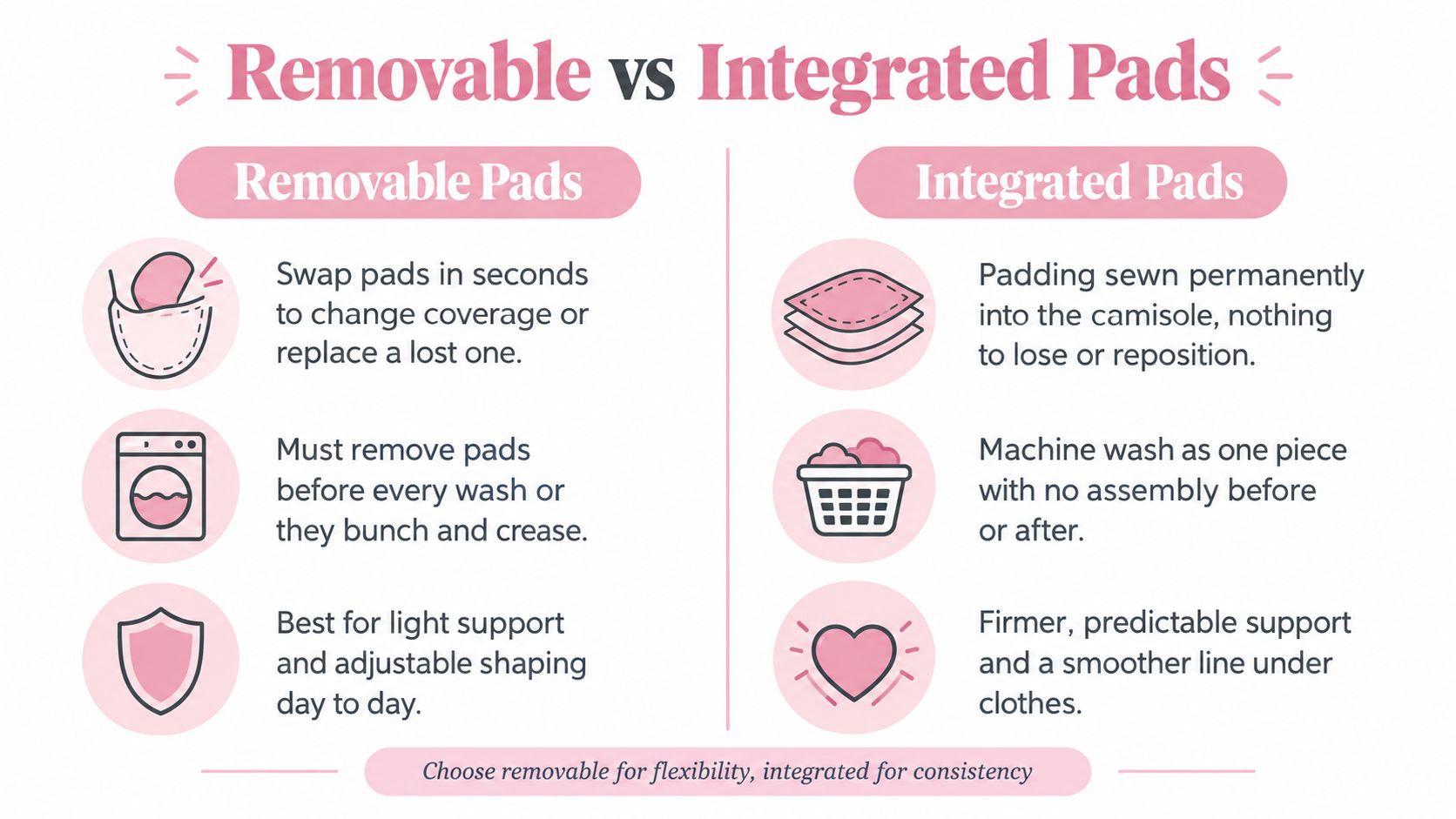
Choose removable pads for flexibility
Removable pads make sense if your needs change between lounging, layering, and going out. You can take them out for a softer feel at home, replace a damaged insert, or adjust the amount of coverage beneath a close-fitting top.
They also make laundering more complicated. Pads can fold inside their pockets, migrate toward the side seam, or crease after a careless wash. If you choose this design, remove the inserts before washing, reshape them while damp, and return them only when the camisole is completely dry.
A removable pad is useful when:
- Your wardrobe changes often: You can use lighter coverage under relaxed clothing and more shaping under delicate or clingy fabrics.
- You want replaceability: A lost or misshapen insert doesn't automatically end the life of the camisole.
- You prefer a softer evening fit: Removing the pads reduces structure when you're relaxing or sleeping.
For a helpful explanation of how padding changes a garment's shape and feel, read this guide to a bra with padding.
Choose integrated pads for a stable silhouette
Integrated pads are sewn into the garment, so there's nothing to reposition before you leave home. They usually create a more predictable outline beneath clothing, especially when the cup is molded or stitched into a defined shape.
The trade-off is less customization. If the shape doesn't suit your bust, you can't remove the insert and start again. You also need to follow the care label carefully because heat and rough washing can affect both the pad and the surrounding elastic.
My recommendation is simple. Choose removable pads for adaptability and integrated pads when you want the camisole to behave the same way every time. For workwear, travel, and fitted clothing, consistency usually wins.
The Engineering Behind Real Support
A camisole can look supportive in a mirror and fail by lunchtime. Padding shapes the bust, but the underbust band, support panel, and strap position determine whether it carries weight through a full day.
Start with the underbust band
Choose an elastic band at least 1 inch wide. 1.25 inches performs better for day-long wear because the added width spreads pressure across more of the ribcage instead of pressing along one narrow edge. See this built-in-bra camisole analysis for construction guidance.
A narrow band may feel comfortable during a quick fitting, then dig, roll, or ride upward as you move. The band should sit level around your body, stay flat when you sit, and remain close to your ribs when you raise your arms. If it shifts, the garment is offering light coverage, not dependable support.
Look for spandex or power-mesh content in the support zone, especially around the shelf bra. Outer fabric stretch alone does little to hold the bust. Adjustable straps also matter. Set them so the cups or support panel sit over the fullest part of the bust, rather than below it or high against the chest. Cotton can feel pleasant against skin, as this cotton shelf-bra camisole guide explains, but comfort does not replace resistance in the support panel.
Treat care instructions as part of the engineering
Elastic must recover after stretching. With regular care, shelf elastic can retain usable recovery through repeated washing, while heat drying can shorten its working life. Treat the care label as a buying requirement.
Follow the stated wash method and skip heat drying when instructed. Repeated heat can weaken elastic fibers, turning a firm band into a loose layer that no longer anchors the support zone.
Check the garment after washing. The band should return to its original shape, and the support panel should remain smooth rather than rippled. That test shows whether the camisole is built for all-day wear or only light coverage.
Sizing for Your Specific Bust Size
Choose a built-in-bra camisole by your ribcage and bust measurements, not by clothing size alone. A camisole may cover several bra sizes, so the label cannot confirm that the band will anchor or the pads will sit correctly. One retail chart maps a single camisole range across 34D through 38C, showing how the same size can fit differently across bust shapes. Check the brand's intimates size guide and compare both measurements before ordering, using this intimates sizing guidance as a reference.
Smaller busts need comfort and clean coverage
A soft camisole with light padding can provide enough coverage for everyday layering on a smaller bust. Check that the cups lie flat, the neckline stays in place, and the pads cover the breast tissue instead of sitting below it.
Do not add excess torso fabric just to create more room in the cups. A loose body can let the shelf bra shift, leaving the camisole looking right while providing little support. If the hem or band rides upward when you lift your arms, the torso length or underbust tension is wrong.
Pad placement matters as much as cup volume. Pads that sit too low leave a gap above the bust and cannot create reliable shaping.
Fuller busts need structure, not hope
Fuller busts need a firm underbust band, adjustable straps, shaped or molded cups, and reinforced seams. Wider side panels can guide tissue toward the front, while spandex or power-mesh in the support zone helps the garment hold its shape. A narrow band or low-set pad may look fine while standing still, then lose contact with the ribs as you move.
Shelf-bra camisoles usually provide light support and suit smaller cups or low-impact wear. Fuller-bust shoppers should look for stronger elastic, molded cups, adjustable straps, or room to wear a separate bra underneath. Shopper feedback on built-in-bra tops also reflects mixed results, including loose bodies, inadequate lift, and padding that does not stay effective. See this coverage of built-in-bra tops for additional context.
Use a movement test before keeping the garment:
- Raise both arms: The band should remain under the bust.
- Bend forward: The cups should not gape or spill at the top.
- Check the side view: The bust should sit inside the cup area, not below its lower edge.
- Walk for a few minutes: Slipping straps or a rolling band signals poor construction for your needs.
Styling Camisoles for Everyday Scenarios
Match the camisole's support level to the day ahead. A light, soft style works for lounging, while a firmer band and shaped cups make more sense beneath a blazer, fitted knit, or dress.

For desk work, wear a structured camisole beneath a blazer or cardigan. Choose a neckline that won't compete with the outer layer and a smooth surface that won't show beneath silk or fine knits. On the weekend, pair a softer version with high-waisted jeans or well-fitted shorts, then leave an open shirt over it for coverage and shape.
Travel calls for a breathable fabric, secure straps, and a band that won't distract you while sitting for long periods. For sleep, choose light padding and a gentle fit rather than daytime compression. A camisole designed for nursing may need easy access, while one intended for mastectomy use may need specialized pockets or a recovery-focused construction, so don't assume one garment can serve every purpose.
The styling camisole pajamas for weddings resource is useful if you're considering a coordinated camisole set for getting ready or relaxed event dressing.
A quick visual guide can help you compare the difference between a fashion layer and a support garment.
Your Final Checklist for Buying
Before checkout, test the camisole as a support garment. Check these points:
- Band width: Choose at least 1 inch, with 1.25 inches preferred for longer wear. A wider, stable band supports better through a busy day.
- Pad design: Choose removable pads for adjustable coverage or integrated pads for a consistent shape. Check that each pad sits over the bust, not below it.
- Bust fit: Fuller busts need adjustable straps, shaped cups, and firm side or underbust construction.
- Fabric recovery: Look for spandex or power-mesh in the support zone, and follow the care label.
- Use case: Choose separately for sleep, travel, workwear, nursing, or higher-movement needs.
For fabric, finish, and craftsmanship, read this Italian crafted camisole guide. Compare the band, cups, and straps on your body. Nuage Wears offers camisoles with built-in padded support, including the Holder Cami Top with built-in 3D bra cups and Slim-Strap Tank Top with anti-slip inner support. Visit Nuage Wears to review options for workwear, travel, or off-duty wear.