
You shift in your chair halfway through a meeting, and the waistband that felt smooth at the sink flips into a crease. You tug it flat. It stays folded. By lunch the edge is digging, even though the pack promised a band that would not roll.
That crease is a construction failure, not a bad morning. No roll waistband underwear stays flat only when width, stretch, recovery, stitching, and the fabric underneath agree. A band that will not roll is not the same thing as a band that will not dig. The same holding force can feel easy when it is shared, and sharp when it is squeezed into a thin line.
Table of Contents
- What No-Roll Waistband Underwear Means in Practice
- Stretch Recovery That Keeps the Band Flat
- How to Spot a Band That Will Not Roll
- Rise and Cut for Sitting Walking and Travel
- Why Sweat Makes a Waistband Curl
- Wash Care That Protects Elastic Recovery
- Choose a Pair That Stays Flat Without Digging
What No-Roll Waistband Underwear Means in Practice
A no-roll waistband is a pressure and stability result. It describes how a band behaves on a moving body, which is why two pairs with the same label can wear completely differently once you sit down. Hips flex, the front of the band meets a softer curve, and one bit of the edge grips while the rest moves. The edge flips, then the crease stays.
Garment-pressure research describes comfortable clothing compression as typically about 1.96–3.92 kPa. Pressure changes with body curve, fabric tension, movement, and how stiff the elastic is. A narrow, high-tension band piles that force onto a small strip of skin, so it digs, and the edge is more likely to fold. A wider bonded or smoothly covered band spreads the same hold, so the peak pressure drops.
Sizing down backfires. A tighter band raises tension on the same small contact area, so pressure climbs and digging gets worse while the edge still finds a fold line. A jar lid shows why. A thin rubber band twists the moment you turn the jar, while a wide sleeve shares the grip and stays put. The difference comes down to contact width.
Five builds and the wear they suit
Filter the pair in front of you with this table before you trust comfort language on the label.
| Construction | How it stays flat | Stretch behavior | Best when |
|---|---|---|---|
| Vertical-stitch pinhole elastic | Stitches through the band keep the elastic from folding | About 30% expansion to pass the hips and 50–70% total elongation with strong recovery | Everyday briefs whose edge flips when you sit |
| Bonded waistband | Heat or adhesive bond removes a thick folded elastic edge | Even tension only if the bond stretches and recovers with the fabric | Smooth looks under workwear and fitted clothes |
| Covered wider elastic | More skin contact spreads the same holding force | Comfortable compression near 1.96–3.92 kPa if the band is not over-tight | High-rise wear and long sitting |
| Raw-cut or laser-cut edge | No bulky elastic to flip; the fabric edge must recover on its own | Curls if the knit relaxes or loses recovery | Leggings, silk, and no-show outfits |
| Narrow high-tension elastic | Holds by tightness on a small contact area | Concentrates pressure, then folds at the edge | Usually the build to avoid |
A credible check is simple. After repeated sit-to-stand and walking, the edge should still sit in the same place, with no visible flip, and the pressure should stay in that comfort range. Front, side, and back can feel different once your hips bend, so a static stretch on a table tells you little. If your skin reacts to a stiff edge, pair the band choice with fabric advice from Thermo Recovery Wear before you blame the size.
Width on its own changes little. A wider band helps only when the elastic, the stitches or bond, and the fabric all recover together.
Stretch Recovery That Keeps the Band Flat
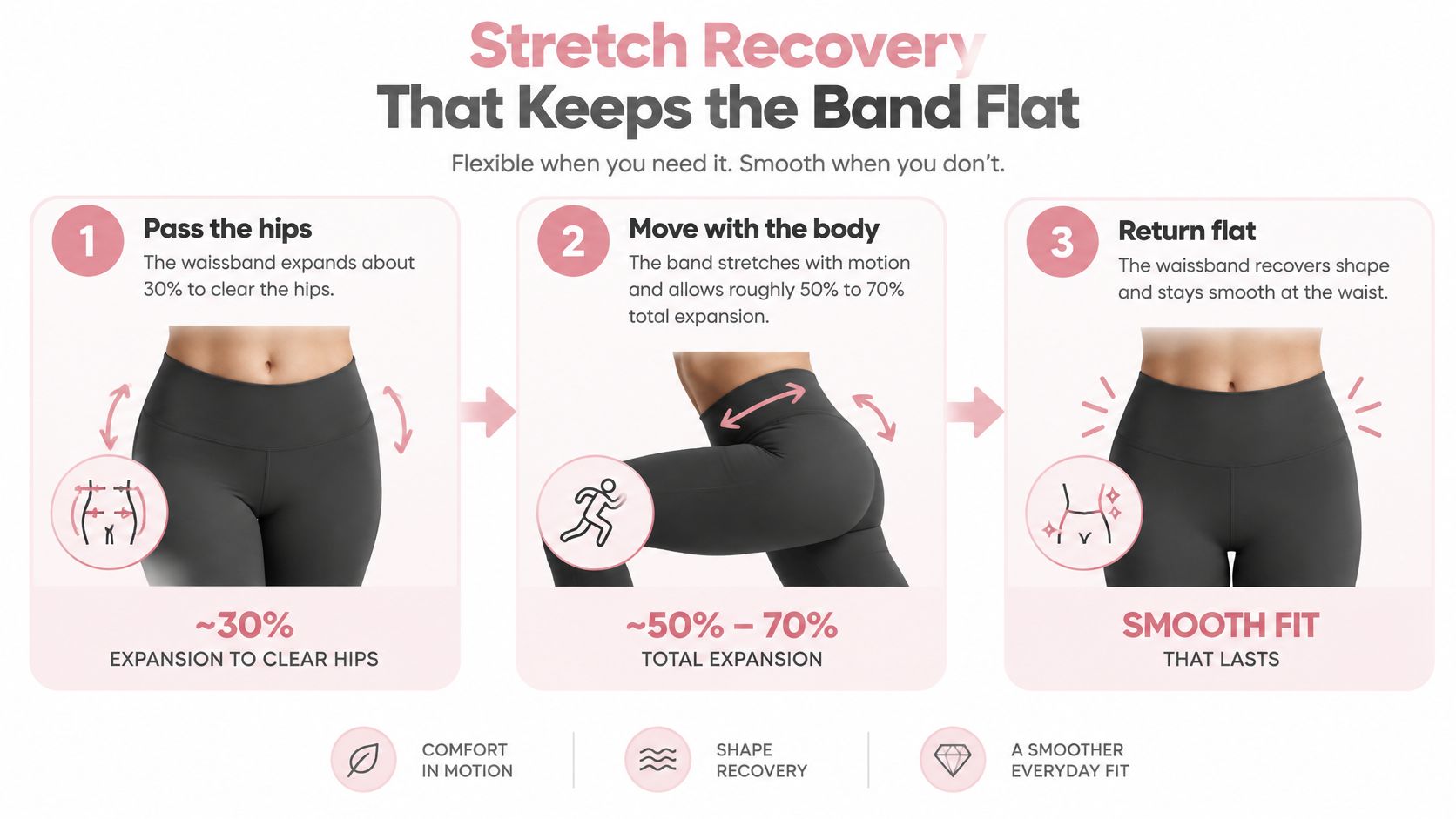
A useful waistband does three jobs in order. It clears your hips. It moves while you sit and walk. Then it returns flat. Miss the last job and the first two do not matter.
Pass, move, return
Textile guidance on elastic types puts the usual spec in plain numbers: a waistband commonly needs about 30% expansion to pass over the hips, and about 50–70% total elongation so that sitting and walking do not permanently deform it. A band that stretches on and does not spring back loosens, folds, or rolls.
Narrow elastic curls when width, stretch, recovery, stitching, and the garment fabric are mismatched. A pinhole, or vertical-stitch, construction runs stitches through the band so the elastic is held flat against you. That stitch lock still needs the elastic itself to come back. If the fibers take a permanent set, the pair that was smooth in week one starts rolling in week three. The band did not get narrower. It stopped returning to its old length.
A new hair tie snaps back into a small loop. A tired one stays long and twists the moment you move. Elastic ages on that same curve, except a waistband has to keep recovering all day against skin that bends. This is also where digging enters the picture. The farther a band has to stretch to close around you, the closer it runs to its permanent-set point and the harder it presses while it gets there. Sizing down to stop a roll often trades a folding edge for a crease plus a sore mark.
How the lab tests recovery
ASTM D4964 is the common test for narrow elastic, including tapes, webs, straps, and waistbands. Under that method, the specimen is set at a 75 ± 1 mm gauge length, stretched at 300 ± 10 mm per minute, held at the set elongation for 30 ± 1 seconds, then checked for recovery after another 30 ± 1 seconds. You do not need a lab at home. You need the idea: stretch, pause, release, and watch whether the band comes back smooth or returns wavy and limp.
AATCC Method 150 is the companion wash check. It looks at dimensional change in stretch woven or knit fabrics after laundering, so it tells you whether the recovery you felt on day one survives the wash cycle. No-roll performance is recovery plus that stability, produced by the elastic, the stitches or bond, and the fabric working as one system. If you want the fiber side of that spring, the notes on nylon and spandex underwear show why those blends are asked to stretch and come back.
A wider band with poor recovery still folds. It just folds as a bigger crease.
How to Spot a Band That Will Not Roll
You can inspect a new pair in a fitting room or on the bed the day it arrives. The size tag is the least useful clue.
Measure your hip and waist in centimeters or inches first, then set those numbers next to the brand's size chart. If you sit between sizes, try the size you would wear for a long travel day, then judge the band by movement, not by the tag. The same labeled size can sit cleanly on one body and roll on another because grading and ease are not identical from cut to cut.
Five checks, in order
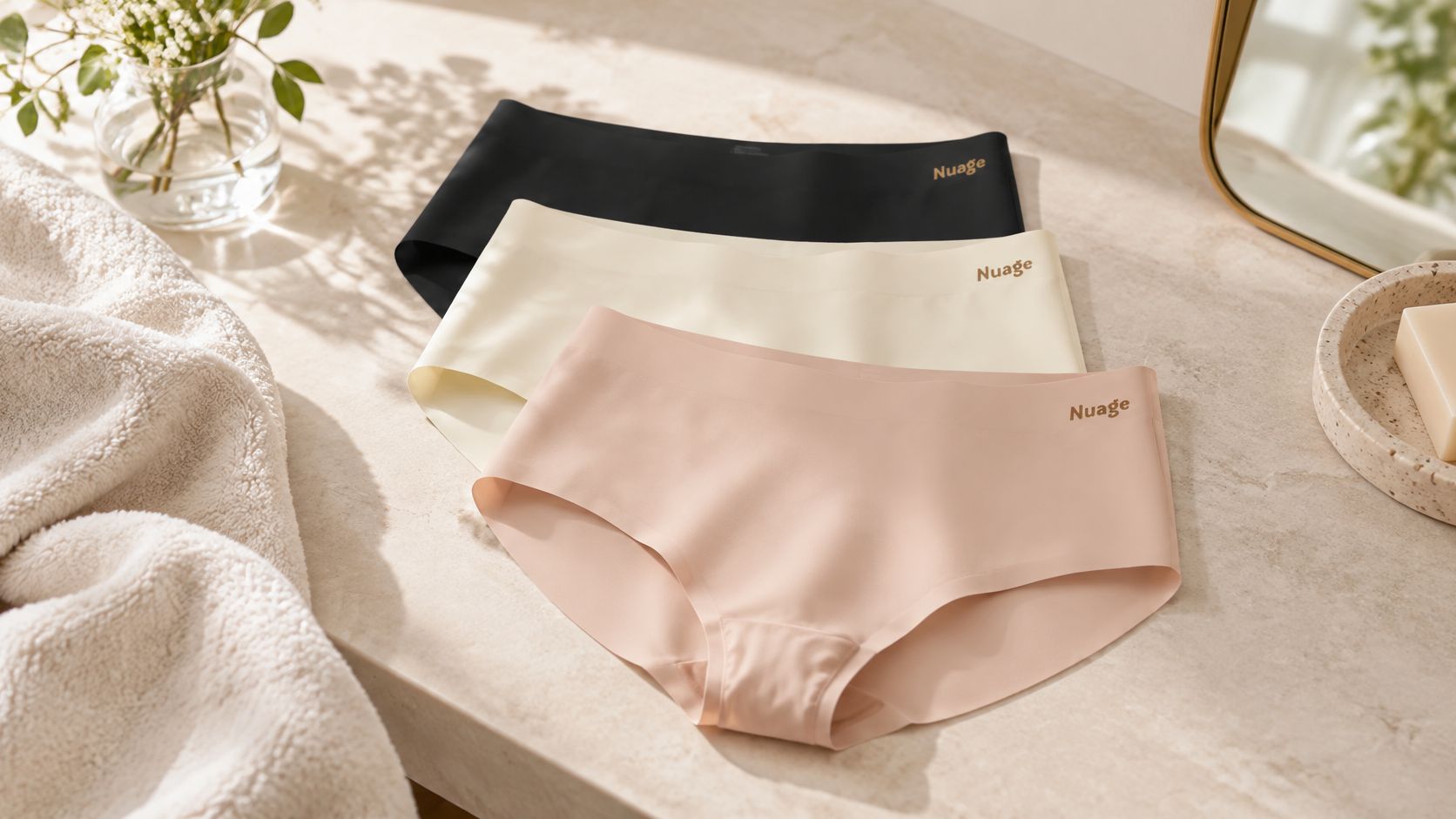
- Lay it flat and name the build. Look for a thick folded elastic that can invert, a bonded strip, vertical stitches through the band, or a raw-cut edge. A raw-cut waist, like the one on the NuCloud Original Mid-Rise Brief(3-Pack), has no bulky elastic to flip, so the fabric itself has to recover.
- Pinch center front, side, and back. Thickness should feel even. A lump at a seam is a hinge. That hinge is where the edge likes to crease once you sit.
- Stretch the band about a third wider. Hold for a few seconds and let go. A useful band returns smooth. A wavy or limp return means the elastic already took a set, even if the pair is new.
- Do five sit-to-stand moves, then a short walk. Watch the front edge while your hips flex. This is the deciding step. A band that feels secure for the first minute can still invert the moment you sit.
- Check your skin after 30 minutes of ordinary wear. A red mark that lingers means pressure is concentrated, even if the band has not rolled.
False friends and the keep-or-return rule
A firmer band can feel locked in for sixty seconds and still fold once you sit. A pretty wide band still fails if the fabric below it shifts and drags the edge with it.
Flat after the sit-stand, with no lingering red mark, is a pass. An immediate curl or a deep crease is a return. Do not talk yourself into "it will relax." A band that inverts on day one is telling you the build and your body already disagree.
Rise and Cut for Sitting Walking and Travel
People who sit at a desk for six hours usually ask about pressure, not firmness. A waistband has to do two separate jobs at once: keep its edge flat and spread load so nothing presses into the stomach. Width, elastic recovery, and how widely pressure is shared decide both.
A band can stay in place and still hurt. Narrow bands and exposed elastic press the same force into a thinner line, so red marks and soreness show up even when nothing has rolled. A write-up on ergonomic waistband tension tracking 34 waistbands over a 103-day blind test with 10 testers ties red marks lasting more than 30 minutes to pressure concentration, and loosening after 20–30 wash cycles to weaker elastic.
Sizing down stops a roll by raising pressure per inch, which is exactly why the same move deepens the dig. The band grips harder because a narrower strip of it is being forced into your skin. Sizing up spreads that force and calms the red line, but a looser edge has less hold and can start to drift. Pick the row for the posture that lasts longest, not for a ten-minute errand.
| Situation | Rise and width | Size move | Watch-out |
|---|---|---|---|
| Desk sitting or driving | Mid or high rise with a broader band | Do not size down just to stop roll | Front edge folds or digs when hips flex |
| Walking and workouts | Mid rise with strong recovery and a stay-put leg | Wear true size | Sweat lets a narrow edge grip and curl |
| Travel and long sitting | Soft high rise that shares pressure | Size up if between sizes | Heat raises friction and edge curl |
| Fitted clothes and leggings | Bonded or raw-cut low to mid rise | Do not go tighter than a comfortable hip pass | A thick elastic shows and can flip |
Match the row to the longest block of your day
Real days rarely sit inside one row. A commute, eight hours at a desk, and an evening walk touch three of them, so count hours rather than outfits. The desk row wins that day because sitting dominates it, and the broader band it asks for also serves the walking row, since both depend on the edge moving and returning without creasing.
Where rows conflict, look at what they share. Sitting and travel both punish concentrated pressure, so a soft high rise covers both. Walking and fitted clothes both punish a band that cannot flex, so recovery plus a bonded or raw-cut edge covers both. The common temptation under leggings is going tighter, which solves the visible-ridge problem by reopening the pressure problem. That is the same trade the size-down column warns about.
Nuage Wears maps products to these rows instead of making one blanket no-roll claim: high-rise waistbands in the no-digging range suit long sitting, bonded mid-rise briefs are built to resist roll under clothes, and stay-put cuts are meant for walking. Read the rise and the band type against the row you live in.
Choose for the hours you sit or move the most. A band that only behaves on a short errand will fail on a real day.
Why Sweat Makes a Waistband Curl
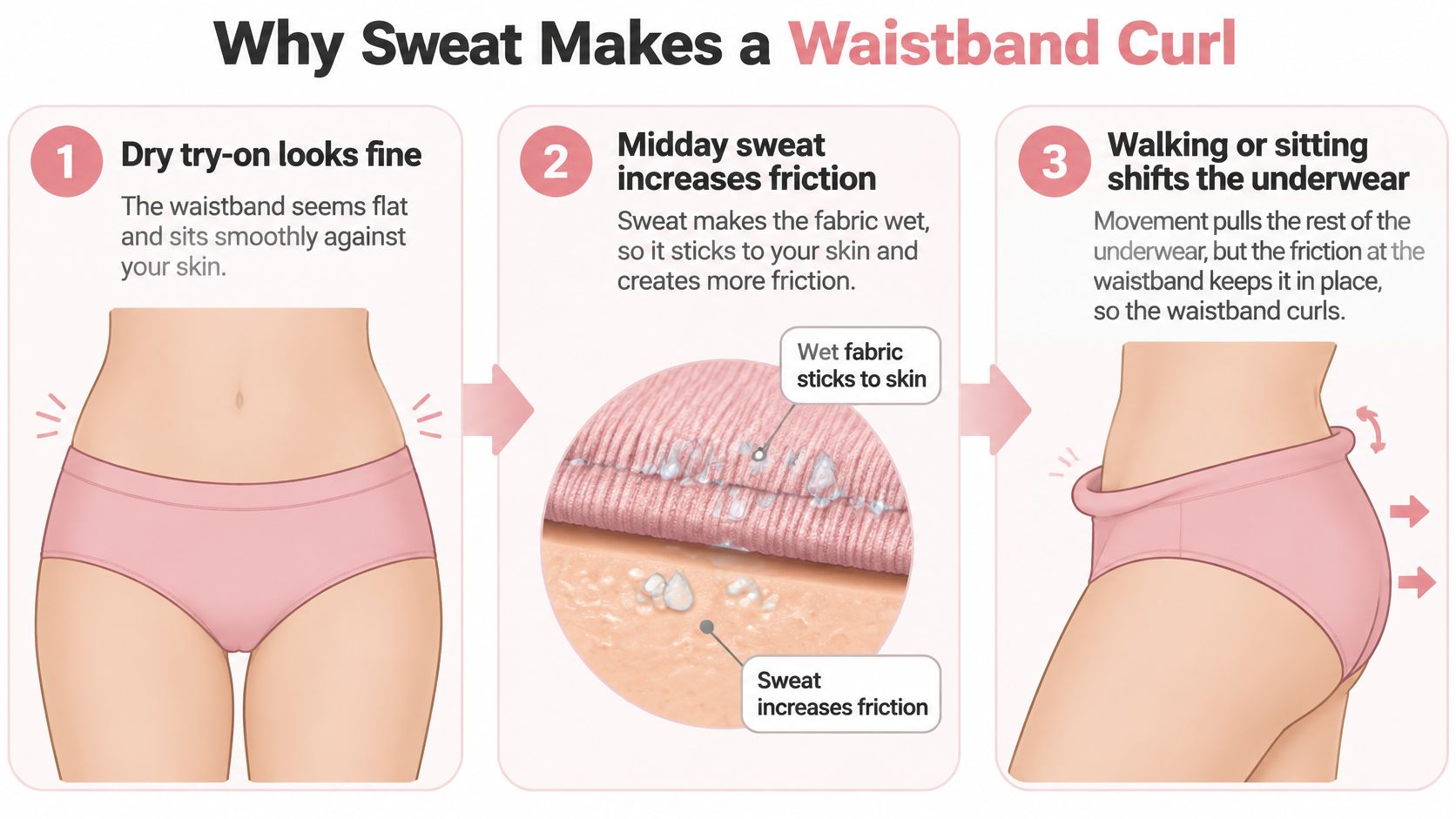
The dry try-on lies. At 9 a.m. the band looks flat in a cool room. At 3 p.m., after a warm commute, a workout, or a long flight, the same pair has curled at the front.
The stuck edge
Research on tight-fitting clothing reports that wet conditions significantly increase textile-skin friction and discomfort. Perspiration raises resistance to sliding and, at the same time, raises shear at the waistband edge. If the band is narrow, stiff, or slow to recover, friction holds one portion still while the rest of the underwear shifts with your step or your sit. The stuck edge shears, then curls.
Dry paper slides across a table. Damp paper grabs and wrinkles. A sweaty band grabs skin the same way. The grab comes from a stickier surface, and your body stayed the same. The edge could not slide and return.
Three responses that belong together
- Enough stretch with high recovery. The edge has to move with you and come back, or the first sticky spot becomes a permanent crease.
- A broader band. One wet point should not be able to flip the whole edge. Sharing the contact keeps a single grab from winning.
- A more breathable zone at the waist. Less moisture at the band means less of that grab, so breathability does the same flatness job as recovery and width.
A sweaty curl and a post-wash curl can look identical and still have different causes, which is why the laundry side gets its own checklist later in this guide. Judge a new pair on a warm day or after a real walk, because fitting-room lights only show you the dry version. And resist sizing down so the band grips harder: clamping tighter raises the pressure at the one stuck point, so the curl stops and the red line starts. A band that stays flat only by digging has traded one failure for another, and a "no roll" claim means something only when it holds through motion and moisture.
Wash Care That Protects Elastic Recovery
First-wear fit and life after laundry are different tests. A band can pass on Monday and fail in week six because the elastic, not your body, changed.
A 2026 industry overview reports that about 42% of consumers experience inconsistent sizing, and that online underwear returns can exceed 30%. A rolled band gets blamed on the wrong cause all the time. Sort the cause before you sort the drawer.
- Poor construction rolls on day one, before any wash.
- The wrong size digs or slips as soon as you move.
- Fabric relaxation shows up after wears, as the knit takes a set.
- Heat or rough washing kills recovery later, so a band that was fine becomes wavy.
What to write down
Keep one pair as the benchmark if you buy multipacks or pack for travel. Compare the others to that pair, not to your memory.
| When | What to record | Pass sign | Fail sign |
|---|---|---|---|
| Before the first wash | Relaxed width and a gentle stretch | Edge returns flat | Already twisted, wavy, or limp |
| After about 10 washes | Same stretch, washed cool | Tension close to new and still flat when sitting | Noticeably looser or a curly edge |
| After 20 to 30 washes | Width, twist, and any red mark | Still flat through sit-stand | Permanent growth or a roll that will not smooth |
Early washes can temporarily increase elongation before later cycles reduce elasticity. One loose wash is not a verdict. Look again at 20 to 30.
Care in the order that protects the spring
- Follow the care label before you improvise a "hotter is cleaner" cycle.
- Wash cool, at or under 30°C (86°F), with mild detergent.
- Skip high heat and the dryer. Heat is what takes the spring out of elastane.
- Use a mesh bag if the pair is bonded or made without seams, so the bond is not abraded against zippers.
- Air-dry flat or hanging. Do not stretch the band over a hot rail.
The walk-through in how to wash underwear matches this order if you want the full routine beside the label.
Day-one roll is a fit or construction return. Roll that shows up only after hot washes is a care problem.
Choose a Pair That Stays Flat Without Digging
Buy for the longest block of your day, and let width plus recovery share the load. A waistband works like a belt: a narrow one concentrates pressure, a loose one slips, and a too-tight one can stay flat while still digging. Sizing down to stop rolling usually trades one problem for another.
When two sizes both look promising, use a half-minute changing-room check:
- Wear the smaller size first. If it is smooth only while you stand, it is too small for sitting.
- Switch to the larger size. If the edge shifts on a short walk, the cut is wrong even if the size feels kind.
- Keep the size that stays flat through the same-day sit-stand check and leaves skin calm afterward.
On a product page, including at Nuage Wears, read for band type, band width, and whether the fabric is described as recovering, not for a general comfort line. Multipacks make sense after that size is settled and you want the same daily pair again.
Nuage Wears builds everyday underwear around the problems in this guide, from high-rise bands that share pressure to bonded and raw-cut edges designed to stay flat under clothes and on long days. Compare the band type and rise on each style with the way you sit, walk, and travel, then keep the pair that passes a same-day sit-stand without a red mark. Visit Nuage Wears and match a cut to your longest block of the day.